Vue normale

Il y a de nouveaux articles disponibles, cliquez pour rafraîchir la page.
À partir d’avant-hierFlux principal

85·Faut-il craindre l’intelligence artificielle (IA) ?

Par : Marc HENRY
23 juin 2024 à 18:39

Définition de l’Intelligence Artificielle

Pour ma part, je ne crains nullement ce que l’on appelle “l’Intelligence Artificielle” (IA). Depuis quelques années, on voit se développer sur internet et les réseaux sociaux, une nouvelle forme de diffusion de l’information écrit et visuelle. Cette diffusion fait appel aux nouvelles technologies fondées sur l’informatique. Rappelons pour commencer que l’IA est une branche de l’informatique. Celle qui permet aux systèmes d’apprendre et d’exécuter des tâches normalement associées à l’intelligence humaine. Comme la reconnaissance vocale, la prise de décisions ou la perception visuelle. Rappelons que dans les années 80, deux techniques importantes furent développées.

La première, le deep learning (DL), ou « apprentissage en profondeur », a permis aux ordinateurs d’apprendre par l’expérience. Le second, le « système expert » (SE), imite la capacité de l’être humain à prendre des décisions. Les ordinateurs ont commencé à utiliser un raisonnement fondé sur des « règles » en recourant principalement à une structure « si… alors » mise en œuvre pour répondre à des questions binaires. Ici, la réponse est soit oui, soit non. Depuis les années 2000, trois améliorations ont été apportées :

1. Développement des unités de traitement graphique (GPU) sans lesquelles une IA serait non crédible, provoquant juste un simple haussement d’épaules.

2. Exploitation de l’énorme quantité d’informations mémorisées (Le “Big Data”) depuis qu’internet existe (BD).

3. Développement de nouveaux algorithmes utilisant des variables cachées qui permettent de trier et d’optimiser les résultats d’un calcul.

Variables cachées

En réalité, les points #1 et #2 sont assez triviaux et de nature purement technologique. Ils n’expliquent pas le développement fulgurant observé dans le domaine de l’IA ces dernières années. Ce qui est crucial, c’est le point #3 sur lequel il convient d’être plus bavard :


Car, la description « accessible » que l’on a d’un système, est très souvent la liste de ses comportements observables. Une telle liste est très habituellement une fonction de variables qui ne sont pas immédiatement évidentes. On parle alors de variables dites “cachées” ou bien encore “latentes”. Et, ces variables “cachées” mais hautement pertinentes, sont beaucoup moins nombreuses que les variables observées qui nous sont directement accessibles. D’où le développement de nouveaux algorithmes dont le but n’est pas de traiter directement les observables accessibles. Mais, plutôt, de réduire l’espace des données disponibles à quelques variables cachées. Variables qui sont peu nombreuses, et qui décrivent au mieux les données brutes disponibles.

Analyse en Composantes Principales (ACP)

L’outil clé est ici l’analyse en composantes principales (ACP ou PCA en anglais pour principal component analysis). Cette analyse consiste à transformer des variables dites « corrélées » sur un plan statistique, en nouvelles variables décorrélées les unes des autres. Ces nouvelles variables se nomment « composantes principales » ou axes principaux. L’ACP permet donc de résumer l’information énorme disponible avec de nombreuses variables corrélées en un petit nombre de variables indépendantes les unes des autres. D’un point de vue mathématique, selon le domaine d’application, on utilise soit la transformation de Karhunen–Loève (KLT), soit la transformation de Hotelling (HT).
Les champs d’application de l’ACP sont aujourd’hui multiples, allant de la biologie à la recherche économique et sociale, et plus récemment le traitement d’images et l’apprentissage automatique. L’utilité de l’ACP réside dans les points suivants :

Description et visualisation des données complexes.

Décorrélation des données brutes, la nouvelle base étant constituée d’axes non corrélés entre eux.

Minimisation du bruit, en considérant que les axes que l’on décide d’oublier sont des axes bruités.

Effectuer une réduction de dimension des données d’entraînement en apprentissage automatique.

Il s’agit d’une approche aussi bien géométrique que statistique. Géométrique, puisque les variables se représentent dans un nouvel espace, selon des directions d’inertie maximale. Statistique, parce que la recherche porte sur des axes indépendants expliquant au mieux la variabilité — la variance — des données. En résumé, lorsqu’il s’agit de compresser un ensemble de variables aléatoires, les premiers axes de l’ACP constituent un meilleur choix, aussi bien du point de vue de l’inertie géométrique que depuis la perspective de la variance statistique.

Insuffisance du ternaire GPU/BD/ACP

Après cette démystification de ce qui se cache derrière une IA, se pose l’inévitable question de savoir si la notion “d’intelligence” est réductible à ce ternaire (GPU/BD/ACP). Pour ce qui me concerne, la réponse à cette question est un “non”, franc et massif. Et, pour bien enfoncer le clou, voici quelques éléments de réflexion.


Pour fonctionner, une IA a besoin d’accéder à une base de données de type Big Data (BD), la plus large possible. Le gros problème qu’elle rencontre ici est que pour accéder aux données, il lui faut disposer d’une source d’alimentation électrique. Débranchez l’IA du secteur, ou bien, retirez-lui sa batterie et il n’y a plus rien, de manière instantanée. Toutefois, dès que vous remettez une source d’énergie, le système redémarre et redevient totalement opérationnel.

Pour un être humain, ce débranchement instantané est impossible. Si vous le privez de nourriture, il pourra continuer à fonctionner pendant des années tant qu’il aura de l’eau à sa disposition. Évidemment, si vous lui supprimez l’eau, il finira par mourir au bout de quelques jours. Mais, en aucun cas, la perte d’activité sera instantanée comme avec une intelligence artificielle. Et, une fois l’être humain mort, impossible de redevenir opérationnel si la nourriture et l’eau redeviennent disponibles. Ces simples considérations d’alimentation, nous font toucher du doigt que si le cerveau est parfaitement capable d’utiliser le triangle GPU/BD/ACP, il ne peut pas être réduit à cela. Il y a un plus, qui dépasse le strict cadre informatique.

Et, la Conscience ?

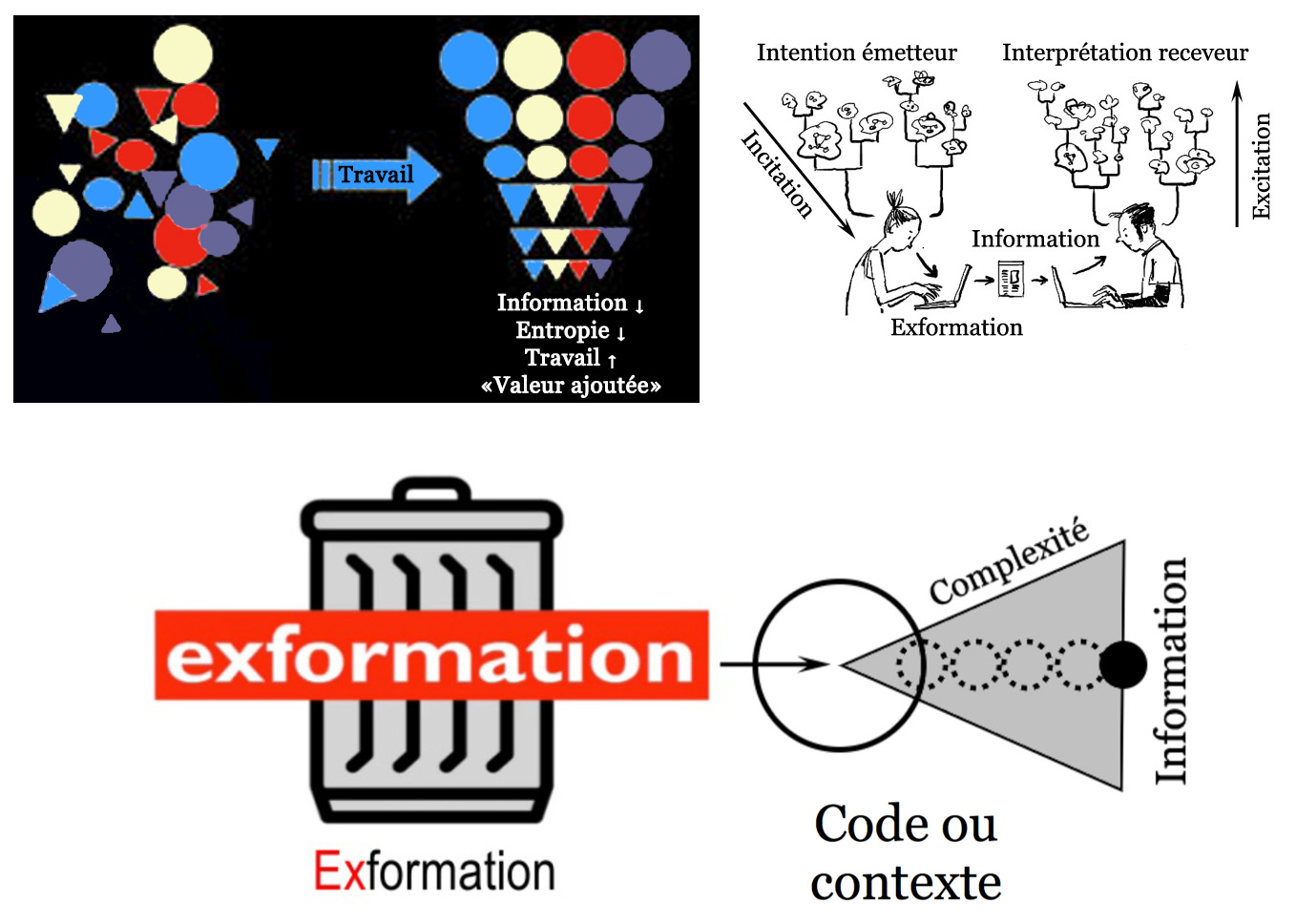
Ce truc est, bien sûr, ce que l’on appelle la “conscience”. Et, comme il est facile de le démontrer (voir https://riviste.fupress.net/index.php/subs/article/view/161), cette conscience est aussi bien neuronale (le moi vu de l’extérieur) qu’extra-neuronale (le moi-même vu de l’intérieur). Rappelons que si le moi traite l’information transmise à l’extérieur du système, le moi-même traite pour sa part l’exformation, c’est-à-dire le contexte, qui lui reste piégé à l’intérieur du système n’étant jamais transmis (voir ici pour en savoir plus : https://marchenry.org/product/de-linformation-a-lexformation/). Pour faire plus simple, un cerveau humain traite l’information aussi bien de manière digitale via les neurones (GPU/BD/ACP) que de manière intuitive via l’eau d’hydratation de ces mêmes neurones. Bref, tant qu’une IA n’utilisera pas l’eau, elle restera largement en deçà d’une intelligence biologique (IB), bactérienne, végétale, animale ou humaine. Car, la fonction “intuition” utilise l’eau, interface de communication instantanée et non locale avec le vide quantique, appelé aussi “éther”.

Intelligence Biologique

Un dernier point concerne la notion même d’intelligence. Si l’on y réfléchit un tant soit peu, pas besoin d’être intelligent pour prendre des décisions lorsque l’on dispose d’une base de données gigantesque. Bien au contraire. On reconnaît l’intelligence quand on est capable de prendre la bonne décision avec un minimum d’information à sa disposition. L’IA, telle qu’on la connaît de nos jours, n’est donc en rien “intelligente”. Car, si l’on réduit la taille de la BD à un contenu minimal, plus rien ne sort. Avec des êtres humains, c’est totalement différent. Certains d’entre eux, appelés “génies” sont capables de faire des merveilles, voire des miracles, avec trois fois rien comme données. La raison en est simple, et l’on retrouve ici la possibilité de décider par intuition, et non par raisonnement.

Conclusion

On peut hautement être impressionné par les performances actuelles de l’intelligence artificielle. Mais, qu’il soit bien clair qu’il s’agit ici de performance technologique sous réserve d’un accès sans limites à l’électricité. Rien n’empêche de rêver à un monde dans lequel les machines remplaceraient les êtres biologiques fonctionnant à l’eau. Mais, un tel monde serait extrêmement peu efficace et d’une viabilité nulle à long terme.

Plutôt que de parler d’intelligence artificielle, on ferait peut-être mieux de parler de machines expertes dans le traitement de l’information. Car, on peut exceller dans la collecte et l’analyse d’un maximum d’information, tout en étant un parfait idiot sur le plan de la créativité. La folie actuelle autour de tous ces robots hyper-efficaces, ne pourra pas durer éternellement. Alors que la vie biologique, bactérienne ou cellulaire, existe depuis des milliards d’années. Par conséquent, s’il y a lieu d’être inquiets pour l’avenir, c’est plutôt face aux manipulations génétiques ou à la pollution toujours croissante de l’eau.

The post 85·Faut-il craindre l’intelligence artificielle (IA) ? appeared first on Marc HENRY - Natur'Eau Quant.

Silicon Valley’s unlikely ally to defend generative AI

Par : Paris Marx
14 juin 2024 à 14:00
Silicon Valley’s unlikely ally to defend generative AI

When ChatGPT was released in November 2022, many artists and publishers quickly realized another technological threat was on the horizon. Boosters were enthusiastic about how generative AI tools could churn out writing and images that would, in the process, devalue the work of writers, journalists, illustrators, and many other professions. But it all depended on the ability of those companies to take the collective knowledge of billions of people from the open web to feed into their artificial intelligence (AI) models.

Immediately, many of those professions who felt threatened saw an opportunity they could seize to present a legal speed bump for the seeming inevitability of AI adoption. Over the past year and a half, a series of groups that include visual artists, authors, and news organizations have launched copyright lawsuits directed at that vulnerability. The US Copyright Office has also refused to grant copyright protection to works created with generative AI tools — a campaign that has been supported by groups like the Writers Guild of America, SAG-AFTRA, and the Authors Guild.

If governments or the courts affirm the demands of artists and media groups, AI companies would have to remove copyrighted works from their training data or develop complex new systems to identify and compensate the owners of those copyrights. That’s something they want to avoid at all costs. In recent months, OpenAI has been proactively making deals with news publishers to gain access to their archives, but the industry isn’t stopping there.

Last week, tech lobby group Chamber of Progress launched a campaign called “Generate and Create” to ensure it remains legal for AI companies to train their models on copyrighted works. The group represents Amazon, Apple, Meta, Google, and many others. Their argument is not only that generative AI “lowers barriers for producing art,” but that training on existing works should be considered fair use. They’ve found an unlikely ally in the argument: anti-copyright activists. After taking on film and music industry lobbyists in service of the little guy in the 2000s, they’ve flipped as their libertarian politics push them defend some of the biggest and most exploitative companies in the world.

Apple hopes AI will make you buy a new iPhone

Par : Paris Marx
11 juin 2024 à 13:00
Apple hopes AI will make you buy a new iPhone

After months of obsessing by tech media, Apple’s generative AI features are (almost) here. In a prerecorded keynote at its Worldwide Developers’ Conference (WWDC) on Monday, company executives ran through a series of features like proofreading and changing the tone of text, recording and transcribing phone calls, a more capable Siri voice assistant, and an emoji generator which all fell under the label of “Apple Intelligence” — its branding term for generative AI. But none of them were anything to get too excited about.

The biggest takeaway from Apple’s keynote is that the air continues to flow out of the generative AI bubble. Last month, Google and OpenAI had their own lackluster showcases to demonstrate a series of evolutionary and even mundane features that were hard for anyone not steeped in AI boosterism to get excited about. One of the standout subpar moments of the Google event was when the company showed off how its Gemini chatbot could find a user’s license plate number in the Photos app as if it was a huge deal. Apple virtually recreated it, but with a driver’s license number instead.

AI hype is over. AI exhaustion is setting in.
Google and OpenAI’s latest showcases suggest the AI bubble’s days are numbered
Apple hopes AI will make you buy a new iPhoneDisconnectParis Marx
Apple hopes AI will make you buy a new iPhone

Unlike what OpenAI and Google were doing last year, Apple clearly isn’t trying to make people think its generative AI features are going to change the world. If we weren’t in this moment of AI hype driven by investor exuberance rather than tangible technological progress, these features would just be like any other additions to Apple’s operating systems. But they have to be singled out and given some extra fanfare because that’s usually what helps boost a company’s share price these days — or at least protects it from sliding.

After all the build up, Apple’s stock dropped in after market trading but jumped on Tuesday. The company clearly has a strategy to use its Apple Intelligence features to try to address some of the deeper problems with its business. It just remains to see if it will work, and if some of those generative AI features it’s banking on to deliver a boost might come back to bite it.

Sign up for Disconnect

Tech critic Paris Marx provides the critical take on Silicon Valley you’ve been missing

Email sent! Check your inbox to complete your signup.

No spam. Unsubscribe anytime.

Apple’s ambitions still face challenges

Last month, Apple was in the crosshairs of artists when it released an advertisement for the new iPad Pro that showed a whole range of creative tools being destroyed to give way to the thin black slab of glass and metal. The company meant to illustrate how much creative work it believed could be done on the device, but after over a year of concern about how tech companies are deploying generative AI to take work away from artists, it sparked an uproar. As Apple rolls out its text and image generation features, the company risks more creative ire.

The image generator built into Apple Intelligence contains the strange and glossy aesthetic we’ve come to expect from AI-generated visuals. Not to mention that the use cases the feature is supposed to make possible — like being able to send personalized generated images in text messages — seem wholly unnecessary. But the worst part is that Apple isn’t being open about where it’s getting the data that powers its models.

In a news release, the company said it used licensed data and “publicly available data collected by our web-crawler,” with the option for publishers to opt out of having their content gathered as training data. It also assured users that their personal data and interactions are not being used. But the company didn’t say whether copyrighted works were absorbed into its training data without creators’ permission, suggesting it likely followed similar methods as other tech companies. Just days ago, Chamber of Progress launched a campaign to defend the legality of tech companies using copyrighted works in AI training data. Apple is a member of that lobby group.

On top of the potential anger from publishers and artists, Apple could face a public backlash once people actually get their hands on its generative AI features. After Google’s I/O event in May, it was pilloried for the terrible AI Overviews it enabled on Search that gave out an endless stream of incorrect and even dangerous answers. We’ve yet to see whether Siri will have its own controversial recommendations to make or if Apple’s built-in image generator will start spitting out offensive AI slop like so many others. That will be tested in the coming months.

Privacy is also still an open question, but the one it may be least likely to face criticism on. Apple has long presented itself as being uniquely committed to protecting user privacy, even as some groups have called those claims into question for not being as solid as the company suggests. The company’s AI features have previously done a lot of their processing directly on the device, but with generative AI it will be sending some tasks to servers it says will be highly secure, so much that it’s calling them “Private Cloud Compute.”

After looking over Apple’s breakdown of the system, cryptographer and Johns Hopkins University professor Matthew Green wrote on Twitter that “if you gave an excellent team a huge pile of money and told them to build the best ‘private’ cloud in the world, it would probably look like this.” Even with that praise, he warned there will still be a lot of vulnerabilities that could be difficult for researchers for detect. Apple also still hasn’t said whether users will be able to fully opt out of the feature if they choose to. But those protections only apply to Apple Intelligence. If a user wants to use the ChatGPT integration, almost all of that goes out the window and users must agree to share data with OpenAI on far less secure terms.

AI to drive iPhone sales

One thing you can say for Apple’s generative AI plans is that it does seem to have better curated the use cases it’s targeting instead of trying to throw everything at the wall, like some of its competitors. That doesn’t eliminate the broader problems that critics have been identifying with generative AI for more than a year, but the framing of the features does signal how Apple is hoping to use them.

The company isn’t positioning Apple Intelligence as a new subscription that users can sign up for to boost its digital services revenue. Instead, it’s just another set of features made available to people who buy its hardware — like its suite of office software. That not only further dispels the notion that generative AI is some groundbreaking development, but shows Apple is positioning the features to help it drive hardware sales — and specifically a new cycle of iPhone upgrades.

The company has been struggling with plateauing iPhone unit sales for years. It increased sales revenue by hiking prices through the introduction of its iPhone X and later iPhone Pro models, but even that stopped working last year when it had four consecutive quarters of declining revenue. Recently, iPhone sales in China saw a recovery, but that was driven by deep discounts.

Apple Intelligence will be limited to iPads and Macs with M1 chips, meaning certain models released in the last few years, but that’s even more constrained for iPhones. The only existing models that will be able to run the generative AI features when they’re released are the premium 15 Pro and Pro Max models that came out last fall, meaning the WWDC keynote was essentially a message to consumers that they’d better get ready to upgrade if they want the latest and greatest AI tools on their phone.

Roundup: Apple wants to hike iPhone prices again
Read to the end for an important statement about X… or Twitter?
Apple hopes AI will make you buy a new iPhoneDisconnectParis Marx
Apple hopes AI will make you buy a new iPhone

Apple Intelligence will be the central part of a big push to drive an iPhone upgrade supercycle in the fall to deliver good financial results for the fiscal year. Rumors suggest Apple is even planning to launch a new model alongside the iPhone 16 series that’s tentatively named the iPhone Slim and will be even more expensive than the Pro Max.

Apple Intelligence is not the company’s “next big thing.” After the Vision Pro bombed and the car project was canceled, generative AI may help drive some additional sales in its existing hardware lineup, but Apple still seems as paralyzed by its success as it’s been for some time. It’s lucky chatbots and image generators aren’t the pivotal moment Sam Altman wanted us to believe, or the company might have really been in trouble.

UPDATE (June 11, 2023): Clarified Apple’s share price movements after markets opened.

Sign up for Disconnect

Tech critic Paris Marx provides the critical take on Silicon Valley you’ve been missing

Email sent! Check your inbox to complete your signup.

No spam. Unsubscribe anytime.

Kara Swisher's story about Sam Altman is falling apart

Par : Paris Marx
31 mai 2024 à 16:54
Kara Swisher's story about Sam Altman is falling apart

When Sam Altman was ousted as CEO of OpenAI on November 17, 2023, Kara Swisher started tweeting up a storm of “scoopage,” as she referred to her calls with high-ranking tech figures. Over the days Altman was on the outside, Swisher helped to craft a narrative that a board stacked with his internal rivals had pulled off a coup without a legitimate reason. The face of the AI boom had been betrayed and deserved to retake his position at the helm.

Swisher has been open about the fact she personally likes Altman. In her memoir Burn Book, she wrote, “I have come to know and like the young entrepreneur since I met him in 2005.” He also joined Swisher for an event in San Francisco to promote the book earlier this year. During his ouster, Swisher’s narrative was the story Altman wanted told. It cast him as the victim and helped to set the foundation for his triumphant return — one that would increase his power over the company and serve key investors like Microsoft.

In Swisher’s framing, which she repeats in her book, OpenAI was riven by divisions between AI optimists like Altman and doomers like cofounder and chief scientist Ilya Sutskever who believed artificial general intelligence (AGI) was on the horizon, presented a threat to humanity, and that the company wasn’t doing enough to mitigate that threat. The doomer camp took its opportunity to oust Altman, but misjudged its power and Altman was restored days later.

Kara Swisher’s Reality Distortion Field
In “Burn Book,” the longtime tech journalist tries to rewrite her story for the post-techlash era
Kara Swisher's story about Sam Altman is falling apartDisconnectParis Marx
Kara Swisher's story about Sam Altman is falling apart

In her commentary, Swisher often focused on a statement that Altman hadn’t been “candid” in his communications with the board, using it to suggest there was no real reason for Altman’s removal beyond factionalism, while claims he was “manipulative and headstrong” were dismissed as “sound[ing] like a typical [Silicon Valley] CEO to me.” She even went on CNN to call OpenAI’s board “incompetent” and to advocate for their resignation to open the way for Altman’s reinstatement.

Internal division was surely one factor in the board’s decision, but Swisher’s narrative and outright advocacy for Altman skillfully downplayed other factors whose details started to become clearer after his swift return as CEO. Those allegations focused more on Altman’s conduct and treatment of employees — things Swisher has a long history of ignoring as part of her “prick-to-productivity ratio.” Altman was another “prick” she cared more about being close to than seeing exposed.

Sign up for Disconnect

Tech critic Paris Marx provides the critical take on Silicon Valley you’ve been missing

Email sent! Check your inbox to complete your signup.

No spam. Unsubscribe anytime.

Why Altman was really ousted

The day after Altman was restored as CEO, the Washington Post published a report into the side of his history that people like Swisher had little time for. Sources told the outlet the board was concerned that Altman was trying to remove checks on his power at OpenAI and had “a pattern of consistent and subtle manipulation that sows division between individuals.” A couple weeks later, journalist Nitasha Tiku built on that earlier reporting with more details suggesting Altman had been “psychologically abusive” and had allegedly been “pitting employees against each other in unhealthy ways.” Those actions had been central considerations for the board when they decided to remove him.

In 2019, Altman had also been removed as head of Y Combinator for putting “his own interests ahead of the organization,” according to the Post. At the time, he was making personal investments in companies he was selecting for inclusion in the accelerator’s fund. Even going back to his first startup Loopt, the management team had reportedly asked the board to remove him as CEO twice for “deceptive and chaotic behavior,” according to former OpenAI board member Helen Toner. Those details are often left out of the glowing profiles Altman receives today, not unlike how figures like Musk had their histories effectively rewritten once they became successful.

Elon Musk wants to relive his start-up days. He’s repeating the same mistakes.
What PayPal’s history teaches us about Elon Musk’s management of Twitter
Kara Swisher's story about Sam Altman is falling apartDisconnectParis Marx
Kara Swisher's story about Sam Altman is falling apart

During the ouster saga, OpenAI employees released a letter saying they’d resign en masse if Altman wasn’t restored as CEO. But the Washington Post found employees reported facing peer pressure to add their names and had a financial incentive to bring him back. If he wasn’t, an investment deal that would allow them to cash out would be put in jeopardy.

More recently, Vox revealed that employees were forced to sign strict non-disclosure and non-disparagement agreements once they left he company, or else they could lose their vested equity. Altman claimed he didn’t know about those clauses, but his response doesn’t line up with documents Vox obtained suggesting he would have been very aware and that company lawyers were aggressive in getting ex-employees to sign away their ability to speak about or criticize the company.

A recent interview Toner gave to the TED AI Show casts further doubt on Swisher’s version of events. Toner elaborated on the reasons Altman was removed from the company, explaining that two executives had spoken to the board about negative experiences with Altman that included lying, manipulation, and creating a toxic atmosphere at the company. Altman also didn’t disclose his ownership of the OpenAI Startup Fund and lied about the company’s safety processes. The board felt it “just couldn’t believe things that Sam was telling us,” explained Toner. She was also personally targeted by Alman when she published a research paper he didn’t like.

Ultimately, Toner explained the quick and stealthy removal of Altman as being necessary because if he knew in advance he’d “pull out all the stops, do everything in his power to undermine the board.” Those are clearly well-founded concerns, given that’s exactly what Altman did after he was ousted. He muddied the waters and ensured his narrative of events was the one that dominated the discussion about the company. Swisher served as a central conduit in that campaign.

Altman is cementing his power

After returning to OpenAI, Altman has cemented his power over the company. He brought in a new board that will be far less likely to challenge to his leadership. Earlier this month, Sutskever left the company, as did safety lead and company executive Jan Leike. OpenAI also dissolved the Superalignment team that Leike headed up. On Twitter, Leike explained that his disagreements with OpenAI leadership had been growing “for quite some time” and he was concerned “safety culture and processes have taken a backseat to shiny products.” Vox reported that five more of the company’s safety-conscious employees had left since Altman’s return as CEO as they lost trust in his leadership.

Scarlett Johansson can’t escape tech exploitation
OpenAI grabbing her voice is just the latest scandal that demands a regulatory response
Kara Swisher's story about Sam Altman is falling apartDisconnectParis Marx
Kara Swisher's story about Sam Altman is falling apart

To replace that team, OpenAI created a safety and security committee earlier this week stacked with company executives, including Altman himself. Meanwhile, the prospect of OpenAI throwing off the shackles of its non-profit status continues to be discussed and the company has reported branched out from its Microsoft dependency to sign a deal with Apple that will give it a greater sense of independence. Even in the face of the blowback from the non-disclosure scandal and the potential legal action from the drama over the use of a voice sounding very similar to Scarlett Johansson’s in GPT-4o, Altman’s power is only growing.

While Swisher might make the occasional jabs at the “man-boys” of Silicon Valley, as she refers to them in her book, she’s desperate to be in their circles and part of the power game. She’s chosen a few CEOs to more regularly criticize now that they don’t give her the access she craves, but there are many more whose narratives she will happily help turn into the official record whenever it will help them. Altman is in that group, and six months after his removal and return as CEO of OpenAI, it’s become very apparent that Swisher was echoing the Altman line and defending his interests. As she says in her book, she’s happy to give “flawed people … a little break,” as long as they have the power to justify it.

Sign up for Disconnect

Tech critic Paris Marx provides the critical take on Silicon Valley you’ve been missing

Email sent! Check your inbox to complete your signup.

No spam. Unsubscribe anytime.

Scarlett Johansson can’t escape tech exploitation

Par : Paris Marx
22 mai 2024 à 13:16
Scarlett Johansson can’t escape tech exploitation

Less than a week after OpenAI showed off a demo of its GPT-4o with a voice that sounded so strikingly similar to Scarlett Johansson’s that Sam Altman even went to far as to tweet “her” — a reference to the 2013 Spike Jonze movie of the same name — we found out it wasn’t a coincidence at all. According to a statement released by Johansson, Altman had been trying to get the actress to be the voice of the product as far back as last September. He was seemingly desperate to make his favorite movie a reality — or at least a version of it that provided the aesthetic Altman needed to keep pushing the fantasy that his large language models will soon develop consciousness.

her

— Sam Altman (@sama) May 13, 2024

According to Johansson, Altman pitched her on the idea that putting her voice behind the chatbot would “bridge the gap between tech companies and creatives and help consumers to feel comfortable with the seismic shift concerning humans and Al.” Probably more important to Altman, hearing Johansson would be “comforting to people” — or at least the tech bros trying to recreate Her. Ultimately, Johansson turned down the offer. But Altman wasn’t done.

Two days before OpenAI’s Spring Update focused on GPT-4o, he contacted Johansson’s agent once again, asking her to reconsider. But he didn’t even wait for a response. They company went ahead with the demo, prompting questions for OpenAI about how much it sounded like Johansson, jokes on Saturday Night Live referencing it, and even the actress’ close friends to message her asking if she was involved. OpenAI has now pulled the “Sky” voice that imitates Johansson, but the whole debacle brings up a number of important issues.

Sign up for Disconnect

Tech critic Paris Marx provides the critical take on Silicon Valley you’ve been missing

Email sent! Check your inbox to complete your signup.

No spam. Unsubscribe anytime.

The internet’s dark side

Putting OpenAI aside for a moment, it’s hard to ignore how often Johansson gets caught up in these cycles of tech exploitation and ends up having to become the face of campaigns against it. Back in 2021, she sued Disney when it decided to put Black Widow on Disney+ the same day it was poised to hit theaters without consulting her. Part of Johansson’s compensation was tied to box office performance, so she could credibly argue she’d be paid less as a result of the decision, but it also happened to play into bigger concerns in the industry.

WarnerMedia had sent its 2021 slate of movies to streaming too, without bothering to talk to the actors and directors involved with the projects first. Those decisions heightened the growing dissatisfaction in Hollywood with the streaming model and the decisions being made by major studios. Johansson ultimately settled, but her decision to sue was seen as an important move in a growing fight between talent and studios — regardless of her A-list status. That fight came to a head last year when actors and writers went on a months-long strike demanding a better deal. But Johansson may have been primed for that legal fight due to the longer battle she’s been forced to wage against digital exploitation.

“The digital age is cannibalizing us”
Hollywood actors join writers in strike against companies using tech to degrade their profession
Scarlett Johansson can’t escape tech exploitationDisconnectParis Marx
Scarlett Johansson can’t escape tech exploitation

When explicit AI-generated photos of Taylor Swift spread across Twitter/X earlier this year, a lot more people woke up to the growing problem of non-consensual deepfake or AI-generated sexual images that generative AI tools have made much easier to create. But the problem didn’t begin with generative AI. In 2018, Johansson spoke out about deepfakes after fake videos that put her face on graphic sex scenes started spreading online and racking up millions of views. Her statement was scathing, calling the internet “a vast wormhole of darkness that eats itself.”

“The fact is that trying to protect yourself from the internet and its depravity is basically a lost cause, for the most part,” she wrote at the time. “Obviously, if a person has more resources, they may employ various forces to build a bigger wall around their digital identity. But nothing can stop someone from cutting and pasting my image or anyone else’s onto a different body and making it look as eerily realistic as desired.” For all the benefits that came of online connection, the internet continues to have a dark underbelly that often gets minimized by its biggest defenders.

By that point, Johansson was already well-acquainted with the ways the internet could be used to more easily victimize women, whether celebrities like her or just regular everyday people. Years earlier, she’d experienced having men make a life-sized robot using her face without her permission. Her email account was also been hacked and nude photos that were taken from it were later published online. (The hacker eventually got ten years in prison.) As the generative AI boom has taken off, she’s been dealing with it once again, having already sued Lisa AI for using her likeness to promote its product. Now she’s being forced to turn her attention to OpenAI.

Time for action

Since generative AI tools started taking off in November 2022, companies like OpenAI have been playing fast and loose with the rules that govern the use of copyrighted works and people’s personal data. We’ve seen countless examples of AI image generators churning out visuals that look remarkably similar to major franchise films or the graphic styles of specific artists, and voice actors have reported having their voices hijacked by AI voice generators. A proposed class action was launched last week against an AI company called LOVO which is accused of doing just that. Johansson, once again, is among those whose voices were stolen.

AI hype is over. AI exhaustion is setting in.
Google and OpenAI’s latest showcases suggest the AI bubble’s days are numbered
Scarlett Johansson can’t escape tech exploitationDisconnectParis Marx
Scarlett Johansson can’t escape tech exploitation

In the same way that Taylor Swift’s victimization at the hands of people generating sexual images of her put a spotlight on the issue, Altman’s ham-fisted attempt to build an AI assistant with Johansson’s voice will now do the same for a whole range of other abuses by companies like his own. The scandal has prompted other artists to speak out in support of Johansson and has made lawmakers take note of the problem. The reality is that the issue of Johansson’s voice is just the tip of the iceberg, and as the hype dissipates, this could be an important moment in the deflation of the AI bubble.

In her statement, Johansson connects what OpenAI did to her to those broader issues. “In a time when we are all grappling with deepfakes and the protection of our own likeness, our own work, our own identities, I believe these are questions that deserve absolute clarity,” she writes. Ultimately, she demands transparency from OpenAI and for lawmakers to move forward with regulation to protect individuals’ rights in the face of AI companies trampling all over them.

This scandal presents an opportunity for voices that have already been trying to raise the issue of theft and exploitation by AI companies to seize the spotlight Johansson has placed on generative AI and demand lawmakers take action. Protecting people’s voices and likenesses is important, but that effort can go much further to take on AI companies training on people’s work without their permission and the broader victimization their tools enable. It’s time to stop falling for Altman’s con and clean up the mess generative AI tools are making.

Sign up for Disconnect

Tech critic Paris Marx provides the critical take on Silicon Valley you’ve been missing

Email sent! Check your inbox to complete your signup.

No spam. Unsubscribe anytime.

AI hype is over. AI exhaustion is setting in.

Par : Paris Marx
17 mai 2024 à 15:18
AI hype is over. AI exhaustion is setting in.

At the end of Google’s snorefest of an I/O presentation on Tuesday, CEO Sundar Pichai took the stage to inform the crowd his team had used the term “AI” 120 times over the preceding two hours. He then said it one more time for good measure, so the counter would tick over to 121 and the audience could clap like a bunch of trained seals. The tired display wasn’t just an illustration of how fully Silicon Valley has embraced the latest hype cycle, but also how exhausting the whole thing has become a year and a half after the release of ChatGPT.

Throughout the keynote, Google executives showed off a ton of pretty standard features that were supposed to seem far more impressive because they had some link to Gemini, the name for its current suite of large language models (LLMs). The lemmings in the audience celebrated such groundbreaking features as getting Google Photos to find your license plate number, having a chatbot process the return for some shoes you ordered online, and getting Gemini to throw together some spreadsheets for you. The revolutionary nature of the AI future just continues to astound.

The company also brought DeepMind’s Demis Hassabis — excuse me, Sir Demis Hassabis — up to do some AI boosting of his own. That including repeating a debunked claim that Google’s AI tools had discovered a ton of “new materials” last year. Researchers who reviewed a subset of Google’s data concluded “we have yet to find any strikingly novel compounds,” with one telling 404 Media, “the Google paper falls way short in terms of it being a useful, practical contribution to the experimental materials scientists.” A little later, they got Donald Glover to lend some credibility to Google’s AI video generation efforts, making the dubious claim that it will let anyone become a director — just like we were told with home video cameras, smartphones, and other technologies that did little to break down Hollywood’s gates.

How Hollywood used the digital transition against workers
The challenge facing striking workers goes much deeper than streaming and AI
AI hype is over. AI exhaustion is setting in.DisconnectParis Marx
AI hype is over. AI exhaustion is setting in.

Gone are the days when tech executives could reasonably make us believe artificial general intelligence (AGI) was on the horizon because they’d thrown so much capital and compute behind getting their models to do slightly more advanced work than they’d done before. They certainly can’t scare us any longer with the idea that sentient AIs are on the cusp of enslaving us, if not just killing us all. Beyond the massively oversold new features that might not even need an LLM in the first place, the leaders of this AI push are getting lost in their own fantasies.

Sign up for Disconnect

Tech critic Paris Marx provides the critical take on Silicon Valley you’ve been missing

Email sent! Check your inbox to complete your signup.

No spam. Unsubscribe anytime.

Take OpenAI CEO Sam Altman. He’s recently been making the podcast rounds sounding as though the past year of AI proselytizing has made him lose his remaining grasp on reality. Earlier this week, he appeared on the Logan Bartlett Show where he claimed AI will create a huge market for “human, in-person, fantastic experiences” — something that definitely doesn’t exist in the metaverses Altman must think we currently live in. A few days earlier, he joined the increasingly radicalized bros at All-In to explain that universal basic income is dead; instead we should strive for a universal basic compute where everyone would get a share in an LLM to use or sell as they see fit. It had big “let them eat compute” energy.

OpenAI had a showcase of its own this week that was similarly underwhelming, despite how much the company’s executives and parts of the media tried to pretend otherwise. As a few members of the OpenAI team showed off a ChatGPT voice bot doing math equations, responding to basic requests, and doing a very short voice translation demo with a flirty, female tone that got commentators obsessively comparing it to the movie Her, the tool itself kept making mistakes and unrelated comments that the presenters had to awkwardly laugh off. Over at Intelligencer, John Herrman astutely observed that AGI is no closer to being achieved, so OpenAI is getting its tools to “perform the part of an intelligent machine.”

Going back to the 1960s, we know humans are suckers for computers that pretend to be thinking machines, even when they’re doing nothing of the sort. Leading the update, OpenAI CTO Mira Murati said its updated chatbot just “feels so magical.” But as we know, magic is an illusion that always has an explanation. OpenAI just doesn’t want us to know what’s happening below the hood of its tools and keep buying the fantasy as long as possible. Murati is the same woman who became a meme back in March for the expression she pulled when asked in a Wall Street Journal interview if YouTube videos had been used to train OpenAI’s Sora video generator.

The reality is that no matter how much OpenAI, Google, and the rest of the heavy hitters in Silicon Valley might want to continue the illusion that generative AI represents a transformative moment in the history of digital technology, the truth is that their fantasy is getting increasingly difficult to maintain. The valuations of AI companies are coming down from their highs and major cloud providers are tamping down the expectations of their clients for what AI tools will actually deliver. That’s in part because the chatbots are still making a ton of mistakes in the answers they give to users, including during Google’s I/O keynote. Companies also still haven’t figured out how they’re going to make money off all this expensive tech, even as the resource demands are escalating so much their climate commitments are getting thrown out the window.

AI is fueling a data center boom. It must be stopped.
Silicon Valley believes more computation is essential for progress. But they ignore the resource burden and don’t care if the benefits materialize.
AI hype is over. AI exhaustion is setting in.DisconnectParis Marx
AI hype is over. AI exhaustion is setting in.

This whole AI cycle was fueled by fantasies, and when people stop falling for them the bubble starts to deflate. In The Guardian, John Naughton recently laid out the five stages of financial bubbles, noting AI is between stages three and four: euphoria and profit-taking. Tech companies like Microsoft and Google are still spending big to maintain the illusion, but it’s hard to deny that savvy investors see the writing on the wall and are planning their exits, if they haven’t already begun them to avoid being wiped out. The fifth stage — panic — is where we’re headed next.

That doesn’t mean generative AI will disappear. Think back to the last AI cycle in the mid-2010s when robots and AI were supposed to take all our jobs and make us destitute. The fantasy of self-driving cars is still limping along and some of those tools became entrenched, particularly the algorithmic management techniques used to carve workers out of labor protections and make it harder for them to put up a fight against bosses like Amazon and Uber.

Even though the excitement around generative AI is giving way to exhaustion, that doesn’t mean the companies behind these tools aren’t still trying to expand their power over how we used digital technology. It’s quite clear that Google is trying to further sideline the open web by ingesting it into its model then expecting people to spend even more time on its platforms than anywhere else. Things aren’t so different with OpenAI, where they’re hoping to revive the failed voice assistant push that followed the last moment of AI hype and get people used to depending on ChatGPT for virtually everything they do.

Google wants to take over the web
Its new plan for search shows how AI hype hides the real threat of increased corporate power
AI hype is over. AI exhaustion is setting in.DisconnectParis Marx
AI hype is over. AI exhaustion is setting in.

Between those visions, the Google one feels far more threatening because of the structural transformation it hopes to carry out that will further platformize our online experience, at a moment when people are feeling increasingly frustrated with the state of the internet as the services we’ve come to depend on further erode under pressure to maximize profits. But that doesn’t mean OpenAI’s efforts should be ignored. With the backing of Microsoft, it wants to sell people an illusion of intelligence to get them to take their guards down for a power play of its own.

Each of these companies present a threat in their own way, but there might be some solace in the recognition that the return to AI winter is inevitable — and the crash that’s coming could be unlike one we’ve seen in quite some time. The question is how long companies will keep spending increasingly vast sums to pump a little more hot air into the bubble to delay its total deflation. Seeing a CEO count the number of times his underlings said “AI” during a keynote suggests they’re already running on fumes.

Sign up for Disconnect

Tech critic Paris Marx provides the critical take on Silicon Valley you’ve been missing

Email sent! Check your inbox to complete your signup.

No spam. Unsubscribe anytime.

Why Does Biological Evolution Work? A Minimal Model for Biological Evolution and Other Adaptive Processes

3 mai 2024 à 20:40

The Model

Why does biological evolution work? And, for that matter, why does machine learning work? Both are examples of adaptive processes that surprise us with what they manage to achieve. So what’s the essence of what’s going on? I’m going to concentrate here on biological evolution, though much of what I’ll discuss is also relevant to machine learning—but I’ll plan to explore that in more detail elsewhere.

OK, so what is an appropriate minimal model for biology? My core idea here is to think of biological organisms as computational systems that develop by following simple underlying rules. These underlying rules in effect correspond to the genotype of the organism; the result of running them is in effect its phenotype. Cellular automata provide a convenient example of this kind of setup. Here’s an example involving cells with 3 possible colors; the rules are shown on the left, and the behavior they generate is shown on the right:

Note: Click any diagram to get Wolfram Language code to reproduce it.

We’re starting from a single () cell, and we see that from this “seed” a structure is grown—which in this case dies out after 51 steps. And in a sense it’s already remarkable that we can generate a structure that neither goes on forever nor dies out quickly—but instead manages to live (in this case) for exactly 51 steps.

But let’s say we start from the trivial (“null”) rule that makes any pattern die out immediately. Can we end up “adaptively evolving” to the rule above? Imagine making a sequence of randomly chosen “point mutations”—each changing just one outcome in the rule, as in:

Then suppose that at each step—in a minimal analog of natural selection—we “accept” any mutation that makes the lifetime longer (though not infinite), or at least the same as before, and we reject any mutation that makes the lifetime shorter, or infinite. It turns out that with this procedure we can indeed “adaptively evolve” to the rule above (where here we’re showing only “waypoints” of progressively greater lifetime):

Different sequences of random mutations give different sequences of rules. But the remarkable fact is that in almost all cases it’s possible to “make progress”—and routinely reach rules that give long-lived patterns (here with lifetimes 107, 162 and 723) with elaborate morphological structure:

Is it “obvious” that our simple process of adaptive evolution will be able to successfully “wrangle” things to achieve this? No. But the fact that it can seems to be at the heart of why biological evolution manages to work.

Looking at the sequences of pictures above we see that there are often in effect “different mechanisms” for producing long lifetimes that emerge in different sequences of rules. Typically we first see the mechanism in simple form, then as the adaptive process continues, the mechanism gets progressively more developed, elaborated and built on—not unlike what we often appear to see in the fossil record of biological evolution.

But let’s drill down and look in a little more detail at what’s happening in the simple model we’re using. In the 3-color nearest-neighbor (k = 3, r = 1) cellular automata we’re considering, there are 26 (= 33 – 1) relevant cases in the rule (there’d be 27 if we didn’t insist that
). “Point mutations” affect a single case, changing it to one of two (= 3 – 1) possible alternative outcomes—so that there are altogether 52 (= 26 × 2) possible distinct “point mutations” that can be made to a given rule.

For example, starting from the rule

the results of possible single point mutations are:

And even with such point mutations there’s usually considerable diversity in the behavior they generate:

In quite a few cases the pattern generated is exactly the same as the one for the original rule. In other cases it dies out more quickly—or it doesn’t die out at all (either becoming periodic, or growing forever). And in this particular example, in just one case it achieves “higher fitness”, surviving longer.

If we make a sequence of random mutations, many will produce shorter-lived or infinite lifetime (“tumor”) patterns, and these we’ll reject (or, in biological terms, we can imagine they’re “selected out”):

But still there can be many “neutral mutations” that don’t change the final pattern (or at least give a pattern of the same length). And at first we might think that these don’t achieve anything. But actually they’re critical in allowing single point mutations to build up to larger mutations that can eventually give longer-lived patterns:

Tracing our whole adaptive evolution process above, the total number of point mutations involved in getting from one (increasingly long-lived) “fitness waypoint” to another is:

Here are the underlying rules associated with these fitness waypoints (where the numbers count cumulative “accepted mutations”, ignoring ones that go “back and forth”):

One way to get a sense of what’s going on is to take the whole sequence of (“accepted”) rules in the adaptive evolution process, and plot them in a dimension-reduced rendering of the (27-dimensional) rule space:

There are periods when there’s a lot of “wandering around” going on, with many mutations needed to “make progress”. And there are other periods when things go much faster, and fewer mutations are needed.

As another way to see what’s going on, we can plot the maximum lifetime achieved so far against the total number of mutation steps made:

We see plateaus (including an extremely long one) in which “no progress” is made, punctuated by sometimes-quite-large, sudden changes, often brought on by just a single mutation.

If we include “rejected mutations” we see that there’s a lot of activity going on even in the plateaus; it just doesn’t manage to make progress (one can think of each red dot that lies below a plateau as being like a mutation—or an organism—that “doesn’t make it”, and is selected out):

It’s worth noting that there can be multiple different (“phenotype”) patterns that occur across a plateau. Here’s what one sees in the particular example we’re considering:

But even between these “phenotypically different” cases, there can be many “genotypically different” rules. And in a sense this isn’t surprising, because usually only parts of the underlying rule are “coding”; other parts are “noncoding”, in the sense that they’re not sampled during the generation of the pattern from that rule.

And for example this highlights for each “fitness waypoint rule” which cells make use of a “fresh” case in the rule that hasn’t so far been sampled during the generation of the pattern:

And we see that even in the last rule shown here, only 18 of the 26 relevant cases in the rule are actually ever sampled during the generation of the pattern (from the particular, single-red-cell initial condition used). So this means that 8 cases in the rule are “undetermined” from the phenotype, implying that there are 38 = 6561 possible genotypes (i.e. rules) that will give the same result.

So far we’ve mostly been talking about one particular random sequence of mutations. But what happens if we look at many possible such sequences? Here’s how the longest lifetime (or, in effect, “fitness”) increases for 100 different sequences of random mutations:

And what’s perhaps most notable here is that it seems as if these adaptive processes indeed don’t “get stuck”. It may take a while (with the result that there are long plateaus) but these pictures suggest that eventually “adaptive evolution will find a way”, and one will get to rules that show longer lifetimes—as the progressive development of the distribution of lifetimes reflects:

The Multiway Graph of All Possible Mutation Histories

In what we’ve done so far we’ve always been discussing particular paths of adaptive evolution, determined by particular sequences of random mutations. But a powerful way to get a more global view of the process of adaptive evolution is to look—in the spirit of our Physics Project, the ruliad, etc.—not just at individual paths of adaptive evolution, but instead at the multiway graph of all possible paths. (And in making a correspondence with biology, multiway graphs give us a way to talk about adaptive evolution not just of individual sequences of organisms, but also populations.)

To start our discussion, let’s consider not the 3-color cellular automata of the previous section, but instead (nearest-neighbor) 2-color cellular automata—for which there are just 128 possible relevant rules. How are these rules related by point mutations? We can construct a graph of every possible way that one rule from this set can be transformed to another by a single point mutation:

If we imagine 5-bit rather than 7-bit rules, there are only 16 relevant ones, and we can readily see that the graph of possible mutations has the form of a Boolean hypercube:

Let’s say we start from the “null rule” . Then we enumerate the rules obtained by a single point mutation (and therefore directly connected to the null rule in the graph above)—then we see what behavior they produce, say from the initial condition ……:

Some of these rules we can view as “making progress”, in the sense that they yield patterns with longer lifetimes (not impressively longer, just 2 rather than 1). But other rules “make no progress” or generate patterns that “live forever”. Keeping only mutations that don’t lead to shorter or infinite lifetimes, we can construct a multiway graph that shows all possible mutation paths:

Although this is a very small graph (with just 15 rules appearing), we can already see hints of some important phenomena. There are “fitness-neutral” mutations that can “go both ways”. But there are also plenty of mutations that only “go one way”—because the other way they would decrease fitness. And a notable feature of the graph is that once one’s “committed” to a particular part of the graph, one often can’t reach a different one—suggesting an analogy to the existence of distinct branches in the tree of life.

Moving beyond 2-color, nearest-neighbor (k = 2, r = 1) cellular automata, we can consider k = 2, r = ones. A typical such cellular automaton is:

For k = 2, r = 1 there were a total of 128 (= 223 – 1) relevant rules. For k = 2, r = , there are a total of 32,768 (= 224 – 1). Starting with the null rule, and again using initial condition …, here are a few specific examples of adaptive evolution paths for such cellular automata:

And here is the beginning of the multiway graph for k = 2, r = rules—showing rules reached by up to two mutations starting from the null rule:

This graph contains many examples of “fitness-neutral sets”—rules that have the same fitness and that can be transformed into each other by mutations. A few examples of such fitness-neutral sets:

In the first case here, the “morphology of the phenotypic patterns” is the same for all “genotypic rules” in the fitness-neutral set. But in the other cases there are multiple morphologies within a single fitness-neutral set.

If we included all individual rules we’d get a complete k = 2, r = multiway graph with a total of 1884 nodes. But if we just include one representative from every fitness-neutral set, we get a more manageable multiway graph, with a total of 86 nodes:

Keeping only one representative from pairs of patterns that are related by left-right symmetry, we get a still-simpler graph, now with a total of 49 nodes:

There’s quite a lot of structure in this graph, with both divergence and convergence of possible paths. But overall, there’s a certain sense that different sections of the graph separate into distinct branches in which adaptive evolution in effect “pursues different ideas” about how to increase fitness (i.e. lifetime of patterns).

We can think of fitness-neutral sets as representing a certain kind of equivalence class of rules. There’s quite a range of possible structures to these sets—from ones with a single element to ones with many elements but few distinct morphologies, to ones with different morphologies for every element:

What about larger spaces of rules? For k = 2, r = 2 there are altogether about 2 billion (225 – 1) relevant rules. But if we choose to look only at left-right symmetric ones, this number is reduced to 524,288 (= 219). Here are some examples of sequences of rules produced by adaptive evolution in this case, starting from the null rule, and allowing only mutations that preserve symmetry (and now using a single black cell as the initial condition):

Once again we can identify fitness-neutral sets—though this time, in the vast majority of cases, the patterns generated by all members of a given set are the same:

Reducing out fitness-neutral sets, we can then compute the complete (transitively reduced) multiway graph for symmetric k = 2, r = 2 rules (containing a total of 60 nodes):

By reducing out fitness-neutral sets, we’re creating a multiway graph in which every edge represents a mutation that “makes progress” in increasing fitness. But actual paths of adaptive evolution based on random sequences of mutations can do any amount of “rattling around” within fitness-neutral sets—not to mention “trying” mutations that decrease fitness—before reaching mutations that “make progress”. So this means that even though the reduced multiway graph we’ve drawn suggests that the maximum number of steps (i.e. mutations) needed to adaptively evolve from the null rule to any other is 9, it can actually take any number of steps because of the “rattling around” within fitness-neutral sets.

Here’s an example of a sequence of accepted mutations in a particular adaptive evolution process—with the mutations that “make progress” highlighted, and numbers indicating rejected mutations:

We can see “rattling around” in a fitness-neutral set, with a cycle of morphologies being generated. But while this represents one way to reach the final pattern, there are also plenty of others, potentially involving many fewer mutations. And indeed one can determine from the multiway graph that an absolutely shortest path is:

This involves the sequence of rules:

We’re starting from the null rule, and at each step making a single point mutation (though because of symmetry two bits can sometimes be changed). The first few mutations don’t end up changing the “phenotypic behavior”. But after a while, enough mutations (here 6) have built up that we get morphologically different behavior. And after just 3 more mutations, we end up with our final pattern.

Our original random sequence of mutations gets to the same result, but in a much more tortuous way, doing a total of 169 mutations which often cancel each other out:

In drawing a multiway graph, we’re defining what evolutionary paths are possible. But what about probabilities? If we assume that every point mutation is equally likely, we can in effect “analyze the flow” in the multiway graph, and determine the ultimate probability that each rule will be reached (with higher probabilities here shown redder):

The Fitness Landscape

Multiway graphs give a very global view of adaptive evolution. But in understanding the process of adaptive evolution, it’s also often useful to think somewhat more locally. We can imagine that all the possible rules are laid out in a certain space, and that adaptive evolution is trying to find appropriate paths in this space. Potentially we can suppose that there’s a “fitness landscape” defined in the space, and that adaptive evolution is trying to follow a path that progressively ascends to higher peaks of fitness.

Let’s consider again the very first example we gave above—of adaptive evolution in the space of 3-color cellular automata. At each step in this adaptive evolution, there are 52 possible point mutations that can be made to the rule. And one can think of each of these mutations as corresponding to making an “elementary move” in a different direction in the (26-dimensional) space of rules.

Here’s a visual representation of what’s going on, based on the particular path of adaptive evolution from our very first example above:

What we’re showing here is in effect the sequence of “decisions” that are being made to get us from one “fitness waypoint” to another. Different possible mutations are represented by different radial directions, with the length of each line being proportional to the fitness achieved by doing that mutation. At each step the gray disk represents the previous fitness. And what we see is that many possible mutations lead to lower fitness outcomes, shown “within the disk”. But there are at least some mutations that have higher fitness, and “escape the disk”.

In the multiway graph, we’d trace every mutation that leads to higher fitness. But for a particular path of adaptive evolution as we’ve discussed it so far, we imagine we always just pick at random one mutation from this set—as indicated here by a red line. (Later we’ll discuss different strategies.)

Our radial icons can be thought of as giving a representation of the “local derivative” at each point in the space of rules, with longer lines corresponding to directions with larger slopes “up the fitness landscape”.

But what happens if we want to “knit together” these local derivatives to form a picture of the whole space? Needless to say, it’s complicated. And as a first example, consider k = 2, r = 1 cellular automaton rules.

There are a total of 128 relevant such rules, that (as we discussed above) can be thought of as connected by point mutations to form a 7-dimensional Boolean hypercube. As also discussed above, of all 128 relevant rules, only 15 appear in adaptive evolution processes (the others are in effect never selected because they represent lower fitness). But now we can ask where these rules lie on the whole hypercube:

Each node here represents a rule, with the size of the highlighted nodes indicating their corresponding fitness (computed from lifetime with initial condition ……). The node shown in green corresponds to the null rule.

Rendering this in 3D, with fitness shown as height, we get what we can consider a “fitness landscape”:

And now we can think of our adaptive evolution as proceeding along paths that never go to nodes with lower height on this landscape.

We get a more filled-in “fitness landscape” when we look at k = 2, r = rules (here with initial condition ……):

Adaptive evolution must trace out a “never-go-down” path on this landscape:

Along this path, we can make “derivative” pictures like the ones above to represent “local topography” around each point—indicating which of the possible upwards-on-the-landscape directions is taken:

The rule space over which our “fitness landscape” is defined is ultimately discrete and effectively very high-dimensional (15-dimensional for k = 2, r = rules)—and it’s quite challenging to produce an interpretable visualization of it in 3D. We’d like it if we could lay out our rendering of the rule space so that rules which differ just by one mutation are a fixed (“elementary”) 2D distance apart. In general this won’t be possible, but we’re trying to at least approximate this by finding a good layout for the underlying “mutation graph”.

Using this layout we can in principle make a “fitness landscape surface” by interpolating between discrete points. It’s not clear how meaningful this is, but it’s perhaps useful in engaging our spatial intuition:

We can try machine learning and dimension reduction, operating on the set of “rule vectors” (i.e. outcome lists) that won’t be rejected in our adaptive evolution process—and the results are perhaps slightly better:

By the way, if we use this dimension reduction for rule space, here’s how the behavior of rules lays out:

And here, for comparison, is a feature space plot based on the visual appearance of these patterns:

The Whole Space: Exhaustive Search vs. Adaptive Evolution

In adaptive evolution, we start, say, from the null rule and then make random mutations to try to reach rules with progressively larger fitness. But what about just exhaustively searching the complete space of possible rules? The number of rules rapidly becomes unmanageably big—but some cases are definitely accessible:

For example, there are just 524,288 symmetric k = 2, r = 2 rules—of which 77,624 generate patterns with finite lifetimes. Ultimately, though, there are just 77 distinct phenotypic patterns that appear—with varying lifetimes and varying multiplicity (where at least in this case the multiplicity is always associated with “unused bits” in the rule):

How do these exhaustive results compare with what’s generated in the multiway graph of adaptive evolutions? They’re almost the same, but for the addition of the two extra cases

which are generated by rules of the form (where the gray entries don’t matter):

Why don’t such rules ever appear in our adaptive evolution? The reason is that there isn’t a chain of point mutations starting from the null rule that can reach these rules without going through rules that would be rejected by our adaptive evolution process. If we draw a multiway graph that includes every possible “acceptable” rule, then we’ll see a separate part in the graph, with its own root, that contains rules that can’t be reached by our adaptive evolution from the null rule:

So now if we look at all (symmetric k = 2, r = 2) rules, here’s the distribution of lifetimes we get:

The maximum, as seen above, is 65. The overall distribution roughly follows a power law, with an exponent around –3:

As we saw above, not all rules make use of all their bits (i.e. outcomes) in generating phenotypic patterns. But what we see is that the larger the lifetime achieved, the more bits tend to be needed:

And in a sense this isn’t surprising: as we’ll discuss later, we can expect to need “more bits in the program” to specify more elaborate behavior—or, in particular, behavior that embodies a larger number for lifetime.

So what about general (i.e. not necessarily symmetric) k = 2, r = 2 rules? There are 231 ≅ 2 billion of these. If we exhaustively search through them, we find about 75 million that have finite lifetimes. The distribution of these lifetimes is:

Again it’s roughly a power law, but now with exponent around –3.5:

Here are the actual 100 patterns produced that have the longest lifetimes (in all asymmetric cases there are also rules giving left-right flipped patterns):

It’s interesting to see here a variety of “qualitatively different ideas” being used by different rules. Some (like the one with lifetime 151) we might somehow imagine could have been constructed specifically “for the purpose” of having their particular, long lifetime. But others (like the one with lifetime 308) somehow seem more “coincidental”—behaving in an apparently random way, and then just “happening to die out” after a certain number of steps.

Since we found these rules by exhaustive search, we know they’re the only possible ones with such long lifetimes (at least with k = 2, r = 2). So then we can infer that the ornate structures we see are in some sense necessary to achieve the objective of, say, having a finite lifetime of more than 100 steps. So that means that if we go through a process of adaptive evolution and achieve a lifetime above 100 steps, we see a complex pattern of behavior not because of “complicated choices in our process of adaptive evolution”, but rather because to achieve such a lifetime one has no choice but to use such a complex pattern. Or, in other words, the complexity we see is a reflection of “computational necessity”, not historical accidents of adaptive evolution.

Note also that (as we’ll discuss in more detail below) there are certain behaviors we can get, and others that we cannot. So, for example, there is a rule that gives lifetime 308, but none that gives lifetime 300. (Though, yes, if we used more complicated initial conditions or a more complicated family of rules we could find such a rule.)

Much as we saw in the symmetric k = 2, r = 2 case above, almost any long lifetimes require using all the available bits in the rule:

But, needless to say, there’s an exception—a pair of rules with lifetime 84 where the outcome for the case doesn’t matter:

But, OK, so can these long-lifetime rules be reached by single-mutation adaptive evolution from the null rule? Rather than trying to construct the whole multiway graph for the general k = 2, r = 2 case starting from the null rule, we can instead construct what’s in effect an inverse multiway graph in which we start from a given rule, then successively make all single point mutations that reach rules with progressively shorter lifetimes:

And what we see is that at least in this case such a procedure never reaches the null rule. The “furthest” it gets is to lifetime-2 rules, and among these rules the closest to the null rule are:

But it turns out that there’s no way to reach these 2-bit rules by a single point mutation from any of the 26 1-bit rules that aren’t rejected by our adaptive evolution process. And in fact this isn’t just an issue for this particular long-lifetime rule; it’s something quite general among k = 2 rules. And indeed, constructing the “forward” multiway graph starting from the null rule, we find we can only ever reach lifetime-1 rules.

Ultimately this is a particular feature of rules with just 2 colors—and it’s specific to starting with something like the null rule that has lifetime 1—but it’s an illustration of the fact that there can even be large swaths of rule space that can’t be reached by adaptive evolution with point mutations.

What about symmetric k = 2, r = 2 rules? Well, to maintain symmetry we have to deal with mutations that change not just one but two bits. And this turns out to mean that (except in the cases we discovered above) the inverse multiway system starting from long-lifetime rules always successfully reaches the null rule:

There’s something else to notice here, however. Looking at this graph, we see that there’s a way to get with just one 2-bit mutation from a lifetime-1 to a lifetime-65 rule:

We didn’t see this in our multiway graph above because we had applied transitive reduction to it. But if we don’t do that, we find that a few large lifetime jumps are possible—as we can see on this plot of possible lifetimes before and after a single point mutation:

Going beyond k = 2, r = 2 rules, we can consider symmetric k = 3, r = 1 rules, of which there are 317, or about 129 million. The distribution of lifetimes in this case is

which again roughly fits a power law, again with exponent around –3.5:

But now the maximum lifetime found is not just 308, but 2194:

One again, there are some different “ideas” on display, with a few curious examples of convergence—such as the rules we see with lifetimes 989 and 990 (as well as 1068 and 1069) which give essentially the same patterns after just exchanging colors, and adding one “prefatory” step.

What about general k = 3, r = 1 rules? There are too many to easily search exhaustively. But directed random sampling reveals plenty of long-lifetime examples, such as:

And now the tail of very long lifetimes extends further, for example with:

It’s a little easier to see what the lifetime-10863 rule does if one visualizes it in sections (and adjusts colors to get more contrast):

Sampling 100 steps out every 2000 (as well as at the very end), we see elaborate alternation between periodic and seemingly random behavior—but none of it gives any obvious clue of the remarkable fact that after 10863 steps the whole pattern will die out:

The Issue of Undecidability

As our example criterion for the “fitness” of cellular automaton rules, we’ve used the lifetimes of the patterns they generate—always assuming that if the patterns don’t terminate at all they should be considered to have fitness zero.

But how can we tell if a pattern is going to terminate? In the previous section, for example, we saw patterns that live a very long time—but do eventually terminate.

Here are some examples of the first 100 steps of patterns generated by a few k = 3, r = 1 symmetric rules:

What will happen with these patterns? We know from what we see here that none of them have lifetimes less than 100 steps. But what would allow us to say more? In a few cases we can see that the patterns are periodic, or have obvious repeating structures, which means they’ll never terminate. But in the other cases there’s no obvious way to predict what will happen. Explicitly running the rules for another 100 steps we discover some more outcomes:

Going to 500 steps there are some surprises. Rule (a) becomes periodic after 388 steps; rules (o) and (v) terminate after 265 and 377 steps, respectively:

But is there a way to systematically say what will happen “in the end” with all the remaining rules? The answer is that in general there is not; it’s something that must be considered undecidable by any finite computation.

Given how comparatively simple the cellular automaton rules we’re considering are, we might have assumed that with all our sophisticated mathematical and computational methods we’d always be able to “jump ahead of them”—and figure out their outcome without the computational effort of explicitly running each step.

But the Principle of Computational Equivalence suggests that pretty much whenever the behavior of these rules isn’t obviously simple, it will in effect be of equal computational sophistication to any other system, and in particular to any methods that we might use to predict it. And the result is the phenomenon of computational irreducibility that implies that in many systems—presumably including most of the cellular automata here—there isn’t any way to figure out their outcome much more efficiently than by explicitly tracing each of their steps. So this means that to know what will happen “in the end”—after an infinite number of steps—might take an unlimited amount of computational effort. Or, in other words, it must be considered effectively undecidable by any finite computation.

As a practical matter we might look at the observed distribution of lifetimes for a particular type of cellular automaton, and become pretty confident that there won’t be longer finite lifetimes for that type of cellular automaton. But for the k = 3, r = 1 rules from the previous section, we might have been fairly confident that a few thousand steps was the longest lifetime that would ever occur—until we discovered the 10,863-step example.

So let’s say we run a particular rule for 10,000 steps and it hasn’t died out. How can we tell if it never will? Well, we have to construct a proof of some kind. And that’s easy to do if we can see that the pattern becomes, say, completely periodic. But in general, computational irreducibility implies we won’t be able to do it. Might there, though, still be special cases where we can? In effect, those would have to correspond to “pockets of computational reducibility” where we manage to find a compressed description of the cellular automaton behavior.

There are cases like this where there isn’t strict periodicity, but where in the end there’s basically repetitive behavior (here with period 480):

And there are cases of nested behavior, which is never periodic, but is nevertheless simple enough to be predictable:

But there are always surprises. Like this example—which eventually resolves to have period 6, but only after 7129 steps:

So what does all this mean for our adaptive evolution process? It implies that in principle we could miss a very long finite lifetime for a particular rule, assuming it to be infinite. In a biological analogy we might have a genome that seems to lead to unbounded perhaps-tumor-like growth—but where actually the growth in the end “unexpectedly” stops.

Computation Theoretic Perspectives and Busy Beavers

What we’re asking about the dying out of patterns in cellular automata is directly analogous to the classic halting problem for Turing machines, or the termination problem for term rewriting, Post tag systems, etc. And in looking for cellular automata that have the longest-lived patterns, we’re studying a cellular automaton analog of the so-called busy beaver problem for Turing machines.

We can summarize the results we’ve found so far (all for single-cell initial conditions):

The profiles (i.e. widths of nonzero cells) for the patterns generated by these rules are

and the “integrals” of these curves are what give the “areas” in the table above.

For the reasons described in the previous section, we can only be certain that we’ve found lower bounds on the actual maximum lifetime—though except in the last few cases listed it seems very likely that we do in fact have the maximum lifetime.

It’s somewhat sobering, though, to compare with known results for maximum (“busy beaver”) lifetimes for Turing machines (where now s is the number of Turing machine states, the Turing machines are started from blank tapes, and they are taken to “halt” when they reach a particular halt state):

Sufficiently small Turing machines can have only modest lifetimes. But even slightly bigger Turing machines can have vastly larger lifetimes. And in fact it’s a consequence of the undecidability of the halting problem for Turing machines that the maximum lifetime grows with the size of the Turing machine faster than any computable function (i.e. any function that can be computed in finite time by a Turing machine, or whose value can be proved by a finite proof in a finite axiom system).

But, OK, the maximum lifetime increases with the “size of the rule” for a Turing machine, or a cellular automaton. But what defines the “size of a rule”? Presumably it should be roughly the number of independent bits needed to specify the rule (which we can also think of as an approximate measure of its “information content”)—or something like log2 of the number of possible rules of its type.

At the outset, we might imagine that all 232 k = 2, r = 2 rules would need 32 bits to specify them. But as we discussed above, in some cases some of the bits in the rule don’t matter when it comes to determining the patterns they produce. And what we see is that the more bits that matter (and so have to be specified), the longer the lifetimes that are possible:

So far we’ve only been discussing cellular automata with single-cell initial conditions. But if we use more complicated initial conditions what we’re effectively doing is adding more information content into the system—with the result that maximum lifetimes can potentially get larger. And as an example, here are possible lifetimes for k = 2, r = rules with a sequence of possible initial conditions:

Probabilistic Approximations?

Cellular automata are at their core deterministic systems: given a particular cellular automaton rule and a particular initial condition, every aspect of the behavior that is generated is completely determined. But is there any way that we can approximate this behavior by some probabilistic model? Or might we at least usefully be able to use such a model if we look at the aggregate properties of large numbers of different rules?

One hint along these lines comes from the power-law distributions we found above for the frequencies of different possible lifetimes for cellular automata of given types. And we might wonder whether such distributions—and perhaps even their exponents—could be found from some probabilistic model.

One possible approach is to approximate a cellular automaton by a probabilistic process—say one in which a cell becomes black with probability p if it or either of its neighbors were black on the step before. Here are some examples of what can happen with this (“directed percolation”) setup:

The behavior varies greatly with p; for small p everything dies out, while for large p it fills in:

And indeed the final density—starting from random initial conditions—has a sharp (phase) transition at around p = 0.54 as one varies p:

If instead one starts from a single initial black cell one sees a slightly different transition:

One can also plot the probabilities for different “survival times” or “lifetimes” for the pattern:

And right around the transition the distribution of lifetimes follows a power law—that’s roughly τ–1 (which happens to be what one gets from a mean field theory estimate).

So how does this relate to cellular automata? Let’s say we have a k = 2 rule, and we suppose that the colors of cells can be approximated as somehow random. Then we might suppose that the patterns we get could be like in our probabilistic model. And a potential source for the value of p to use would be the fraction of cases in the rule that give a black cell as output.

Plotting the lifetimes for k = 2, r = 2 rules against these fractions, we see that the longest lifetimes do occur when a little under half the outcomes are black (though notice this is also where the binomial distribution implies the largest number of rules are concentrated):

If we don’t try thinking about the details of cellular automaton evolution, but instead just consider the boundaries of finite-lifetime patterns we generate, we can imagine approximating these (say for symmetric rules) just by random walks—that when they collide correspond to the pattern dying out:

The standard theory of random walks then tells us that the probability to survive τ steps is proportional to τ–3/2 for large τ—a power law, though not immediately one of the same ones that we’ve observed for our cellular automaton lifetimes.

Other Adaptive Evolution Strategies

In what we’ve done so far, we’ve always taken each step of our process of adaptive evolution to pick an outcome of equal or greater fitness. But what if we adopt a “more impatient” procedure in which at each step we insist on an outcome that has strictly greater fitness?

For k = 2 it’s simply not possible with this procedure (at least with a null initial condition) to “escape” the null rule; everything that can be reached with 1 mutation still has lifetime 1. With k = 3 it’s possible to go one step, but only one, as captured by this multiway graph:

But we’re assuming here that we have to reach greater fitness with just one mutation. What if we allow two mutations at a time? Well, then we can “make progress”. And here’s the multiway graph in this case for symmetric k = 2, r = 2 rules:

We don’t reach as many phenotypic patterns as by using single mutations and allowing “fitness-neutral moves”, but where we do get, we get much quicker, without any “back and forth” in fitness-neutral spaces.

If we allow up to 3 mutations, we get still further:

And indeed we seem to get a pretty good representative sampling of “what’s out there” in this rule space, even though we reach only 37 rules, compared to the 77,624 (albeit with many duplicated phenotypic patterns) from our standard approach allowing neutral moves.

For k = 3, r = 1 symmetric rules single mutations can get 2 steps:

But now if we allow up to 2 mutations, we can go much further—and the fact that we now don’t have to deal with neutral moves means we can explicitly construct at least the first few steps of the multiway graph in this case:

We can go further if at each step we just pick a random higher-fitness rule reached with two or fewer mutations:

The adaptive evolution histories we just showed can be generated in effect by randomly trying a series of possibilities at each step, then picking the first one that exhibits increased fitness. Another approach is to use what amounts to “local exhaustive search”: at each step, look at results from all possible mutations, and pick one that gives the largest fitness. At least in smaller rule spaces, it’s common that there will be several results with the same fitness, and as an example we’ll just pick among these at random:

One might think that this approach would in effect always be an optimization of the adaptive evolution process. But in practice its systematic character can end up making it get stuck, in some sense repeatedly “trying to do the same thing” even if it “isn’t working”.

Something of an opposite approach involves loosening our criteria for which paths can be chosen—and for example allowing paths that temporarily reduce fitness, say by one step of lifetime:

In effect here we’re allowing less-than-maximally-fit organisms to survive. And we can represent the overall structure of what’s happening by a multiway graph—which now includes “backtracking” to lower fitnesses:

But although the details are different, in the end it doesn’t seem as if allowing this kind of backtracking has any dramatic effect. Somehow the basic phenomena around the process of adaptive evolution are strong enough that most of the details of how the adaptive evolution is done don’t ultimately matter much.

An Aside: Sexual Reproduction

In everything we’ve done so far, we’ve been making mutations only to individual rules. But there’s another mechanism that exists in many biological organisms: sexual reproduction, in which in effect a pair of rules (i.e. genomes) get mixed to produce a new rule. As a simple model of the crossover that typically happens with actual genomes, we can take two rules, and splice together the beginning of one with the end of the other:

In general there will be many ways to combine pairs of rules like this. In a direct analogy to our Physics Project, we can represent such “recombinations” as “events” that take two rules and produce one:

The analog of our multiway graph for all possible paths of adaptive evolution by mutations is now what we call in our Physics Project a token-event graph:

In dealing just with mutations we were able to take a single rule and progressively modify it. Now we always have to work with a “population” of rules, combining them two at a time to generate new rules. We can represent conceivable combinations among one set of rules as follows:

There are at this point many different choices we could make about how to set up our model. The particular approach we’ll use selects just n of the = n (n – 1)/2 possible combinations:

Then for each of these selected combinations we attempt a crossover, keeping those “children” (drawn here between their parents) that are not rejected as a result of having lower fitness:

Finally, to “maintain our gene pool”, we carry forward parents selected at random, so that we still end up with n rules. (And, yes, even though we’ve attempted to make this whole procedure as clean as possible, it’s still a mess—which seems to be inevitable, and which has, as we’ll discuss below, bedeviled computational studies of evolution in the past.)

OK, so what happens when we apply this procedure, say to k = 3, r = 1 rules? We’ll pick 4 rules at random as our initial population (and, yes, two happen to produce the same pattern):

Then in a sequence of steps we’ll successively pick various combinations:

And here are the distinct “phenotype patterns” produced in this process (note that even though there can be multiple copies of the same phenotype pattern, the underlying genotype rules are always distinct):

As a final form of summarization we can just plot the successive fitnesses of the patterns we generate (with the size of each dot reflecting the number of times a particular fitness occurs):

In this case we reach a steady state after 9 steps. The larger the population the longer the adaptive evolution will typically keep going. Here are a couple of examples with population 10, showing all the patterns obtained:

Showing in each case only the longest-lifetime rule found so far we get:

The results aren’t obviously different from what we were finding with mutation alone—even though now we’ve got a much more complicated model, with a whole population of rules rather than a single rule. (One obvious difference, though, is that here we can end up with overall cycles of populations of rules, whereas in the pure-mutation case that can only happen among fitness-neutral rules.)

Here are some additional examples—now obtained after 500 steps with population 25

and with population 50:

And so far as one can tell, even here there are no substantial differences from what we saw with mutation. Certainly there are detailed features introduced by sexual reproduction and crossover, but for our purposes in understanding the big picture of what’s happening in adaptive evolution it seems sufficient to do as we have done so far, and consider only mutation.

An Even More Minimal Model

By investigating adaptive evolution in cellular automata we’re already making dramatic simplifications relative, say, to actual biology. But in the effort to understand the essence of phenomena we see, it’s helpful to go even further—and instead of thinking about computational rules and their behavior, just think about vertices on a “mutation graph”, each assigned a certain fitness.

As an example, we can set up a 2D grid, assigning each point a certain random fitness:

And then, starting from a minimum-fitness point, we can follow the same kind of adaptive evolution procedure as above, at each step going to a neighboring point with an equal or greater fitness:

Typically we don’t manage to go far before we get stuck, though with the uniform distribution of fitness values used here, we still usually end on a fairly large fitness value.

We can summarize the possible paths we can take by the multiway graph:

In our cellular automaton rule space—and, for that matter, in biology—neighboring points don’t just have independent random fitnesses; instead, the fitnesses are determined by a definite computational procedure. So as a simple approximation, we can just take the fitness of each point to be a particular function of its graph coordinates. If the function forms something like a “uniform hill”, then the adaptive evolution procedure will just climb it:

But as soon as the function has “systematic bumpiness” there’s a tremendous tendency to quickly get stuck:

And if there’s some “unexpected spot of high fitness”, adaptive evolution typically won’t find it (and it certainly won’t if it’s surrounded by a lower-fitness “moat”):

So what happens if we increase the dimensionality of the “mutation space” in which we’re operating? Basically it becomes easier to find a path that increases fitness:

And we can see this, for example, if we look at Boolean hypercubes in increasing numbers of dimensions:

But ultimately this relies on the fact that in the neighborhood reachable by mutations from a given point, there’ll be a “sufficiently random” collection of fitness values that it’ll (likely) be possible to find a “direction” that’s “going up” in fitness. Yet this alone won’t in general be enough, because we also need it to be the case that there’s enough regularity in the fitness landscape that we can systematically navigate it to find its maximum—and that the maximum is not somehow “unexpected and isolated”.

What Can Adaptive Evolution Achieve?

We’ve seen that adaptive evolution can be surprisingly successful at finding cellular automata that produce patterns with long but finite lifetimes. But what about other types of “traits”? What can (and cannot) adaptive evolution ultimately manage to do?

For example, what if we’re trying to find cellular automata whose patterns don’t just live “as long as possible” but instead die after a specific number of steps? It’s clear that within any finite set of rules (say with particular k and r) there’ll only be a limited collection of possible lifetimes. For symmetric k = 2, r = 2 rules, for example, the possible lifetimes are:

But as soon as we’re dealing even with k = 3, r = 1 symmetric rules it’s already in principle possible to get every lifetime up to 100. But what about adaptive evolution? How well does it do at reaching rules with all those lifetimes? Let’s say we do single point mutation as before, but now we “accept” a mutation if it leads not specifically to a larger finite lifetime, but to a lifetime that is closer in absolute magnitude to some desired lifetime. (Strictly, and importantly, in both cases we also allow “fitness-neutral” mutations that leave the lifetime the same.)

Here are examples of what happens if we try to adaptively evolve to get lifetime exactly 50 in k = 3, r = 1 rules:

It gets close—and sometimes it overshoots—but, at least in these particular examples, it never quite makes it. Here’s what we see if we look at the lifetimes achieved with 100 different random sequences of mutations:

Basically they mostly get stuck at lifetimes close to 50, but not exactly 50. It’s not that k = 3, r = 1 rules can’t yield lifetime 50; exhaustive search shows that even many symmetric such rules can:

It’s just that our adaptive evolution process usually gets stuck before it reaches rules like these. Even though there’s usually enough “room to maneuver” in k = 3, r = 1 rule space to get to generally longer lifetimes, there’s not enough to specifically get to lifetime 50.

But what about k = 4, r = 1 rule space? There are now not 1012 but about 1038 possible rules. And in this rule space it becomes quite routine to be able to reach lifetime 50 through adaptive evolution:

It can sometimes take a while, but most of the time in this rule space it’s possible to get exactly to lifetime 50:

What happens with other “lifetime goals”? Even symmetric k = 3, r = 1 rules can achieve many lifetime values:

Indeed, the first “missing” values are 129, 132, 139, etc. And, for example, many multiples of 50 can be achieved:

But it becomes increasingly difficult for adaptive evolution to reach these specific goals. Increasing the size of the rule space always seems to help; so for example with k = 4, r = 1, if one’s aiming for lifetime 100, the actual distribution of lifetimes reached is:

In general the distribution gets broader as the lifetime sought gets larger:

We saw above that across the whole space of, say, k = 4, r = 1 rules, the frequency of progressively larger lifetimes falls roughly according to a power law. So this means that the fractional region in rule space that achieves a given lifetime gets progressively smaller—with the result that typically the paths followed by adaptive evolution are progressively more likely to get stuck before they reach it.

OK, so what about other kinds of objectives? Say ones more related to the morphologies of patterns? As a simple example, let’s consider the objective of maximizing the “widths” of finite-lifetime patterns. We can try to achieve this by adaptive evolution in which we reject any mutations that lead to decreased width (where “width” is defined as the maximum horizontal extent of the pattern). And once again this process manages to “discover” all sorts of “mechanisms” for achieving larger widths (here each pattern is labeled by its height—i.e. lifetime—and width):

There are certain structural constraints here. For example, the width can’t be too large relative to the height—because if it’s too large, patterns tend to grow forever.

But what if we specifically try to select for maximal “pattern aspect ratio” (i.e. ratio of width to height)? In essentially every case so far, adaptive evolution has in effect “invented many different mechanisms” to achieve whatever objective we’ve defined. But here it turns out we essentially see “the same idea” being used over and over again—presumably because this is the only way to achieve our objective given the overall structure of how the underlying rules we’re using work:

What if we ask something more specific? Like, say, that the aspect ratio be as close to 3 as possible. Much of the time the “solution” that adaptive evolution finds is the correct if trivial:

But sometimes it finds another solution—and often a surprisingly elaborate and complicated one:

How about if our goal is an aspect ratio of π ≈ 3.14? It turns out adaptive evolution can still do rather well here even just with the symmetric k = 3, r = 1 rules that we’re using:

We can also ask about properties of the “inside” of the pattern. For example, we can ask to maximize the lengths of uniform runs of nonwhite cells in the center column of the pattern. And, once again, adaptive evolution can successfully lead us to rules (like these random examples) where this is large:

We can go on and get still more detailed, say asking about runs of particular lengths, or the presence or number of particular subpatterns. And eventually—just like when we asked for too long a lifetime—we’ll find that the cases we’re looking for are “too sparse”, and adaptive evolution (at least in a given rule space) won’t be able to find them, even if exhaustive search could still identify at least a few examples.

But just what kinds of objectives (or fitness functions) can be handled how well by adaptive evolution, operating for example on the “raw material” of cellular automata? It’s an important question—an analog of which is also central to the investigation of machine learning. But as of now we don’t really have the tools to address it. It’s somehow reminiscent of asking what kinds of functions can be approximated how well by different methods or basis functions. But it’s more complicated. Solving it, though, would tell us a lot about the “reach” of adaptive evolution processes, not only for biology but also for machine learning.

What It Means for What’s Going On in Biology

How do biological organisms manage to be the way they are, with all their complex and seemingly clever solutions to such a wide range of challenges? Is it just natural selection that does it, or is there in effect more going on? And if “natural selection does it”, how does it actually manage it?

From the point of view of traditional engineering what we see in biology is often very surprising, and much more complex and “clever” than we’d imagine ever being able to create ourselves. But is the secret of biology in a sense just natural selection? Well, actually, there’s often an analog of natural selection going on even in engineering, as different designs get tried and only some get selected. But at least in traditional engineering a key feature is that one always tries to come up with designs where one can foresee their consequences.

But biology is different. Mutations to genomes just happen, without any notion that their consequences can be foreseen. But still one might assume that—when guided by natural selection—the results wouldn’t be too different to what we’d get in traditional engineering.

But there’s a crucial piece of intuition missing here. And it has to do with how randomly chosen programs behave. We might have assumed (based on our typical experience with programs we explicitly construct for particular purposes) that at least a simple random program wouldn’t ever do anything terribly interesting or complicated.

But the surprising discovery I made in the early 1980s is that this isn’t true. And instead, it’s a ubiquitous phenomenon that in the computational universe of possible programs, one can get immense complexity even from very simple programs. So this means that as mutation operates on a genome, it’s essentially inevitable that it’ll end up sampling programs that show highly complex behavior. At the outset, one might have imagined that such complexity could only be achieved by careful design and would inevitably be at best rare. But the surprising fact is that—because of how things fundamentally work in the computational universe—it’s instead easy to get.

But what does complexity have to do with creating “successful organisms”? To create a “successful organism” that can prosper in a particular environment there fundamentally has to be some way to get to a genome that will “solve the necessary problems”. And this is where natural selection comes in. But the fact that it can work is something that’s not at all obvious.

There are really two issues. The first is whether a program (i.e. genome) even exists that will “solve the necessary problems”. And the second is whether such a program can be found by a “thread” of adaptive evolution that goes only through intermediate states that are “fit enough” to survive. As it turns out, both these issues are related to the same fundamental features of computation—which are also responsible for the ubiquitous appearance of complexity.

Given some underlying framework—like cellular automata, or like the basic apparatus of life—is there some rule that can be implemented in that framework that will achieve some particular (computational) objective? The Principle of Computational Equivalence says that generically the answer will be yes. In effect, given almost any “underlying hardware”, it’ll ultimately be possible to come up with “software” (i.e. a rule) that achieves almost any (“physically possible”) given objective—like growing an organism of at least some kind that can survive in a particular environment. But how can we actually find a rule that achieves this?

In principle we could do exhaustive search. But that will be exponentially difficult—and in all but toy cases will be utterly infeasible in practice. So what about adaptive evolution? Well, that’s the big question. And what we’ve seen here is that—rather surprisingly—simple mutation and selection (i.e. the mechanisms of natural selection) very often provide a dramatic shortcut for finding rules that do what we want.

So why is this? In effect, adaptive evolution is finding a path through rule space that gets to where we want to go. But the surprising part is that it’s managing to do this one step at a time. It’s just trying random variations (i.e. mutations) and as soon as it finds one that’s not a “step down in fitness”, it’ll “take it”, and keep going. At the outset it’s certainly not obvious that this will work. In particular, it could be that at some point there just won’t be any “way forward”. All “directions” will lead only to lower fitness, and in effect the adaptive evolution will get stuck.

But the key observation from the experiments in our simple model here is that this typically doesn’t happen. And there seem to be basically two things going on. The first is that rule space is in effect very high-dimensional. So that means there are “many directions to choose from” in trying to find one that will allow one to “take a step forward”. But on its own this isn’t enough. Because there could be correlations between these directions that would mean that if one’s blocked in one direction one would inevitably be blocked in all others.

So why doesn’t this happen? Well, it seems to be the result of the fundamental computational phenomenon of computational irreducibility. A traditional view based on experience with mathematical science had been that if one knew the underlying rule for a system then this would immediately let one predict what the system would do. But what became clear from my explorations in the 1980s and 1990s is that in the computational universe this generically isn’t true. And instead, that the only way one can systematically find out what most computational systems will do is explicitly to run their rules, step by step, doing in effect the same irreducible amount of computational work that they do.

So if one’s just presented with behavior from the system one won’t be in a position to “decode it” and “see its simple origins”. Unless one’s capable of doing as much computational work as the system itself, one will just have to consider what it’s doing as (more or less) “random”. And indeed this seems to be at the root of many important phenomena, such as the Second Law of thermodynamics. And I also suspect it’s at the root of the effectiveness of adaptive evolution, notably in biology.

Because what computational irreducibility implies is that around every point in rule space there’ll be a certain “effective randomness” to fitnesses one sees. And if there are many dimensions to rule space that means it’s overwhelmingly likely that there’ll be “paths to success” in some directions from that point.

But will the adaptive evolution find them? We’ve assumed that there are a series of mutations to the rule, all happening “at random”. And the point is that if there are n elements in the rule, then after some fraction of n mutations we should find our “success direction”. (If we were doing exhaustive search, we’d instead have to try about kn possible rules.)

At the outset it might seem conceivable that the sequence of mutations could somehow “cleverly probe” the structure of rule space, “knowing” what directions would or would not be successful. But the whole point is that going from a rule (i.e. genotype) to its behavior (i.e. phenotype) is generically a computationally irreducible process. So assuming that mutations are generated in a computationally bounded way it’s inevitable that they can’t “break computational irreducibility” and so will “experience” the fitness landscape in rule space as “effectively random”.

OK, but what about “achieving the characteristics an organism needs”? What seems to be critical is that these characteristics are in a sense computationally simple. We want an organism to live long enough, or be tall enough, or whatever. It’s not that we need the organism to perform some specific computationally irreducible task. Yes, there are all sorts of computationally irreducible processes happening in the actual development and behavior of an organism. But as far as biological evolution is concerned all that matters is ultimately some computationally simple measure of fitness. It’s as if biological evolution is—in the sense of my recent observer theory—a computationally bounded observer of underlying computationally irreducible processes.

And to the observer what emerges is the “simple law” of biological evolution, and the idea that, yes, it is possible just by natural selection to successfully generate all sorts of characteristics.

There are all sorts of consequences of this for thinking about biology. For example, in thinking about where complexity in biology “comes from”. Is it “generated by natural selection”, perhaps reflecting the complicated sequence of historical accidents embodied in the particular collection of mutations that occurred? Or is it from somewhere else?

In the picture we’ve developed here it’s basically from somewhere else—because it’s essentially a reflection of computational irreducibility. Having said that, we should remember that the very possibility of being able to have organisms with such a wide range of different forms and functions is a consequence of the universal computational character of their underlying setup, which in turn is closely tied to computational irreducibility.

And it’s in effect because natural selection is so coarse in its operation that it does not somehow avoid the ubiquitous computational irreducibility that exists in rule space, with the result that when we “look inside” biological systems we tend to see computational irreducibility and the complexity associated with it.

Something that we’ve seen over and over again here is that, yes, adaptive evolution manages to “solve a problem”. But its solution looks very complex to us. There might be some “simple engineering solution”—involving, say, a very regular pattern of behavior. But that’s not what adaptive evolution finds; instead it finds something that to us is typically very surprising—very often an “unexpectedly clever” solution in which lots of pieces fit together just right, in a way that our usual “understand-what’s-going-on” engineering practices would never let us invent.

We might not have expected anything like this to emerge from the simple process of adaptive evolution. But—as the models we’ve studied here highlight—it seems to be an inevitable formal consequence of core features of computational systems. And as soon as we recognize that biological systems can be viewed as computational, then it also becomes something inevitable for them—and something we can view as in a sense formally derivable for them.

At the outset we might not have been able to say “what matters” in the emergence of complexity in biology. But from the models we’ve studied, and the arguments we’ve made, we seem to have quite firmly established that it’s a fundamentally computational phenomenon, that relies only on certain general computational features of biological systems, and doesn’t depend on their particular detailed components and structure.

But in the end, how “generic” is the complexity that comes out of adaptive evolution? In other words, if we were to pick programs, say completely at random, how different would the complexity they produce be from the complexity we see in programs that have been adaptively evolved “for a purpose”? The answer isn’t clear—though to know it would provide important foundational input for theoretical biology.

One has the general impression that computational irreducibility is a strong enough phenomenon that it’s the “dominant force” that determines behavior and produces complexity. But there’s still usually something a bit different about the patterns we see from rules we’ve found by adaptive evolution, compared to rules we pick at random. Often there seems to be a certain additional level of “apparent mechanism”. The details still look complicated and in some ways quite random, but there seems to be a kind of “overall orchestration” to what’s going on.

And whenever we can identify such regularities it’s a sign of some kind of computational reducibility. There’s still plenty of computational irreducibility at work. But “high fitness” rules that we find through adaptive evolution typically seem to exhibit traces of their specialness—that manifests in at least a certain amount of computational reducibility.

Whenever we manage to come up with a “narrative explanation” or a “natural law” for something, it’s a sign that we’ve found a pocket of computational reducibility. If we say that a cellular automaton manages to live long because it generates certain robust geometric patterns—or, for that matter, that an organism lives long because it proofreads its DNA—we’re giving a narrative that’s based on computational reducibility.

And indeed whenever we can successfully identify a “mechanism” in our cellular automaton behavior, we’re in effect seeing computational reducibility. But what can we say about the aggregate of a whole collection of mechanisms?

In a different context I’ve discussed the concept of a “mechanoidal phase”, distinguished, say, from solids and liquids by the presence of a “bulk orchestration” of underlying components. It’s something closely related to class 4 behavior. And it’s interesting to note that if we look, for example, at the rules we found from adaptive evolution at the end of the previous section, their evolution from random initial conditions mostly shows characteristic class 4 behavior:

In other words, adaptive evolution is potentially bringing us to “characteristically special” places in rule space—perhaps suggesting that there’s something “characteristically special” about the kind of structures that are produced in biological systems. And if we could find a way to make general statements about that “characteristic specialness” it would potentially lead us to a framework for constructing a new broad formal theory in biology.

Correspondence with Biological Phenomena

The models we’ve studied here are extremely simple in their basic construction. And at some level it’s remarkable that—without for example including any biophysics or biochemistry—they can get anywhere at all in capturing features of biological systems and biological evolution.

In a sense this is ultimately a reflection of the fundamentally computational character of biology—and the generality of computational phenomena. But it’s very striking that even the patterns of cellular automaton behavior we see look very “lifelike and organic”.

In actual biology even the shortest genomes are vastly longer than the tiny cellular automaton rules we’ve considered. But even by the time we’re looking at the length-27 “genomic sequences” in k = 3, r = 1 cellular automata, there are already 3 trillion possible sequences, which seems to be enough to see many core “combinatorially driven” biology-like phenomena.

The running of a cellular automaton rule might also at first seem far away from the actual processes that create biological organisms—involving as they do things like the construction of proteins and the formation of elaborate functional and spatial structures. But there are more analogies than one might at first imagine. For example, it’s common for only particular cases in the cellular automaton rule to be used in a given region of the pattern that’s formed, much as particular genes are typically turned on in different tissues in biological organisms.

And, for example, the “geometrical restriction” to a simple 1D array of “cells” doesn’t seem to matter much as soon as there’s sophisticated computation going on; we still get lots of structures that are actually surprisingly reminiscent of typical patterns of biological growth.

One of the defining features of biological organisms is their capability for self-reproduction. And indeed if it wasn’t for this kind of “copying” there wouldn’t be anything like adaptive evolution to discuss. Our models don’t attempt to derive self-reproduction; they just introduce it as something built into the models.

And although we’ve considered several variants, we’re basically also just building into our models the idea of mutations. And what we find is that it seems as if single point mutations made one at a time are enough to capture basic features of adaptive evolution.

We’ve also primarily considered what amounts to a single lineage—in which there’s just a single rule (or genome) at a given step. We do mutations, and we mostly “implement natural selection” just by keeping only rules that lead to patterns whose fitness is no less than what we had before.

If we had a whole population of rules it probably wouldn’t be so significant, but in the simple setup we’re using, it turns out to be important that we don’t reject “fitness-neutral mutations”. And indeed we’ve seen many examples where the system wanders around fitness-neutral regions of rule space before finally “discovering” some “innovation” that allows it to increase fitness. The way our models are set up, that “wandering” always involves changes in the “genotype”—but usually at most minor changes in the phenotype. So it’s very typical to see long periods of “apparent equilibrium” in which the phenotype changes rather little, followed by a “jump” to a new fitness level and a rather different phenotype.

And this observation seems quite aligned with the phenomenon of “punctuated equilibrium” often reported in the fossil record of actual biological evolution.

Another key feature of biological organisms and biological evolution is the formation of distinct species, as well as distinct phyla, etc. And indeed we ubiquitously see something that seems to be directly analogous in our multiway graphs of all possible paths of adaptive evolution. Typically we see distinct branches forming, based on what seem like “different mechanisms” for achieving fitness.

No doubt in actual biology there are all sorts of detailed phenomena related to reproductive or spatial isolation. But in our models the core phenomenon that seems to lead to the analog of “branching in the tree of life” is the existence of “distinctly different computational mechanisms” in different parts of rule space. It’s worth noting that at least with our finite rule spaces, branches can die out, with no “successor species” appearing the multiway graph.

And indeed looking at the actual patterns produced by rules in different parts of the multiway graph it’s easy to imagine morphologically based taxonomic classifications—that would be somewhat, though not perfectly, aligned with the phylogenetic tree defined by actual rule mutations. (At a morphological level we quite often see some level of “convergent evolution” in our multiway graphs; in small examples we sometimes also see actual “genomic convergence”—which will typically be astronomically rare in actual biological systems.)

One of the remarkable features of our models is that they allow quite global investigation of the “overall history” of adaptive evolution. In many of the simple cases we’ve discussed, the rule space we’re using is small enough that in a comparatively modest number of mutation steps we get to the “highest fitness we can reach”. But (as the examples we saw in Turing machines suggest) expanding the size of the rules we’re using even just a little can be expected to be sufficient to allow us to get astronomically further.

And the further we go, the more “mechanisms” will be “invented”. It’s an inevitable feature of systems that involve computational irreducibility that there are new and unpredictable things that will go on showing up forever—along with new pockets of computational reducibility. So even after a few billion years—and the trillion generations and 1040 or so organisms that have ever lived—there’s still infinitely further for biological evolution to go, and more and more branches to be initiated in the tree of life, involving more and more “new mechanisms”.

I suppose one might imagine that at some point biological organisms would reach a “maximum fitness”, and go no further. But even in our simple model with fitness measured in terms of pattern lifetime, there’ll be no upper limit on fitness; given any particular lifetime, it’s a feature of the fundamental theory of computation that there’ll always be a program that will yield a larger lifetime. Still, one might think, at some point enough is enough: the giraffe’s neck is long enough, etc. But if nothing else, competition between organisms will always drive things forward: yes, a particular lineage of organisms achieved a certain fitness, but then another lineage can come along and get to that fitness too, forcing the first lineage to go even further so as to not lose out.

Of course, in our simple model we’re not explicitly accounting for interactions with other organisms—or for detailed properties of the environment, as well as countless other effects. And no doubt there are many biological phenomena that depend on these effects. But the key point here is that even without explicitly accounting for any of these effects, our simple model still seems to capture many core features of biological evolution. Biological evolution—and, indeed, adaptive evolution in general—is, it seems, fundamentally a computational phenomenon that robustly emerges quite independent of the details of systems.

In the past few years our Physics Project has given strong evidence that the foundations of physics are fundamentally computational—with the core laws of physics arising as inevitable consequences of the way observers like us “parse” the ruliad of all possible computational processes. And what we’ve seen here now suggests that there’s a remarkable commonality between the foundations of physics and biology. Both are anchored in computational irreducibility. And both sample slices of computational reducibility. Physics because that’s what observers like us do to get descriptions of the world that fit in our finite minds. Biology because that’s what biological evolution does in order to achieve the “coarse objectives” set by natural selection.

The intuition of physics tends to be that there are ultimately simple models for things, whereas in biology there’s a certain sense that everything is always almost infinitely complicated, with a new effect to consider at every turn. But presumably that’s in large part because what we study in biology tends to quickly come face to face with computational irreducibility—whereas in physics we’ve been able to find things to study that avoid this. But now the commonality in foundations between physics and biology suggests that there should also be in biology the kind of structure we have in physics—complete with general laws that allow us to make useful, broad statements. And perhaps the simple model I’ve presented here can help lead us there—and in the end help build up a new paradigm for thinking about biology in a fundamentally theoretical way.

Historical Notes

There’s a long—if circuitous—history to the things I’m discussing here. Basic notions of heredity—particularly for humans—were already widely recognized in antiquity. Plant breeding was practiced from the earliest days of agriculture, but it wasn’t until the late 1700s that any kind of systematic selective breeding of animals began to be commonplace. Then in 1859 Charles Darwin described the idea of “natural selection” whereby competition of organisms in their natural environment could act like artificial selection, and, he posited, would over long periods lead to the development of new species. He ended his Origin of Species with the claim that:

… from the war of nature … the production of the higher animals, directly follows. … and whilst this planet has gone cycling on according to the fixed law of gravity, from so simple a beginning endless forms most beautiful and most wonderful have been, and are being, evolved.

What he appears to have thought is that there would somehow follow from natural selection a general law—like the law of gravity—that would lead to the evolution of progressively more complex organisms, culminating in the “higher animals”. But absent the kind of model I’m discussing here, nothing in the later development of traditional evolutionary theory really successfully supported this—or was able to give much analysis of it.

Right around the same time as Darwin’s Origin of Species, Gregor Mendel began to identify simple probabilistic laws of inheritance—and when his work was rediscovered at the beginning of the 1900s it was used to develop mathematical models of the frequencies of genetic traits in populations of organisms, with key contributions to what became the field of population genetics being made in the 1920s and 1930s by J. B. S. Haldane, R. A. Fisher and Sewall Wright, who came up with the concept of a “fitness landscape”.

On a quite separate track there had been efforts ever since antiquity to classify and understand the growth and form of biological organisms, sometimes by analogy to physical or mathematical ideas—and by the 1930s it seemed fairly clear that chemical messengers were somehow involved in the control of growth processes. But the mathematical methods used for example in population genetics basically only handled discrete traits (or simple numerical ones accessible to biometry), and didn’t really have anything to say about something like the development of complexity in the forms of biological organisms.

The 1940s saw the introduction of what amounted to electrical-engineering-inspired approaches to biology, often under the banner of cybernetics. Idealized neural networks were introduced by Warren McCulloch and Walter Pitts in 1943, and soon the idea emerged (notably in the work of Donald Hebb in 1949) that learning in such systems could occur through a kind of adaptive evolution process. And by the time practical electronic computing began to emerge in the 1950s there was widespread belief that ideas from biology—including evolution—would be useful as an inspiration for what could be done. Often what would now just be described as adaptive algorithms were couched in biological evolution terms. And even when iterative methods were used for optimization (say in industrial production or engineering design) they were sometimes presented as being grounded in biological evolution.

Meanwhile, by the 1960s, there began to be what amounted to Monte Carlo simulations of population-genetics-style evolutionary processes. A particularly elaborate example was work by Nils Barricelli on what he called “numeric evolution” in which a fairly complicated numerical-cellular-automaton-like “competition between organisms” program with “randomness” injected from details of data layout in computer memory showed what he claimed to be biological-evolution-like phenomena (such as symbiosis and parasitism).

In a different direction there was an attempt—notably by John von Neumann—to “mathematicize the foundations of biology” leading by the late 1950s to what we’d now call 2D cellular automata “engineered” in complicated ways to show phenomena like self-reproduction. The followup to this was mostly early-theoretical-computer-science work, with no particular connection to biology, and no serious mention of adaptive evolution. When the Game of Life was introduced in 1970 it was widely noted as “doing lifelike things”, but essentially no scientific work was done in this direction. By the 1970s, though, L-systems and fractals had introduced the idea of recursive tree-like or nested structures that could be generated by simple algorithms and rendered by computer graphics—and seemed to give forms close to some seen in biology. My own work on 1D cellular automata (starting in 1981) focused on systematic scientific investigation of simple programs and what they do—with the surprising conclusion that even very simple programs can produce highly complex behavior. But while I saw this as informing the generation of complexity in things like the growth of biological organisms, I didn’t at the time (as I’ll describe below) end up seriously exploring any adaptive evolution angles.

Still another thread of development concerned applying biological-like evolution not just to parameters but to operations in programs. And for example in 1958 Richard Friedberg at IBM tried making random changes to instructions in machine-code programs, but didn’t manage to get this to do much. (Twenty years later, superoptimizers in practical compilers did begin to successfully use such techniques.) Then in the 1960s, John Holland (who had at first studied learning in neural nets, and was then influenced by Arthur Burks who had worked on cellular automata with von Neumann) suggested representing what amounted to programs by simple strings of symbols that could readily be modified like genomic sequences. The typical idea was to interpret the symbols as computational operations—and to assign a “fitness” based on the outcome of those operations. A “genetic algorithm” could then be set up by having a population of strings that was adaptively evolved. Through the 1970s and 1980s occasional practical successes were reported with this approach, particularly in optimization and data classification—with much being made of the importance of sexual-reproduction-inspired crossover operations. (Something that began to be used in the 1980s was the much simpler approach of simulated annealing—that involves randomly changing values rather than programs.)

By the beginning of the 1980s the idea had also emerged of adaptively modifying the structure of mathematical expressions—and of symbolic expressions representing programs. There were notable applications in computer graphics (e.g. by Karl Sims) as well as to things like the 1984 Core War “game” involving competition between programs in a virtual machine. In the 1990s John Koza was instrumental in developing the idea of “genetic programming”, notably as a way to “automatically create inventions”, for example in areas like circuit and antenna design. And indeed to this day scattered applications of these methods continue to pop up, particularly in geometrical and mechanical design.

From the very beginning there’d been controversy around Darwin’s ideas about evolution. First, there was the issue of conflict with religious accounts of creation. But there were also—often vigorous—disagreements within the scientific community about the interpretation of the fossil record and about how large-scale evolution was really supposed to operate. A notable issue—still very active in the 1980s—was the relationship between the “freedom of evolution” and the constraints imposed by the actual dynamics of growth in organisms (and interactions between organisms). And despite much insistence that the only reasonable “scientific” (as opposed to religious) point of view was that “natural selection is all there is”, there were nagging mysteries that suggested there must be other forces at work.

Building on the possibilities of computer experimentation (as well as things like my work on cellular automata) there emerged in the mid-1980s, particularly through the efforts of Chris Langton, a focus on investigating computational models of “artificial life”. This resulted in all sorts of simulations of ecosystems, etc. that did produce a variety of evolution-related phenomena known from field biology—but typically the models were far too complex in their structure for it to be possible to extract fundamental conclusions from them. Still, there continued to be specific, simpler experiments. For example, in 1986, for his book The Blind Watchmaker, Richard Dawkins made pictures of what he called “biomorphs”, produced by adaptively adjusting parameters for a simple tree-growth algorithm based on the overall shapes generated.

In the 1980s, stimulated by my work, there were various isolated studies of “rule evolution” in cellular automata (as well as art and museum exhibits based on this), and in the 1990s there was more systematic work—notably by Jim Crutchfield and Melanie Mitchell—on using genetic algorithms to try to evolve cellular automaton rules to solve tasks like density classification. (Around this time “evolutionary computation” also began to emerge as a general term covering genetic algorithms and other usually-biology-inspired adaptive computational methods.)

Meanwhile, accelerating in the 1990s, there was great progress in understanding actual molecular mechanisms in biology, and in figuring out how genetic and developmental processes work. But even as huge amounts of data accumulated, enthusiasm for large-scale “theories of biology” (that might for example address the production of complexity in biological evolution) seemed to wane. (The discipline of systems biology attempted to develop specific, usually mathematical, models for biological systems—but there never emerged much in the way of overarching theoretical principles, except perhaps, somewhat specifically, in areas like immunology and neuroscience.)

One significant exception in terms of fundamental theory was Greg Chaitin’s concept from around 2010 of “metabiology”: an effort (see below) to use ideas from the theory of computation to understand very general features of the evolution of programs and relate them to biological evolution.

Starting in the 1950s another strand of development (sometimes viewed as a practical branch of artificial intelligence) involved the idea of “machine learning”. Genetic algorithms were one of half a dozen common approaches. Another was based on artificial neural nets. For decades machine learning languished as a somewhat esoteric field, dominated by engineering solutions that would occasionally deliver specific application results. But then in 2011 there was unexpectedly dramatic success in using neural nets for image identification, followed in subsequent years by successes in other areas, and culminating in 2022 with the arrival of large language models and ChatGPT.

What hadn’t been anticipated was that the behavior of neural nets can change a lot if they’re given sufficiently huge amounts of training. But there isn’t any good understanding of just why this is so, and just how successful neural nets can be at what kinds of tasks. Ever since the 1940s it has been recognized that there are relations between biological evolution and learning in neural nets. And having now seen the impressive things neural nets can do, it seems worthwhile to look again at what happens in biological evolution—and to try to understand why it works, not least as a prelude to understanding more about neural nets and machine learning.

Personal Notes

It’s strange to say, but most of what I’ve done here I should really have done forty years ago. And I almost did. Except that I didn’t try quite the right experiments. And I didn’t have the intuition to think that it was worth trying more.

Forty years later, I have new intuition, particularly informed by experience with modern machine learning. But even now, what made possible what I’ve done here was a chance experiment done for a somewhat different purpose.

Back in 1981 I had become very interested in the question of how complexity arises in the natural world, and I was trying to come up with models that might capture this. Meanwhile, I had just finished Version 1.0 of SMP, the forerunner to Mathematica and the Wolfram Language—and I was wondering how one might generalize its pattern-matching paradigm to “general AI”.

As it happened, right around that time, neural nets gained some (temporary) popularity. And seeing them as potentially relevant to both my topics I started simulating them and trying to see what kind of general theory I could develop about them. But I found them frustrating to work with. There seemed to be too many parameters and details to get any clear conclusions. And, at a practical level, I couldn’t get them to do anything particularly useful.

I decided that for my science question I needed to come up with something much simpler. And as a kind of minimal merger of spin systems and neural nets I ended up inventing cellular automata (only later did I discover that versions of them had been invented several times before).

As soon as I started doing experiments on them, I discovered that cellular automata were a window into an amazing new scientific world—that I have continued to explore in one way or another ever since. My key methodology, at least at first, was just to enumerate the simplest possible cellular automaton rules, and see what they did. The diversity—and complexity—of their behavior was remarkable. But the simplicity of the rules meant that the details of “successive rules” were usually fairly different—and while there were common themes in their overall behavior, there didn’t seem to be any particular structure to “rule space”. (Occasionally, though, particularly in finding examples for exposition, I would look at slightly more complicated and “multicolored” rules, and I certainly anecdotally noticed that rules with nearby rule numbers often had definite similarities in their behavior.)

It so happened that around the time I started publishing about cellular automata in 1983 there was a fair amount of ambient interest in theoretical biology. And (perhaps in part because of the “cellular” in “cellular automata”) I was often invited to theoretical biology conferences. People would sometimes ask about adaptation in cellular automata, and I would usually just emphasize what individual cellular automata could do, without any adaptation, and what significance it might have for the development of organisms.

But in 1985 I was going to a conference (at Los Alamos) on “Evolution, Games and Learning” and I decided I should take a look at the relation of these topics to cellular automata. But, too quickly, I segued away from investigating adaptation to trying to see what kind of pattern matching and other operations cellular automata might be able to be explicitly set up to do:

Click to enlarge

Many aspects of this paper still seem quite modern (and in fact should probably be investigated more now!). But—even though I absolutely had the tools to do it—I simply failed at that time to explore what I’ve now explored here.

Back in 1984 Problem 7 in my “Twenty Problems in the Theory of Cellular Automata” was “How is different behavior distributed in the space of cellular automaton rules?” And over the years I’d occasionally think about “cellular automaton rule space”, wondering, for example, what kind of geometry it might have, particularly in the continuum limit of infinitely large rules.

By the latter half of the 1980s “theoretical biology” conferences had segued to “artificial life” ones. And when I went to such conferences I was often frustrated. People would show me simulations that seemed to have far too many parameters to ever be able to conclude much. People would also often claim that natural selection was a “very simple theory”, but as soon as it was “implemented” there’d be all kinds of issues—and choices to be made—about population sizes, fitness cutoffs, interactions between organisms, and so on. And the end result was usually a descent into some kind of very specific simulation without obvious robust implications.

(In the mid-1980s I put a fair amount of effort into developing both the content and the organization of a new direction in science that I called “complex systems research”. My emphasis was on systems—like cellular automata—that had definite simple rules but highly complex behavior. Gradually, though, “complexity” started to be a popular general buzzword, and—I suspect partly to distinguish themselves from my efforts—some people started emphasizing that they weren’t just studying complex systems, they were studying complex adaptive systems. But all too often this seemed mostly to provide an excuse to dilute the clarity of what could be studied—and I was sufficiently put off that I paid very little attention.)

By the mid-1990s, I was in the middle of writing A New Kind of Science, and I wanted to use biology as an example application of my methodology and discoveries in the computational universe. In a section entitled “Fundamental Issues in Biology” I argued (as I have here) that computational irreducibility is a fundamentally stronger force than natural selection, and that when we see complexity in biology it’s most likely of “computational origin” rather than being “sculpted” by natural selection. And as part of that discussion, I included a picture of the “often-somewhat-gradual changes” in behavior that one sees with successive 1-bit changes in a k = 3, r = 1 cellular automaton rule (yes, the book was not in color):

Click to enlarge

This wasn’t done adaptively; it was basically just looking along a “random straight line” in rule space. And indeed both here and in most of the book, I was concerned with what systems like cellular automata “naturally do”, not what they can be constructed (or adaptively evolved) to do. I did give “constructions” of how cellular automata can perform particular computational tasks (like generating primes), and, somewhat obscurely, in a section on “Intelligence in the Universe” I explored finding k = 3, r = 1 rules that can successfully “double their input” (my reason for discussing these rules was to highlight the difficulty of saying whether one of these cellular automata was “constructed for a purpose” or was just “doing what it does”):

Click to enlarge

Many years went by. There’d be an occasional project at our Summer School about rule space, and occasionally about adaptation. I maintained an interest in foundational questions in biology, gradually collecting information and sometimes giving talks about the subject. Meanwhile—though I didn’t particularly internalize the connection then—by the mid-2010s, through our practical work on it in the Wolfram Language, I’d gotten quite up to speed with modern machine learning. Around the same time I also heard from my friend Greg Chaitin about his efforts (as he put it) to “prove Darwin” using the kind of computational ideas he’d applied in thinking about the foundations of mathematics.

Then in 2020 came our Physics Project, with its whole formalism around things like multiway graphs. It didn’t take long to realize that, yes, what I was calling “multicomputation” wasn’t just relevant for fundamental physics; it was something quite general that could be applied in many areas, which by 2021 I was trying to catalog:

Areas of multicomputation

I did some thinking about each of these. The one I tackled most seriously first was metamathematics, about which I finished a book in 2022. Late that year I was finishing a (50-year-in-gestation) project—informed by our Physics Project—on understanding the Second Law of thermodynamics, and as part of this I made what I thought was some progress on thinking about the fundamental character of biological systems (though not their adaptive evolution).

And then ChatGPT arrived. And in addition to being involved with it technologically, I started to think about the science of it, and particularly about how it could work. Part of it seemed to have to do with unrecognized regularities in human language, but part of it was a reflection of the emerging “meta discovery” that somehow if you “bashed” a machine learning system hard enough, it seemed like it could manage to learn almost anything.

But why did this work? At first I thought it must just be an “obvious” consequence of high dimensionality. But I soon realized there was more to it. And as part of trying to understand the boundaries of what’s possible I ended up a couple of months ago writing a piece exploring “Can AI Solve Science?”:

Can AI Solve Science?

I talked about different potential objectives for science (making predictions, generating narrative explanations, etc.) And deep inside the piece I had a section entitled “Exploring Spaces of Systems” in which I talked about science problems of the form “Can one find a system that does X?”—and asked whether systems like neural nets could somehow let one “jump ahead” in what would otherwise be huge exhaustive searches. As a sideshow to this I thought it might be interesting to compare with what a non-neural-net adaptive evolution process could do.

Remembering Greg Chaitin’s ideas about connecting the halting problem to biological evolution I wondered if perhaps one could just adaptively evolve cellular automaton rules to find ones that generated a pattern with a particular finite lifetime. I imagined it as a classic machine learning problem, with a “loss function” one needed to minimize.

And so it was that just after 1 am on February 22 I wrote three lines of Wolfram Language code—and tried the experiment:

Click to enlarge

And it worked! I managed to find cellular automaton rules that would generate patterns living exactly 50 steps:

Click to enlarge

In retrospect, I was slightly lucky. First, that this ended up being such a simple experiment to try (at least in the Wolfram Language) that I did it even though I didn’t really expect it to work. And second, that for my very first experiment I picked parameters that happened to immediately work (k = 4, lifetime 50, etc.).

But, yes, I could in principle have done the same experiment 40 years ago, though without the Wolfram Language it wouldn’t have been so easy. Still, the computers I had back then were powerful enough that I could in principle have generated the same results then as now. But without my modern experience of machine learning I don’t think I would have tried—and I would certainly have given up too easily. And, yes, it’s a little humbling to realize that I’ve gone so many years assuming adaptive evolution was out of the reach of simple, clean experiments. But it’s satisfying now to be able to check off another mystery I’ve long wondered about. And to think that much more about the foundations of biology—and machine learning—might finally be within reach.

Thanks

Thanks to Brad Klee, Nik Murzin and Richard Assar for their help.

The specific results and ideas I’ve presented here are mostly very recent, but they build on background conversations I’ve had—some recently, some more than 40 years ago—with many people, including: Sydney Brenner, Greg Chaitin, Richard Dawkins, David Goldberg, Nigel Goldenfeld, Jack Good, Jonathan Gorard, Stephen J. Gould, Hyman Hartman, John Holland, Christian Jacob, Stuart Kauffman, Mark Kotanchek, John Koza, Chris Langton, Katja Della Libera, Aristid Lindenmayer, Pattie Maes, Bill Mydlowec, John Novembre, Pedro de Oliveira, George Oster, Norman Packard, Alan Perelson, Thomas Ray, Philip Rosedale, Robert Rosen, Terry Sejnowski, Brian Silverman, Karl Sims, John Maynard Smith, Catherine Wolfram, Christopher Wolfram and Elizabeth Wolfram.

The People’s AI

Par : Doc Searls
28 mai 2024 à 17:01
Prompt: “A vast field on which the ground spells the letters A and I, with people on it, having a good time.” Via Copilot | Designer

People need their own AIs. Personally and collectively.

We won’t get them from Anthropic, Apple, Google, OpenAI, Meta, or Microsoft. Not even from Apple.

All those companies will want to provide AIaaS: AI as a Service, rather than AI that’s yours alone. Or ours, collectively.

The People’s AI can only come from people. Since it will be made of code, it will come from open-source developers working for all of us, and not just for their employers—even if those employers are companies listed above.*

That’s how we got Linux, Apache, MySQL, Python, and countless other open-source code bases on which the digital world is now built from the ground up. Our common ground is open-source code, standards, and protocols.

The sum of business that happens atop that common ground is incalculably vast. It also owes to what we first started calling because effects twenty years ago at Bloggercon. That was when people were making a lot more money because of blogging than with blogging.

Right after that it also became clear that most of the money being made in the whole tech world was because of open-source code, standards, and protocols, rather than with them. (I wrote more about it here, here, and here.)

So, thanks to because effects, the most leveraged investments anyone can make today will be in developing open source code for The People’s AI.

That’s the AI each of us will have for our own, and that we can use both by ourselves and together as communities.

Those because investments will pay off on the with side as lavishly as investments in TCP/IP, HTTP, Linux, and countless other open-source efforts have delivered across the last three decades.

Only now they’ll pay off a lot faster. For all of us.


*See what I wrote for Linux Journal in 2006 about how IBM got clueful about paying kernel developers to work for the whole world and not just one company.

Intelligence artificielle et réalité augmentée, un couple fait pour durer ! - Grégory MAUBON

Encore un article qui va parler d’IA me direz-vous ! En effet, mais vous devez constater avec moi qu’au-delà du buzzword, l’intelligence artificielle bouscule de plus en plus de domaines depuis quelques années. Les technologies immersives, et en particulier la RA ne sont pas, ne sont pas épargnées et j’en avais déjà parlé à propos des lunettes de réalité augmentée.
Permalien

The digital revolution has failed

Par : Paris Marx
8 mars 2024 à 16:22
The digital revolution has failed

The internet emerged from the defense research establishment, but as it was breaking out of those constraints in the 1990s to be unleashed onto the wider world, it had to be given a new story — and libertarian capitalists wrote it. Picking up on the melding of libertarianism, technological optimism, and neoliberal economics over the previous couple decades, they deployed a narrative that changed the way we thought about the emerging network and laid the groundwork for the commercial opportunity that followed its privatization in 1995.

The following year, Electronic Frontier Foundation cofounder John Perry Barlow released a manifesto from the World Economic Forum in Davos — a fact that should’ve immediately set off alarm bells — that became a defining narrative for the era. Cyberspace was to be a virgin frontier, divorced from the realities of the material world it depended on, where people would interact with each other as equals, free from the burdens of race, sex, or wealth, and it was those users who would construct it free from the dictates of the big, bad government. The new virtual world was to be “an act of nature and it grows itself through our collective actions,” he wrote.

Those utopian libertarian visions may have been relatively easy to believe in the web’s more anarchic years, where even though companies were having cash shoveled at them as investors and founders sought to cash in on that new frontier, it was still easy for people to spin up their own websites and stake a claim, so to speak, beyond the growing digital towns of the nascent tech capitalists. But as the boom went bust with the turn of the new millennium and the companies that remained sought to solidify their positions, the enclosure of the digital commons became a far greater priority.

While Barlow had plenty of scorn to heap on governments, he didn’t have the same disdain for corporations that saw the cyberspace he proclaimed as a libertarian paradise to be a great means to make a lot of money — something that should’ve been clear from the site where he made his so-called declaration of independence. As the investment flooded in, lawmakers prioritized the economic value (and geopolitical power) that could be wrung from the internet, while new media like Wired Magazine sprang up to advocate for the new industry. The public was kept at the center of the narrative, but in reality the wider benefits became a lesser concern as long as the money kept flowing.

Sign up for Disconnect

Tech critic Paris Marx provides the critical take on Silicon Valley you’ve been missing

Email sent! Check your inbox to complete your signup.

No spam. Unsubscribe anytime.

Early benefits of the internet age

While greater commercialization brought more drawbacks to virtual life, there can be no denying that there were clear benefits to be had from the global connection the internet enabled. Suddenly the information of the world was at users’ fingertips, and communities on virtually any subject could easily be sought out as the network of websites, chat rooms, and forums kept expanding. While there was some technical skill needed for certain forms of engagement, it wasn’t so hard to customize your own web page to represent your identity to fellow netizens and participate alongside everyone else.

Even as the enclosure into platforms sped up in the 2000s (and certainly annoyed the more tech-savvy early adopters), it wasn’t entirely bad: the simplicity that came with platformization made it much easier for billions more people to get online and start finding reasons to keep coming back, especially since the commercialization was still at an early stage and had done little to compromise the user experience.

For a time, everything seemed to be heading in the right direction: internet access expanded and speeds increased, our access to it moved from the desk into our pockets, whatever information we sought would be served up in milliseconds, high-quality entertainment was easily accessible without advertising at an affordable price — if it cost anything at all — and you never had to lose touch with anyone. When things seemed to be going well, it was easier to overlook the occasional stories that should’ve been a warning for what was to come.

The erosion of the web’s promise

We now look back on those times as the good old days, before the ambitions of tech companies vastly expanded and the pressure for profit accelerated the degradation of what they’d built. Our relationship with the tech industry has changed and the broad consensus on its impact on the world has been souring for years as the benefits of the digital revolution slowed while the drawbacks began to escalate through the 2010s as greed became too strong a force to contain.

These days the finger is often pointed to Facebook as the standard bearer of the turn against tech, but Google seems far more illustrative. It began as a university research project where creators Sergey Brin and Larry Page openly acknowledged how advertising would compromise the search engine’s quality. But once they spun it out as a private company and later listed on public markets, Google began its slow slide toward what it is today: embracing advertising paired with a “Don’t Be Evil” slogan that would eventually be abandoned as the pressure to keep growing the ad profits increased. Now when you turn to it for the information it claims to deliver, you’re more likely to get a bunch of listicles optimized for its search algorithms that are stuffed with affiliate links and terrible ads, if not just a bunch of AI-generated trash.

And Google’s not the only one. Facebook has never been a darling, but any commitment to promoting positive engagement among users went out the window ages ago with the need to juice ad profits, even if that meant spreading right-wing extremism and false information, abetting genocide, and even blocking the spread of real news if it meant having to share a pittance of its massive profits with struggling publishers. The greed of those two companies has sent news media spiraling, with lower ad revenue leading to successive layoffs that reduce the quality of the journalism they publish while their websites are stuffed with poor quality ads if not locked behind a paywall altogether.

Meanwhile, the promise of streaming entertainment has turned into a nightmare after corporate consolidation and the sidelining of competition. Subscription prices keep going higher, ads are increasingly part of the deal, and the old promise of unlimited access is gone as they keep yanking down programming for tax breaks and cost savings. Ecommerce hasn’t been spared either. Amazon feels like it’s taken over, but in the meantime it pulled back from being the main seller to turn itself into a poorly governed marketplace where deceptively presented low-quality goods proliferate and everyone has to pay more to pad the company’s bottom line. Don’t even get me started on the trends Shein and Temu are pioneering.

Generative AI closes off a better future
Ursula Le Guin said we must be able to imagine freedom. AI traps us in the past.
The digital revolution has failedDisconnectParis Marx
The digital revolution has failed

But it doesn’t end there. As tech companies sought to escape the confines of the web and move into the wider world, they’ve left a trail of disaster in their wake. The gig economy pretended app-based mediation was worthy of tearing hard-won workers’ rights to shreds, while data-hungry companies stuck surveillance devices anywhere they could get away with. The promise of algorithmic efficiency caused discriminatory systems to proliferate through society with little consideration for the wider repercussions. The effort to route as many interactions as possible through apps and make our smartphones as addictive as possible has spawned an epidemic of loneliness and even social disconnection.

Add to all that how the effort to stick screens, connectivity, and voice commands in as many places as possible has not only created a steady wave of devices that quickly become e-waste, but a wider problem where our appliances don’t last nearly as long in part because that tech fails so easily and our cars are less safe because key functions were shifted onto large touchscreens in anticipation of a driverless revolution that never arrived. And just as those issues were piling up, generative AI arrived on scene to make it even worse.

Enter the AI-generated swamp

The models behind the chatbots and visual generators that have taken the tech industry by storm over the past year were made by ingesting as much data as these companies could capture online as possible. That included whatever images and text they could find, including copyrighted books, works of art, news articles, and even the user-generated content and data billions of people have been spreading across the web for the past three decades. They took that collectively produced trove of information and communication as the foundation of their own businesses.

The tools they unleashed onto the world have only accelerated the trajectory of the web, filling social media feeds with AI-generated videos and text (some of it even produced by artificial users), tempting declining news media to try to pass AI-generated stories off as real, and worsening the quality of Google search results with the new wave of AI-generated garbage taking the web by storm. There’s a conspiracy theory that the web is effectively dead, and made up primarily of bots and generated content. While that may not already be true, the AI companies seem determined to make it a reality.

If you listen to CEOs like Sam Altman or venture capitalists like Marc Andreessen, they want us to believe that these tools are the beginning of a vast expansion in human potential, but that’s incredibly hard to believe for anyone who knows the history of Silicon Valley’s deception and can see through the hype to understand how these tools actually work. They’re not intelligent or prescient; they’re just churning out synthetic material that aligns with all the connections they’ve made between the training data they pulled from the open web.

Once again, the push to adopt these AI technologies isn’t about making our lives better, it’s about reducing the cost of producing ever more content to keep people engaged, to serve ads against, and keep people subscribed to struggling streaming services. The public doesn’t want the quality of news, entertainment, and human interactions to further decline because of the demands of investors for even greater profits, but that doesn’t matter. Everything must be sacrificed on the altar of tech capitalism.

AI is fueling a data center boom. It must be stopped.
Silicon Valley believes more computation is essential for progress. But they ignore the resource burden and don’t care if the benefits materialize.
The digital revolution has failedDisconnectParis Marx
The digital revolution has failed

Probably the most perverse aspect of it all is that making all of that (often quite poor quality) synthetic media has such an enormous cost. On the one hand you have the labor impact, where the people doing some of the jobs we’d most want done by fellow humans and maybe even to have more people engaging in — the creative work of writing and art that enriches human society — are the first to be targeted by people who seem most divorced from the human condition. But then layer on top of that the energy, water, and mineral cost of running all the data centers behind those tools, along with Altman’s comments about the potential need for geoengineering to make his dystopian future a reality, and it shows how little the proliferation of AI tools has to offer us.

Another internet is possible

There can only be one conclusion from all of this: the digital revolution has failed. The initial promise was a deception to lay the foundation for another corporate value-creation scheme, but the benefits that emerged from it have been so deeply eroded by commercial imperatives that the drawbacks far outweigh the remaining redeeming qualities — and that only gets worse with every day generative AI tools are allowed to keep flooding the web with synthetic material.

The time for tinkering around the edges has passed, and like a phoenix rising from the ashes, the only hope to be found today is in seeking to tear down the edifice the tech industry has erected and to build new foundations for a different kind of internet that isn’t poisoned by the requirement to produce obscene and ever-increasing profits to fill the overflowing coffers of a narrow segment of the population.

There were many networks before the internet, and there can be new networks that follow it. We don’t have to be locked into the digital dystopia Silicon Valley has created in a network where there was once so much hope for something else entirely. The ongoing erosion already seems to be sending people fleeing by ditching smartphones (or at least trying to reduce how much they use them), pulling back from the mess that social media has become, and ditching the algorithmic soup of streaming services.

Personal rejection is a welcome development, but as the web declines, we need to consider what a better alternative could look like and the political project it would fit within. We also can’t fall for any attempt to cast a libertarian “declaration of independence” as a truly liberatory future for everyone.

Sign up for Disconnect

Tech critic Paris Marx provides the critical take on Silicon Valley you’ve been missing

Email sent! Check your inbox to complete your signup.

No spam. Unsubscribe anytime.

2023 : une année de consolidation, de diversification et d’innovations

30 janvier 2024 à 11:00

2023 : une année de consolidation, de diversification et d’innovations

Numéricité est un studio des transformations, pour un numérique au service de l’impact et de l’intérêt général. Choisir Numéricité, c’est opter pour une méthode originale qui transforme la transformation (et les organisations).

L’année 2023 a été marquée par une consolidation et une diversification de nos activités.

Nous avons affirmé notre expertise dans la formation et le coaching des équipes projets, l’élaboration de stratégies data, la conception d’ateliers innovants et stimulants, ainsi que le développement de services numériques performants, toujours en conformité avec le RGPD.

Retour sur les moments phares qui ont rythmé cette année.

Numéricité a poursuivi sa croissance et s’est affirmé comme un acteur de la transformation numérique. Pour continuer d’accompagner au mieux les projets de nos clients, huit nouvelles personnes ont rejoint la famille Numéricité. Par ordre d’arrivée :

  • Romain Tales, Digital Transformation Specialist
  • Alexandre Le Borgne, Juriste en droit du numérique public
  • Daniel Manéa, Apprenti développeur full-stack
  • Mathilde Bras, Strategy & Innovation Manager
  • Maxime Lubrano, Responsable communication multimédia et stratégie éditoriale
  • Sarah Pilhan, Chargée de communication multimédia et stratégie éditoriale
  • Antoine Lelong, Développeur full-stack, apprenti recruté en CDI
  • Sam Khouma, Chef de projet & Product owner

Notre réseau d’experts s’est renforcé. Mathilde Hoang, Experte en transformation numérique, nous a rejoint en février. Cette collaboration nous permet d’avoir une deuxième implantation internationale, à Hanoï au Vietnam. Nous avons également renouvelé notre collaboration avec Vincent Motte, Chef de projet, et maintenons ainsi notre présence à Abidjan en Côte-d’Ivoire.

Afin d’œuvrer à la réussite des projets de nos clients, nous mettons nos expertises en commun. Celles-ci sont de plus en plus reconnues et demandées. Certains de nos experts sont d’ailleurs référencés par de grandes institutions internationales telles que le FMI ou la Banque Mondiale, et sélectionnés par ailleurs dans le cadre du Collège Numérique France 2030 du Secrétariat général pour l’investissement.

Un pôle communication s’est structuré au sein de Numéricité. Le défi ? Traduire et transmettre les expertises de l’équipe et mieux faire connaitre l’accompagnement 360° que l’on peut proposer qu’il s’agisse de conformité juridique, de développement produit en mode agile ou d’accompagnement en transformation numérique.

Cette année a également été marquée par la poursuite de nos partenariats avec d’autres acteurs de la transformation numérique tels qu’Octo, Nextmap, La Javaness, Hubvisory, Bearing Point, Malt et Opteamis.

Au sein de cet écosystème, nous faisons de notre connaissance fine du numérique public français une force. Plusieurs membres de l’équipe en ont été les forgerons dans une précédente vie professionnelle. En conciliant cela aux méthodes et techniques issues de la culture numérique, nous proposons une approche originale en mesure de donner de nouvelles capacités aux organisations que nous accompagnons.

Ensemble, transformons la transformation numérique pour en faire un levier d’amélioration de vos organisations : 

Les entreprises et administrations publiques sont convaincues de la valeur de la donnée qui est un actif stratégique pour l’ensemble de l’organisation et pas seulement pour un seul service ou une direction métier. C’est pourquoi les entreprises et les administrations publiques se transforment afin de mieux valoriser ces données et investissent dans la construction et la mise en place d’une stratégie data au service de leur stratégie globale.

Nous appuyons cette transformation à travers la co-construction de stratégies data portant sur l’ouverture des données, la modernisation des SI afin de les orienter vers une meilleure circulation de la donnée, et construisons des produits data à destination des métiers. Nous intervenons ainsi dans des secteurs à l’impact quotidien : les mobilités, la santé, le logement, le travail, l’inclusion, l’environnement, la fiscalité, les douanes, etc.

Nous réinterrogeons et transformons les organisations à travers une meilleure prise en compte des données au service de l’impact : c’est une des traductions concrètes de notre offre Transfo-soft.

Afin de faciliter la vie des usagers, citoyens comme entreprises, notre pôle Intelligence juridique et conformité a appuyé l’ouverture des données, comme celles produites par France Chaleur Urbaine ou MaCantine.

Moderniser les SI est un prérequis pour faciliter la circulation de la donnée. Pour cela, nous proposons une expertise d’audit nous permettant de formuler des recommandations d’actions concrètes. L’objectif est d’engager la transformation par les métiers, en améliorant leur process internes ou leur organisation produit par exemple.

Nous avons accompagné de nombreux acteurs, territoires et gouvernements dans la concertation, la construction et la priorisation de leurs stratégies data. Un seul impératif : mettre l’humain, que ce soit les métiers, les acteurs économiques et/ou les usagers au cœur de la réflexion.

Pour embarquer ces différents collectifs, qu’ils soient spécialistes ou non de la data, nous disposons d’un large éventail de formats : open-lab, ateliers, entretiens, expérimentations, cas d’usage, datadays, hackathons. Il s’agit là d’une première brique de notre approche produit des stratégies data, visant ensuite à s’interroger sur les données à mobiliser, la gouvernance à constituer, les compétences à renforcer, avant de réaliser des expérimentations à petite échelle pour confirmer les orientations.

Ces missions ont largement ponctué notre activité en 2023. Voici quelques exemples emblématiques :

  • Réaliser le bilan de la feuille de route du numérique 2021-2023 du Ministère de l’Éducation nationale et de la Jeunesse et des Académies et identifier les actions du futur plan relatif aux données et codes sources pour la période 2024-2027 à travers un open-lab.
  • Mobiliser le potentiel des datas pour améliorer les mobilités à l’échelle régionale lors d’un hackathon au cours duquel les participants pouvaient répondre aux quatre défis pensés en lien avec la stratégie open data d’Île-de-France Mobilités.
  • Aligner les différentes parties prenantes du Groupe Vyv sur une position ambitieuse autour de l’ouverture des données assurantielles, qui permette de mettre l’usager au centre de l’utilisation de ces données, en organisant une série d’open-lab.
  • Accompagner la rédaction de la feuille de route de la Direction du Numérique et de la Modernisation de Nouvelle-Calédonie, en organisant en partenariat avec Atlas Management une série d’ateliers, en proposant un parangonnage des exemples internationaux et en coachant des prototypes (POC) data appuyés sur la donnée.

Nous suivons la même méthode produit dans la conception de services numériques appuyés sur des données. 2023 a été marquée par la conception de 10 produits numériques par notre Pôle design et technologies.

Par exemple, avec La Fabrique des ministères sociaux et l’ARS Île-de-France, nous avons conçu et développé un outil de datavisualisation des causes médicales de décès, s’appuyant sur quelques 315K certificats de décès franciliens émis depuis 2020 et l’industrialisation d’un flux de données de l’INSERM.

Nous avons également accompagné l’Agence Nationale d’Information sur le Logement (ANIL) dans l’élaboration d’une base de données partagée avec ses relais départementaux, afin de faciliter le partage d’informations au sein du réseau. AdilStatWeb2 a été consulté 815 000 fois et une interface de croisement des données a été créée.


La démocratisation des intelligences artificielle génératives (IAG) est en train de bousculer nos pratiques à une vitesse fulgurante. Avec ces avancées, viennent des défis complexes en matière de sécurité, de responsabilité et de protection des droits fondamentaux.

Pour en savoir plus sur l’encadrement législatif de l’intelligence artificielle, (re)découvrez nos derniers articles de décryptage :

Écoutez notre podcast sur la régulation du numérique par le législateur avec Éric Bothorel, député de la 5e circonscription des Côtes-d’Armor : 

En interne, nous mobilisons plusieurs outils d’IAG (ChatGPT, MidJourney et Copilot) pour gagner en maîtrise et en efficacité tout en explorant les fonctionnalités pour de futures missions. Nous sommes d’ailleurs en train d’entraîner un NuméricitéGPT, connecté à OpenAI et basé sur le scraping des contenus de notre site, pour répondre à des besoins de communication et de partage des savoirs en interne.

Dans le cadre de nos missions, nous nous sommes particulièrement intéressés au domaine des agents conversationnels appuyés sur de grands modèles de langage (Large Language Model ou LLM). Ces innovations nous ont permis de développer des solutions adaptables, qui garantissent la protection des données exploitées.

Nous avons entraîné un modèle basé sur le LLM Mistral pour expérimenter l’usage d’un agent conversationnel sur des questions de santé sexuelle. Pour répondre, l’agent s’appuie sur des contenus web scrapés sur différents sites officiels.

Nous avons prototypé deux agents conversationnels connectés à OpenAI grâce à une clé d’API. L’hébergement de ces bots sur nos serveurs garanti la souveraineté en assurant qu’aucune données fiscales sensibles ne soient transmises à OpenAI. Grâce à ces bots, les agents de la Direction Générale des Impôts (DGI) de Mauritanie acquièrent de l’autonomie dans leurs tâches quotidiennes en pouvant générer de manière automatisée des rapports d’analyse des indicateurs issus de leur tableau de bord (bot Reporter) et interroger directement leurs jeux de données (FileBot).

Notre pôle Intelligence juridique et conformité participe à déterminer et maîtriser les impacts de l’IA dans l’administration. Cela l’a conduit à élaborer différents guides de bonnes pratiques. Avec La Javaness, nous avons accompagné Pôle Emploi afin de confronter l’offre de service de la plateforme IA aux différents usages, afin d’en adapter le contenu et inscrire ce produit et les services associés dans un processus d’amélioration. L’enjeu était de créer un socle IA du service public de l’emploi qui soit un gage de souveraineté et d’efficacité pour la puissance publique.

Numéricité prône une approche 360° de la conformité : nos missions s’articulent entre la protection de la vie privée et la circulation des données. Nous intervenons tant à l’échelle d’un projet qu’à l’échelle d’une organisation et proposons pour cela une conception agile de la conformité. Pour cela, nous travaillons au plus près des équipes, en leur proposant de nombreux formats adaptés à leurs besoins, que ce soit des cliniques, des formations, des stands ou du question/réponse via messagerie instantanée.

Nous avons accompagné la conformité d’acteurs de toutes tailles, publics comme privés, dont plus d’une centaine de Startups d’État.

Nous avons pu également administrer un premier audit “blanc” à l’Unédic, inspiré des audits de certification appliqués par la CNIL, afin de formuler des recommandations et des corrections.

Chez Numéricité, nous avons l’open source chevillé au corps (et au cœur). Dans l’ensemble de nos projets, nous nous efforçons de mettre en place ou orienter nos clients vers des solutions open source.

Par exemple, nous avons déployé Onyxia afin de permettre aux agents de quatre pays d’Afrique de l’Ouest partenaires du projet DATAFID de se former et s’entraîner à la datascience avec pour objectif d’améliorer les recettes fiscales et douanières. Pour en savoir plus sur Onyxia, et plus largement sur le projet DATAFID. 

Nos convictions dans les communs se sont aussi traduites par notre participation à la sixième édition de Numérique en Commun[s]. À cette occasion, nous avons pu proposer deux ateliers sur la conception de produits data avec et pour des utilisateurs non spécialistes de la donnée, et sur le RGPD comme accélérateur des projets. Nous avons également accompagné l’Institut national de l’information géographique et forestière (IGN), partenaire de l’évènement, dans la conception et l’éditorialisation de ses formats.

Vivez notre aventure à Numérique en Commun[s] et découvrez les cinq principes d’action pour développer des produits data avec et pour des utilisateurs non spécialistes de la donnée issus de l’atelier :

Cette rétrospective de nos activités en 2023 serait incomplète sans parler nos interventions à l’international et notre expertise e-gov. Nous intervenons actuellement dans 15 pays.

Carte des pays d'intervention de Numéricité en 2023

Nos interventions e-gov sont au croisement de l’ensemble de nos expertises.

  • Accompagnement dans l’élaboration de stratégies data
    • Au Rwanda, nous avons poursuivi notre mission afin d’évaluer la maturité numérique des administrations, mettre en place et animer la gouvernance du réseau interministériel des “chiefs digital officers”.
    • À Madagascar, nous sommes intervenus sur les enjeux du partage des données entre administration et la nécessaire rationalisation des architectures du SI en vue de la numérisation de l’État-civil, afin d’Insuffler la dynamique et la culture de l’interopérabilité au sein d’administrations fonctionnant en silo.
    • Au Botswana, nous avons formulé un cadrage stratégique des activités de l’opérationnalisation de la stratégie SmartBots, visant à stimuler la transformation numérique dans l’économie, le gouvernement et la société.

Nos experts référencés par le Fonds Monétaire International (FMI) ont par ailleurs appuyé la réalisation d’études préparatoires au Cameroun et en Tunisie.

    • En juillet 2023, nous avons été sollicités afin de construire et faciliter un séminaire de partage d’expérience organisé par le FMI pour 8 administrations fiscales d’Afrique centrale à Yaoundé : Burundi, Cameroun, Guinée équatoriale, République centrafricaine, République du Congo, République Démocratique du Congo, Sao Tomé-et-Principe, et Tchad.
    • En octobre 2023, nous avons évaluer la gestion de la conformité et l’analyse des données de la DGI tunisienne afin de formuler des recommandations techniques, et sensibiliser les agents et les cadres au lien avec le Compliance Risk Management.

  • Ingénierie juridique et conformité :
    • En Libye, au Bénin, en Mauritanie, au Cameroun et au Vietnam, nous avons réalisé une cartographie du droit applicable, et formulé des guides des bonnes pratiques afin d’orienter les édifices juridiques de ces pays.
    • Pour Ho Chi Minh Ville, nous avons analysé les textes prévus dans le cadre du déploiement d’une plateforme de services publics en lignes afin d’identifier les manques pour la mise en application opérationnelle (gouvernance des données, régulation, responsabilité, interopérabilité, etc.). Nous avons également formulé une série de recommandations en nous appuyant sur les meilleurs pratiques issues des standards internationaux en la matière.

Pour en savoir plus sur notre accompagnement de la Libye dans l’appréhension des enjeux de la transformation numérique

  • Ruptures et expérimentations technologiques :
    • Mobiliser des modèles d’intelligence artificielle pour améliorer l’efficacité du contrôle douanier ? Nous l’avons rendu possible en expérimentant RandomForestClassifier, un algorithme d’apprentissage supervisé, avec les douanes nigériennes.
    • Automatiser la génération de rapports de données grâce à l’intelligence artificielle ? Nous avons prototypé deux bots pour la Direction Générale des Impôts mauritanienne. Le bot “Reporter” et le “FileBot” sont des Proof of concept servant de base à une étude préalable avant de développer un modèle d’intelligence artificielle générative.

  • Formations et transmission d’expertise :
    • Nous avons rédigé un guide à destination des cadres de l’administration vietnamienne, sur les bonnes pratiques françaises en matière de dématérialisation de l’administration.
    • En Côte-d’Ivoire, au Togo et en Mauritanie, 180 agents des administrations fiscales et douanières ont été formés aux techniques de datascience, à travers plus de 80 sessions de formations, donnant lieu à la création d’une quarantaine de tableaux de bord.
    • Les agents des impôts du Sénégal ont suivi nos formations aux techniques de webscraping et datamining.

2023 a été une année de succès, d’innovation et d’impact pour Numéricité. Nous nous imposons comme un acteur de l’écosystème de la transformation numérique, tout en y apportant notre touche d’originalité.

Nous continuons de transformer la transformation numérique avec une équipe talentueuse d’experts et des projets ambitieux, en portant une attention particulière à l’impact et à l’éthique. 

Pour en découvrir davantage sur notre méthode et envisager de nouveaux projets ensemble, contactez-nous : contact@numericite.eu

Feed Time

Par : Doc Searls
4 avril 2024 à 21:25
I asked ChatGPT to give me “people eating blogs” and got this after it suggested some details.

Two things worth blogging about that happened this morning.

One was getting down and dirty trying to make DALL-E 3 work. That turned into giving up trying to find DALL-E (in any version) on the open Web and biting the $20/month bullet for a Pro account with ChatGPT, which for some reason maintains its DALL-E 3 Web page while having “Try in ChatGPT↗︎” on that page link to the ChatGPT home page rather than a DALL-E one. I gather that the free version of DALL-E is now the one you get at Microsoft’s Copilot | Designer, while the direct form of DALL-E is what you get when you prompt ChatGPT (now 4.0 for Pro customers… or so I gather) to give you an image that credits nothing to DALL-E.

The other thing was getting some great help from Dave Winer in putting the new Feedroll category of my Feedland feeds placed on this blog, in a way similar stylistically to old-fashioned blogrolls (such as the one here). You’ll find it in the right column of this blog now. One cool difference from blogrolls is that the feedroll is live. Very cool. I’m gradually expanding it.

Meanwhile, after failing to get ChatGPT or Copilot | Designer to give me the image I needed on another topic (which I’ll visit here later) I prompted them to give me an image that might speak to a feedroll of blogs. ChatGPT gave me the one above, not in response to “people eating blogs” (my first attempt), but instead to “People eating phone, mobile and computer screens of type.” Microsoft | Designer gave me these:

Redraw your own inconclusions.

Looking for DALL-E 3 Help

Par : Doc Searls
4 avril 2024 à 15:48

dall-e 3 header
I just returned to DALL-E 3 after using its Microsoft version (currently called Copilot | Designer) for a while. But I can’t get in.

See how it says “Try in ChatGPT↗︎?” When I do that, it goes to https://chat.openai.com/. After I log in there, it offers no clue about where DALL-E 3 is. So I asked, “How do I get to the DALL-E 3 page after I’m logged in here?”

ChatGPT answered, “As of my last update in January 2022, DALL-E 3 is a hypothetical iteration of the DALL-E model, and there’s no information about its existence or how to access it. If it were to be released, you might typically find access through OpenAI’s website or platform if they make it available to the public. However, without further updates or announcements, it’s challenging to provide specific instructions. If OpenAI releases DALL-E 3 or any similar model in the future, you can check their official website or announcements for information on how to access it.”

Additional useless dialog followed. So now I’ll ask the Lazyweb. Does anyone know how to get into DALL-E 3?

Personal AI at VRM Day and IIW

Par : Doc Searls
20 mars 2024 à 21:07

Prompt: A woman uses personal AI to know, get control of, and put to better use all available data about her property, health, finances, contacts, calendar, subscriptions, shopping, travel, and work. Via Microsoft Copilot Designer, with spelling corrections by the author.

Most AI news is about what the giants (OpenAI/Microsoft, Meta, Google/Apple, Amazon, Adobe, Nvidia) are doing (seven $trillion, anyone?), or what AI is doing for business (all of Forbes’ AI 50). Against all that, personal AI appears to be about where personal computing was in 1974: no longer an oxymoron but discussed more than delivered.

For evidence, look up “personal AI.” All the results will be about business (see here and here) or “assistants” that are just suction cups on the tentacles of giants (Siri, Google Assistant, Alexa, Bixby), or wannabes that do the same kind of thing (Lindy, Hound, DataBot).

There may be others, but three exceptions I know are Kin, Personal AI and Pi.

Personal AI is finding its most promoted early uses on the side of business more than the side of customers. Zapier, for example, explains that Personal AI “can be used as a productivity or business tool.”

Kin and Pi are personal assistants that help you with your life by surveilling your activities for your own benefit. I’ve signed up for both, but have only experienced Pit,” or “just vent,” when I ask it to help me with the stuff outlined in (and under) the AI-generated image above, it wants to hook me up with a bunch of siloed platforms that cost money, or to do geeky things (PostgreSQL, MongoDB, Python on my own computer. Provisional conclusion: Pi means well, but the tools aren’t there yet. [Later… Looks like it’s going to morph into some kind of B2B thing, or be abandoned outright, now that Inflection AI’s CEO, Mustafa Suleyman is gone to Microsoft. Hmm… will Microsoft do what we’d like in this space?]

Open source approaches are out there: OpenDAN, Khoj, Kwaai , and Llama are four, and I know at least one will be at VRM Day and IIW.

So, since personal AI may finally be what pushes VRM into becoming a Real Thing, we’ll make it the focus of our next VRM Day.

As always, VRM Day will precede IIW in the same location: the Boole Room of the Computer History Museum in Mountain View, just off Highway 101 in the heart of Silicon Valley. It’ll be on Monday, 15 April, and start at 9am. There’s a Starbucks across the street and ample parking because the museum is officially closed on Mondays, but the door is open. We lunch outdoors (it’s always clear) at the sports bar on the other corner.

Registration is open now at this Eventbrite link:

https://vrmday2024a.eventbrite.com

You can also just show up, but registering gives us a rough headcount, which is helpful for bringing in the right number of chairs and stuff like that.

See you there!


Can AI Solve Science?

5 mars 2024 à 23:21

Note: Click any diagram to get Wolfram Language code to reproduce it. Wolfram Language code for training the neural nets used here is also available (requires GPU).

Can AI Solve Science?

Won’t AI Eventually Be Able to Do Everything?

Particularly given its recent surprise successes, there’s a somewhat widespread belief that eventually AI will be able to “do everything”, or at least everything we currently do. So what about science? Over the centuries we humans have made incremental progress, gradually building up what’s now essentially the single largest intellectual edifice of our civilization. But despite all our efforts, there are still all sorts of scientific questions that remain. So can AI now come in and just solve all of them?

To this ultimate question we’re going to see that the answer is inevitably and firmly no. But that certainly doesn’t mean AI can’t importantly help the progress of science. At a very practical level, for example, LLMs provide a new kind of linguistic interface to the computational capabilities that we’ve spent so long building in the Wolfram Language. And through their knowledge of “conventional scientific wisdom” LLMs can often provide what amounts to very high-level “autocomplete” for filling in “conventional answers” or “conventional next steps” in scientific work.

But what I want to do here is to discuss what amount to deeper questions about AI in science. Three centuries ago science was transformed by the idea of representing the world using mathematics. And in our times we’re in the middle of a major transformation to a fundamentally computational representation of the world (and, yes, that’s what our Wolfram Language computational language is all about). So how does AI stack up? Should we think of it essentially as a practical tool for accessing existing methods, or does it provide something fundamentally new for science?

My goal here is to explore and assess what AI can and can’t be expected to do in science. I’m going to consider a number of specific examples, simplified to bring out the essence of what is (or isn’t) going on. I’m going to talk about intuition and expectations based on what we’ve seen so far. And I’m going to discuss some of the theoretical—and in some ways philosophical—underpinnings of what’s possible and what’s not.

So what do I actually even mean by “AI” here? In the past, anything seriously computational was often considered “AI”, in which case, for example, what we’ve done for so long with our Wolfram Language computational language would qualify—as would all my “ruliological” study of simple programs in the computational universe. But here for the most part I’m going to adopt a narrower definition—and say that AI is something based on machine learning (and usually implemented with neural networks), that’s been incrementally trained from examples it’s been given. Often I’ll add another piece as well: that those examples include either a large corpus of human-generated scientific text, etc., or a corpus of actual experience about things that happen in the world—or, in other words, that in addition to being a “raw learning machine” the AI is something that’s already learned from lots of human-aligned knowledge.

OK, so we’ve said what we mean by AI. So now what do we mean by science, and by “doing science”? Ultimately it’s all about taking things that are “out there in the world” (and usually the natural world) and having ways to connect or translate them to things we can think or reason about. But there are several, rather different, common “workflows” for actually doing science. Some center around prediction: given observed behavior, predict what will happen; find a model that we can explicitly state that says how a system will behave; given an existing theory, determine its specific implications. Other workflows are more about explanation: given a behavior, produce a human-understandable narrative for it; find analogies between different systems or models. And still other workflows are more about creating things: discover something that has particular properties; discover something “interesting”.

In what follows we’ll explore these workflows in more detail, seeing how they can (or cannot) be transformed—or informed—by AI. But before we get into this, we need to discuss something that looms over any attempt to “solve science”: the phenomenon of computational irreducibility.

The Hard Limit of Computational Irreducibility

Often in doing science there’s a big challenge in finding the underlying rules by which some system operates. But let’s say we’ve found those rules, and we’ve got some formal way to represent them, say as a program. Then there’s still a question of what those rules imply for the actual behavior of the system. Yes, we can explicitly apply the rules step by step and trace what happens. But can we—in one fell swoop—just “solve everything” and know how the system will behave?

To do that, we in a sense have to be “infinitely smarter” than the system. The system has to go through all those steps—but somehow we can “jump ahead” and immediately figure out the outcome. A key idea—ultimately supported at a foundational level by our Physics Project—is that we can think of everything that happens as a computational process. The system is doing a computation to determine its behavior. We humans—or, for that matter, any AIs we create—also have to do computations to try to predict or “solve” that behavior. But the Principle of Computational Equivalence says that these computations are all at most equivalent in their sophistication. And this means that we can’t expect to systematically “jump ahead” and predict or “solve” the system; it inevitably takes a certain irreducible amount of computational work to figure out what exactly the system will do. And so, try as we might, with AI or otherwise, we’ll ultimately be limited in our “scientific power” by the computational irreducibility of the behavior.

But given computational irreducibility, why is science actually possible at all? The key fact is that whenever there’s overall computational irreducibility, there are also an infinite number of pockets of computational reducibility. In other words, there are always certain aspects of a system about which things can be said using limited computational effort. And these are what we typically concentrate on in “doing science”.

But inevitably there are limits to this—and issues that run into computational irreducibility. Sometimes these manifest as questions we just can’t answer, and sometimes as “surprises” we couldn’t see coming. But the point is that if we want to “solve everything” we’ll inevitably be confronted with computational irreducibility, and there just won’t be any way—with AI or otherwise—to shortcut just simulating the system step by step.

There is, however, a subtlety here. What if all we ever want to know about are things that align with computational reducibility? A lot of science—and technology—has been constructed specifically around computationally reducible phenomena. And that’s for example why things like mathematical formulas have been able to be as successful in science as they have.

But we certainly know we haven’t yet solved everything we want in science. And in many cases it seems like we don’t really have a choice about what we need to study; nature, for example, forces it upon us. And the result is that we inevitably end up face-to-face with computational irreducibility.

As we’ll discuss, AI has the potential to give us streamlined ways to find certain kinds of pockets of computational reducibility. But there’ll always be computational irreducibility around, leading to unexpected “surprises” and things we just can’t quickly or “narratively” get to. Will this ever end? No. There’ll always be “more to discover”. Things that need more computation to reach. Pockets of computational reducibility that we didn’t know were there. And ultimately—AI or not—computational irreducibility is what will prevent us from ever being able to completely “solve science”.

There’s a curious historical resonance to all this. Back at the beginning of the twentieth century, there was a big question of whether all of mathematics could be “mechanically solved”. The arrival of Gödel’s theorem, however, seemed to establish that it could not. And now that we know that science also ultimately has a computational structure, the phenomenon of computational irreducibility—which is, in effect, a sharpening of Gödel’s theorem—shows that it too cannot be “mechanically solved”.

We can still ask, though, whether the mathematics—or science—that humans choose to study might manage to live solely in pockets of computational reducibility. But in a sense the ultimate reason that “math is hard” is that we’re constantly seeing evidence of computational irreducibility: we can’t get around actually having to compute things. Which is, for example, not what methods like neural net AI (at least without the help of tools like Wolfram Language) are good at.

Things That Have Worked in the Past

Before getting into the details of what modern machine-learning-based AI might be able to do in “solving science”, it seems worthwhile to recall some of what’s worked in the past—not least as a kind of baseline for what modern AI might now be able to add.

I myself have been using computers and computation to discover things in science for more than four decades now. My first big success came in 1981 when I decided to try enumerating all possible rules of a certain kind (elementary cellular automata) and then ran them on a computer to see what they did:

I’d assumed that with simple underlying rules, the final behavior would be correspondingly simple. But in a sense the computer didn’t assume that: it just enumerated rules and computed results. And so even though I never imagined it would be there, it was able to “discover” something like rule 30.

Over and over again I have had similar experiences: I can’t see how some system can manage to do anything “interesting”. But when I systematically enumerate possibilities, there it is: something unexpected, interesting—and “clever”—effectively discovered by computer.

In the early 1990s I wondered what the simplest possible universal Turing machine might be. I would never have been able to figure it out myself. The machine that had held the record since the early 1960s had 7 states and 4 colors. But the computer let me discover just by systematic enumeration the 2-state, 3-color machine

that in 2007 was proved universal (and, yes, it’s the simplest possible universal Turing machine).

In 2000 I was interested in what the simplest possible axiom system for logic (Boolean algebra) might be. The simplest known up to that time involved 9 binary (Nand) operations. But by systematically enumerating possibilities, I ended up finding the single 6-operation axiom (which I proved correct using automated theorem proving). Once again, I had no idea this was “out there”, and certainly I would never have been able to construct it myself. But just by systematic enumeration the computer was able to find what seemed to me like a very “creative” result.

In 2019 I was doing another systematic enumeration, now of possible hypergraph rewriting rules that might correspond to the lowest-level structure of our physical universe. When I looked at the geometries that were generated I felt like as a human I could roughly classify what I saw. But were there outliers? I turned to something closer to “modern AI” to do the science—making a feature space plot of visual images:

Feature space plot of visual images

It needed me as a human to interpret it, but, yes, there were outliers that had effectively been “automatically discovered” by the neural net that was making the feature space plot.

I’ll give one more example—of a rather different kind—from my personal experience. Back in 1987—as part of building Version 1.0 of what’s now Wolfram Language—we were trying to develop algorithms to compute hundreds of mathematical special functions over very broad ranges of arguments. In the past, people had painstakingly computed series approximations for specific cases. But our approach was to use what amounts to machine learning, burning months of computer time fitting parameters in rational approximations. Nowadays we might do something similar with neural nets rather than rational approximations. But in both cases the concept is to find a general model of the “world” one’s dealing with (here, values of special functions)—and try to learn the parameters in the model from actual data. It’s not exactly “solving science”, and it wouldn’t even allow one to “discover the unexpected”. But it’s a place where “AI-like” knowledge of general expectations about smoothness or simplicity lets one construct the analog of a scientific model.

Can AI Predict What Will Happen?

It’s not the only role of science—and in the sections that follow we’ll explore others. But historically what’s often been viewed as a defining feature of successful science is: can it predict what will happen? So now we can ask: does AI give us a dramatically better way to do this?

In the simplest case we basically want to use AI to do inductive inference. We feed in the results of a bunch of measurements, then ask the AI to predict the results of measurements we haven’t yet done. At this level, we’re treating the AI as a black box; it doesn’t matter what’s happening inside; all we care about is whether the AI gives us the right answer. We might think that somehow we can set up the AI up so that it “isn’t making any assumptions”—and is just “following the data”. But it’s inevitable that there’ll be some underlying structure in the AI, that makes it ultimately assume some kind of model for the data.

Yes, there can be a lot of flexibility in this model. But one can’t have a truly “model-less model”. Perhaps the AI is based on a huge neural network, with billions of numerical parameters that can get tweaked. Perhaps even the architecture of the network can change. But the whole neural net setup inevitably defines an ultimate underlying model.

Let’s look at a very simple case. Let’s imagine our “data” is the blue curve here—perhaps representing the motion of a weight suspended on a spring—and that the “physics” tells us it continues with the red curve:

Now let’s take a very simple neural net

and let’s train it using the “blue curve” data above to get a network with a certain collection of weights:

Now let’s apply this trained network to reproduce our original data and extend it:

And what we see is that the network does a decent job of reproducing the data it was trained on, but when it comes to “predicting the future” it basically fails.

So what’s going on here? Did we just not train long enough? Here’s what happens with progressively more rounds of training:

It doesn’t seem like this helps much. So maybe the problem is that our network is too small. Here’s what happens with networks having a series of sizes:

And, yes, larger sizes help. But they don’t solve the problem of making our prediction successful. So what else can we do? Well, one feature of the network is its activation function: how we determine the output at each node from the weighted sum of inputs. Here are some results with various (popular) activation functions:

And there’s something notable here—that highlights the idea that there are “no model-less models”: different activation functions lead to different predictions, and the form of the predictions seems to be a direct reflection of the form of the activation function. And indeed there’s no magic here; it’s just that the neural net corresponds to a function whose core elements are activation functions.

So, for example, the network

corresponds to the function

where ϕ represents the activation function used in this case.

Of course, the idea of approximating one function by some combination of standard functions is extremely old (think: epicycles and before). Neural nets allow one to use more complicated (and hierarchical) combinations of more complicated and nonlinear functions, and provide a more streamlined way of “fitting all the parameters” that are involved. But at a fundamental level it’s the same idea.

And for example here are some approximations to our “data” constructed in terms of more straightforward mathematical functions:

These have the advantage that it’s quite easy to state “what each model is” just by “giving its formula”. But just as with our neural nets, there are problems in making predictions.

(By the way, there are a whole range of methods for things like time series prediction, involving ideas like “fitting to recurrence relations”—and, in modern times, using transformer neural nets. And while some of these methods happen to be able to capture a periodic signal like a sine wave well, one doesn’t expect them to be broadly successful in accurately predicting functions.)

OK, one might say, perhaps we’re trying to use—and train—our neural nets in too narrow a way. After all, it seems as if it was critical to the success of ChatGPT to have a large amount of training data about all kinds of things, not just some narrow specific area. Presumably, though, what that broad training data did was to let ChatGPT learn the “general patterns of language and common sense”, which it just wouldn’t be able to pick up from narrower training data.

So what’s the analog for us here? It might be that we’d want our neural net to have a “general idea of how functions work”—for example to know about things like continuity of functions, or, for that matter, periodicity or symmetry. So, yes, we can go ahead and train not just on a specific “window” of data like we did above, but on whole families of functions—say collections of trigonometric functions, or perhaps all the built-in mathematical functions in the Wolfram Language.

And, needless to say, if we do this, we’ll surely be able to successfully predict our sine curve above—just as we would if we were using traditional Fourier analysis with sine curves as our basis. But is this “doing science”?

In essence it’s saying, “I’ve seen something like this before, so I figure this is what’s going to happen now”. And there’s no question that can be useful; indeed it’s an automated version of a typical thing that a human experienced in some particular area will be able to do. We’ll return to this later. But for now the main point is that at least when it comes to things like predicting functions, it doesn’t seem as if neural nets—and today’s AIs—can in any obvious way “see further” than what goes into their construction and training. There’s no “emergent science”; it’s just fairly direct “pattern matching”.

Predicting Computational Processes

Predicting a function is a particularly austere task and one might imagine that “real processes”—for example in nature—would have more “ambient structure” which an AI could use to get a “foothold” for prediction. And as an example of what we might think of as “artificial nature” we can consider computational systems like cellular automata. Here’s an example of what a particular cellular automaton rule does, with a particular initial condition:

There’s a mixture here of simplicity and complexity. And as humans we can readily predict what’s going to happen in the simple parts, but basically can’t say much about the other parts. So how would an AI do?

Clearly if our “AI” can just run the cellular automaton rule then it will be able to predict everything, though with great computational effort. But the real question is whether an AI can shortcut things to make successful predictions without doing all that computational work—or, put another way, whether the AI can successfully find and exploit pockets of computational reducibility.

So, as a specific experiment, let’s set up a neural net to try to efficiently predict the behavior of our cellular automaton. Our network is basically a straightforward—though “modern”—convolutional autoencoder, with 59 layers and a total of about 800,000 parameters:

It’s trained much like an LLM. We got lots of examples of the evolution of our cellular automaton, then we showed the network the “top half” of each one, and tried to get it to successfully continue this, to predict the “bottom half”. In the specific experiment we did, we gave 32 million examples of 64-cell-wide cellular automaton evolution. (And, yes, this number of examples is tiny compared to all possible initial configurations.) Then we tried feeding in “chunks” of cellular automaton evolution 64 cells wide and 64 steps long—and looked to see what probabilities the network assigned to different possible continuations.

Here are some results for a sequence of different initial conditions:

And what we see is what we might expect: when the behavior is simple enough, the network basically gets it right. But when the behavior is more complicated, the network usually doesn’t do so well with it. It still often gets it at least “vaguely right”—but the details aren’t there.

Perhaps, one might think, the network just wasn’t trained for long enough, or with enough examples. And to get some sense of the effect of more training, here’s how the predicted probabilities evolve with successive quarter million rounds of training:

These should be compared to the exact result:

And, yes, with more training there is improvement, but by the end it seems like it probably won’t get much better. (Though its loss curve does show some sudden downward jumps during the course of training, presumably as “discoveries” are made—and we can’t be sure there won’t be more of these.)

It’s extremely typical of machine learning that it manages to do a good job of getting things “roughly right”. But nailing the details is not what machine learning tends to be good at. So when what one’s trying to do depends on that, machine learning will be limited. And in the prediction task we’re considering here, the issue is that once things go even slightly off track, everything basically just gets worse from there on out.

Identifying Computational Reducibility

Computational reducibility is at the center of what we normally think of as “doing science”. Because it’s not only responsible for letting us make predictions, it’s also what lets us identify regularities, make models and compressed summaries of what we see—and develop understanding that we can capture in our minds.

But how can we find computational reducibility? Sometimes it’s very obvious. Like when we make a visualization of some behavior (like the cellular automaton evolution above) and immediately recognize simple features in it. But in practice computational reducibility may not be so obvious, and we may have to dig through lots of details to find it. And this is a place where AI can potentially help a lot.

At some level we can think of it as a story of “finding the right parametrization” or the “right coordinate system”. As a very straightforward example, consider the seemingly quite random cloud of points:

Just turning this particular cloud of points to the appropriate angle reveals obvious regularities:

But is there a general way to pick out regularities if they’re there? There’s traditional statistics (“Is there a correlation between A and B?”, etc.). There’s model fitting (“Is this a sum of Gaussians?”). There’s traditional data compression (“Is it shorter after run-length encoding?”). But all of these pick out only rather specific kinds of regularities. So can AI do more? Can it perhaps somehow provide a general way to find regularities?

To say one’s found a regularity in something is basically equivalent to saying one doesn’t need to specify all the details of the thing: that there’s a reduced representation from which one can reconstruct it. So, for example, given the “points-lie-on-lines” regularity in the picture above, one doesn’t need to separately specify the positions of all the points; one just needs to know that they form stripes with a certain separation.

OK, so let’s imagine we have an image with a certain number of pixels. We can ask whether there’s reduced representation that involves less data—from which the image can effectively be reconstructed. And with neural nets there’s what one might think of as a trick for finding such a reduced representation.

The basic idea is to set up a neural net as an autoencoder that takes inputs and reproduces them as outputs. One might think this would be a trivial task. But it’s not, because the data from the input has to flow through the innards of the neural net, effectively being “ground up” at the beginning and “reconstituted” at the end. But the point is that with enough examples of possible inputs, it’s potentially possible to train the neural net to successfully reproduce inputs, and operate as an autoencoder.

But now the idea is to look inside the autoencoder, and to pull out a reduced representation that it’s come up with. As data flows from layer to layer in the neural net, it’s always trying to preserve the information it needs to reproduce the original input. And if a layer has fewer elements, what’s present at that layer must correspond to some reduced representation of the original input.

Let’s start with a standard modern image autoencoder, that’s been trained on a few billion images typical of what’s on the web. Feed it a picture of a cat, and it’ll successfully reproduce something that looks like the original picture:

But in the middle there’ll be a reduced representation, with many fewer pixels—that somehow still captures what’s needed of the cat (here shown with its 4 color channels separated):

We can think of this as a kind of “black-box model” for the cat image. We don’t know what the elements (“features”) in the model mean, but somehow it’s successfully capturing “the essence of the picture”.

So what happens if we apply this to “scientific data”, or for example “artificial natural processes” like cellular automata? Here’s a case where we get successful compression:

In this case it’s not quite so successful:

And in these cases—where there’s underlying computational irreducibility—it has trouble:

But there’s a bit more to this story. You see, the autoencoder we’re using was trained on “everyday images”, not these kinds of “scientific images”. So in effect it’s trying to model our scientific images in terms of constructs like eyes and ears that are common in pictures of things like cats.

So what happens if—like in the case of cellular automaton prediction above—we train an autoencoder more specifically on the kinds of images we want?

Here are two very simple neural nets that we can use as an “encoder” and a “decoder” to make an autoencoder:

Now let’s take the standard MNIST image training set, and use these to train the autoencoder:

Each of these images has 28×28 pixels. But in the middle of the autoencoder we have a layer with just two elements. So this means that whatever we ask it to encode must be reduced to just two numbers:

And what we see here is that at least for images that look more or less like the ones it was trained on, the autoencoder manages to reconstruct something that looks at least roughly right, even from the radical compression. If you give it other kinds of images, however, it won’t be as successful, instead basically just insisting on reconstructing them as looking like images from its training set:

OK, so what about training it on cellular automaton images? Let’s take 10 million images generated with a particular rule:

Now we train our autoencoder on these images. Then we try feeding it similar images:

The results are at best very approximate; this small neural net didn’t manage to learn the “detailed ways of this particular cellular automaton”. If it had been successful at characterizing all the apparent complexity of the cellular automaton evolution with just two numbers, then we could have considered this an impressive piece of science. But, unsurprisingly, the neural net was effectively blocked by computational irreducibility.

But even though it can’t “seriously crack computational irreducibility” the neural net can still “make useful discoveries”, in effect by finding little pieces of computational reducibility, and little regularities. So, for example, if we take images of “noisy letters” and use a neural net to reduce them to pairs of numbers, and use these numbers to place the images, we get a “dimension-reduced feature space plot” that separates images of different letters:

But consider, for example, a collection of cellular automata with different rules:

Here’s how a typical neural net would arrange these images in “feature space”:

And, yes, this has almost managed to automatically discover the four classes of behavior that I identified in early 1983. But it’s not quite there. Though in a sense this is a difficult case, very much face-to-face with computational irreducibility. And there are plenty of cases (think: arrangement of the periodic table based on element properties; similarity of fluid flows based on Reynolds number; etc.) where one can expect a neural net to key into pockets of computational reducibility and at least successfully recapitulate existing scientific discoveries.

AI in the Non-human World

In its original concept AI was about developing artificial analogs of human intelligence. And indeed the recent great successes of AI—say in visual object recognition or language generation—are all about having artificial systems that reproduce the essence of what humans do. It’s not that there’s a precise theoretical definition of what makes an image be of a cat versus of a dog. What matters is that we can have a neural net that will come to the same conclusions as humans do.

So why does this work? Probably it’s because neural nets capture the architectural essence of actual brains. Of course the details of artificial neural networks aren’t the same as biological brains. But in a sense the big surprise of modern AI is that there seems to be enough universality to make artificial neural nets behave in ways that are functionally similar to human brains, at least when it comes to things like visual object recognition or language generation.

But what about questions in science? At one level we can ask whether neural nets can emulate what human scientists do. But there’s also another level: is it possible that neural nets can just directly work out how systems—say in nature—behave? Imagine we’re studying some physical process. Human scientists might find some human-level description of the system, say in terms of mathematical equations. But the system itself is just directly doing what it does. And the question is whether that’s something a neural net can capture.

And if neural nets “work” on “human-like tasks” only because they’re architecturally similar to brains, there’s no immediate reason to think that they should be able to capture “raw natural processes” that aren’t anything to do with brains. So what’s going on when AI does something like predicting protein folding?

One part of the story, I suspect, is that even though the physical process of protein folding has nothing to do with humans, the question of what aspects of it we consider significant does. We don’t expect that the neural net will predict the exact position of every atom (and in natural environments the atoms in a protein don’t even have precisely fixed positions). Instead, we want to know things like whether the protein has the “right general shape”, with the right “identifiable features” (like, say, alpha helices), or the right functional properties. And these are now more “human” questions—more in the “eye of the beholder”—and more like a question such as whether we humans judge an image to be of a cat versus a dog. So if we conclude that a neural net “solves the scientific problem” of how a protein folds, it might be at least in part just because the criteria of success that our brains (“subjectively”) apply is something that a neural net—with its brain-like architecture—happens to be able to deliver.

It’s a bit like producing an image with generative AI. At the level of basic human visual perception, it may look like something we recognize. But if we scrutinize it, we can see that it’s not “objectively” what we think it is:

It wasn’t ever really practical with “first-principles physics” to figure out how proteins fold. So the fact that neural nets can get even roughly correct answers is impressive. So how do they do it? A significant part of it is surely effectively just matching chunks of protein to what’s in the training set—and then finding “plausible” ways to “stitch” these chunks together. But there’s probably something else too. One’s familiar with certain “pieces of regularity” in proteins (things like alpha helices and beta sheets). But it seems likely that neural nets are effectively plugging into other kinds of regularity; they’ve somehow found pockets of reducibility that we didn’t know were there. And particularly if just a few pockets of reducibility show up over and over again, they’ll effectively represent new, general “results in science” (say, some new kind of commonly occurring “meta-motif” in protein structure).

But while it’s fundamentally inevitable that there must be an infinite number of pockets of computational reducibility in the end, it’s not clear at the outset either how significant these might be in things we care about, or how successful neural net methods might be in finding them. We might imagine that insofar as neural nets mirror the essential operation of our brains, they’d only be able to find pockets of reducibility in cases where we humans could also readily discover them, say by looking at some visualization or another.

But an important point is that our brains are normally “trained” only on data that we readily experience with our senses: we’ve seen the equivalent of billions of images, and we’ve heard zillions of sounds. But we don’t have direct experience of the microscopic motions of molecules, or of a multitude of kinds of data that scientific observations and measuring devices can deliver.

A neural net, however, can “grow up” with very different “sensory experiences”—say directly experiencing “chemical space”, or, for that matter “metamathematical space”, or the space of financial transactions, or interactions between biological organisms, or whatever. But what kinds of pockets of computational reducibility exist in such cases? Mostly we don’t know. We know the ones that correspond to “known science”. But even though we can expect others must exist, we don’t normally know what they are.

Will they be “accessible” to neural nets? Again, we don’t know. Quite likely, if they are accessible, then there’ll be some representation—or, say, visualization—in which the reducibility will be “obvious” to us. But there are plenty of ways this could fail. For example, the reducibility could be “visually obvious”, but only, say, in 3D volumes where, for example, it’s hard even to distinguish different structures of fluffy clouds. Or perhaps the reducibility could be revealed only through some computation that’s not readily handled by a neural net.

Inevitably there are many systems that show computational irreducibility, and which—at least in their full form—must be inaccessible to any “shortcut method”, based on neural nets or otherwise. But what we’re asking is whether, when there is a pocket of computational reducibility, it can be captured by a neural net.

But once again we’re confronted with the fact there are no “model-less models”. Some particular kind of neural net will readily be able to capture some particular kinds of computational reducibility; another will readily be able to capture others. And, yes, you can always construct a neural net that will approximate any given specific function. But in capturing some general kind of computational reducibility, we are asking for much more—and what we can get will inevitably depend on the underlying structure of the neural net.

But let’s say we’ve got a neural net to successfully key into computational reducibility in a particular system. Does that mean it can predict everything? Typically no. Because almost always the computational reducibility is “just a pocket”, and there’s plenty of computational irreducibility—and “surprises”—“outside”.

And indeed this seems to happen even in the case of something like protein folding. Here are some examples of proteins with what we perceive as fairly simple structures—and the neural net prediction (in yellow) agrees quite well with the results of physical experiments (gray tubes):

But for proteins with what we perceive as more complicated structures, the agreement is often not nearly as good:

These proteins are all are at least similar to ones that were used to train the neural net. But how about very different proteins—say ones with random sequences of amino acids?

It’s hard to know how well the neural net does here; it seems likely that particularly if there are “surprises” it won’t successfully capture them. (Of course, it could be that all “reasonable proteins” that normally appear in biology could have certain features, and it could be “unfair” to apply the neural net to “unbiological” random ones—though for example in the adaptive immune system, biology does effectively generate at least short “random proteins”.)

Solving Equations with AI

In traditional mathematical science the typical setup is: here are some equations for a system; solve them to find out how the system behaves. And before computers, that usually meant that one had to find some “closed-form” formula for the solution. But with computers, there’s an alternative approach: make a discrete “numerical approximation”, and somehow incrementally solve the equations. To get accurate results, though, may require many steps and lots of computational effort. So then the question is: can AI speed this up? And in particular, can AI, for example, go directly from initial conditions for an equation to a whole solution?

Let’s consider as an example a classical piece of mathematical physics: the three-body problem. Given initial positions and velocities of three point masses interacting via inverse-square-law gravity, what trajectories will the masses follow? There’s a lot of diversity—and often a lot of complexity—which is why the three-body problem has been such a challenge:

But what if we train a neural net on lots of sample solutions? Can it then figure out the solution in any particular case? We’ll use a rather straightforward “multilayer perceptron” network:

We feed it initial conditions, then ask it to generate a solution. Here are a few examples of what it does, with the correct solutions indicated by the lighter background paths:

When the trajectories are fairly simple, the neural net does decently well. But when things get more complicated, it does decreasingly well. It’s as if the neural net has “successfully memorized” the simple cases, but doesn’t know what to do in more complicated cases. And in the end this is very similar to what we saw above in examples like predicting cellular automaton evolution (and presumably also protein folding).

And, yes, once again this is a story of computational irreducibility. To ask to just “get the solution” in one go is to effectively ask for complete computational reducibility. And insofar as one might imagine that—if only one knew how to do it—one could in principle always get a “closed-form formula” for the solution, one’s implicitly assuming computational reducibility. But for many decades I’ve thought that something like the three-body problem is actually quite full of computational irreducibility.

Of course, had a neural net been able to “crack the problem” and immediately generate solutions, that would effectively have demonstrated computational reducibility. But as it is, the apparent failure of neural nets provides another piece of evidence for computational irreducibility in the three-body problem. (It’s worth mentioning, by the way, that while the three-body problem does show sensitive dependence on initial conditions, that’s not the primary issue here; rather, it’s the actual intrinsic complexity of the trajectories.)

We already know that discrete computational systems like cellular automata are rife with computational irreducibility. And we might have imagined that continuous systems—described for example by differential equations—would have more structure that would somehow make them avoid computational irreducibility. And indeed insofar as neural nets (in their usual formulation) involve continuous numbers, we might have thought that they would be able in some way to key into the structure of continuous systems to be able to predict them. But somehow it seems as if the “force of computational irreducibility” is too strong, and will ultimately be beyond the power of neural networks.

Having said that, though, there can still be a lot of practical value to neural networks in doing things like solving equations. Traditional numerical approximation methods tend to work locally and incrementally (if often adaptively). But neural nets can more readily handle “much larger windows”, in a sense “knowing longer runs of behavior” and being able to “jump ahead” across them. In addition, when one’s dealing with very large numbers of equations (say in robotics or systems engineering), neural nets can typically just “take in all the equations and do something reasonable” whereas traditional methods effectively have to work with the equations one by one.

The three-body problem involves ordinary differential equations. But many practical problems are instead based on partial differential equations (PDEs), in which not just individual coordinates, but whole functions f[x] etc., evolve with time. And, yes, one can use neural nets here as well, often to significant practical advantage. But what about computational irreducibility? Many of the equations and situations most studied in practice (say for engineering purposes) tend to avoid it, but certainly in general it’s there (notably, say, in phenomena like fluid turbulence). And when there’s computational irreducibility, one can’t ultimately expect neural nets to do well. But when it comes to satisfying our human purposes—as in other examples we’ve discussed—things may look better.

As an example, consider predicting the weather. In the end, this is all about PDEs for fluid dynamics (and, yes, there are also other effects to do with clouds, etc.). And as one approach, one can imagine directly and computationally solving these PDEs. But another approach would be to have a neural net just “learn typical patterns of weather” (as old-time meteorologists had to), and then have the network (a bit like for protein folding) try to patch together these patterns to fit whatever situation arises.

How successful will this be? It’ll probably depend on what we’re looking at. It could be that some particular aspect of the weather shows considerable computational reducibility and is quite predictable, say by neural nets. And if this is the aspect of the weather that we care about, we might conclude that the neural net is doing well. But if something we care about (“will it rain tomorrow?”) doesn’t tap into a pocket of computational reducibility, then neural nets typically won’t be successful in predicting it—and instead there’d be no choice but to do explicit computation, and perhaps impractically much of it.

AI for Multicomputation

In what we’ve discussed so far, we’ve mostly been concerned with seeing whether AI can help us “jump ahead” and shortcut some computational process or another. But there are also lots of situations where what’s of interest is instead to shortcut what one can call a multicomputational process, in which there are many possible outcomes at each step, and the goal is for example to find a path to some final outcome.

As a simple example of a multicomputational process, let’s consider a multiway system operating on strings, where at each step we apply the rules {A BBB, BB A} in all possible ways:

Given this setup we can ask a question like: what’s the shortest path from A to BABA? And in the case shown here it’s easy to compute the answer, say by explicitly running a pathfinding algorithm on the graph:

There are many kinds of problems that follow this same general pattern. Finding a winning sequence of plays in a game graph. Finding the solution to a puzzle as a sequence of moves through a graph of possibilities. Finding a proof of a theorem given certain axioms. Finding a chemical synthesis pathway given certain basic reactions. And in general solving a multitude of NP problems in which many “nondeterministic” paths of computation are possible.

In the very simple example above, we’re readily able to explicitly generate a whole multiway graph. But in most practical examples, the graph would be astronomically too large. So the challenge is typically to suss out what moves to make without tracing the whole graph of possibilities. One common approach is to try to find a way to assign a score to different possible states or outcomes, and to pursue only paths with (say) the highest scores. In automated theorem proving it’s also common to work “downward from initial propositions” and “upward from final theorems”, trying to see where the paths meet in the middle. And there’s also another important idea: if one has established the “lemma” that there’s a path from X to Y, one can add X Y as a new rule in the collection of rules.

So how might AI help? As a first approach, we could consider taking something like our string multiway system above, and training what amounts to a language-model AI to generate sequences of tokens that represent paths (or what in a mathematical setting would be proofs). The idea is to feed the AI a collection of valid sequences, and then to present it with the beginning and end of a new sequence, and ask it to fill in the middle.

We’ll use a fairly basic transformer network:

Then we train it by giving lots of sequences of tokens corresponding to valid paths (with E being the “end token”)

together with “negative examples” indicating the absence of paths:

Now we “prompt” the trained network with a “prefix” of the kind that appeared in the training data, and then iteratively run “LLM style” (effectively at zero temperature, i.e. always choosing the “most probable” next token):

For a while, it does perfectly—but near the end it starts making errors, as indicated by the tokens shown in red. There’s different performance with different destinations—with some cases going off track right at the beginning:

How can we do better? One possibility is at each step to keep not just the token that’s considered most probable, but a stack of tokens—thereby in effect generating a multiway system that the “LLM controller” could potentially navigate. (One can think of this somewhat whimsically as a “quantum LLM”, that’s always exploring multiple paths of history.)

(By the way, we could also imagine training with many different rules, then doing what amounts to zero-shot learning and giving a “pre-prompt” that specifies what rule we want to use in any particular case.)

One of the issues with this LLM approach is that the sequences it generates are often even “locally wrong”: the next element can’t follow from the one before according to the rules given.

But this suggests another approach one can take. Instead of having the AI try to “immediately fill in the whole sequence”, get it instead just to pick “where to go next”, always following one of the specified rules. Then a simple goal for training is in effect to get the AI to learn the distance function for the graph, or in other words, to be able to estimate how long the shortest path is (if it exists) from any one node to any other. Given such a function, a typical strategy is to follow what amounts to a path of “steepest descent”—at each step picking the move that the AI estimates will do best in reducing the distance to the destination.

How can this actually be implemented with neural networks? One approach is to use two encoders (say constructed out of transformers)—that in effect generate two embeddings, one for source nodes, and one for destination nodes. The network then combines these embeddings and learns a “metric” that characterizes the distance between the nodes:

Training such a network on the multiway system we’ve been discussing—by giving it a few million examples of source-destination distances (plus an indicator of whether this distance is infinite)—we can use the network to predict a piece of the distance matrix for the multiway system. And what we find is that this predicted matrix is similar—but definitely not identical—to the actual matrix:

Still, we can imagine trying to build a path where at each step we compute the estimated distances-to-destination predicted by the neural net for each possible destination, then pick the one that “gets furthest”:

Each individual move here is guaranteed to be valid, and we do indeed eventually reach our destination BABA—though in slightly more steps than the true shortest path. But even though we don’t quite find the optimal path, the neural net has managed to allow us to at least somewhat prune our “search space”, by prioritizing nodes and traversing only the red edges:

(A technical point is that the particular neural net we’ve used here has the property that all paths between any given pair of nodes always have the same length—so if any path is found, it can be considered “the shortest”. A rule like {A AAB, BBA B} doesn’t have this property and a neural net trained for this rule can end up finding paths that reach the correct destination but aren’t as short as they could be.)

Still, as is typical with neural nets, we can’t be sure how well this will work. The neural net might make us go arbitrarily far “off track”, and it might even lead us to a node where we have no path to our destination—so that if we want to make progress we’ll have to resort to something like traditional algorithmic backtracking.

But at least in simple cases the approach can potentially work well—and the AI can successfully find a path that wins the game, proves the theorem, etc. But one can’t expect it to always work. And the reason is that it’s going to run into multicomputational irreducibility. Just as in a single “thread of computation” computational irreducibility can mean that there’s no shortcut to just “going through the steps of the computation”, so in a multiway system multicomputational irreducibility can mean that there’s no shortcut to just “following all the threads of computation”, then seeing, for example, which end up merging with which.

But even though this could happen in principle, does it in fact happen in practice in cases of interest to us humans? In something like games or puzzles, we tend to want it to be hard—but not too hard—to “win”. And when it comes to mathematics and proving theorems, cases that we use for exercises or competitions we similarly want to be hard, but not too hard. But when it comes to mathematical research, and the frontiers of mathematics, one doesn’t immediately expect any such constraint. And the result is then that one can expect to be face-to-face with multicomputational irreducibility—making it hard for AI to help too much.

There is, however, one footnote to this story, and it has to do with how we choose new directions in mathematics. We can think of a metamathematical space formed by building up theorems from other theorems in all possible ways in a giant multiway graph. But as we’ll discuss below, most of the details of this are far from what human mathematicians would think of as “doing mathematics”. Instead, mathematicians implicitly seem to do mathematics at a “higher level” in which they’ve “coarse grained” this “microscopic metamathematics”—much as we might study a physical fluid in terms of comparatively-simple-to-describe continuous dynamics even though “underneath” there are lots of complicated molecular motions.

So can AI help with mathematics at this “fluid-dynamics-style” level? Potentially so, but mainly in what amounts to providing code assistance. We have something we want to express, say, in Wolfram Language. But we need help—“LLM style”—in going from our informal conception to explicit computational language. And insofar as what we’re doing follows the structural patterns of what’s been done before, we can expect something like an LLM to help. But insofar as what we’re expressing is “truly new”, and inasmuch as our computational language doesn’t involve much “boilerplate”, it’s hard to imagine that an AI trained on what’s been done before will help much. Instead, what we in effect have to do is some multicomputationally irreducible computation, that allows us to explore to some fresh part of the computational universe and the ruliad.

Exploring Spaces of Systems

“Can one find a system that does X?” Say a Turing machine that runs for a very long time before halting. Or a cellular automaton that grows, but only very slowly. Or, for that matter, a chemical with some particular property.

This is a somewhat different type of question than the ones we’ve been discussing so far. It’s not about taking a particular rule and seeing what its consequences are. It’s about identifying what rule might exist that has certain consequences.

And given some space of possible rules, one approach is exhaustive search. And in a sense this is ultimately the only “truly unbiased” approach, that will discover what’s out there to discover, even when one doesn’t expect it. Of course, even with exhaustive search, one still needs a way to determine whether a particular candidate system meets whatever criterion one has set up. But now this is the problem of predicting a computation—where the things we said above apply.

OK, but can we do better than exhaustive search? And can we, for example, find a way to figure out what rules to explore without having to look at every rule? One approach is to do something like what happens in biological evolution by natural selection: start, say, from a particular rule, and then incrementally change it (perhaps at random), at every step keeping the rule or rules that do best, and discarding the others.

This isn’t “AI” as we’ve operationally defined it here (it’s more like a “genetic algorithm”)—though it is a bit like the inner training loop of a neural net. But will it work? Well, that depends on the structure of the rule space—and, as one sees in machine learning—it tends to work better in higher-dimensional rule spaces than lower-dimensional ones. Because with more dimensions there’s less chance one will get “stuck in a local minimum”, unable to find one’s way out to a “better rule”.

And in general, if the rule space is like a complicated fractal mountainscape, it’s reasonable to expect one can make progress incrementally (and perhaps AI methods like reinforcement learning can help refine what incremental steps to take). But if instead it’s quite flat, with, say, just one “hole” somewhere (“golf-course style”), one can’t expect to “find the hole” incrementally. So what is the typical structure of rule spaces? There are certainly plenty of cases where the rule space is altogether quite large, but the number of dimensions is only modest. And in such cases (an example being finding small Turing machines with long halting times) there often seem to be “isolated solutions” that can’t be reached incrementally. But when there are more dimensions, it seems likely that what amounts to computational irreducibility will more or less guarantee that there’ll be a “random-enough landscape” that incremental methods will be able to do well, much as we have seen in machine learning in recent years.

So what about AI? Might there be a way for AI to learn how to “pick winners directly in rule space”, without any kind of incremental process? Might we perhaps be able to find some “embedding space” in which the rules we want are laid out in a simple way—and thus effectively “pre-identified” for us? Ultimately it depends on what the rule space is like, and whether the process of exploring it is necessarily (multi)computationally irreducible, or whether at least the aspects of it that we care about can be explored by a computationally reducible process. (By the way, trying to use AI to directly find systems with particular properties is a bit like trying to use AI to directly generate neural nets from data without incremental training.)

Let’s look at a specific simple example based on cellular automata. Say we want to find a cellular automaton rule that—when evolved from a single-cell initial condition—will grow for a while, but then die out after a particular, exact number of steps. We can try to solve this with a very minimal AI-like “evolutionary” approach: start from a random rule, then at each “generation” produce a certain number of “offspring” rules, each with one element randomly changed—then keep whichever is the “best” of these rules. If we want to find a rule that “lives” for exactly 50 steps, we define “best” to be the one that minimizes a “loss function” equal to the distance from 50 of the number of steps a rule actually “lives”.

So, for example, say we start from the randomly chosen (3-color) rule:

Our evolutionary sequence of rules (showing here only the “outcome values”) might be:

If we look at the behavior of these rules, we see that—after an inauspicious start—they manage to successfully evolve to reach a rule that meets the criterion of “living for exactly 50 steps”:

What we’ve shown here is a particular randomly chosen “path of evolution”. But what happens with other paths? Here’s how the “loss” evolves (over the course of 100 generations) for a collection of paths:

And what we see is that there’s only one “winner” here that achieves zero loss; on all the other paths, evolution “gets stuck”.

As we mentioned above, though, with more “dimensions” one’s less likely to get stuck. So, for example, if we look at 4-color cellular automaton rules, there are now 64 rather than 27 possible elements (or effectively dimensions) to change, and in this case, many paths of evolution “get further”

and there are more “winners” such as:

How could something like neural nets help us here? Insofar as we can use them to predict cellular automaton evolution, they might give us a way to speed up what amounts to the computation of the loss for each candidate rule—though from what we saw in an earlier section, computational irreducibility is likely to limit this. Another possibility is that—much as in the previous section—we could try to use neural nets to guide us in which random changes to make at each generation. But while computational irreducibility probably helps in making things “effectively random enough” that we won’t get stuck, it makes it difficult to have something like a neural net successfully tell us “which way to go”.

Science as Narrative

In many ways one can view the essence of science—at least as it’s traditionally been practiced—as being about taking what’s out there in the world and somehow casting it in a form we humans can think about. In effect, we want science to provide a human-accessible narrative for what happens, say in the natural world.

The phenomenon of computational irreducibility now shows us that this will often ultimately not be possible. But whenever there’s a pocket of computational reducibility it means that there’s some kind of reduced description of at least some part of what’s going on. But is that reduced description something that a human could reasonably be expected to understand? Can it, for example, be stated succinctly in words, formulas, or computational language? If it can, then we can think of it as representing a successful “human-level scientific explanation”.

So can AI help us automatically create such explanations? To do so it must in a sense have a model for what we humans understand—and how we express this understanding in words, etc. It doesn’t do much good to say “here are 100 computational steps that produce this result”. To get a “human-level explanation” we need to break this down into pieces that humans can assimilate.

As an example, consider a mathematical proof, generated by automated theorem proving:

Automated theorem–proving table

A computer can readily check that this is correct, in that each step follows from what comes before. But what we have here is a very “non-human thing”—about which there’s no realistic “human narrative”. So what would it take to make such a narrative? Essentially we’d need “waypoints” that are somehow familiar—perhaps famous theorems that we readily recognize. Of course there may be no such things. Because what we may have is a proof that goes through “uncharted metamathematical territory”. So—AI assisted or not—human mathematics as it exists today may just not have the raw material to let us create a human-level narrative.

In practice, when there’s a fairly “short metamathematical distance” between steps in a proof, it’s realistic to think that a human-level explanation can be given. And what’s needed is very much like what Wolfram|Alpha does when it produces step-by-step explanations of its answers. Can AI help? Potentially, using methods like our second approach to AI-assisted multicomputation above.

And, by the way, our efforts with Wolfram Language help too. Because the whole idea of our computational language is to capture “common lumps of computational work” as built-in constructs—and in a sense the process of designing the language is precisely about identifying “human-assimilable waypoints” for computations. Computational irreducibility tells us that we’ll never be able to find such waypoints for all computations. But our goal is to find waypoints that capture current paradigms and current practice, as well as to define directions and frameworks for extending these—though ultimately “what we humans know about” is something that’s determined by the state of human knowledge as it’s historically evolved.

Proofs and computational language programs are two examples of structured “scientific narratives”. A potentially simpler example—aligned with the mathematical tradition for science—is a pure formula. “It’s a power law”. “It’s a sum of exponentials”. Etc. Can AI help with this? A function like FindFormula is already using machine-learning-inspired techniques to take data and try to produce a “reasonable formula for it”.

Here’s what it does for the first 100 primes:

Going to 10,000 primes it produces a more complicated result:

Or, let’s say we ask about the relation between GDP and population for countries. Then we can get formulas like:

But what (if anything) do these formulas mean? It’s a bit like with proof steps and so on. Unless we can connect what’s in the formulas with things we know about (whether in number theory or economics) it’ll usually be difficult to conclude much from them. Except perhaps in some rare cases where one can say “yes, that’s a new, useful law”—like in this “derivation” of Kepler’s third law (where 0.7 is a pretty good approximation to 2/3):

There’s an even more minimal example of this kind of thing in recognizing numbers. Type a number into Wolfram|Alpha and it’ll try to tell you what “possible closed forms” for the number might be:

Possible closed forms of 12.1234

There are all sorts of tradeoffs here, some very AI informed. What’s the relative importance of getting more digits right compared to having a simple formula? What about having simple numbers in the formula compared to having “more obscure” mathematical constants (e.g. π versus Champernowne’s number)? When we set up this system for Wolfram|Alpha 15 years ago, we used the negative log frequency of constants in the mathematical literature as a proxy for their “information content”. With modern LLM techniques it may be possible to do a more holistic job of finding what amounts to a “good scientific narrative” for a number.

But let’s return to things like predicting the outcome of processes such as cellular automaton evolution. In an earlier section we discussed getting neural nets to do this prediction. We viewed this essentially as a “black-box” approach: we wanted to see if we could get a neural net to successfully make predictions, but we weren’t asking to get a “human-level understanding” of those predictions.

It’s a ubiquitous story in machine learning. One trains a neural net to successfully predict, classify, or whatever. But if one “looks inside” it’s very hard to tell what’s going on. Here’s the final result of applying an image identification neural network:

And here are the “intermediate thoughts” generated after going through about half the layers in the network:

Maybe something here is a “definitive signature of catness”. But it’s not part of our current scientific lexicon—so we can’t usefully use it to develop a “scientific narrative” that explains how the image should be interpreted.

But what if we could reduce our images to just a few parameters—say using an autoencoder of the kind we discussed above? Conceivably we could set things up so that we’d end up with “interpretable parameters”—or, in other words, parameters where we can give a narrative explanation of what they mean. For example, we could imagine using something like an LLM to pick parameters that somehow align with words or phrases (“pointiness”, “fractal dimension”, etc.) that appear in explanatory text from around the web. And, yes, these words or phrases could be based on analogies (“cactus-shaped”, “cirrus-cloud-like”, etc.)—and something like an LLM could “creatively” come up with these names.

But in the end there’s nothing to say that a pocket of computational reducibility picked out by a certain autoencoder will have any way to be aligned with concepts (scientific or otherwise) that we humans have yet explored, or so far given words to. Indeed, in the ruliad at large, it is overwhelmingly likely that we’ll find ourselves in “interconcept space”—unable to create what we would consider a useful scientific narrative.

This depends a bit, however, on just how we constrain what we’re looking at. We might implicitly define science to be the study of phenomena for which we have—at some time—successfully developed a scientific narrative. And in this case it’s of course inevitable that such a narrative will exist. But even given a fixed method of observation or measurement it’s basically inevitable that as we explore, computational irreducibility will lead to “surprises” that break out of whatever scientific narrative we were using. Or in other words, if we’re really going to discover new science, then—AI or not—we can’t expect to have a scientific narrative based on preexisting concepts. And perhaps the best we can hope for is that we’ll be able to find pockets of reducibility, and that AI will “understand” enough about us and our intellectual history that it’ll be able to suggest a manageable path of new concepts that we should learn to develop a successful scientific narrative for what we discover.

Finding What’s Interesting

A central part of doing open-ended science is figuring out “what’s interesting”. Let’s say one just enumerates a collection of cellular automata:

The ones that just die out—or make uniform patterns—“don’t seem interesting”. The first time one sees a nested pattern generated by a cellular automaton, it might seem interesting (as it did to me in 1981). But pretty soon it comes to seem routine. And at least as a matter of basic ruliology, what one ends up looking for is “surprise”: qualitatively new behavior one hasn’t seen before. (If one’s concerned with specific applications, say to modeling particular systems in the world, then one might instead want to look at rules with certain structure, whether or not their behavior “abstractly seems interesting”.)

The fact that one can expect “surprises” (and indeed, be able to do useful, truly open-ended science at all) is a consequence of computational irreducibility. And whenever there’s a “lack of surprise” it’s basically a sign of computational reducibility. And this makes it plausible that AI—and neural nets—could learn to identify at least certain kinds of “anomalies” or “surprises”, and thereby discover some version of “what’s interesting”.

Usually the basic idea is to have a neural net learn the “typical distribution” of data—and then to identify outliers relative to this. So for example we might look at a large number of cellular automaton patterns to learn their “typical distribution”, then plot a projection of this onto a 2D feature space, indicating where certain specific patterns lie:

Some of the patterns show up in parts of the distribution where their probabilities are high, but others show up where the probabilities are low—and these are the outliers:

Are these outliers “interesting”? Well, it depends on your definition of “interesting”. And in the end that’s “in the eye of the beholder”. Here, the “beholder” is a neural net. And, yes, these particular patterns wouldn’t be what I would have picked. But relative to the “typical patterns” they do seem at least “somewhat different”. And presumably it’s basically a story like the one with neural nets that distinguish pictures of cats and dogs: neural nets make at least somewhat similar judgements to the ones we do—perhaps because our brains are structurally like neural nets.

OK, but what does a neural net “intrinsically find interesting”? If the neural net is trained then it’ll very much be influenced by what we can think of as the “cultural background” it gets from this training. But what if we just set up neural nets with a given architecture, and pick their weights at random? Let’s say they’re neural nets that compute functions . Then here are examples of collections of functions they compute:

Not too surprisingly, the functions that come out very much reflect the underlying activation functions that appear at the nodes of our neural nets. But we can see that—a bit like in a random walk process—“more extreme” functions are less likely to be produced by neural nets with random weights, so can be thought of as “intrinsically more surprising” for neural nets.

But, OK, “surprise” is one potential criterion for “interestingness”. But there are others. And to get a sense of this we can look at various kinds of constructs that can be enumerated, and where we can ask which possible ones we consider “interesting enough” that we’ve, for example, studied them, given them specific names, or recorded them in registries.

As a first example, let’s consider a family of hydrocarbon molecules: alkanes. Any such molecule can be represented by a tree graph with nodes corresponding to carbon atoms, and having valence at most 4. There are a total of 75 alkanes with 10 or fewer carbons, and all of them typically appear in standard lists of chemicals (and in our Wolfram Knowledgebase). But with 10 carbons only some alkanes are “interesting enough” that they’re listed, for example in our knowledgebase (aggregating different registries one finds more alkanes listed, but by 11 carbons at least 42 out of 159 always seem to be “missing”—and are not highlighted here):

What makes some of these alkanes be considered “more interesting” in this sense than others? Operationally it’s a question of whether they’ve been studied, say in the academic literature. But what determines this? Partly it’s a matter of whether they “occur in nature”. Sometimes—say in petroleum or coal—alkanes form through what amount to “random reactions”, where unbranched molecules tend to be favored. But alkanes can also be produced in biological systems, through careful orchestration, say by enzymes. But wherever they come from, it’s as if the alkanes that are more familiar are the ones that seem “more interesting”. So what about “surprise”? Whether a “surprise alkane”—say made by explicit synthesis in a lab—is considered “interesting” probably depends first and foremost on whether it’s identified to have “interesting properties”. And that in turn tends to be a question of how its properties fit into the whole web of human knowledge and technology.

So can AI help in determining which alkanes we’re likely to consider interesting? Traditional computational chemistry—perhaps sped up by AI—can potentially determine the rates at which different alkanes are “randomly produced”. And in a quite different direction, analyzing the academic literature—say with an LLM—can potentially predict how much a certain alkane can be expected to be studied or talked about. Or (and this is particularly relevant for drug candidates) whether there are existing hints of “if only we could find a molecule that does ___” that one can pick up from things like academic literature.

As another example, let’s consider mathematical theorems. Much like with chemicals, one can in principle enumerate possible mathematical theorems by starting from axioms and then seeing what theorems can progressively be derived from them. Here’s what happens in just two steps starting from some typical axioms for logic:

There are a vast number of “uninteresting” (and often seemingly very pedantic) theorems here. But among all these there are two that are interesting enough that they’re typically given names (“the idempotence laws”) in textbooks of logic. Is there any way to determine whether a theorem will be given a name? One might have thought that would be a purely historical question. But at least in the case of logic there seems to be a systematic pattern. Let’s say one enumerates theorems of logic starting with the simplest, and going on in a lexicographic order. Most theorems in the list will be derivable from earlier ones. But a few will not. And these turn out to be basically exactly the ones that are typically given names (and highlighted here):

Or, in other words, at least in the rather constrained case of basic logic, the theorems considered interesting enough to be given names are the ones that “surprise us with new information”.

If we look more generally in “metamathematical space” we can get some empirical idea of where theorems that have been “considered interesting” lie:

Could an AI predict this? We could certainly create a neural net trained from the existing literature of mathematics, and its few million stated theorems. And we could then start feeding this neural net theorems found by systematic enumeration, and asking it to determine how plausible they are as things that might appear in mathematical literature. And in our systematic enumeration we could even ask the neural net to determine what “directions” are likely to be “interesting”—like in our second method for “AI-assisted traversal of multiway systems” above.

But when it comes to finding “genuinely new science” (or math) there’s a problem with this—because a neural net trained from existing literature is basically going to be looking for “more of the same”. Much like the typical operation of peer review, what it’ll “accept” is what’s “mainstream” and “not too surprising”. So what about the surprises that computational irreducibility inevitably implies will be there? By definition, they won’t be “easily reducible” to what’s been seen before.

Yes, they can provide new facts. And they may even have important applications. But there often won’t be—at least at first—a “human-accessible narrative” that “reaches” them. And what it’ll take to create that is for us humans to internalize some new concept that eventually becomes familiar. (And, yes, as we discussed above, if some particular new concept—or, say, new theorem—seems to be a “nexus” for reaching things, that becomes a target for a concept that’s worth us “adding”.)

But in the end, there’s a certain arbitrariness in which “new facts” or “new directions” we want to internalize. Yes, if we go in a particular direction it may lead us to certain ideas or technology or activities. But abstractly we don’t know which direction we might go is “right”; at least in the first instance, that seems like a quintessential matter of human choice. There’s a potential wrinkle, though. What if our AIs know enough about human psychology and society that they can predict “what we’d like”? At first it might seem that they could then successfully “pick directions”. But once again computational irreducibility blocks us—because ultimately we can’t “know what we’ll like” until we “get there”.

We can relate all this to generative AI, for example for images or text. At the outset, we might imagine enumerating images that consist of arbitrary arrays of pixels. But an absolutely overwhelming fraction of these won’t be at all “interesting” to us; they’ll just look to us like “random noise”:

By training a neural net on billions of human-selected images, we can get it to produce images that are somehow “generally like what we find interesting”. Sometimes the images produced will be recognizable to the point where we’ll be able to give a “narrative explanation” of “what they look like”:

But very often we’ll find ourselves with images “out in interconcept space”:

Are these “interesting”? It’s hard to say. Scanning the brain of a person looking at them, we might notice some particular signal—and perhaps an AI could learn to predict that. But inevitably that signal would change if some type of “interconcept image” become popular, and started, say, to be recognized as a kind of art that people are familiar with.

And in the end we’re back to the same point: things are ultimately “interesting” if our choices as a civilization make them so. There’s no abstract notion of “interestingness” that an AI or anything can “go out and discover” ahead of our choices.

And so it is with science. There’s no abstract way to know “what’s interesting” out of all the possibilities in the ruliad; that’s ultimately determined by the choices we make in “colonizing” the ruliad.

But what if—instead of going out into the “wilds of the ruliad”—we stay close to what’s already been done in science, and what’s already “deemed interesting”? Can AI help us extend what’s there? As a practical matter—at least when supplemented with our computational language as a tool—the answer is at some level surely yes. And for example LLMs should be able to produce things that follow the pattern of academic papers—with dashes of “originality” coming from whatever randomness is used in the LLM.

How far can such an approach get? The existing academic literature is certainly full of holes. Phenomenon A was investigated in system X, and B in Y, but not vice versa, etc. And we can expect that AIs—and LLMs in particular—can be useful in identifying these holes, and in effect “planning” what science is (by this criterion) interesting to do. And beyond this, we can expect that things like LLMs will be helpful in mapping out “usual and customary” paths by which the science should be done. (“When you’re analyzing data like this, one typically quotes such-and-such a metric”; “when you’re doing an experiment like this, you typically prepare a sample like this”; etc.) When it comes to actually “doing the science”, though, our actual computational language tools—together with things like computationally controlled experimental equipment—will presumably be what’s usually more central.

But let’s say we’ve defined some major objective for science (“figure out how to reverse aging”, or, a bit more modestly, “solve cryonics”). In giving such an objective, we’re specifying something we consider “interesting”. And then the problem of getting to that objective is—at least conceptually—like finding a proof of theorem or a synthesis pathway for a chemical. There are certain “moves we can make”, and we need to find out how to “string these together” to get to the objective we want. Inevitably, though, there’s an issue with (multi)computational irreducibility: there may be an irreducible number of steps we need to take to get to the result. And even though we may consider the final objective “interesting”, there’s no guarantee that we’ll find the intermediate steps even slightly interesting. Indeed, in many proofs—as well as in many engineering systems—one may need to build on an immense number of excruciating details to get to the final “interesting result”.

But let’s talk more about the question of what to study—or, in effect, what’s “interesting to study”. “Normal science” tends to be concerned with making incremental progress, remaining within existing paradigms, but gradually filling in and extending what’s there. Usually the most fertile areas are on the interfaces between existing well-developed areas. At the outset, it’s not at all obvious that different areas of science should ultimately fit together at all. But given the concept of the ruliad as the ultimate underlying structure, this begins to seem less surprising. Still, to actually see how different areas of science can be “knitted together” one will often have to identify—perhaps initially quite surprising—analogies between very different descriptive frameworks. “A decidable theory in metamathematics is like a black hole in physics”; “concepts in language are like particles in rulial space”; etc.

And this is an area where one can expect LLMs to be helpful. Having seen the “linguistic pattern” of one area, one can expect them to be able to see its correspondence in another area—potentially with important consequences.

But what about fresh new directions in science? Historically, these have often been the result of applying some new practical methodology (say for doing a new kind of experiment or measurement)—that happens to open up some “new place to look”, where people have never looked before. But usually one of the big challenges is to recognize that something one sees is actually “interesting”. And to do this often in effect involves the creation of some new conceptual framework or paradigm.

So can AI—as we’ve been discussing it here—be expected to do this? It doesn’t seem likely. AI is typically something trained on existing human material, intended to extrapolate directly from that. It’s not something built to “go out into the wilds of the ruliad”, far from anything already connected to humans.

But in a sense that is the domain of “arbitrary computation”, and of things like the simple programs we might enumerate or pick at random in ruliology. And, yes, by going out into the “wilds of the ruliad” it’s easy enough to find fresh, new things not currently assimilated into science. The challenge, though, is to connect them to anything we humans currently “understand” or “find interesting”. And that, as we’ve said before, is something that quintessentially involves human choice, and the foibles of human history. There are an infinite collection of paths that could be taken. (And indeed, in a “society of AIs”, there could be AIs that pursue a certain collection of them.) But in the end what matters to us humans and the enterprise we normally call “science” is our internal experience. And that’s something we ultimately have to form for ourselves.

Beyond the “Exact Sciences”

In areas like the physical sciences we’re used to the idea of being able to develop broad theories that can do things like make quantitative predictions. But there are many areas—for example in the biological, human and social sciences—that have tended to operate in much less formal ways, and where things like long chains of successful theoretical inferences are largely unheard of.

So might AI change that? There seem to be some interesting possibilities, particularly around the new kinds of “measurements” that AI enables. “How similar are those artworks?” “How close are the morphologies of those organisms?” “How different are those myths?” These are questions that in the past one mostly had to address by writing an essay. But now AI potentially gives us a path to make such things more definite—and in some sense quantitative.

Typically the key idea is to figure out how to take “unstructured raw data” and extract “meaningful features” from it that can be handled in formal, structured ways. And the main thing that makes this possible is that we have AIs that have been trained on large corpora that reflect “what’s typical in our world”—and which have in effect formed definite internal representations of the world, in terms of which things can for example be described (as we did above) by lists of numbers.

What do those numbers mean? At the outset we typically have no idea; they’re just the output of some neural net encoder. But what’s important is that they’re definite, and repeatable. Given the same input data, one will always get the same numbers. And, what’s more, it’s typical that when data “seems similar” to us, it’ll tend to be assigned nearby numbers.

In an area like physical science, we expect to build specific measuring devices that measure quantities we “know how to interpret”. But AI is much more of a black box: something is being measured, but at least at the outset we don’t necessarily have any interpretation of it. Sometimes we’ll be able to do training that associates some description we know, so that we’ll get at least a rough interpretation (as in a case like sentiment analysis). But often we won’t.

(And it has to be said that something similar can happen even in physical science. Let’s say we test whether one material scratches the surface of another. Presumably we can interpret that as some kind of hardness of the material, but really it’s just a measurement, that becomes significant if we can successfully associate it with other things.)

One thing that’s particularly notable about “AI measurements” is how they can potentially pick out “small signals” from large volumes of unstructured data. We’re used to having methods like statistics to do similar things on structured, numerical data. But it’s a different story to ask from billions of webpages whether, say, kids who like science typically prefer cats or dogs.

But given an “AI measurement” what can we expect to do with it? None of this is very clear yet, but it seems at least possible that we can start to find formal relationships. Perhaps it will be a quantitative relationship involving numbers; perhaps it will be better represented by a program that describes a computational process by which one measurement leads to others.

It’s been common for some time in areas like quantitative finance to find relationships between what amount to simple forms of “AI measurements”—and to be concerned mainly with whether they work, rather than why they work, or how one might narratively describe them.

In a sense it seems rather unsatisfactory to try to build science on “black-box” AI measurements that one can’t interpret. But at some level this is just an accelerated version of what we often do, say with everyday language. We’re exposed to some new observation or measurement. And eventually we invent words to describe it (“it looks like a fractal”, etc.). And then we can start “reasoning in terms of it”, etc.

But AI measurements are potentially a much richer source of formalizable material. But how should we do that formalization? Computational language seems to be key. And indeed we already have examples in the Wolfram Language—where functions like ImageIdentity or TextCases (or, for that matter, LLMFunction) can effectively make “AI measurements”, but then we can take their results, and work symbolically with them.

In physical science we often imagine that we’re working only with “objective measurements” (though my recent “observer theory” implies that actually our nature as observers is crucial even). But AI measurements seem to have a certain immediate “subjectivity”—and indeed their details (say, associated with the particulars of a neural net encoder) will be different for every different AI we use. But what’s important is that if the AI is trained on very large amounts of human experience, there’ll be a certain robustness to it. In a sense we can view many AI measurements as being like the output of a “societal observer”—that uses something like the whole mass of human experience, and in doing so gains a certain “centrality” and “inertia”.

What kind of science can we expect to build on the basis of what a “societal observer” measures? For the most part, we don’t yet know. There’s some reason to think that (as in the case of physics and metamathematics) such measurements might tap into pockets of computational reducibility. And if that’s the case, we can expect that we’ll be able to start doing things like making predictions—albeit perhaps only for the results of “AI measurements” which we’ll find hard to interpret. But by connecting such AI measurements to computational language, there seems to be the potential to start constructing “formalized science” in places where it’s never been possible before—and in doing so, to extend the domain of what we might call “exact sciences”.

(By the way, another promising application of modern AIs is in setting up “repeatable personas”: entities that effectively behave like humans with certain characteristics, but on which large-scale repeatable experiments of the kind typical in physical science can be done.)

So… Can AI Solve Science?

At the outset, one might be surprised that science is even possible. Why is it that there is regularity that we can identify in the world that allows us to form “scientific narratives”? Indeed, we now know from things like the concept of the ruliad that computational irreducibility is inevitably ubiquitous—and with it fundamental irregularity and unpredictability. But it turns out that the very presence of computational irreducibility necessarily implies that there must be pockets of computational reducibility, where at least certain things are regular and predictable. And it is within these pockets of reducibility that science fundamentally lives—and indeed that we try to operate and engage with the world.

So how does this relate to AI? Well, the whole story of things like trained neural nets that we’ve discussed here is a story of leveraging computational reducibility, and in particular computational reducibility that’s somehow aligned with what human minds also use. In the past the main way to capture—and capitalize on—computational reducibility was to develop formal ways to describe things, typically using mathematics and mathematical formulas. AI in effect provides a new way to make use of computational reducibility. Normally there’s no human-level narrative to how it works; it’s just that somehow within a trained neural net we manage to capture certain regularities that allow us, for example, to make certain predictions.

In a sense the predictions tend to be very “human style”, often looking “roughly right” to us, even though at the level of precise formal detail they’re not quite right. And fundamentally they rely on computational reducibility—and when computational irreducibility is present they more or less inevitably fail. In a sense, the AI is doing “shallow computation”, but when there’s computational irreducibility one needs irreducible, deep computation to work out what will happen.

And there are plenty of places—even in working with traditional mathematical structures—where what AI does won’t be sufficient for what we expect to get out of science. But there are also places where “AI-style science” can make progress even when traditional methods cannot. If one’s doing something like solving a single equation (say, ODE) precisely, AI probably won’t be the best tool. But if one’s got a big collection of equations (say for something like robotics) AI may successfully be able to give a useful “rough estimate” of what will happen, even when traditional methods would get utterly bogged down in details.

It’s a general feature of machine learning—and AI—techniques that they can be very useful if an approximate (“80%”) answer is good enough. But they tend to fail when one needs something more “precise” and “perfect”. And there are quite a few workflows in science (and probably more that can be identified) where this is exactly what one needs. “Pick out candidate cases for something”. “Identify a feature that might important”. “Suggest a possible question to explore”.

There are clear limitations, though, particularly whenever there’s computational irreducibility. In a sense the typical AI approach to science doesn’t involve explicitly “formalizing things”. But in many areas of science formalization is precisely what’s been most valuable, and what’s allowed towers of results to be obtained. And in recent times we have the powerful new idea of formalizing things computationally—and in particular in using computational language to do this.

And given such a computational formalization, we’re able to start doing irreducible computations that let us reach discoveries we have no way to anticipate. We can, for example, enumerate possible computational systems or processes, and see “fundamental surprises”. In typical AI there’s randomness that gives us a certain degree of “originality” in our exploration. But it’s of a fundamentally lower level than we can reach with actual irreducible computations.

So what should we expect for AI in science going forward? We’ve got in a sense a new—and rather human-like—way of leveraging computational reducibility. It’s a new tool for doing science, destined to have many practical uses. In terms of fundamental potential for discovery, though, it pales in comparison to what we can build from the computational paradigm, and from irreducible computations that we do. But probably what will give us the greatest opportunity to move science forward is to combine the strengths of AI and of the formal computational paradigm. Which, yes, is part of what we’ve been vigorously pursuing in recent years with the Wolfram Language and its connections to machine learning and now LLMs.

Notes

My goal here has been to outline my current thinking about the fundamental potential (and limitations) of AI in science—developing my ideas by using the Wolfram Language and its AI capabilities to do various simple experiments. I view what I’ve done here as just a beginning. Essentially every experiment could, for example, be done in much more detail, and with much more analysis. (And just click any image to get the Wolfram Language that made it, so you can repeat or extend it.)

“AI in science” is a hot topic these days in the world at large, and I am surely aware only of a small part of everything that’s been done. My own emphasis has been on trying to “do the obvious experiments” and trying to piece together for myself the “big picture” of what’s going on. I should emphasize that there’ve been a regular stream of outstanding and impressive “engineering innovations” in AI in recent times, and I won’t be at all surprised if experiments that haven’t worked well for me could be dramatically improved by future such innovations, conceivably even changing my “big-picture” conclusions from them.

I must also offer an apology. While I’ve been exposed—though often basically just “through the grapevine”—to lots of things being done on “AI in science”, especially over the past year, I haven’t made any serious attempt to systematically study the literature of the field, or trace its history and the provenance of ideas in it. So I must leave it to others to make connections between what I’ve done here and what other people may (or may not) have done elsewhere. It’d be fascinating to do a serious analysis of the history of work on AI in science, but it’s not something I’ve had a chance to do.

In my efforts here I have been greatly assisted by Wolfram Institute fellows Richard Assar (“Ruliad Fellow”) and Nik Murzin (“Fourmilab Fellow”). I’m also grateful to the many people who I’ve talked to—or heard from—about AI in science (and related topics) in recent times, including Giulio Alessandrini, Mohammed AlQuraishi, Brian Frezza, Roger Germundsson, George Morgan, Michael Trott and Christopher Wolfram.
DAOFest Marseille ❤️

Avec 50 participants et plus de 10 intervenants, nous avons réinventé le format des Barcamp. J’ai vraiment apprécié cette expérience. Je suis extrêmement satisfait du format et des interactions. Il était audacieux d’aborder une innovation radicale telle que les DAO à travers mon expérience sur la cartographie, remettant en question la souveraineté. Mais aussi déconstruire …

Continuer la lecture « DAOFest Marseille ❤️ »

How to Think Computationally about AI, the Universe and Everything

27 octobre 2023 à 21:47

Transcript of a talk at TED AI on October 17, 2023, in San Francisco

Human language. Mathematics. Logic. These are all ways to formalize the world. And in our century there’s a new and yet more powerful one: computation.

And for nearly 50 years I’ve had the great privilege of building an ever taller tower of science and technology based on that idea of computation. And today I want to tell you some of what that’s led to.

There’s a lot to talk about—so I’m going to go quickly… sometimes with just a sentence summarizing what I’ve written a whole book about.

You know, I last gave a TED talk thirteen years ago—in February 2010—soon after Wolfram|Alpha launched.

TED Talk 2010

And I ended that talk with a question: is computation ultimately what’s underneath everything in our universe?

I gave myself a decade to find out. And actually it could have needed a century. But in April 2020—just after the decade mark—we were thrilled to be able to announce what seems to be the ultimate “machine code” of the universe.

Wolfram Physics Project

And, yes, it’s computational. So computation isn’t just a possible formalization; it’s the ultimate one for our universe.

It all starts from the idea that space—like matter—is made of discrete elements. And that the structure of space and everything in it is just defined by the network of relations between these elements—that we might call atoms of space. It’s very elegant—but deeply abstract.

But here’s a humanized representation:

A version of the very beginning of the universe. And what we’re seeing here is the emergence of space and everything in it by the successive application of very simple computational rules. And, remember, those dots are not atoms in any existing space. They’re atoms of space—that are getting put together to make space. And, yes, if we kept going long enough, we could build our whole universe this way.

Eons later here’s a chunk of space with two little black holes, that eventually merge, radiating ripples of gravitational radiation:

And remember—all this is built from pure computation. But like fluid mechanics emerging from molecules, what emerges here is spacetime—and Einstein’s equations for gravity. Though there are deviations that we just might be able to detect. Like that the dimensionality of space won’t always be precisely 3.

And there’s something else. Our computational rules can inevitably be applied in many ways, each defining a different thread of time—a different path of history—that can branch and merge:

But as observers embedded in this universe, we’re branching and merging too. And it turns out that quantum mechanics emerges as the story of how branching minds perceive a branching universe.

The little pink lines here show the structure of what we call branchial space—the space of quantum branches. And one of the stunningly beautiful things—at least for a physicist like me—is that the same phenomenon that in physical space gives us gravity, in branchial space gives us quantum mechanics.

In the history of science so far, I think we can identify four broad paradigms for making models of the world—that can be distinguished by how they deal with time.

4 paradigms

In antiquity—and in plenty of areas of science even today—it’s all about “what things are made of”, and time doesn’t really enter. But in the 1600s came the idea of modeling things with mathematical formulas—in which time enters, but basically just as a coordinate value.

Then in the 1980s—and this is something in which I was deeply involved—came the idea of making models by starting with simple computational rules and then just letting them run:

Can one predict what will happen? No, there’s what I call computational irreducibility: in effect the passage of time corresponds to an irreducible computation that we have to run to know how it will turn out.

But now there’s something even more: in our Physics Project things become multicomputational, with many threads of time, that can only be knitted together by an observer.

It’s a new paradigm—that actually seems to unlock things not only in fundamental physics, but also in the foundations of mathematics and computer science, and possibly in areas like biology and economics too.

You know, I talked about building up the universe by repeatedly applying a computational rule. But how is that rule picked? Well, actually, it isn’t. Because all possible rules are used. And we’re building up what I call the ruliad: the deeply abstract but unique object that is the entangled limit of all possible computational processes. Here’s a tiny fragment of it shown in terms of Turing machines:

OK, so the ruliad is everything. And we as observers are necessarily part of it. In the ruliad as a whole, everything computationally possible can happen. But observers like us can just sample specific slices of the ruliad.

And there are two crucial facts about us. First, we’re computationally bounded—our minds are limited. And second, we believe we’re persistent in time—even though we’re made of different atoms of space at every moment.

So then here’s the big result. What observers with those characteristics perceive in the ruliad necessarily follows certain laws. And those laws turn out to be precisely the three key theories of 20th-century physics: general relativity, quantum mechanics, and statistical mechanics and the Second Law.

It’s because we’re observers like us that we perceive the laws of physics we do.

We can think of different minds as being at different places in rulial space. Human minds who think alike are nearby. Animals further away. And further out we get to alien minds where it’s hard to make a translation.

How can we get intuition for all this? We can use generative AI to take what amounts to an incredibly tiny slice of the ruliad—aligned with images we humans have produced.

We can think of this as a place in the ruliad described using the concept of a cat in a party hat:

Zooming out, we see what we might call “cat island”. But pretty soon we’re in interconcept space. Occasionally things will look familiar, but mostly we’ll see things we humans don’t have words for.

In physical space we explore more of the universe by sending out spacecraft. In rulial space we explore more by expanding our concepts and our paradigms.

We can get a sense of what’s out there by sampling possible rules—doing what I call ruliology:

Even with incredibly simple rules there’s incredible richness. But the issue is that most of it doesn’t yet connect with things we humans understand or care about. It’s like when we look at the natural world and only gradually realize we can use features of it for technology. Even after everything our civilization has achieved, we’re just at the very, very beginning of exploring rulial space.

But what about AIs? Just like we can do ruliology, AIs can in principle go out and explore rulial space. But left to their own devices, they’ll mostly be doing things we humans don’t connect with, or care about.

The big achievements of AI in recent times have been about making systems that are closely aligned with us humans. We train LLMs on billions of webpages so they can produce text that’s typical of what we humans write. And, yes, the fact that this works is undoubtedly telling us some deep scientific things about the semantic grammar of language—and generalizations of things like logic—that perhaps we should have known centuries ago.

You know, for much of human history we were kind of like LLMs, figuring things out by matching patterns in our minds. But then came more systematic formalization—and eventually computation. And with that we got a whole other level of power—to create truly new things, and in effect to go wherever we want in the ruliad.

But the challenge is to do that in a way that connects with what we humans—and our AIs—understand.

And in fact I’ve devoted a large part of my life to building that bridge. It’s all been about creating a language for expressing ourselves computationally: a language for computational thinking.

The goal is to formalize what we know about the world—in computational terms. To have computational ways to represent cities and chemicals and movies and formulas—and our knowledge about them.

It’s been a vast undertaking—that’s spanned more than four decades of my life. It’s something very unique and different. But I’m happy to report that in what has been Mathematica and is now the Wolfram Language I think we have now firmly succeeded in creating a truly full-scale computational language.

In effect, every one of the functions here can be thought of as formalizing—and encapsulating in computational terms—some facet of the intellectual achievements of our civilization:

It’s the most concentrated form of intellectual expression I know: finding the essence of everything and coherently expressing it in the design of our computational language. For me personally it’s been an amazing journey, year after year building the tower of ideas and technology that’s needed—and nowadays sharing that process with the world on open livestreams.

A few centuries ago the development of mathematical notation, and what amounts to the “language of mathematics”, gave a systematic way to express math—and made possible algebra, and calculus, and ultimately all of modern mathematical science. And computational language now provides a similar path—letting us ultimately create a “computational X” for all imaginable fields X.

We’ve seen the growth of computer science—CS. But computational language opens up something ultimately much bigger and broader: CX. For 70 years we’ve had programming languages—which are about telling computers in their terms what to do. But computational language is about something intellectually much bigger: it’s about taking everything we can think about and operationalizing it in computational terms.

You know, I built the Wolfram Language first and foremost because I wanted to use it myself. And now when I use it, I feel like it’s giving me a superpower:

I just have to imagine something in computational terms and then the language almost magically lets me bring it into reality, see its consequences and then build on them. And, yes, that’s the superpower that’s let me do things like our Physics Project.

And over the past 35 years it’s been my great privilege to share this superpower with many other people—and by doing so to have enabled such an incredible number of advances across so many fields. It’s a wonderful thing to see people—researchers, CEOs, kids—using our language to fluently think in computational terms, crispening up their own thinking and then in effect automatically calling in computational superpowers.

And now it’s not just people who can do that. AIs can use our computational language as a tool too. Yes, to get their facts straight, but even more importantly, to compute new facts. There are already some integrations of our technology into LLMs—and there’s a lot more you’ll be seeing soon. And, you know, when it comes to building new things, a very powerful emerging workflow is basically to start by telling the LLM roughly what you want, then have it try to express that in precise Wolfram Language. Then—and this is a critical feature of our computational language compared to a programming language—you as a human can “read the code”. And if it does what you want, you can use it as a dependable component to build on.

OK, but let’s say we use more and more AI—and more and more computation. What’s the world going to be like? From the Industrial Revolution on, we’ve been used to doing engineering where we can in effect “see how the gears mesh” to “understand” how things work. But computational irreducibility now shows that won’t always be possible. We won’t always be able to make a simple human—or, say, mathematical—narrative to explain or predict what a system will do.

And, yes, this is science in effect eating itself from the inside. From all the successes of mathematical science we’ve come to believe that somehow—if only we could find them—there’d be formulas to predict everything. But now computational irreducibility shows that isn’t true. And that in effect to find out what a system will do, we have to go through the same irreducible computational steps as the system itself.

Yes, it’s a weakness of science. But it’s also why the passage of time is significant—and meaningful. We can’t just jump ahead and get the answer; we have to “live the steps”.

It’s going to be a great societal dilemma of the future. If we let our AIs achieve their full computational potential, they’ll have lots of computational irreducibility, and we won’t be able to predict what they’ll do. But if we put constraints on them to make them predictable, we’ll limit what they can do for us.

So what will it feel like if our world is full of computational irreducibility? Well, it’s really nothing new—because that’s the story with much of nature. And what’s happened there is that we’ve found ways to operate within nature—even though nature can still surprise us.

And so it will be with the AIs. We might give them a constitution, but there will always be consequences we can’t predict. Of course, even figuring out societally what we want from the AIs is hard. Maybe we need a promptocracy where people write prompts instead of just voting. But basically every control-the-outcome scheme seems full of both political philosophy and computational irreducibility gotchas.

You know, if we look at the whole arc of human history, the one thing that’s systematically changed is that more and more gets automated. And LLMs just gave us a dramatic and unexpected example of that. So does that mean that in the end we humans will have nothing to do? Well, if you look at history, what seems to happen is that when one thing gets automated away, it opens up lots of new things to do. And as economies develop, the pie chart of occupations seems to get more and more fragmented.

And now we’re back to the ruliad. Because at a foundational level what’s happening is that automation is opening up more directions to go in the ruliad. And there’s no abstract way to choose between them. It’s just a question of what we humans want—and it requires humans “doing work” to define that.

A society of AIs untethered by human input would effectively go off and explore the whole ruliad. But most of what they’d do would seem to us random and pointless. Much like now most of nature doesn’t seem like it’s “achieving a purpose”.

One used to imagine that to build things that are useful to us, we’d have to do it step by step. But AI and the whole phenomenon of computation tell us that really what we need is more just to define what we want. Then computation, AI, automation can make it happen.

And, yes, I think the key to defining in a clear way what we want is computational language. You know—even after 35 years—for many people the Wolfram Language is still an artifact from the future. If your job is to program it seems like a cheat: how come you can do in an hour what would usually take a week? But it can also be daunting, because having dashed off that one thing, you now have to conceptualize the next thing. Of course, it’s great for CEOs and CTOs and intellectual leaders who are ready to race onto the next thing. And indeed it’s impressively popular in that set.

In a sense, what’s happening is that Wolfram Language shifts from concentrating on mechanics to concentrating on conceptualization. And the key to that conceptualization is broad computational thinking. So how can one learn to do that? It’s not really a story of CS. It’s really a story of CX. And as a kind of education, it’s more like liberal arts than STEM. It’s part of a trend that when you automate technical execution, what becomes important is not figuring out how to do things—but what to do. And that’s more a story of broad knowledge and general thinking than any kind of narrow specialization.

You know, there’s an unexpected human-centeredness to all of this. We might have thought that with the advance of science and technology, the particulars of us humans would become ever less relevant. But we’ve discovered that that’s not true. And that in fact everything—even our physics—depends on how we humans happen to have sampled the ruliad.

Before our Physics Project we didn’t know if our universe really was computational. But now it’s pretty clear that it is. And from that we’re inexorably led to the ruliad—with all its vastness, so hugely greater than all the physical space in our universe.

So where will we go in the ruliad? Computational language is what lets us chart our path. It lets us humans define our goals and our journeys. And what’s amazing is that all the power and depth of what’s out there in the ruliad is accessible to everyone. One just has to learn to harness those computational superpowers. Which starts here. Our portal to the ruliad:

New AI Usage Data Shows Who’s Using AI — and Uncovers a Population of ‘Super-Users’ - Salesforce News

Dans cette étude flash de Salesforce sur les usages de l'IA on retrouve des conclusions connues : les plus jeunes sont les plus importants utilisateurs de l'IA générative et ils ont des usages clairs et précis. Globalement, les plus âgés comprennent moins bien la technologie, ce qui les bride dans leurs utilisations
Permalien
❌
❌