
Vue lecture

Il y a de nouveaux articles disponibles, cliquez pour rafraîchir la page.
🔲 ☆

On Customer Constituency

A customer looks at a market where choice rules and nobody owns anybody. Source: Microsoft Copilot | Designer

I’m in a discussion of business constituencies. On the list (sourced from the writings of Doug Shapiro) are investors, employees, suppliers, customers, and regulators.

The first three are aware of their membership, but the last two? Not so sure.

Since ProjectVRM works for customers, let’s spin the question around. Do customers have a business constituency? If so, businesses are members by the customer’s grace. She can favor, ignore, or more deeply engage with any of those businesses at her pleasure. She does not “belong” to any of them, even though any or all of them may refer to her, or their many other customers, with possessive pronouns.

Take membership (e.g. Costco, Sam’s Club) and loyalty (CVS, Kroger) programs off the table. Membership systems are private markets, and loyalty programs are misnomered. (For more about that, read the “Dysloyalty” chapter of The Intention Economy.)

Let’s look instead at businesses that customers engage as a matter of course: contractors, medical doctors, auto mechanics, retail stores, restaurants, clubs, farmers’ markets, whatever. Some may be on speed dial, but most are not. What matters in all cases is that these businesses are responsible to their customers. “The real and effectual discipline which is exercised over a workman is that of his customers,” Adam Smith writes. “It is the fear of losing their employment which restrains his frauds and corrects his negligence.” That’s what it means to be a customer’s constituent.

An early promise of the Internet was supporting that “effectual discipline.” For the most part, that hasn’t happened. The “one clue” in The Cluetrain Manifesto said “we are not seats or eyeballs or end users or consumers. we are human beings and our reach exceeds your grasp. deal with it.” Thanks to ubiquitous surveillance and capture by corporate giants and unavoidable platforms, corporate grasp far outreaches customer agency.

That’s one reason ProjectVRM has been working against corporate grasp since 2006, and just as long for customer reach. Our case from the start has been that customer independence and agency are good for business. We just need to prove it.

🔲 ☆

Cluetrain at 25

Chris Locke found this on the Web in early 1999, and it became the main image on the Cluetrain Manifesto homepage. We’ve never found its source.

The Cluetrain Manifesto will turn 25 in two months.

I am one of its four authors, and speak here only for myself. The others are David Weinberger, Rick Levine, and Chris Locke. David and Rick may have something to say. Chris, alas, demonstrates the first words in Chapter One of The Cluetrain Manifesto in its book form. Try not to be haunted by Chris’s ghost when you read it.

Cluetrain is a word that did not exist before we made it up in 1999. It is still tweeted almost daily on X (née Twitter), and often on BlueSky and Threads, the Twitter wannabes. And, of course, on Facebook. Searching Google Books no longer says how many results it finds, but the last time I was able to check, the number of books containing the word cluetrain was way past 10,000.

So by now cluetrain belongs in the OED, though nobody is lobbying for that. In fact, none of the authors lobbied for Cluetrain much in the first place. Chris and David wrote about it in their newsletters, and I said some stuff in Linux Journal.  But that was about it. Email was the most social online medium back then, so we did our best with that. We also decided not to make Cluetrain a Thing apart from its website. That meant no t-shirts, bumper stickers, or well-meaning .orgs. We thought what it said should succeed or fail on its own.

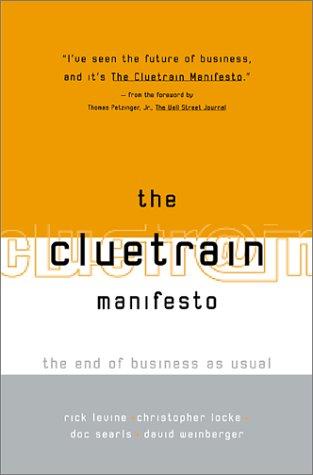
Among other things, it succeeded in grabbing the interest of Tom Petzinger, who devoted a column in The Wall Street Journal to the manifesto.* And thus a meme was born. In short order, we were approached with a book proposal, decided a book would be a good way to expand on the website, and had it finished by the end of August. The first edition came out in January 2000—just in time to help burst the dot-com bubble. It also quickly became a bestseller, even though (or perhaps in part because) the whole book was also published for free on the Cluetrain website—and is still there.Cluetrain cover

You can’t tell from the image of the cover on the right, but that orange was as da-glo as a road cone, and the gray at the bottom was silver. You couldn’t miss seeing it on the displays and shelves of bookstores, which were still thick on the ground back then.

A quarter century after we started working on Cluetrain, I think its story has hardly begun—because most of what it foresaw, or called for, has not come true. Yet.

So I’m going to visit some of Cluetrain’s history and main points in a series of posts here. This is the first one.


*A search for that column on the WSJ.com website brings up nothing: an example of deep news‘ absence. But I do have the text, and may share it with you later.)

🔲 ☆

Markets vs. Marketing in the Age of AI

Maybe history will defeat itself.

Remember FreePC? It was a thing, briefly, at the end of the last millennium, right before Y2K pooped the biggest excuse for a party in a thousand years. This may help. The idea was to put ads in the corner of your PC’s screen. The market gave it zero stars, and it failed.

And now comes Telly, hawking free TVs with ads in a corner, and a promise to “optimize your ad experience.” As if anybody wants an ad experience other than no advertising at all.

Negative demand for advertising has been well advertised by both ad blocking (the biggest boycott in human history) and ad-free “prestige” TV, (or SVOD, for subscription video on demand). With those we gladly pay—a lot— not to see advertising. (See numbers here.)

But the advertising business (in the mines of which I toiled for too much of my adult life) has always smoked its own exhaust and excels best at getting high with generous funders. (Yeah, some advertising works, but on the whole people still hate it on the receiving end.)

The fun will come when our own personal AI bots, working for our own asses, do battle with the robot Nazgûls of marketing — and win, because we’re on the Demand side of the marketplace, and we’ll do a better job of knowing what we want and don’t want to buy than marketing’s surveillant AI robots can guess at. Supply will survive, of course. But markets will defeat marketing by taking out the middle creep.

The end state will be one Cluetrain forecast in 1999, Linux Journal named in 2006, the VRM community started working on that same year, and The Intention Economy detailed in 2012. The only thing all of them missed was how customer intentions might be helped by personal AI.

Personal.* Not personalized.

Markets will become new and better dances between Demand and Supply, simply because Demand will have better ways to take the lead, and not just follow all the time. Simple as that.


*For more on how this will work, see Individual Empowerment and Agency on a Scale We’ve Never Seen Before.

❌