Vue lecture

Il y a de nouveaux articles disponibles, cliquez pour rafraîchir la page.
🔲 ⭐

La conquête spatiale : ultime fantasme du capitalisme ?

L’avenir de l’humanité se trouverait à quelques millions de kilomètres, sur une planète inhabitable et aride. Le futur de l’industrie lourde et polluante se situerait dans l’espace. Ou bien encore, le tournant écologique passerait par un voyage touristique en orbite. Tels sont les fantasmes du secteur spatial, nourris par les grandes figures de « l’astrocapitalisme » (Elon Musk et autres magnats). Ils prospèrent au sein du New Space, ce slogan aux allures de nouvelle ère dans laquelle le secteur privé porterait désormais la conquête spatiale, en opposition aux agences publiques, accusées d’être politiques et bureaucratiques. Cette modalité de la « conquête spatiale », associant les rêves du marché à ceux de Prométhée, n’est ni anodine, ni le fruit du hasard : elle résulte d’une industrie et d’une idéologie spatiale cohérente dont Irénée Régnauld, chercheur associé à l’université de technologie de Compiègne, et Arnaud Saint-Martin, sociologue, retracent la construction dans Une histoire de la conquête spatiale, ouvrage dense et bienvenu paru en janvier 2024. Recension.

Aux origines militaires de l’exploration spatiale

Le programme militaire nazi serait-il le véritable acte de naissance des futures fusées ? C’est l’histoire que rappellent Irénée Régnauld et Arnaud Saint-Martin. Dans l’entre-deux-guerres, en Allemagne, les expériences de la Société pour la navigation spatiale, créée en 1927 par des passionnés rêvant de visiter les astres, suscitent en effet l’intérêt de la Wehrmacht et de la Luftwaffe en quête d’armes nouvelles. Plusieurs sont recrutés par l’armée et contribuent au développement des programmes balistiques du Troisième Reich, d’abord dans l’usine de Peenemünde avant de rejoindre l’usine-camp de Dora, à proximité des camps de Dora-Mittelbau et de Buchenwald. Les missiles Aggregat profiteront d’une main d’œuvre esclavagisée, puis d’un intérêt soutenu des hauts dignitaires nazis lorsque les armées allemandes commenceront à reculer sur les fronts de la Seconde Guerre mondiale. 

Mais les « Wunderwaffen » [les « armes du miracle », selon le terme employé par la propagande nazie pour désigner des projets d’armes révolutionnaires censées sauver le régime, ndlr], dont font partie les Aggregat, ne parviendront pas à retourner la situation. Après la chute du régime, ces ingénieurs hautement convoités sont récupérés par les États-Unis, l’URSS ou encore la France. Ainsi, dans la patrie de l’Oncle Sam, Werhner Von Braun devient, par exemple, le maître d’œuvre de la conquête spatiale étatsunienne à partir de 1958, tandis que ses anciens collègues de Dora se retrouvent partout dans l’industrie spatiale nord-américaine.

Néanmoins, ces origines sont souvent balayées d’un revers de la main dans le récit hégémonique : les ingénieurs n’auraient eu d’autre choix que de travailler pour le Troisième Reich. Au pire, auraient-ils passé un terrible pacte faustien. En s’appuyant sur la recherche existante1, Irénée Régnauld et Arnaud Saint-Martin rappellent que les accointances nazies de plusieurs ingénieurs sont avérées et sont même connues du renseignement étatsunien, tandis que les conditions d’exploitation des travailleurs à Peenemünde et Dora ne pouvaient être ignorées de leurs maîtres d’œuvre.

Ces origines nazies sont-elles pour autant consubstantielles à la conquête spatiale ? Et ces dernières la marquent-elles aujourd’hui encore, aussi bien dans l’organisation du secteur que sur le plan idéologique ? À l’instar de l’historien Johann Chapoutot, soulignant combien l’idéologie nazie n’est pas un hapax mais s’avère bien inscrite dans l’histoire occidentale, les deux auteurs rappellent les liens étroits entre les capitalismes étatsunien et allemand – ce qui explique l’aisance avec laquelle les ingénieurs allemands se coulent dans l’industrie nord-américaine après la guerre. Tous ont baigné dans l’esprit du fordisme : le productivisme et la rationalisation du travail dominaient des deux côtés de l’Atlantique, aussi bien à Détroit qu’à Peenemünde. Pis encore, ils importent les méthodes organisationnelles héritées de leur expérience nazie, au point que Arnaud Saint-Martin et Irénée Régnauld défendent un « devenir Peenemünde » de la NASA, reposant notamment sur la logique « d’arsenal ». 

« Doit-on dès lors parler d’un « devenir Peenemünde » de la NASA, ou faudrait-il plutôt inscrire Peenemünde, tout comme la NASA, dans la dynamique émergente des États technoscientifiques ? »

On peut toutefois s’interroger sur cette filiation : la Big Science, qui désigne le développement d’une science nécessitant des investissements très importants portés par les États, ne doit pas seulement aux programmes balistiques allemands. Le Projet Manhattan, programme militaire étatsunien qui accouche de la première bombe atomique en 1945, s’impose notamment comme l’un des plus grands projets technoscientifiques de cette période, sans nécessité de passer par la généalogie nazie. De même, les programmes militaires abondent durant cette période, sans mobiliser le travail des déportés en camps de concentration.

Doit-on dès lors parler d’un « devenir Peenemünde » de la NASA, ou faudrait-il plutôt inscrire Peenemünde, tout comme la NASA, dans la dynamique émergente des États technoscientifiques2 ? Cette proposition permettrait, en effet, d’inscrire la conquête spatiale dans des évolutions structurelles englobant le fonctionnement nazi, mais sans s’y limiter, car cette évolution concerne alors l’ensemble des États occidentaux. Le nazisme, de ce point de vue, ne constituerait pas l’essence de la conquête spatiale, mais bien plutôt une étape historique avérée, quoique contingente. 

Si l’espace a toujours suscité l’intérêt du secteur militaire, c’est d’ailleurs davantage à des fins d’espionnage. C’est notamment l’esprit de la politique d’Open Skies, proposée initialement par l’administration Eisenhower, et poursuivie à travers les satellites d’espionnage, illustrant comment peuvent être associés à la fois technologie militaire et maintien de la paix. La pratique de l’espionnage par satellite devait permettre une connaissance mutuelle des arsenaux balistiques afin d’interrompre la course aux armements et d’organiser une forme d’inspection internationale à même de rassurer les superpuissances. Le consensus tacite et silencieux qui se noue entre Moscou et Washington autour d’un espionnage mutuel permit ainsi d’apaiser, au moins ponctuellement, les tensions au cours des années 1960.

Astrocapitalisme et New Space : le nouvel « âge d’or » de l’espace ?

Une situation qui connait néanmoins de profondes mutations ces dernières années : l’arsenalisation de l’espace est en marche, dans les faits et dans les esprits, et ouvre une nouvelle course aux armements. Les armes hypersoniques sont emblématiques de cette évolution, tandis que les États ne reculent plus devant la « publicité ostentatoire » des programmes spatiaux militaires, illustrée par la création de nouvelles branches au sein des armées, selon le politiste Guilhem Penent3. Autre aspect souvent délaissé que mettent également en lumière Irénée Régnauld et Arnaud Saint-Martin : l’installation conflictuelle des sites de lancement. À Kourou en Guyane pour le Centre national d’études spatiales (CNES) comme à Boca Chica en Floride avec SpaceX, ces installations sont imposées contre les populations locales selon des logiques qui rappellent les dynamiques coloniales.

En se concentrant sur SpaceX, Irénée Régnauld et Arnaud Saint-Martin soulignent par ailleurs avec ironie qu’Elon Musk, souvent associé à l’idéologie libertarienne, survit uniquement grâce à l’argent public, et participe avec assiduité à une guerre légale contre ses concurrents portant sur les appels d’offre de l’État. L’objectif est de « s’imposer comme prestataire de services des agences fédérales de l’espace ».

Une interdépendance qui tranche avec le récit des défenseurs de l’astrocapitalisme et du New Space, pour qui le secteur spatial connaitrait, un nouvel âge d’or fondé sur la croissance d’acteurs économiques issus du privé, capables d’innovations technologiques de rupture à moindre coût. Or, sans l’argent des contrats publics, les acteurs privés s’effondreraient. Le développement des activités commerciales dans l’espace répond ainsi à une volonté politique des États et de leurs agences spatiales, devenues imprésarios du New Space

L’astrocapitalisme incarne, de ce point de vue, le « spatial fix » conceptualisé par le géographe David Harvey4 : « ce déplacement géographique du capital en vue d’assurer le maintien du taux de profit ». Un déplacement soutenu et orchestré par les États, qui commence néanmoins à inquiéter certains responsables scientifiques et politiques. Le secteur des télécommunications concentre les critiques : le développement de mégaconstellations de satellites en orbite basse, aux durées de vie limitées, pollue par exemple l’espace. Non seulement, les nuisances lumineuses ont suscité l’ire des observatoires astronomiques, mais la pollution atmosphérique des lancements commence à être mieux connue. Cela sans oublier les risques engendrés par la multiplication des débris et le danger d’une réaction en chaîne, répondant au nom de syndrome Kessler dans le vocabulaire spatial. 

« L’astrocapitalisme incarne ainsi le « spatial fix » conceptualisé par le géographe David Harvey : “ce déplacement géographique du capital en vue d’assurer le maintien du taux de profit”. »

On peut toutefois s’interroger sur la pertinence du terme d’« astrocapitalisme », dans la mesure où la spécificité du secteur n’est en rien évidente. Ce capitalisme d’État, dans lequel les autorités politiques délèguent au privé, construisent un droit favorable à son développement, tout en orientant les stratégies de ces grandes entreprises vivant sur fonds publics, s’avère en effet conforme à l’esprit paradoxal du néolibéralisme. Ne gagnerait-on pas à mettre en lumière cette continuité au lieu d’entretenir une rhétorique d’exceptionnalisation du spatial, qui est le produit du récit hégémonique ?

Loin de supposer un tel projet de la part des deux auteurs, il nous apparaît néanmoins indispensable de souligner le risque de récupération d’une telle conceptualisation5. Par-delà la charge critique inhérente au dévoilement des logiques capitalistes d’un système politico-économique si soucieux d’éviter toute caractérisation idéologique, « l’astrocapitalisme » pourrait assurément servir les imaginaires technoscientifiques et extractivistes de l’espace et offrir un nom séduisant aux récits de fiction présentant de tels futurs. Pensons par exemple à The Expanse, œuvre littéraire portée sur les écrans, dans laquelle la ceinture principale d’astéroïdes est exploitée, qui semble être l’incarnation enthousiasmante d’un New Space, réalisant ses plus vertigineuses ambitions, et figurer les « prouesses » de l’astrocapitalisme.

Contre la cosmologie capitaliste : une critique à portée limitée 

L’ouvrage d’Irénée Régnauld et Arnaud Saint-Martin se clôture par un inventaire des récits alternatifs à cet assaut capitaliste sur l’espace. Une partie qui se veut « excentrique », en rappelant par exemple l’intérêt pour les OVNIS, qui a d’ailleurs précédé la conquête spatiale à proprement parler. D’autres chemins sont également ouverts par les contre-cultures et les discours critiques de « l’âge d’or » des années 1960 : mouvements féministes, luttes pour les droits civiques ou encore culture hippie qui ont pu s’opposer à la NASA.

Une place est faite également à la diversité des cosmologies qui interroge l’unicité du regard sur l’espace : toutes les populations ne voient pas dans les corps célestes des entités mortes, libres d’appropriation, d’occupation ou encore d’extraction. Les corps célestes peuvent revêtir un caractère sacré tandis que d’autres savoirs que ceux issus de l’Occident leur prêtent des propriétés vivantes.

La portée de ces critiques fondées sur la diversité des cosmologies mérite toutefois d’être questionnée. Qu’une grande diversité de visions existe – et ce d’ailleurs au sein même des sociétés occidentales – est un fait digne d’être rappelé, comme l’ont fait les deux auteurs en s’appuyant sur une riche recherche en la matière, afin de déconstruire l’idéologie hégémonique à l’œuvre dans le secteur spatial. Or, pourquoi cette critique n’est-elle pas également menée lorsqu’il s’agit de récits situés dans des sociétés non-occidentales ? Les cosmologies des Zunis, des Hopis, des Pawnees ou des Inuits relèveraient-elles de sociétés homogènes, consensuelles et anhistoriques, dont la cosmologie ne relèverait d’aucun rapport de force ni d’intérêts divergents ? En somme, ne risque-t-on pas de reproduire le mythe du « bon sauvage » en considérant qu’une société disposerait d’une cosmologie unanimiste, dont la vertu serait telle qu’elle devrait être érigée en contre-modèle ?

« En somme, ne risque-t-on pas de reproduire le mythe du « bon sauvage » en considérant qu’une société disposerait d’une cosmologie unanimiste, dont la vertu serait telle qu’elle devrait être érigée en contre-modèle ? »

Cette considération pour l’intégration des cosmologies non-occidentales à la critique scientifique, au sens des sciences sociales, n’est pas un appel à déconsidérer la portée de l’argument : les programmes spatiaux portent bien en eux une certaine cosmologie dont on peut interroger la légitimité, d’autant plus lorsque les actions que cette cosmologie légitime conduisent à la négation de l’égale dignité des autres cosmologies. Cependant, cette critique pourrait sembler faible sur le plan de l’effectivité : elle relèverait d’une critique éthique ayant peu de poids face aux enjeux stratégiques du secteur spatial. D’autant plus que cette faiblesse n’est pas rattrapée par les organisations et réseaux portant la critique de la conquête spatiale sur un plan politique, dont « l’influence sur les décisions demeure (…) de l’ordre du symbolique et des relations publiques », selon les deux auteurs.

C’est la raison pour laquelle l’absence d’une certaine alternative nous semble préjudiciable : celle portée par les États du Tiers-Monde dans les années 1970, qui ambitionnaient la création d’une agence internationale pour l’espace à travers l’Accord sur la Lune de 1979, et plus généralement les ambitions internationalistes portées par ces États au cours des années 1960 et 1970, qui n’ont pas échoué partout. En effet, le chapitre quatre évoque les fonds marins comme l’une des cibles du spatial fix : or, ces fonds marins bénéficient du statut de patrimoine commun de l’humanité, ce qui a permis d’empêcher leur exploitation jusqu’à aujourd’hui en interposant une barrière juridique et politique aux ambitions portées par de grandes entreprises. Si la situation n’est évidemment pas idyllique – mais une telle situation, dans un monde de rapports de force, peut-elle exister ? –, elle a le mérite d’encadrer et de politiser la question de l’exploitation des fonds marins.

Une telle ambition était portée par l’Accord sur la Lune qui prévoyait de conférer aux ressources spatiales le statut de patrimoine commun de l’humanité. Malgré le soutien initial du Département d’Etat étatsunien, ce projet a été torpillé par les milieux industriels et l’association L-5 de O’Neill. L’attribution du statut de patrimoine commun de l’humanité aux fonds marins dans les eaux internationales servit alors de mise en garde et de contre-argument pour ces milieux nourris à l’idéologie spatiale. Leur campagne de lobbying fut un succès : Washington se retira de l’accord, conduisant à son échec. 

Cette alternative nous semble mériter l’attention pour plusieurs raisons : elle bénéficie du précédent et de l’actualité des fonds marins, qui permet de soutenir sa faisabilité. Elle fut également portée par les États du Tiers-Monde dans les années 1970 et elle permet de rappeler les ambitions que ces États non-occidentaux prêtaient aux programmes spatiaux, tout en interrogeant le caractère purement occidental et colonial associé à la conquête spatiale. Enfin, elle se détache d’une critique essentiellement éthique, au profit d’un projet juridique et politique fondé sur de l’existant. Cela ne signifie en rien qu’il soit facile de l’obtenir politiquement : le statut des fonds marins comme l’Accord sur la Lune sont le fruit d’un contexte international radicalement différent, sur fond de Groupe des 776 et de Guerre froide. Qui plus est, les évolutions contemporaines du droit de l’espace consistent justement à faire table rase des faibles acquis encore présents dans le Traité de l’espace de 1967. D’où la nécessité d’œuvrer à reconstruire un rapport de force, en associant les héritages tiers-mondistes aux arguments contemporains.

La communauté scientifique a d’ailleurs elle-aussi un rôle à jouer dans ce revirement : l’expansion de l’œkoumène – l’ensemble des terres anthropisées –, portée par de nouvelles formes de colonialismes, exaspère les scientifiques attachés à l’approfondissement des connaissances spatiales, qui remettent en cause l’intérêt de la présence humaine en orbite7. La robotique serait moins chère et plus fiable sans cette dernière ; deux arguments majeurs dans un secteur peinant à attirer l’argent public, lorsqu’il s’agit de financer l’expansion du savoir, plutôt que celle du profit. À cela s’ajoutent les revendications de la communauté astronomique, qui mène un combat depuis plusieurs années contre les mégaconstellations de satellites. 

C’est à ce titre que l’ouvrage d’Irénée Régnauld et Arnaud Saint-Martin peut également être utile. En constituant un riche condensé des dernières recherches en sciences humaines et sociales, il démontre la politisation inhérente à l’idéologie spatiale dominante et s’attache à la déconstruire avec soin dans ses dimensions historiques, culturelles, militaires, économiques et politiques8. Aux derniers fantasmes d’Elon Musk soutenus par la NASA, qui perpétuent un projet colonialiste et extractiviste en assurant que le salut de l’humanité se trouve sur Mars, il importe donc d’opposer un contre-projet qui permette, non pas de « fuir » le cataclysme terrestre, mais de l’éviter.

1. Voir Michael Neufeld, Von Braun: Dreamer of Space, Engineer of War, New York, Vintage Books, 2007.

2. Voir par exemple : Dominique Pestre (éd.), Le gouvernement des technosciences. Gouverner le progrès et ses dégâts depuis 1945, Paris, La Découverte, 2014.

3. Guilhem Penent, « La fin de la militarisation limitée de l’espace ? La France dans le contexte du retour des armes spatiales », Les Champs de Mars, vol. 30, n° 1, 2018.

4. David Harvey, Les Limites du capital, Paris, Editions Amsterdam, 2020.

5. Le secteur spatial a d’ailleurs suscité de nombreuses propositions conceptuelles : il en est ainsi de « l’astrofuturisme » de De Witt Douglas Kilgore (chercheur en études américaines), de « l’astropolitique » de Everett C. Dolman (professeur en stratégie militaire) ou encore de « l’astrosociologie » de Jim Pass (sociologue). 

6. Coalition réunissant 77 pays en développement, créée en 1964 afin de défendre des politiques de développement à l’échelle internationale, avec une certaine influence à l’ONU dans les années 1970.

7. Voir par exemple Donald Goldsmith, Martin Rees, The End of Astronauts: Why Robots Are the Future of Exploration, Cambridge (Mass.), Belknap Press, 2022.

8. Voir notamment le chapitre deux, consacré à la fabrique de l’astroculture dominante.

🔲 ☆

Elon Musk is using Twitter to defend Brazil’s fascists

Elon Musk is using Twitter to defend Brazil’s fascists

On April 7, Elon Musk struck out at a Brazilian Supreme Court justice, branding him “Brazil’s Darth Vader.” For the past several years, Brazilian authorities have been cracking down on the digital platforms where far-right activists organize — an effort that gained steam after an attempted coup in the capital of Brasilia by supporters of former president Jair Bolsonaro on January 8, 2023. Justice Alexandre de Moraes has been leading the charge, and he recently turned his attention to Twitter/X.

The court issued an order to Twitter/X demanding it remove certain accounts related to its investigation, and the platform initially complied without making a big deal of it. That shouldn’t come as a surprise: the company regularly acts on government requests; the percentage it complies with has actually significantly increased since Musk took over, despite his frequent grandstanding about censorship and free speech. But Musk already had ties with the Brazilian far right, and they likely used that connection to get him to declare war on the court and de Moraes specifically. He’d already been meddling in Brazilian politics with the recent release of a Brazilian version of the Twitter Files.

On April 6, Twitter/X’s Global Affairs account posted a longtweet to go public about having to suspend particular accounts and making it very clear that the company’s representatives did not agree with the actions they had to take. “We believe that such orders are not in accordance with the Marco Civil da Internet or the Brazilian Federal Constitution,” the longtweet read. “The people of Brazil, regardless of their political beliefs, are entitled to freedom of speech, due process, and transparency from their own authorities.”

Not long after, Musk posted that all content restrictions in the country would be lifted. The following day he continued, urging Brazilians to download a VPN, saying the demands of the court would be published in full, and calling for de Moraes to be impeached — echoing a longstanding campaign by the Brazilian far right and Bolsonaro himself. Needless to say, Brazilian authorities were not happy to see a foreign billionaire so vigorously refusing to comply with domestic court orders.

Sign up for Disconnect

Tech critic Paris Marx provides the critical take on Silicon Valley you’ve been missing

Email sent! Check your inbox to complete your signup.

No spam. Unsubscribe anytime.

Fighting for digital sovereignty

Musk’s posts prompted a swift response within Brazil. “It is urgent to regulate social networks,” posted Attorney General Jorge Messias to Musk’s platform. “We cannot live in a society in which billionaires domiciled abroad have control of social networks and put themselves in a position to violate the rule of law, failing to comply with court orders and threatening our authorities.” De Moraes acted quickly to launch an inquiry into the legality of Musk’s “disinformation campaign” and added him to a criminal investigation looking into anti-democratic acts by “digital militias.”

The president of the Federal Supreme Court, Luís Roberto Barroso, was even more forceful about the threat Musk’s actions represented by seeking to shield the far right from accountability. “They are trying to use Brazil as a laboratory on how to interfere in local politics and local businesses,” he wrote in a statement. “They are making the case that their decision is more important than the national decision from a state democratic institution.” Political and judicial leaders made it clear they would not stand for any refusal to comply with what many see as reasonable measures. President Lula da Silva even made an account on rival platform Bluesky, building on his existing active presence on Threads.

In declaring war on Brazil’s democratic institutions at the urging of the extreme right, Musk is not only further demonstrating his commitment to using Twitter/X to promote the rise of global fascism; he also calls into question the more widespread and longstanding use of the cudgel of an American conception of free speech by US digital advocates to delegitimize attempts to regulate the internet. Brazil’s fight is not just about taking on Musk’s influence and the power of Bolsonarismo, but also setting a new standard for the regulation of social media platforms that other democratic governments outside the United States can look to for inspiration.

Opening the doors to fascists

Twitter/X has not released the demands of the court, as Musk said it would, and the same day he made that claim the administrator of the company’s Brazilian office, Diego de Lima Gualda, submitted his resignation. Presumably, he didn’t want to face fines or jail time for following Musk’s orders. The company risks being fined $20,000 a day if it doesn’t comply with the court’s orders, and it could even be hit with a complete ban in the country.

Elon Musk is elevating the global extreme right
The billionaire wants to advance his political program while preserving his power and wealth
Elon Musk is using Twitter to defend Brazil’s fascistsDisconnectParis Marx
Elon Musk is using Twitter to defend Brazil’s fascists

Soon after Musk took over Twitter, he fired nearly all the company’s Brazilian staff, including those who moderated the platform for misinformation and incitement to violence, and opened the floodgates to local fascists, just as he did in so many other countries with his amnesty on previously banned far-right accounts. Bolsonaro was a fan of Musk’s plan to buy the platform, calling it a “fresh breath of hope” when Musk visited Brazil in May 2022. According to the Washington Post, Musk’s decisions ensured Twitter was “heavily used by a circle of right-wing influencers” to spread false narratives about election fraud leading up to the attempted coup.

After Musk announced he would stop respecting the court’s orders, Brazilian media listed some of the Bolsonaro supporters and far-right agitators he could restore to the platform. Among them are far-right blogger Allan dos Santos, who fled to the United States in 2020 to avoid arrest, and YouTuber Bruno Aiub (or Monark), who argued for the recognition of a Nazi Party in Brazil. The Brazilian far right is eager to gain an even greater foothold on Musk’s platform, but just because he hears from them doesn’t mean he has a good grasp of wider Brazilian opinion on what he’s been trying to do.

Brazil has more rapidly and successfully gone after its coup plotters than the United States has, and even though the far right demonizes de Moraes, he is “widely considered to have played a role in protecting Brazilian democracy during the 2022 presidential election,” according to the Financial Times. While de Moraes’ actions may occasionally seem extreme, they are also in response to the storming of the highest governing bodies of a country with a much more recent memory of dictatorship. They’re even more justified when you consider that Brazil — like many countries around the world — does not hold the same absolutist conception of free speech as the United States.

The meaning of free speech

Musk loves to claim that his increasingly unhinged and belligerent actions are simply the result of his defense of free speech, yet it’s become very clear that his conception of “free speech” is a political tool to forward the cause of the extreme right, not to defend everyone’s right to say what they want. There are plenty of examples of this since his takeover of Twitter, but it’s easiest to demonstrate with some of his moderation decisions.

In Brazil, Musk acted quickly to allow the Brazilian far right back on the platform after he took over, as he did in many other places. He has frequently said that he would fight attempts at “censorship,” whether from governments or former advertisers. Yet in India, Twitter/X has become an important tool of censorship and information control for the far-right, Hindu-nationalist government of Narendra Modi. Musk has allowed the removal of posts critical of Modi, along with the suspension of journalists and political opponents. That’s quite different from how Musk has been acting in Brazil. In India, the far-right government is free to shape the platform, but when Brazilian authorities try to respond to the threat Musk’s decisions pose to their democratic institutions, he lashes out and calls that the real censorship — because it targets the Bolsonaro supporters and the political program he supports.

As João Brant, digital policy secretary for Brazil’s Secretariat of Social Communication, recently told Wired, “We have a background that is different from the US. It’s more similar to the European concept of freedom of expression.” Since the internet emerged from the United States, there has been an effort to have the US conception of free speech pushed onto the rest of the world because it benefited the US tech companies that rode the internet’s coattails into international markets. But different societies have their own standards of acceptable discourse — and for Brazil, planning to overthrow a democratically elected government is a step too far, regardless of what an American billionaire might think. As Bloomberg columnist Juan Pablo Spinetto explained, “Are calls to overthrow a democratically elected government protected by free speech? It may be the case in the US under the first amendment, but in other developed countries such speech can well be considered sedition.”

The TikTok ban is all about preserving US power
The platform isn’t a national security threat, but a challenge to Silicon Valley’s dominance
Elon Musk is using Twitter to defend Brazil’s fascistsDisconnectParis Marx
Elon Musk is using Twitter to defend Brazil’s fascists

For several decades, US social media platforms were largely free to do as they wanted abroad because of the narrative of all the benefits that were supposed to accompany digital tech, but also because US hegemony protected them from burdensome regulation. As US dominance wanes, so too does the privileged status of its tech companies and the notion that countries just need to accept US dominance of their internet sectors. China aside, Brazil’s campaign against Twitter/X and social media more broadly could mark an important moment in the shift toward a different conception of the internet in a multipolar world.

Challenging the power of social media

In his response to Musk’s tweets refusing to comply with court orders, Justice de Moraes argued that Twitter/X’s actions were “not only abuse of economic power, by trying to ILLEGALLY impact public opinion, but also flagrant induction and instigation to maintain various criminal conducts practiced by the digital militias under investigation.” In short, Brazil would not stand for it, and it seems one of Musk’s yes men dared to talk some sense into him.

On April 15, Reuters reported that Musk’s lawyers contradicted the previous statements of their boss. “As already communicated to the federal police, X Brasil informs that all orders issued by this Supreme Court and the Superior Electoral Court will continue to be fully complied with by X Corp,” they wrote in a letter to de Moraes. This could lead to Musk’s brief Brazil saga fading out of people’s memories as he undoubtedly gets himself embroiled in other scandals in the coming weeks, but it doesn’t change the fundamental point.

The digital revolution has failed
The benefits of the internet are eroding. The AI boom is only accelerating their demise.
Elon Musk is using Twitter to defend Brazil’s fascistsDisconnectParis Marx
Elon Musk is using Twitter to defend Brazil’s fascists

The internet is entering a new era. It may not yet be fully clear what it will look like, but we can be certain that social media platforms are in for more regulation than they’ve seen in the previous two decades as people are no longer falling for the hype and deception they relied on to get away with degrading and capitalizing on our communications for so long. That isn’t inherently a violation of free expression, as understood by many countries, but a necessary correction to align their operations with the laws and values of the countries in which they operate.

Brazil is right to challenge Musk’s policy changes designed to turn Twitter/X into a haven and organizing ground for the global far right — and it shouldn’t stop there. Communications platforms aren’t just profit machines for major corporations or political playthings for US billionaires. If they don’t serve the publics that use them, they should be forced to change. And if they won’t comply, that’s all well and good; they can be replaced with something else that will.

Sign up for Disconnect

Tech critic Paris Marx provides the critical take on Silicon Valley you’ve been missing

Email sent! Check your inbox to complete your signup.

No spam. Unsubscribe anytime.

🔲 ☆

Tesla is in serious trouble

Tesla is in serious trouble

On April 5, Reuters broke some major Tesla news: the $25,000 car that the company had supposedly been staking its future on has been cancelled. Instead, CEO Elon Musk wants to bet the company on his fantasy of creating a robotaxi, despite there being no end in sight for the problems with its self-driving software.

The news organization cited Tesla employees who said they attended a meeting in late February where Musk made the announcement. In Walter Isaacson’s biography of Musk published last year, he described Musk’s initial opposition to building the more affordable model even though it had been part of his strategy for company since his first “master plan” in 2006. Isaacson described a meeting in August 2022 where Musk declared, “No mirrors, no pedals, no steering wheel. This is me taking responsibility for this decision.” The robotaxi was the focus; the low-cost Tesla wasn’t happening.

However, in September lead designer Franz von Holzhausen and a few others convinced Musk to allow them to work on both projects as long as they could use the same vehicle platform. They told Musk a $25,000 model was essential if they hoped to meet the company’s growth targets. Isaacson describes Musk being in a bad mood after the meeting, but accepting the new direction. That clearly didn’t last.

Tesla is in a tough place. After years where it was considered the shining star of the nascent electric vehicle (EV) industry, if not the wider automotive industry, its prospects have begun to dim. With sales slowing, competition mounting, and investors losing interest in Musk’s fantastical promises that never come true, the Tesla story is poised for a shift and its share price could be in for a significant correction. It remains to be seen whether the board will continue to let Musk’s increasingly erratic reign continue.

🔲 ☆

Elon Musk is elevating the global extreme right

💡
Are you an editor or publisher interested in translating this post or any other that Disconnect publishes? Get in touch.
Elon Musk is elevating the global extreme right

Within hours of the Russian invasion of Ukraine in February 2022, Elon Musk had inserted himself into the news cycle by providing Starlink terminals that were quickly ferried by the US military to the besieged country. Musk received great praise for his action, even as governments like those of the United States and Poland had bought many of the terminals and paid for the service being put to use by the Ukrainian army.

But by the fall, Musk’s views had shifted. A Ukrainian attempt to attack Russian forces in Crimea failed in September because its Starlink access had been disabled. In October, Ukrainian soldiers found that SpaceX had geofenced their service area, ensuring that when they got close to Russian positions in southern Ukraine they’d lose Starlink access. Musk was reportedly not only getting fed up with paying part of the cost of the service, but according to Colin Kahl, then Undersecretary of Defense for Policy at the Pentagon who had to personally make a deferential call to the billionaire, “he was getting nervous that Starlink’s involvement was increasingly seen in Russia as enabling the Ukrainian war effort, and was looking for a way to placate Russian concern.” On the same call, Kahl claims Musk volunteered that he’d personally spoken to Russian president Vladimir Putin, something Musk later denied.

The Pentagon negotiated a contract with SpaceX in the months that followed to take over the cost of provisioning Starlink service, which likely also included clauses against Musk’s unilateral disabling of service. Since then, Russia has reportedly also obtained thousands of Starlink terminals that its soldiers are using, and which Musk has shown no sign of disabling. This story shows Musk is not just any old tech billionaire. He’s one of the wealthiest and most powerful people in the world, and that’s turned him into a figure who can stand alongside world leaders and governments as their equal, and in some cases even their superior as they praise him in the hopes of gaining access to his growing empire.

Musk’s shifting preferences away from Ukraine and toward Russia are indicative of a larger shift in his politics where he’s not only been speaking out in favor of right-wing issues and echoing conspiracy theories around topics like immigration and gender, but actively seeking to build an alliance with likeminded political movements the world over. In some cases, there’s a business incentive to what Musk is doing, but it’s become increasingly clear that the relationships he’s forging are not just about getting preferential access for his companies; they're about creating a world where the political agenda he champions on Twitter is the policy of governments around the world.

Sign up for Disconnect

Tech critic Paris Marx provides the critical take on Silicon Valley you’ve been missing

Email sent! Check your inbox to complete your signup.

No spam. Unsubscribe anytime.

Ties to the extreme right

The first key international meeting Musk had with a member of the ascendent extreme right-wing axis in global politics was in May 2022 with Brazilian president Jair Bolsonaro. Musk was officially in the country to launch Starlink, promoting it as a means to connect rural schools and increase monitoring of the Amazon. As Progressive International explained, that narrative not only helped to greenwash Starlink, but also to provide a technological cover for the cuts the Bolsonaro government had been making to environmental protection and enforcement in the rainforest. Bolsonaro also praised Musk’s plan to buy Twitter as a “fresh breath of hope.” Later that year, after Musk took over the company, he fired virtually all the company’s Brazilian staff, leaving it open to right-wing influencers who promoted false narratives about election fraud.

That meeting showed how politics and business could complement one another. Musk got a new market for Starlink and helped advance Brazil’s far-right movement. But things only accelerated from there. In June 2023, he met with Indian prime minister Narendra Modi, calling himself “a fan.” Modi has been credibly called a fascist, and his Hindu nationalist movement is undertaking an unprecedented crackdown on the country’s Muslim population. Musk and Modi discussed potential uses for Starlink in India and the prospect of building a Tesla factory in India. But Musk has also allowed Twitter to become an important tool of Indian government censorship. As the Washington Post reported of Twitter months after the meeting, “A company that not long ago adopted the risky strategy of fighting government censorship in the Indian courts now consistently bends to official demands.” Those demands meant taking down posts critical of the Modi regime and removing the accounts of journalists and political opponents.

No kids, no future. @elonmusk pic.twitter.com/ip281zmMsQ

— Katalin Novák (@KatalinNovak_HU) September 26, 2023

A few months later, Hungarian president Katalin Novák arrived in Texas for a tour of the Tesla Gigafactory. She hails from the same party as prime minister Viktor Orbán, who has been a central figure in the growth of illiberal right-wing populism in Europe, with a particular focus on racist anti-migrant politics and similar natalist views as Musk espouses. The meeting took place because Musk hadn’t been able to attend the Demographic Summit in Budapest the week before. Soon after, he agreed with Orbán’s criticism of European migration policies on Twitter and retweeted a post from a right-wing account called Radio Genoa that called out non-governmental organizations helping save the lives of migrants crossing the Mediterranean. “Let's hope AfD wins the elections to stop this European suicide,” the tweet read. Alternative for Germany (AfD) is a far-right German political party.

In October, Musk replied to a tweet by New Zealand’s newly elected conservative prime minister Chris Luxon, saying, “Congratulations and thank goodness!” He had just ousted the Labour Party and now leads the most right-wing government the country has seen in decades, in coalition with the libertarian ACT and nationalist NZ First parties. Musk has also intervened in the politics of his native South Africa, echoing the myth of “white genocide” spread by white nationalists to suggest Black South Africans are killing white farmers en masse, and more recently has been boosting Ireland’s far-right fringe by giving them free rein on Twitter and echoing their criticisms of the government, including on recent attempts to pass new hate speech legislation. After those interactions, Musk gave an interview to Gript, a website that promotes extreme right-wing politics.

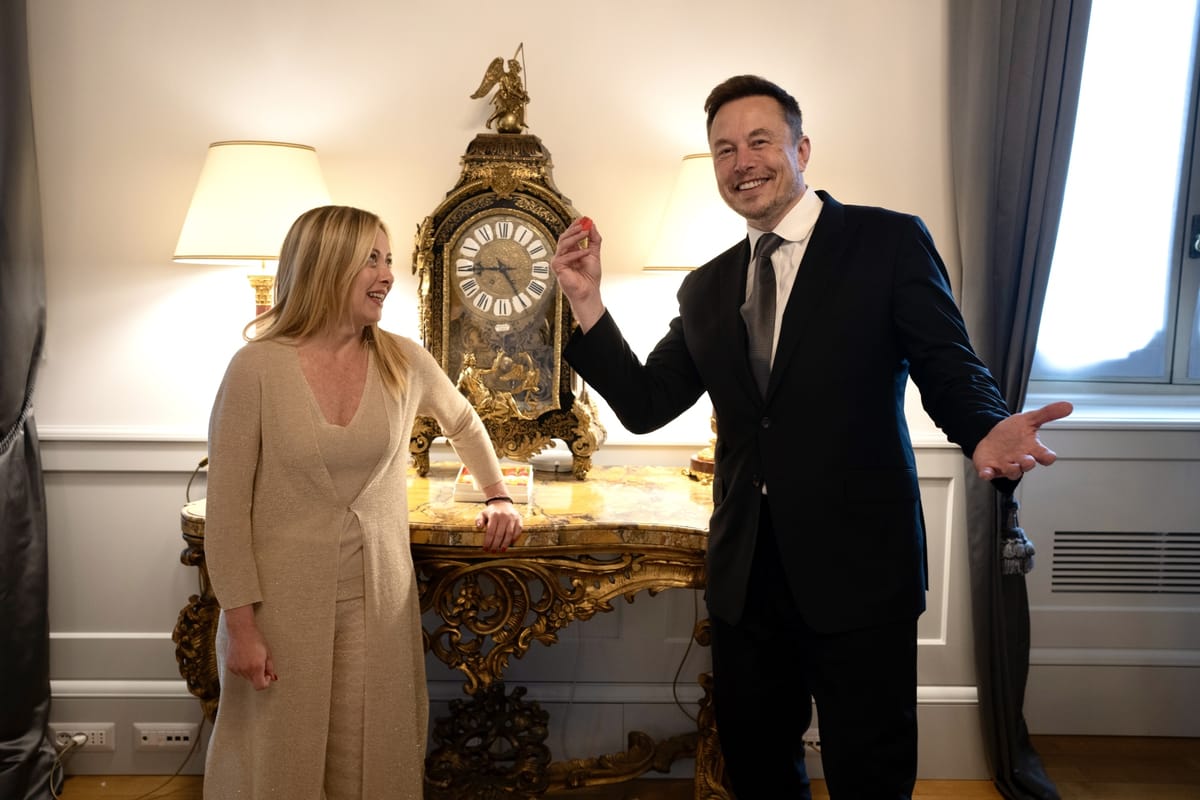
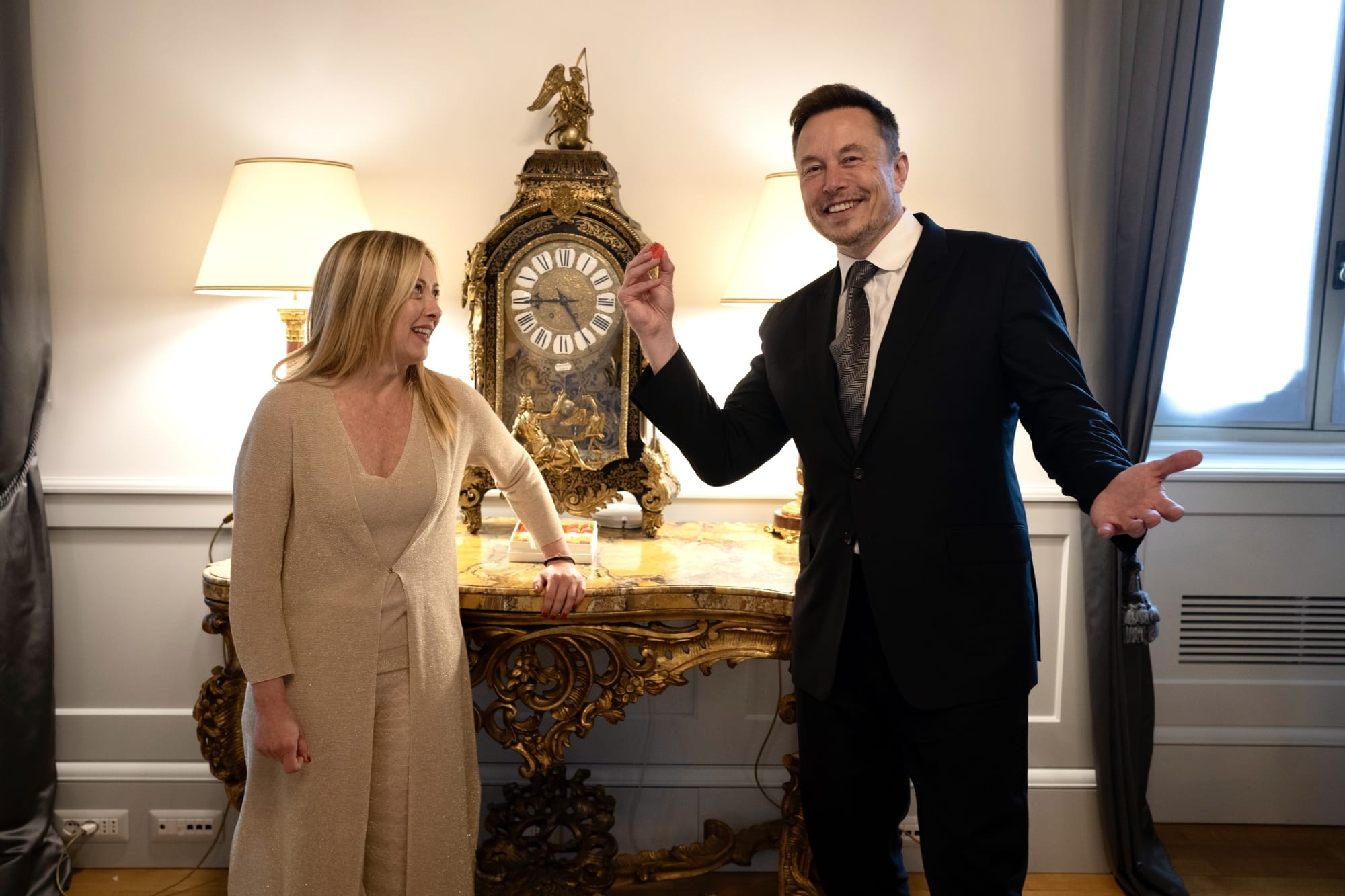
Musk’s most recent dalliances are probably no surprise. Italian prime minister Giorgia Meloni is quickly becoming a driving force in Europe’s tilt to the far right. She leads the Brothers of Italy, which has direct links to the country’s fascist past. In December, Musk was the main attraction at Meloni’s annual Atreju festival for conservative youth. He joined Meloni on stage to warn of “unchecked” migration, emphasize the importance of preserving the “cultural identity” of countries like Italy, dismiss climate fears as “somewhat overblown,” and tell attendees how important it was to have more children. “If people do not have children there is no new generation,” he said, which was almost exactly what the Hungarian president was quoted as telling him months before.

Ho accolto con grande piacere oggi a Palazzo Chigi @elonmusk. Un incontro molto proficuo e un momento di grande cordialità dove abbiamo affrontato alcuni temi cruciali: innovazione, opportunità e rischi dell'intelligenza artificiale, regole europee di mercato e natalità. Avanti… pic.twitter.com/MOQlirj7XC

— Giorgia Meloni (@GiorgiaMeloni) June 15, 2023

Back in the Americas, Musk swiftly congratulated “anarcho-capitalist” Argentine president Javier Milei when he was elected last year and praised an unhinged speech he gave at the World Economic Forum in January. Milei acted quickly to unleash “shock therapy” on Argentina, gutting public spending and making life even worse for citizens who were already struggling under the weight of soaring inflation. Musk is one of the beneficiaries of Milei’s economic deregulation, as rules were changed to allow the launch of Starlink in the South American country. Milei also confirmed that Musk is “extremely interested” in gaining access to the country’s lithium deposits.

To top it all off, Musk met with Israeli president Benjamin Netanyahu in November to clean up his image after echoing an antisemitic conspiracy theory on Twitter. In exchange for his tacit support of the genocidal war in Gaza, Musk promised Israel would have a veto over any access to Starlink in the besieged enclave, including by aid organizations.

Embrace of the Republican Party

Musk’s growing relationship to the global extreme right may be concerning, but it’s not surprising. There was a time when Musk was happy to present himself as a liberal businessman aligned with some progressive priorities like fighting climate change because it meant preferential loans and various subsidies to benefit Tesla, not to mention getting Democratic backing to transform the aerospace industry in SpaceX’s favor. But those days are long gone.

It’s reasonable to believe that Musk has long held views that are more aligned with a conservative understanding of the world, and they were turbocharged as he became more radicalized during the pandemic (arguably by the very platform he now owns) and his position in society changed. No longer is he the plucky upstart challenging the big guys in the automotive and aerospace industries. SpaceX and Tesla are now powerful forces in their own right, and that means they’re subjected to higher standards of accountability. As the Democratic Party has targeted the tech industry for greater regulation and billionaires to pay higher taxes, Musk’s incentive to turn to the political right has only grown. Conservatives are not only willing to embrace him, but will eagerly defend his power just as they do with other corporate titans.

In the United States, Musk has shifted his base of operations from Democratic California to Republican Texas after being wooed by the latter’s governor Greg Abbott. He has a long-running problem with the Securities and Exchange Commission after they held him accountable for lying about having funding to take Tesla private in 2018. He’s also hidden injuries at Tesla from the Occupational Safety and Health Administration, blasted the Fish and Wildlife Agency for doing environmental reviews of SpaceX’s operations in Texas, and has a history of conflicts with the National Highway Traffic Safety Administration.

Elon Musk just escalated his war on workers
The union-busting CEO wants to blow up labor protections around the world
Elon Musk is elevating the global extreme rightDisconnectParis Marx
Elon Musk is elevating the global extreme right

Most recently, Musk decided to have SpaceX sue the National Labor Relations Board to gut its authority, which would cause an unprecedented setback in the rights of workers across the country. That campaign is supported by the Republican Party, which Musk has been forging closer ties to in recent years. He’s explicitly backed extremist GOP candidates and told his followers to vote Republican in the 2022 primary elections. Musk now regularly scaremongers about migration across the southern US border, and even traveled to it last year to sneer at migrants with a Republican lawmaker.

In taking those actions, Musk’s business, political, and personal interests are often intertwined. He’s undoubtedly seeking to preserve his own power and grow his empire, but he’s also looking to move forward the right-wing project that he vocally advocates on Twitter and in virtually any interview he gives these days. Yet not all of his relationships are designed to move forward every one of those interests at the same time.

Mixed motivations are still dangerous

The United States is the place where Musk’s political and business interests are most closely aligned, since he lives there and his companies are based there. As Tesla and SpaceX have grown, he wants to make sure they can continue ignoring environmental and safety regulations and that his vast wealth will not be targeted by lawmakers. That creates an incentive to back the Republican Party, even beyond his political views — though it certainly helps that he agrees with them on a long list of issues. The Republicans also want to be close to the man who was lauded for so long and held up as the creator of our collective future. Seizing him for their project is politically valuable, meaning there’s mutual benefit to the alliance.

The media’s failure on Elon Musk
After building him up, they need to tear him down
Elon Musk is elevating the global extreme rightDisconnectParis Marx
Elon Musk is elevating the global extreme right

In much of the rest of the world, right-wing movements have a similar incentive to attract Musk’s attention and support him because it boosts their profile. In some cases, those alliances are more political, like in Hungary or Italy where Musk does not have major business interests. Meanwhile, there are other instances that are much more about commercial opportunities, such as Musk’s relationship with Modi as Tesla looks to India as a future market for its products and a likely site for a factory that can make use of lower cost labor, along with Argentina’s potential to be a supplier of lithium without the problem of dealing with the left-leaning governments of Chile or Bolivia.

This is also where Musk’s relationship with China is distinct. American liberals often point to Musk’s uncritical embrace of China as evidence of his fondness for the Chinese Communist Party, but that’s a misread of the situation just as it would be for other Silicon Valley companies that have sought to break into the Chinese market. Musk built a relationship with Chinese officials because it’s a large consumer market, is ahead of the West in electric vehicle adoption, and provided low-cost manufacturing labor as he hopes to grow Tesla and export its vehicles to more markets.

Does Musk like the labor discipline and dependability that comes with a lack of Western democracy? Undoubtedly. But he doesn’t have the approach to Xi Jinping as he does with Giorgia Meloni or other members of the extreme right-wing axis. Politically, Musk is much more interested in making sure Western countries align with his values, while other parts of the world are seen through more of an economic lens. Musk approaches India like he does China: whether Modi is fascist or not is of little concern, as long as he can access its market and cheap labor on good terms. If that requires letting Modi’s government censor Twitter to make him happy, then so be it.

Ultimately, Musk is not alone in this. He’s just the most visible Silicon Valley leader to have openly embraced white nationalism and far-right politics to defend the power and wealth he accumulated since the internet’s privatization in the 1990s. It helps that the right-wing views many tech CEOs and investors advocate have a long history in the tech sector, but more than anything they’re concerned with cementing their positions at any cost. Venture capitalist Marc Andreessen was quite explicit about it in last year’s techno-optimist manifesto where he cited numerous far-right thinkers, including the Italian Futurists that supported Meloni’s forebears. If fascism rises again, that’s perfectly fine with the titans of tech, as long as they get to hold onto their influence.

Sign up for Disconnect

Tech critic Paris Marx provides the critical take on Silicon Valley you’ve been missing

Email sent! Check your inbox to complete your signup.

No spam. Unsubscribe anytime.

🔲 ⭐

Elon Musk annonce des fonctionnalités premium gratuites sur X

Tiens, tiens, ce cher Elon Musk nous réserve encore des surprises de taille avec X, anciennement connue sous le nom de Twitter ! Le milliardaire vient d’annoncer que certains comptes auront désormais accès gratuitement à des fonctionnalités premium. Il se prend pour Xavier Niel, le gars 🙂

Concrètement, si votre compte X a plus de 2500 abonnés vérifiés, vous allez pouvoir profiter des fonctionnalités Premium sans débourser un centime. Et si vous avez la chance d’avoir plus de 5000 fidèles followers, c’est carrément Premium+ qui vous tend les bras !

Avant cette annonce fracassante, il fallait casquer 8$ par mois pour avoir accès à Premium et tous ses avantages : des posts plus longs, des uploads vidéos plus conséquents, une priorité dans les réponses et moins de pubs dans votre timeline. Quant aux utilisateurs Premium+, en plus de dire adieu à la publicité, ils ont même droit à Grok, le chatbot d’IA générative de X.

Depuis qu’Elon Musk a racheté Twitter pour la modique somme de 44 milliards de dollars en avril 2022, le réseau social a beaucoup fait parler de lui. Entre les polémiques sur la liberté d’expression, les changements de nom, et les fonctionnalités qui changent ou disparaissent, on ne s’ennuie pas une seconde.

Mais tout n’est pas rose dans le monde merveilleux de X. Un juge américain vient de rejeter une plainte déposée par la plateforme contre un groupe accusant X de laisser proliférer les discours haineux depuis l’arrivée de Musk aux manettes. Le juge a estimé que X ne supportait pas la critique et punissait les défendeurs pour leur liberté d’expression. Un revers cinglant pour le réseau social qui compte bien faire appel.

Et comme si cela ne suffisait pas, le nombre d’utilisateurs quotidiens de X serait en chute libre par rapport à ses concurrents comme Instagram et TikTok. Selon des chiffres rapportés par NBC News, l’utilisation quotidienne de X aux États-Unis aurait chuté de 23% depuis novembre 2022, juste après la finalisation du rachat par Musk. Une baisse bien plus importante que pour les autres géants des réseaux sociaux sur la même période.

Au niveau mondial, c’est pas la joie non plus. Les utilisateurs actifs quotidiens sur X sont descendu à 174 millions, soit une baisse de 15% par rapport à l’année précédente. Pendant ce temps-là, Snapchat, Instagram, Facebook et TikTok continuent de voir leur nombre d’utilisateurs grimper. Aïe aïe aïe…

Alors certes, Elon Musk et son équipe peuvent se vanter d’accueillir encore 250 millions d’utilisateurs quotidiens dans le monde, comme l’a fièrement annoncé X Data en mars dernier. Mais n’oublions pas que c’est quand même moins que les 258 millions revendiqués par le patron en personne fin 2022.

Malgré ces quelques zones de turbulences, X continue d’avancer et d’innover pour séduire les utilisateurs. Les nouvelles fonctionnalités premium gratuites pourraient bien doper l’attractivité de la plateforme et convaincre les indécis de sauter le pas. Après tout, qui n’a pas envie de pouvoir poster des messages plus longs et des vidéos de meilleure qualité sans payer un centime ?

Source

🔲 ☆

Le premier cobaye Neuralink s’éclate sur Civilization VI

Vous vous souvenez sûrement de Neuralink, la startup fondée par Elon Musk qui veut révolutionner les interfaces cerveau-machine ? Eh bien, figurez-vous que leur premier cobaye humain, un certain Noland Arbaugh, s’est amusé comme un petit fou avec son nouveau gadget greffé dans le ciboulot !

Ce cher Noland, un jeune homme de 29 ans paralysé des épaules jusqu’aux pieds suite à un accident de plongée, a eu l’immense privilège de recevoir l’implant Neuralink N1 en janvier dernier. Et croyez-moi, il n’a pas perdu de temps pour tester son joujou high-tech !

Lors d’un livestream sur X (l’ex-Twitter, vous suivez ?), notre cher patient a fait une démonstration époustouflante en jouant aux échecs sur ordi rien qu’avec la force de son esprit. Tel un Jedi de la stratégie, il a déplacé les pièces sur l’échiquier virtuel en un clin d’œil, laissant les spectateurs bouche bée.

Mais ce n’est pas tout ! Noland nous a confié qu’il avait déjà passé une nuit blanche à s’éclater sur Civilization VI, le célèbre jeu de stratégie. Avant son opération, il devait compter sur un pote pour l’aider à jouer, ce qui était loin d’être idéal pour enchaîner les parties jusqu’au bout de la nuit.

Maintenant, grâce à son implant miracle, il peut s’adonner à sa passion sans limites ! Enfin, presque… La seule contrainte, c’est d’attendre que son gadget se recharge quand il a épuisé toute la batterie. Mais bon, c’est un détail quand on peut à nouveau profiter des joies du gaming de manière autonome, non ?

Et ce n’est pas fini ! Notre champion a aussi réussi l’exploit de terminer deuxième à Mario Kart 8 Deluxe en affrontant son père et un ami. Pas mal pour un débutant qui pilote son kart à la force de la pensée !

Bien sûr, comme le souligne Noland, tout n’est pas encore parfait avec cette technologie. Il reste du chemin à parcourir pour que Neuralink tienne toutes ses promesses. Mais avouez que c’est quand même un sacré bond en avant pour redonner de l’autonomie et des loisirs aux personnes paralysées. Bravo Elon 🙂

D’ailleurs, le grand gourou de la tech, ne compte d’ailleurs pas s’arrêter là. Son objectif ultime ? Utiliser les implants pour « shunter » les signaux du cortex moteur directement vers les membres paralysés, histoire de contourner les lésions de la moelle épinière. Carrément !

Mais avant d’en arriver là, Neuralink va devoir convaincre les autorités américaines que ses expériences sont éthiques et sans danger, car la startup a déjà fait polémique avec ses tests sur les animaux, accusée d’avoir provoqué des souffrances inutiles sur des singes, des cochons et probablement Bruno Le Maire si on en croit la dernière annonce du déficit français.

Espérons que cette success story avec Noland ouvre la voie à des essais cliniques plus larges, histoire de transformer la vie d’autres personnes dans sa situation. En attendant, on peut toujours rêver au jour où on pourra tous s’affronter sur Civilization ou Mario Kart par la simple force de notre cerveau !

Perso, si Neuralink me permet de débrancher à la demande le son de mes oreilles quand j’ai les enfants dans les pattes, je me le fait implanter tout de suite !

Source

🔲 ☆

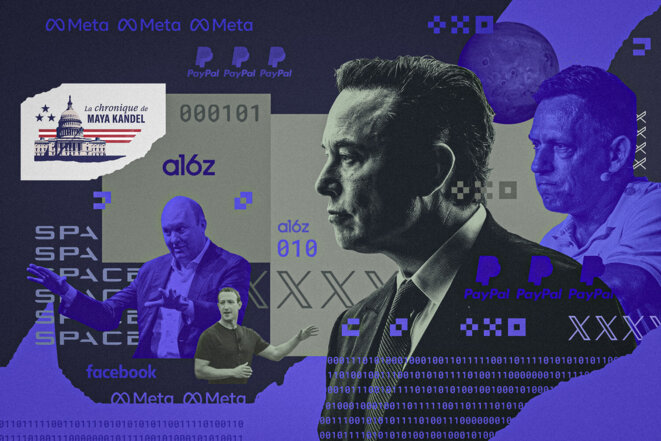
La droite tech contre la démocratie: comment la Silicon Valley s’est radicalisée

Elon Musk et Peter Thiel en tête, la droite tech regroupe une galaxie d’individus qui tracent les contours d’un mouvement politique, intellectuel et financier complexe, et extrêmement influent. Premier volet de notre série sur la transformation de la droite américaine.

La droite tech contre la démocratie : comment la Silicon Valley s’est radicalisée © Photo illustration Simon Toupet / Mediapart

❌