Dans ce troisième épisode, je questionne Boris Sirbey : Pourquoi t'intéresses-tu aux changements civilisationnels ?
"Je trouve que nous vivons beaucoup dans une espèce d'urgence perpétuelle, nous sommes tout le temps en train de réagir à ce qui arrive, et pour moi il s'agit aussi de s'intéresser pas uniquement à ce qu'il faut faire pour répondre aux urgences climatiques et écologiques et autres, mais à se poser enfin la question : Pourquoi en sommes-nous arrivés là ?" C'est un moment où il nous faut prendre beaucoup prendre de hauteur afin de placer les actions au bon niveau.
Olivier Frérot dans l'épisode #1 "Deux axes civilisationnels antagonistes" nous a partagé sa vision du changement radical de civilisation dans lequel nous sommes entrés.
Avec cet épisode #2, Olivier Frérot nous partage sa vision des critères d'émergence de la civilisation en devenir. Et cela commence par être un vivant au milieu des vivants..
Extrait pour vous mettre en appétit : "Je pense que si nous ne mettons pas les mains dans la terre, au sens précis des mots, avec cette attention à les voir comme une graine de germe, (parfois cela prend) et puis souvent ça rate aussi, comme la difficulté de la vie, et puis d'un coup ça y est, ça explose. Je ne suis pas à même de proposer d'autres chemins, tant que je ne ressens pas en moi en quoi moi-même je suis un vivant parce que je participe de la co-création de la vie."
Dans cet épisode de conclusion, nous revenons au temps présent.
Et quelles sont les singularités de notre temps ? Notre gestion et, par conséquent, notre perception du temps est emblématique notamment à travers le trinôme Temps / Travail / Communs.
Nous nous interrogerons également sur d’autres particularités de notre temps : la question de l’urbanité, celle du cosmolocalisme et la notion fondamentale de Surplus.
Sommes nous prêts à dépasser le moment civilisationnel de l’histoire humaine ? Une post-civilisation est-elle possible ? Une série de sept entretiens avec Michel Bauwens.
Episode 5 : LE MONDE QUI VIENT : PAIR A PAIR, CRYPTOS, LES COMMUNS ? Une coopération entre Alter’Coop & Prenez Place ! Vous pouvez retouver cette série sur www.altercoop.org/ecosysteme-…
«Au milieu des années 90, c’est le moment de l’altermondialisme et du mouvement zappatiste, quelque chose émerge, la forme organisationnelle était en train de changer : le pair à pair émerge à ce moment-là. Car l’altermondialisme ce n’érait pas un parti mais, au contraire, une idéologie pluraliste, des gens dans le monde entier organisés en réseau.» Dans ce cinquième épisode Michel Bauwens observe et analyse le monde qui vient, les signes, les expériences en cours, tout ce qui émerge à travers la planète et qui invente de nouvelles formes d’organisation humaine, tout ce qui opère un changement réel de paradigme et pourrait préfigurer notre futur : le pair à pair, l’autoorganisation, l’économie contributive, les cryptos… et au coeur la résurgence des communs. Il introduit également la notion de cosmolocalisme comme troisième voie possible.
Afin de comprendre le changement à venir, nous nous interrogeons sur l’émergence et l’évolution de la civilisation, et nous nous demandons si un nouveau système post-civilisationnel est prêt à devenir la nouvelle réalité de l’humanité. » Michel Bauwens La fondation Pair à Pair co-fondée par Michel Bauwens : wiki.p2pfoundation.net et le lien vers sa newsletter : 4thgenerationcivilization.sub…
Présentation d’Alter’Coop : Alter’Coop s’engage à accompagner en profondeur les transformations de notre société en prenant soin des liens entre les personnes et avec le vivant. Tisser des relations ténues et pérennes, créer les conditions de la confiance, repenser les racines de la coopération, pratiquer au quotidien pour faciliter les transitions.
Dans ce quatrième épisode, Michel Bauwens nous parle du travail de Peter Pogany, macrohistorien de la modernité s’appuyant sur la thermodynamique et les états de conscience des sociétés pour analyser notre cycle caractérisé par l’avènement du premier système global au XIXème siècle, après Napoléon, basé sur la dominance de la classe bourgeoise. Michel aborde ici également la notion de cartel idéologique, la synchronisation des cycles après la seconde guerre mondiale, la question des ressources, celle de l’exportation de l’industrie et de la pollution. Nous tentons d’analyser avec Michel sous d’autres angles certaines crises, celle des années 68 avec l’émergence de la société de consommation et du désir et celle de l’outil-dette au service de la création d’«une illusion de prospérité» puis Occupy Wall Street et, au même moment, brusquement, l’explosion du champ lexical identitaire dans tous les média jusqu’à aujourd’hui... Cette vidéo a été enregistrée le 23/09/2023.
Dans cet épisode, Michel Bauwens interrompt momentanément la présentation des macros historiens pour s'attacher tout particulièrement à la notion de cycle c'est-à-dire le travail qui consiste à repérer identifier ce qui formerait des patterns c'est-à-dire des marqueurs des éléments qui reviendraient tout au long de l'histoire humaine. Cette notion de cycle est indissociable des crises qui annoncent l'avènement de nouvelles formes d'organisation sociétale.
C'est donc bien de cette possibilité ou non de repérer des cycles ou des spirales dont il va être question ici et de leur lien inextricable avec les périodes de crise qui précède toujours les transformations profondes.
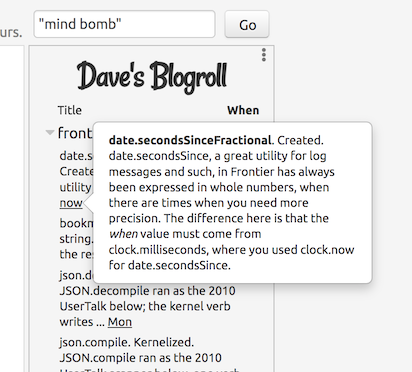
Milestone in Atlantis development, the new version of Frontier that runs on modern OSes. I'm going to start showing what's going on in the development of the product. To kick off, here's a screen shot of my blogroll displaying the latest new part. The updates flow through an RSS 2.0 feed, which is new for Frontier. It used to require a server that managed updates and responded to XML-RPC calls. But once RSS was part of the web, it was a better protocol for releasing code parts. Truly a milestone. There will be lots more little things we can do now that we couldn't do before. But under it all -- it's Frontier.
FeedLand and WordPress have a new hookup. With Scott Hanson's plugin: River Embed for FeedLand you can use feedland.com or feedland.org, or host your own FeedLand, to include a page of news in your site. How it works: Create a timeline, when you're ready show the river to your readers, use the new plugin. For a news orgs like CNN and TechCrunch, both use WordPress, they could have a stream of news from related pubs. For a product site, or a political leader site, news from pubs that cover the area. It's a way of bringing the feed world into the world of news. Here's a thread where you can ask questions.
Google replaced the library card catalog. Imagining that, Claude and ChatGPT et al are as much of a leap. I think libarians must be ecstatic. It moves their job up one level. They now have about 100 librarian-power tool that works for them. Librarians and programmers worked together a lot in the early days of the web. Maybe we'll do that again.
The flaw in how journalism covers US politics. We wait for proof, then it comes, and go back to waiting for proof. We think we want proof, but what we really want is to not have proof. That is if you judge us by our actual behavior. We'll deal with the truth when we have the proof. (That would be a good bumper sticker.)
Claude Code, even though it had blocks preventing it from doing this, overwrote files on an S3 bucket that took one of my major apps off the air. Every customer must be grappling with the same thing. How do I trust it when it can't be trusted? More about this in a tweet earlier today.
BTW, this blog is one of those periods where there are a few mind bombs every freaking day. What's a Mind Bomb? An idea that's so strange or powerful that it explodes in your mind. And that's a good thing!
Just got to the place where I'm thinking of what apps I want to be scriptable with Frontier. First I thought of FeedLand of course, and WordPress. NetNewsWire and micro.blog, because they're products from key contributors in the Frontier community with important products today. What about Mastodon? It's got an API. And if that worked, we'd hook into AT Proto. The funny thing is the first web, because much of the new development came from the Mac community, was built around Frontier. System level scripting was also a big deal right alongside the web. But then Jobs, in 1997, rewrote everything, brought in the Unix products, completely disrupted the good thing we had going as independents. That was probably the moment when we stopped building around the idea that you could script all the apps from one place if they had good APIs. All the server apps all had APIs, had to in order to work on the web. We seem to have caught up, and the opportunities to connect things has never been greater. A big door swings open.
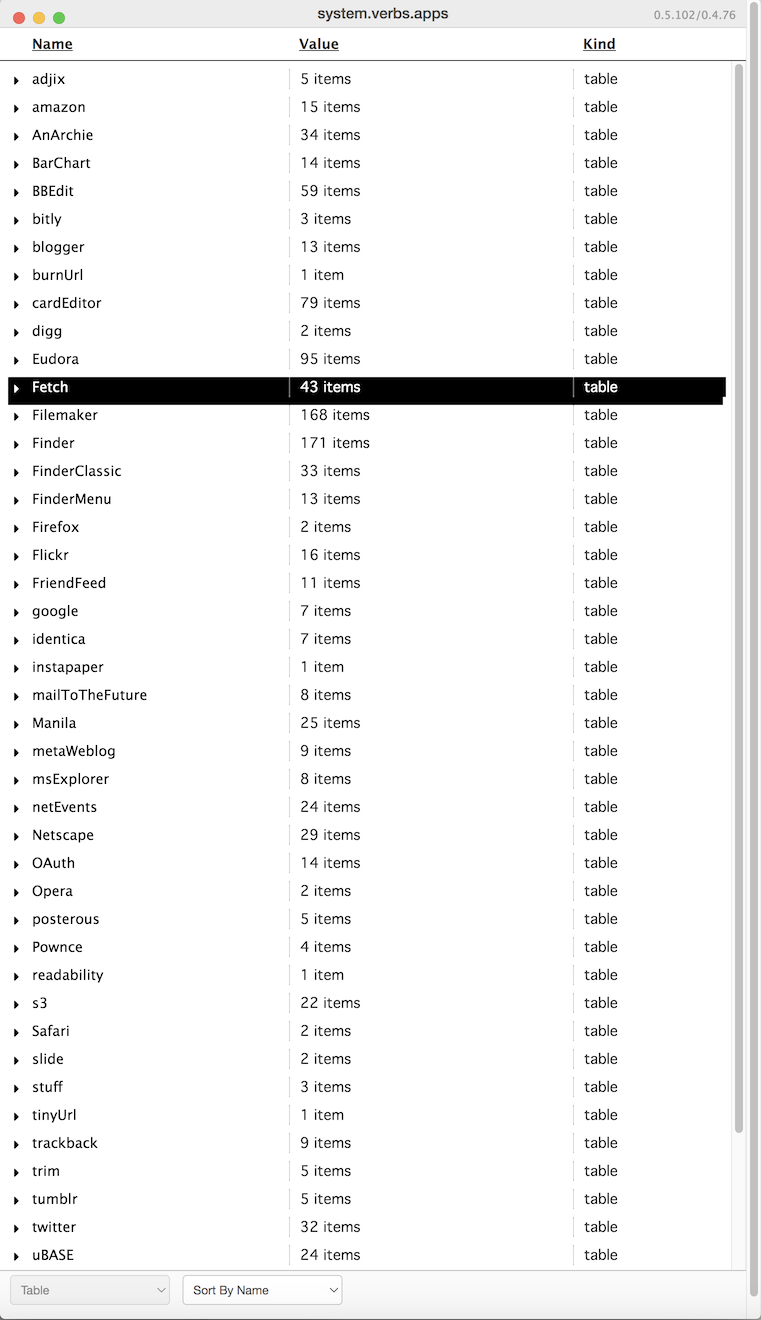
Screen shot of my current system.verbs.apps table. You can tell from reading it that it's been a long time since I've thought much about scriptable apps.
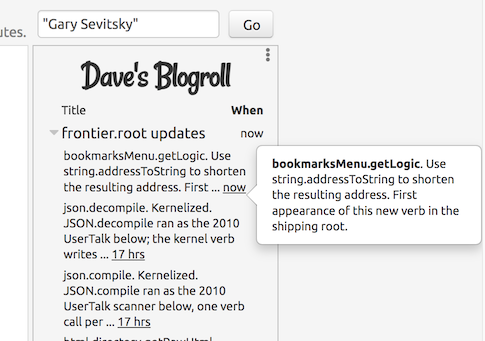
BTW, the rootupdates process is working now, you can follow changes via an RSS 2.0 feed, of course. In this version, the feed is the way updates are transmitted. The enclosure on each item is a fat page. And because it's a feed, I can follow it in FeedLand, and the blogroll on scripting.com picks it up too. Screen shot.
In many ways JavaScript is a better language than UserTalk. For example I miss JSON constants. I miss certain language constructs, like conditional assignments. We don't have the idea of a const. On the other hand, JavaScript doesn't have environment features Frontier has. I want to have Atlantis run JavaScript the same way Cancoon (the codename for the kernel of Frontier before this version) ran AppleScript.
The next milestone will be installing Atlantis on my new macbook, and hooking a monitor up to it, a really nice one, and move my work to that desk. then Berkeley, the name of the system I've been using for eight years, will be here as a backup and source of truth and prior art. That was the goal of the Atlantis project. I could probably do the switch right now. It's like moving out of an old house that you did good stuff in, into a replica, but built out of the latest bits. Honestly I never thought in a million years I'd get here.
My longtime friend Jeff Jarvis says the press is covering the wrong story re AI. I agree, but I think Jeff is covering the wrong story too. This is really a discovery like electricity, or Newtonian physics, calculus, basically the technology of knowledge. I wish I were 22 years old now so I could plan out a long career working this way. I want people like Jeff to understand. Not saying there's no truth to the other stories, but I've yet to hear anything from journalism about how, if left alone, it would develop all areas of human thought.



 Milestone in Atlantis development, the new version of Frontier that runs on modern OSes. I'm going to start showing what's going on in the development of the product. To kick off, here's a