Vue lecture

Il y a de nouveaux articles disponibles, cliquez pour rafraîchir la page.
☑️ ☆

Stories vs. Facts

Stories and facts have always been frenemies. Stories can get along fine without facts, though facts are good to have for framing up stories. Facts by themselves are blah, and need stories to become interesting. So: different beasts, often in conflict, which can make great stories too.

Like right now, when my wife and I are watching The Diplomat on Netflix. The whole series is about the conflict between stories and facts. But then, so is every movie or series about journalism, newsrooms, or any topic where what’s true and what’s being said don’t square up.

In Where Journalism Fails I explain that stories are what journalism sells. Back when we still had newspapers with newsrooms, senior editors constantly barked the same three words at reporters: What’s the story? Because stories are the base format of human interest. That’s why stories sell. It’s why you keep watching, listening, and turning pages.

So it helps to know what exactly makes a story. Fortunately, the basic formula is simple. Stories have three elements:

  1. Character
  2. Problem
  3. Movement

The character can be a person, a cause, a team, a politician, whatever. They can be good or bad, old or young, rich, poor, strange, or anything—as long as they are interesting. To be a character is to be interesting. Stories usually have a collection of them.

The problem is anything that creates or sustains conflict. There can any number of problems as well.

Movement has to be toward resolution, even if that never happens. Without movement, the story collapses.

If your team is up by forty points and there are two minutes left to play, the character that matters is you, and your problem is getting out of the parking lot. After all, many stories are happening at any one time, and you are the lead character in most of them.

Here are another three words you need to know: Facts don’t matter.

Daniel Kahneman says that. So does Scott Adams.

Kahneman says facts don’t matter because people’s minds are already made up about most things, and what their minds are made up about are stories. People already like, dislike, or actively don’t care about the characters involved, and they have well-formed opinions about whatever the problems are.

Adams puts it more simply: “What matters is how much we hate the person talking.” In other words, people have stories about whoever they hate. Or at least dislike.

Now we like to call stories “narratives.” Whenever you hear somebody talk about “controlling the narrative,” they’re not talking about facts. They want to shape or tell stories that may have nothing to do with facts.

But let’s say you’re a decision-maker: the lead character in a personal story about getting a job done. You’re the captain of a ship, the mayor of a town, the detective on a case. What do you need most? Somebody’s narrative? Or facts?

Wouldn’t it be better to have facts than to guess at them? Or to take as fact what somebody simply claims?

This is half of my case for Deep News. The other half is the need to formalize the way we accumulate facts over time, so the result is what we might call history-based news. Because history is made of facts. We’ll tell better stories and make better decisions if we base them on facts.

So it matters how we assemble and accumulate facts, and how we do this together. I’ll visit that in an upcoming post.


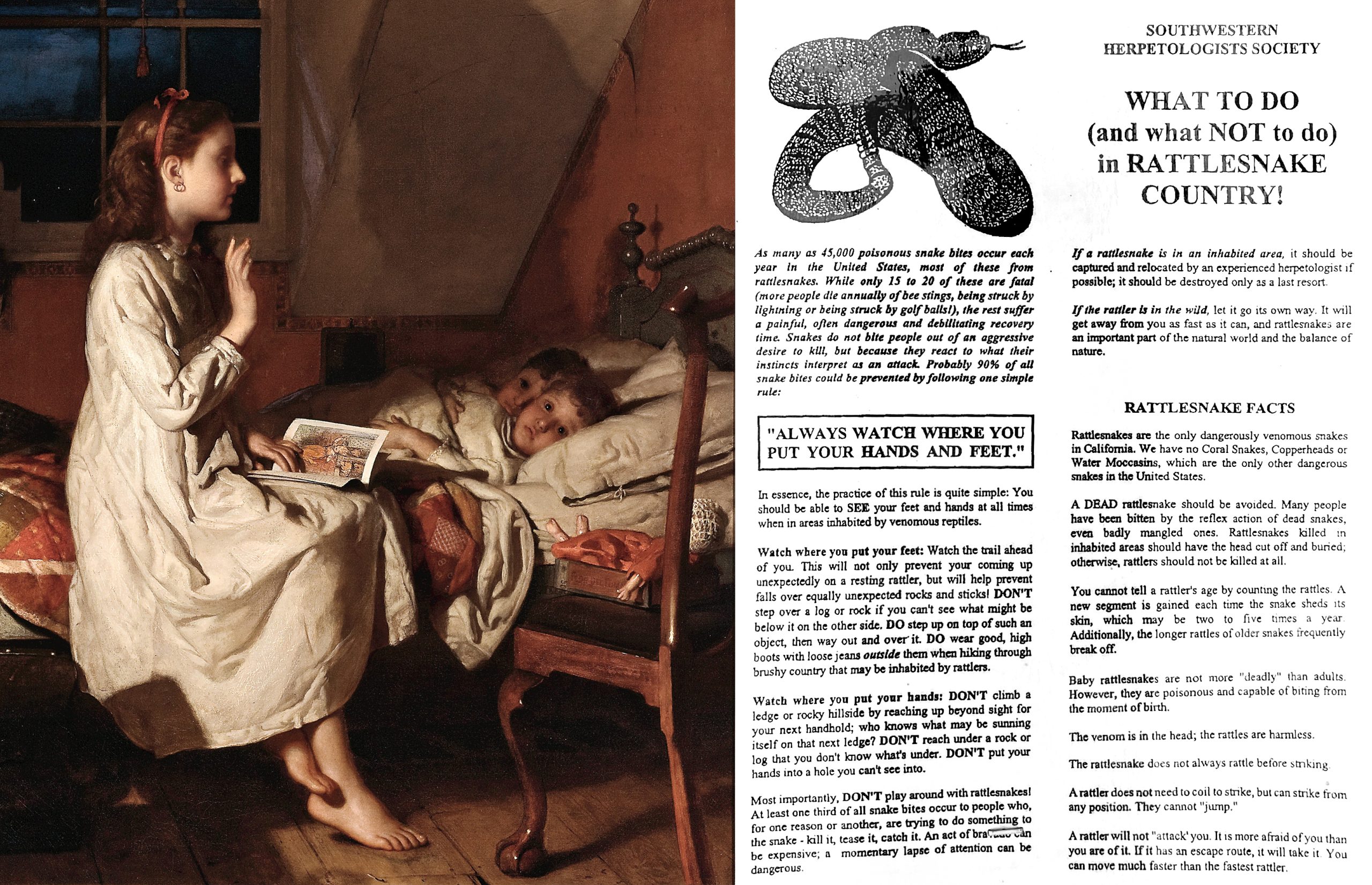
The image above combines the Story of Golden Locks, a painting by Seymour Joseph Guy (MET, 2013.604), via Wikimedia Commons, and a warning posted on Mt. Wilson in California.

☑️ ☆

We Need Wide News

Bloomington, Indiana, my new hometown

How do people get news where you live? How do they remember it?

For most of the industrial age, which is still with us, newspapers answered both those questions—and did so better than any other medium or civic institution. Newspapers were required reading, delivered daily to doorsteps, and sold from places all around town. Old copies also accumulated in libraries and other archives, either as bound volumes or in microfilm reels and microfiche cards. News also came from radio and TV stations, though both did far less archiving, and none were as broad and deep in what they covered and how. Newspapers alone produced deep news.

And wide news as well. Local and regional papers covered politics, government, crises, disasters, sports, fashion, travel, business, religion, births, deaths, schools, and happenings of all kinds. They had reporters assigned across all their sections. No other medium could go as wide.

After the Internet showed up in the mid-’90s, however, people also began getting news from each other, through email, blogs, texting, online-only publications, and social media. To keep up and participate, newspapers, magazines, and other legacy print media built websites and began to publish online. Broadcast media began to stream online too. But the encompassing trend was the digitization of everything and everyone. Consumers became producers. Every person with a computer or a phone was equipped to become a reporter, a photographer, a videographer, or a podcaster. (In the 24 September 2004 issue of IT Garage, I reported that a Google search for podcasts got 24 results. Today it gets 3,84 billion.)

In the midst of all this, the local and regional newspaper business collapsed. The New York Times, Wall Street Journal, and Washington Post found ways to survive and continue to thrive. Many other major papers are getting along but none are what they were. Nor can they be. Today most local papers are gone or shrunk to tiny fractions of their former selves.  Countless local commercial radio stations are now owned by national chains, fed “content” from elsewhere, and maintain minimized or absent local staff. Public radio has survived mostly because it learned long ago how to thrive on listener contributions, bequests, and institutional support. TV news is still alive, but also competing with millions of other sources of video content. None of its coverage is as wide as newspapers were in their long prime.

Another reason for the decline of local news media is economic. Craigslist and its imitaters killed newspapers’ classified sections, which had been a big source of income. Advertisers abandoned the practice of targeting whole populations interested in sports, business, fashion, entertainment, and other subjects. With digital media, advertisers can target tracked individuals. As I put it in Separating Advertising’s Wheat and Chaff, “Madison Avenue fell asleep, direct response marketing ate its brain, and it woke up as an alien replica of itself.” That replica cares not a whit for supporting journalism of any kind.

Eyeballs and eardrums were also pulled toward direct response marketing by algorithms rigged to increase engagement. A collateral effect was pulling individual interests into affinity groups that grew tribal as they became echo chambers favoring the voices that excelled at eliciting emotional responses. Naturally, media specialized for feeding tribal interests emerged, obsolescing media that worked to cross partisan divides—such as old-fashioned newspapers. (In the old days, papers with a bend to the left or the right isolated partisanship to their opinion pages.) Talk radio and cable news became entirely partisan operations.

So, by the time Scott Adams (of Dilbert fame) said “Facts don’t matter. What matters is how much we hate the person talking” (March 13, 2022), what Yeats poetized in The Second Coming seemed fulfilled:

Things fall apart; the centre cannot hold;
Mere anarchy is loosed upon the world,
The blood-dimmed tide is loosed, and everywhere
The ceremony of innocence is drowned;
The best lack all conviction, while the worst
Are full of passionate intensity.

And yet, as James Fallows told Joyce and me a couple of months ago, if you talk to people in small towns about anything but politics, they’re just fine. Moreover, they still work together and get things done. (Jim and Deb gained this wisdom while researching their book and movie, both titled Our Towns.)

Towns do have their fault lines, but people everywhere are held together by their natural need for the conveniences that arise out of shared necessity—for markets, medical help, education, public spaces, and each other. They also need good information about what’s going on where they live. By good I mean the kind of information they used to get before newspapers—and the daily ceremony of innocence newspapers provided—were obsolesced by the Internet.

Back in the mid-’00s, the idea of “citizen journalism” (which went by other labels) first showed up in the writings of Dan Gillmor, J.D. Lasica, Dave Winer, Jeff Jarvis, Jay Rosen, myself, and others. All of us were also concerned about the decline of newspapers. So, in January 2007, after The New York Times sold the Santa Barbara News-Press to a billionaire who fired the staff and made the paper a vehicle for her personal interests, the Center for Information Technology and Society (CITS) at UC Santa Barbara convened a charrette to discuss the future of local newspapers. The title was “Newspaper 2.0.” It was led by yours truly, then (and still) a fellow of the Center. Some of the people mentioned earlier in this paragraph were there, along with exiled News-Press staffers, educators, and other local media, including “place blogs” that were also daily newsletters. Here is a photo series from the event, and the wiki we put together as well. I don’t know to what extent that gathering helped enlarge the degree to which other media made up for the failure of the News-Press (which finally filed for bankruptcy this summer, after a decade and a half of irrelevance). I do know that Santa Barbara now rich with news sources.

Meanwhile, my full attention is here in Bloomington, Indiana. Our local newspaper, the Herald-Times, is still alive and kicking, but not what it was when giant rolls of paper were delivered by train car weekly to the back of the paper’s building at 1900 South Walnut Street, and it was the source of wide news for the town and the region.

Now it’s e pluribus unum time. There are many other media in town, covering many topics, and I’m not yet clear on how much they comprise a news commons. But, as a visiting scholar (along with Joyce) at Indiana University’s Ostrom Workshop, which is all about studying commons, I want to see if our collection of local news media can become an example of wide news at work, whether we call it a commons or not. From my current notes, here is a quick, partial, and linky list of local media—

Periodicals (including newsletters and websites):

Radio:

  • WFHB (has local news and podcasts)
  • WFIU (has local news and podcasts)
  • WIUX (IU student station, has local stuff)
  • WGCL (legacy local radio, AM & FM)
  • WBWB (B97) (pop music, has local news, sister of WHCC)
  • WTTS (legacy Tarzian FM music station, broadcasting from Trafalgar, on the south side of Indianapolis, with a popular local translator of its HD2 channel called Rock96 The Quarry)
  • WHCC (local country station, has some local news, sister of WBWB)
  • WCLS (local album rock station, has a calendar)

TV:

Podcasts

Indiana University

Civic Institutions:

So my idea is to hold a charrette like the one we had in Santa Barbara, to see how those interested in making wide news better can get along. No rush. I just want to put the idea out there and see what happens.

I think one thing that will help is that nobody is trying to do it all anymore. But everybody brings something to the table. Metaphorically speaking, I’d like to put the table there.

Thoughts and ideas are invited. So are corrections and improvements to the above. I see this post, like pretty much everything I write online, as a public draft.

My email is doc at searls dot com.


I shot the photo above on a flight from Indianapolis to Houston after giving this lecture at IU. Here is a whole series on Bloomington from that flight. And here is the rest of the flight as well. All the photos in both are Creative Commons licensed to encourage use and reuse, by anybody. I have about 60,000 photos such as these published online here, and another 5,000 here, all ready for anyone to put in a news story. I bring this up because public photography is one of my small contributions to wide news everywhere. You can see results in countless news stories and at Wikimedia Commons, where photos in Wikipedia come from. I put none of those where they are. Others found them and put them to use.

☑️ ☆

Syndication and the Live Web Economy

This is from a December 2009 newsletter called Suitwatch, which I wrote for Linux Journal, and was 404’d long ago. (But I kept the original.) I’m re-posting it here because I think syndication may be the most potent power any of us have in the Internet age—and because the really simple kind, RSS, has been with us since before I wrote this piece. (I also think RSS has VRM implications as well, but I’ll leave those for another post.) My only edits here were to remove arcana and anachronisms that are pointless today. This graphic illustrates how entrenched and widespread RSS already is:


Until recently, the verb “syndication” was something big publishers and agencies did. As a kid, I recognized “© King Features Syndicate” was the one unfunny thing about Blondie or Dennis the Menace. All it meant to me was that some kind of Business was going on here.

Now millions of individual writers syndicate their own work, usually through RSS (Really Simple Syndication). Publishers and other large organizations do too. This article is syndicated. So are updates to product manuals, changes to development wikis, updates on SourceForge, and searches of keywords. You name it: if there’s something that updates frequently on the Web, there’s a better chance every minute that the new stuff is syndicated if it isn’t already.

Far as I know, not many sources are making money with it. Lots, however, are making money because of it. The syndicated world may not look like an economy yet. But trust me, it is.

At this early stage in its long future history, syndication is primarily a feature of blogging, which is primarily the product of too many people to count. Blogging is not about large-scale things. It’s about human beings who have no scale other than themselves. Only you can be good at being you, and nobody else is the same as you. Syndication does more to expand individual human potential than anything since the invention of type. Or perhaps ever. The syndicated world economy is the one that grows around unleashed personal powers of expression, productivity, creation, distribution, instruction, influence, leadership, whatever.

In a loose sense, syndication is one side of the conversation. Think about conversation in the best sense of the word: as the way people teach and learn from each other, the way topics start and move along. Syndication makes that happen in huge ways.

The notion that “markets are conversation”, popularized by The Cluetrain Manifesto, was borrowed from this case I used to make for a form of marketing that was far more natural and powerful than the formal kind:

  1. Markets are conversation, and
  2. Conversation is fire. Therefore,
  3. Marketing is arson.

If you want to set fires, start conversations that tend to keep going. Nothing does the latter better than syndication.

There are three reasons why we still don’t hear as much about syndication as we should (and will). First, it’s still new. Second, it didn’t come from The Big Guys. (It came from Dave Winer, father of RSS — Really Simple Syndication.) Third, it points toward a value system not grounded only in exchange — one especially suited for the Net, a deeply ironic worldwide environment where everybody is zero distance apart.

But let’s park the value system until later and talk about next week. That’s when I’ll be in San Francisco for Syndicate. It’s the second in a series of conferences by that name. The first was in New York last Spring.

Since I’m the conference chair (disclosure: it’s a paying gig), and since I’ll be giving both the introductory talk and the closing keynote, Syndication is on the front burner of my mind’s stove.

There are others subjects there as well, some of which will be visited in sessions at the show. RSS, for starters. And tagging—a practice so new it’s not even close to having standards of the sort we find at OASIS, the IETF, and the W3C. Instead, it has emerging standards, like the ones we find at microformats.org.

Like syndication, tagging is a long-tail activity. Something individuals do. Along with blogging and syndication, it helps outline a new branch of the Net we’re starting to call the Live Web — as opposed to the Static Web with “sites” that are “built” and tend not to change.

The World Live Web is the title of my December Linux For Suits column in Linux Journal. In it, I note that the directoryless nature of everything on the Web falls in the Unix file path east of the domain name. Every path to a document (or whatever) is a piece of straw in the static Web’s haystack. Google and Yahoo help us find needles in that haystack, but their amazing success at search also tends to confirm the haystack nature of the Static Web itself.

The Live Web is no less webby than the Static Web. They’re both parts of the same big thing. But the Live Web is new and very different. It cannot be understood in Static Web terms.

In that piece, I also observed that blogs, as continuing projects by human authors, leave chronological trails. These give the Live Web something of a structure: a chronological one that goes /year/month/day/date/post, even if that’s not the way each post’s URL is composed. There is an implicit organizational structure here, and it’s chronological.

Tagging, by which individuals can assign categorical tags of their own to everything from links to bookmarks to photos, has given the Live Web an ad hoc categorical structure as well.

So that’s what we’re starting to see emerge here: chronology and category. Rudimentary, sure, but real. And significant.

But not organized. New practices, and new ideas, are coming along too fast.

What matters, above all, is user-in-charge: a form of personal agency in the connected world. That’s a concept so key to everything else that’s happening on the Web, even on the Static one, that we may need a new word for it.

Or an old one, like independencelibertysovereignty, or autonomy. That’s my inner Libertarian, choosing those. If your sensibilities run a bit more to the social side, you may prefer words like actualization or fulfillment. Point is, the Big Boys aren’t in charge anymore. You are. I am. We are.

There’s an economy that will grow around us. I think free software and open-source practices (see various books and essays by Richard M. Stallman and Eric S. Raymond) put tracks in the snow that point in the direction we’re heading, but the phenomenon is bigger than that.

It’s also bigger than Google and Yahoo and Microsoft and IBM and Sun and Red Hat and Apple and the rest of the companies people (especially the media) look to for Leadership. For all the good those companies do in the world, the power shift is underway and is as certain as tomorrow’s dawn. The Big Boys will need to take advantage of it. We’ll need them to, as well.

This power shift is what I’d like to put in front of people’s attention when they come to Syndicate next week, or when they follow the proceedings in blogs and other reports.

Now more than ever, power is personal. Companies large and small will succeed by taking advantage of that fact. And by watching developments that aren’t just coming from The Usual Suspects. Including the Usual Economic Theories.

For example, not everything in an economy is about exchange, or the value chain, or about trade-offs of this for that. Many values come out of effort and care made without expectation of return. Consider your love for your parents, spouses, children, friends, and good work. Consider what you give and still get to keep. Consider debts erased by forgiveness. Consider how knowledge grows without its loss by anyone else.

Sayo Ajiboye, the Nigerian minister who so blew my mind in conversations we had on a plane nearly five years ago (Google them up if you like), taught me that markets are relationships, and not just conversations. Relationships, he said, are not just about exchange. They cannot be reduced to transactions. If you try, you demean the relationships themselves.

Also, in spite of the economic framings of our talk about morality and justice (owing favors, paying for crimes, just desserts), there is a deeper moral system that cannot be understood in terms of exchange. In fact, when you bring up exchange, you miss the whole thing. (Many great teachers have tried in futility to make this point, and I’m probably not doing any better.) Whatever it is, its results are positive. Growth in one place is not matched by shrinking in another. Value in both systems is created. But in the latter one, the purpose is not always, or exclusively, exchange, or profit. At least not from the activity itself. There are because effects at work. And we’re only beginning to understand them, much less practice them in new ways.

Toward that end, some questions…

Where did the Static Web, much less the Live Web, come from? What is it for? What are we doing with it? Whatever the answers, nothing was exchanged for them. (No, not even the record industry, the losses of which owe to their own unwillingness to take advantage of new opportunities opened by the Net.)

Nor was anything exchanged for Linux, which has grown enormously.

As Greg Kroah-Hartman said recently on the Linux-Elitists list,

Remember, Linux is a species, and we aren’t fighting anyone here, we are merely evolving around everyone else, until they aren’t left standing because the whole ecosystem changed without them realizing it.

Yes, we have living ends.

❌