This year on Disconnect I’m trying to interrogate how we use technology and what capacities we have to change it. But that work is only possible because of readers like you.
Become a paid subscriber today so I can keep examining the parts of the tech industry the billionaires prefer us to ignore. Thanks for your support!
Before May of this year, I had never used a ride-hailing app. I had been in an Uber before — precisely two times, when friends had called them after a night out — but never had I actually downloaded the application to my phone to get the full experience.
That changed when I went to South Africa. After having a number of people warn me about my safety and advise me not to use taxis, paired with how the malaria meds I was on were messing with my mental health, I finally gave in. I couldn’t bring myself to download Uber. Having written about its exploitative business model for a decade, that was still a bridge too far. So instead I opted for Bolt, the European alternative.
It didn’t take long for me to see how so many people have been seduced into abandoning taxis for ride-hailing services over the past decade and a half — their attacks on workers’ rights, harms to transportation networks, and exploitation of customers be damned.
The user experience of the ride-hailing app makes you feel like you are in complete control. You are Big Brother for the exploited drivers trying to make a meager living from driving people around.
When you open the app, you can see the cars plying the roads of the digital map on your screen. You choose which kind of driver you want, and can send them specific instructions. You watch them make their way toward you, until you enter the vehicle where very frequently you control the music and might even be offered snacks and amenities — all in the hope you’ll give the driver a good rating at the end. They likely won’t even try to speak with you unless you strike up a conversation. I’ve had some drivers tell me they can drive around for hours with customers not saying a word to them — an incredibly dehumanizing experience.
All of these design decisions and impositions on workers are designed to give drivers the illusion of control, authority, and ultimately of power. It doesn’t matter that Uber has been known to fake the vehicles shown on the screen, has fought being covered by disability legislation, has been sued for failing to address sexual abuse by drivers, has tracked customers, and even used the data it holds to push up fares while driving down driver pay. Once you get used to that feeling of control, it’s hard to quit — something I found myself even after I left South Africa.
Once I arrived in Lisbon, I wanted to stop using Bolt, but I found it hard to give up that sense of control. I downloaded a local taxi app and when I used it I was flooded with worries that weren’t previously there: Would the driver even find me? Would I know how long it would take them to get there? Were there even many taxis in the area? Would I be able to easily pay in the car? They were mostly foolish concerns, but were borne of giving back a certain degree of autonomy to the driver and the anxiety of being in a place I wasn’t familiar with.
Back in Canada, using taxis was no problem. I deleted the Bolt app — it wouldn’t work there anyway — and simply went back to the companies I was used to relying on. I didn’t think twice about it. But a few weeks later in Copenhagen, I needed to get a ride somewhere and my mind immediately went to downloading Bolt again. The sense of security it claimed to provide had worked its way into my psyche. I didn’t give in, but I was fascinated by the staying power it had over me.
The whole experience was an instructive one for me. My writing about the tech industry started with criticism of the gig economy, so I’ve long felt those services were not something I could reasonably use without a degree of hypocrisy. To this day, I still haven’t used a food-delivery app. But actually downloading a ride-hailing app showed me how so many people have gotten hooked on them and resist any pressure to return to using taxis, even as ride-hail prices have risen since the pandemic.
Recently I’ve been thinking a lot about how the digital services and platforms we’ve come to rely on over the past couple decades have affected how we act, how we see ourselves, and how the world around us even functions. I feel like we’re all becoming familiar with that when it comes to things like social media apps, which is part of the reason the efforts to regulate them are getting so much attention. But there are so many smaller, pernicious ways our lives have been transformed by the screens and apps that have been pushed on us in recent years — and in most cases we don’t take the time to consider how they affect us.
I feel like the ride-hailing apps stood out so much to me because they’ve become so normalized for so many. Most people are used to the experience of using them now, and it’s been optimized over time to lock people in and make them overlook the drawbacks of these businesses. Yet, I was coming in after all that work had been done and the rapid way it affected how I saw taxis was startling as someone who’s never felt the need or compulsion to download Uber.
Very quickly, I was finding it hard to imagine doing anything other than using a ride-hailing service. I couldn’t help but think about how many other apps and services have affected us in similar ways that we never stop to question.
I’m sure I don’t need to tell you that people all over the world are turning against data centers.
Residents of Great Torrington in England are trying to stop one of Europe’s largest data centers. Australians recently dealt a blow to one planned near the Blue Mountains, as more than 60,000 people have signed petitions to put a pause on data center projects across the country. Canadians took to the streets of Vancouver to stop two AI factories planned for their city while Hamilton, Ontario was forced to put a moratorium on data center plans because public opposition was so great. And let’s not forget the United States, where 75 major data center projects were blocked in the first three months of 2026.
Just a few years ago, most people wouldn’t have even known much about data centers, let alone decided to turn up at public meetings and demonstrations to stop them. But after the tech industry decided generative AI was its next big thing and accelerated the buildout of massive hyperscale data centers to power it, that all started to change.
People saw their power bills shoot up, their water sullied by nearby data center projects, and had to deal with new industrial neighbors bringing light pollution and an incessant hum to their communities. Not to mention that AI itself hasn’t delivered on its promises, while sticking the public with a growing list of harms that includes everything from flooding the zone with AI-generated lies to pushing friends and family members into spirals after they get addicted to chatbots.
A little over two years ago, I had a feeling we could be headed in this direction. I’d heard about the chaos data centers were wreaking in Ireland, Northern Virginia, Chile, and even The Dalles, Oregon. Everyone was talking about generative AI, but what about the infrastructure that made it all possible? Before the AI boom, communities in those places were already struggling to shoulder the costs of hyperscale development. But with the proliferation of chatbots and image generators, so many more would come under pressure as the tech industry sought to expand its computing power at any cost.
I felt that was a story more people needed to understand: how the hubris of tech billionaires is putting our communities and our planet at risk to serve their fantastical pursuits of power and profit.
The industry wants us to feel this is all inevitable; that we have no means to fight back agains this wave of supposed progress. But around the world, regular people were showing that wasn’t true. They were taking matters into their own hands, and pushing back some of the most powerful companies in the world.
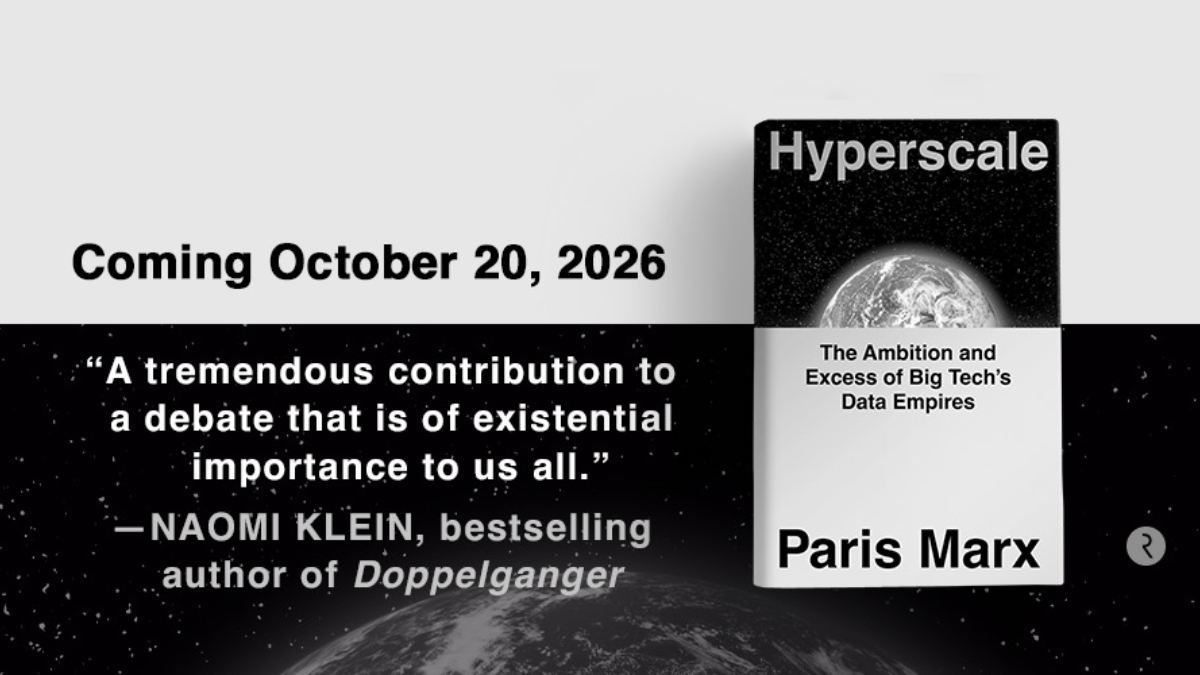
As the tech industry abandons its climate targets and any pretense of having the public good in mind, these are stories we need to hear and learn from. In Hyperscale, I explain how we got to this place and why this scale of development is inherently unsustainable. I tell the stories of attempts to fight back in different parts of the world and, maybe most importantly, I show that we don’t have to go down this path. We can develop technology in a very different way that puts the public good at the forefront, not shareholder profits or billionaire dreams.
Hyperscale: The Ambition and Excess of Big Tech's Data Empires is out on October 20 in Canada and the United States, and on November 5 in the United Kingdom.
You can preorder it wherever you buy your books, including by asking your local bookstore to bring it in! You can also grab a copy from Bookshop in the US or the UK, or get more information on the book’s webpage.
A few weeks ago I was hyping myself up about Dune: Part Two and decided to rewatch the first one. I considered just checking to see which streaming service it was on, but I wanted the best at-home viewing experience to get the most out of the film’s incredible visual aesthetic, so I went looking for the 4K Blu-ray. I was shocked at how hard it was to find.
I started with Best Buy. I worked there about fifteen years ago and remember the aisles that used to be dedicated to DVDs, Blu-rays, and CDs in the center of the store. When I logged onto their website and searched for “dune” though, I got nothing. Not even the regular Blu-ray. That’s because Best Buy has given up on physical media. If you go into one of their stores today, you might find a few shelves hidden in a corner with a few new releases, but that’s about it. And if you find some listed on their website, they’re likely from a marketplace seller, not Best Buy itself.
I checked again as I was writing this, and after the success of Dune: Part Two there are now a couple marketplace sellers listing a vastly overpriced Dune steelbook or the 3D Blu-ray, for the tens of people still sticking 3D glasses on their faces at home.
Next I turned to the big box empire: Walmart. I rarely visit Walmart stores, but I felt I’d seen some physical media there during the early Covid years. The stats say they account for 45% of the market share for physical media sales in the United States, so I figured they’d come through for me. But once again, I got nothing. Today it has a 3D Blu-ray and some boxed sets that contain it from marketplace sellers, but no regular Blu-ray and certainly not one in 4K.
I also checked the website of a local store in Montreal, but they didn’t have it in stock (they now show a couple copies), so finally I had to turn to my last resort: Amazon. And even then I was disappointed. The regular Dune Blu-ray was available, but would take weeks to arrive — it’s currently showing a delivery estimate of mid-April — while the 4K version was only available from a marketplace seller, and would once again take a couple weeks to reach me. That meant I wouldn’t get it until after the release of Dune: Part Two.
Even Amazon — the monopolist ecommerce company that’s supposed to have everything and be able to deliver it all in days — couldn’t get me a simple Blu-ray disc in a reasonable time. What has the world come to?
Sign up for Disconnect
Tech critic Paris Marx provides the critical take on Silicon Valley you’ve been missing
Email sent! Check your inbox to complete your signup.
No spam. Unsubscribe anytime.
To be totally clear, I’m in Canada, so that could be part of the problem given we’re a smaller market. Maybe Americans will chime in and tell me physical media is still easily available down there, but from what I’ve gleaned from Reddit, I suspect that’s not the case. This isn’t even the first time it’s happened to me. When I tried to buy The Lord of the Rings trilogy in regular Blu-ray and 4K (don’t judge me) in the past year, Best Buy and Walmart didn’t list either of them, and Amazon couldn’t get the extended edition Blu-ray set to me for weeks after I ordered it.
I know this just sounds like me complaining that I can’t buy some movies. Oh no, Paris can’t watch Gandalf say “you shall not pass” on disc. Just stream it like everyone else!, you might be thinking. But I think it’s about far more than that, and I presume you might too if you made it this far.
How streaming crushed physical media
Over the past ten years, companies like Netflix made us a promise they’re very clearly reneging on. They told us that subscription services would give us easy access to vast libraries of film and television that could be easily streamed over the internet from anywhere. We’d eventually be able to get virtually anything we could care to watch by paying a reasonable monthly fee, and we’d never have to worry about ads like on cable or broadcast television. For a while, Netflix even promoted the idea of sharing your password with friends and family. But those days are long gone.
Now streaming services seem to be in a race to see who can hike their prices fastest, even as they try to get more subscribers watching ads and crack down on anyone still using their parents’ Netflix account or sharing their Disney+ with a friend. Gone are the days when “love is sharing a password.” Everyone must pay or risk getting cut off. And what are they getting cut off from? Libraries that keep getting smaller as entertainment companies shelve movies and series to get tax write offs or avoid paying residuals and licensing fees. It started with Warner Bros. Discovery’s Max (formerly HBO Max), but then spread to Disney+, Hulu, and Paramount+. I wouldn’t be surprised if even more follow suit.
At the same time as streaming companies show exactly why physical media is so important, it’s precisely the success of streaming that’s causing physical media to become so hard to find. In 2005, DVD sales peaked at $16.3 billion in the United States, while Blu-ray sales hit their peak in 2013 at $2.37 billion. Last year, both formats sold $1.5 billion combined — a drop of 25% from the previous year and a much bigger one from their peak. That will only be made worse as they become more difficult to track down.
Best Buy isn’t the only one pulling back on physical media. Netflix shuttered its DVD-by-mail business last September around the same time as Ingram Entertainment, once the largest US distributor of home media, exited the disc business. Disney announced an abrupt end to its DVD and Blu-ray business in Australia last August and is winding down its Disney Movie Club service in the United States. It’s now outsourcing its physical media business in the United States and Canada to Sony, the company that spearheaded the Blu-ray format, and it’s unclear what that will mean for the future availability of its movies and TV shows on physical discs.
Streaming companies — and, really, tech companies more broadly — have shown us they can’t be trusted. They’ll rip our culture out of our hands if it will please their shareholders because at the end of the day all that really matters is the quarterly earnings and the share price. You can’t depend on streaming libraries, and buying digital versions aren’t a solution either because you don’t even own them. Technically, when you buy a digital product, you’re usually just buying a license that can later be revoked if the company doesn’t want to keep providing the service.
In recent years, even as services like Spotify and Apple Music have dominated the music market, there’s been a resurgence in vinyl sales as people have seen the benefit of having a physical product: not just because you actually own it and can display it, but because it sounds better too. (It’s not just vinyl either; even CD sales are up.) I wouldn’t be surprised if we start seeing something similar with video.
There are already suggestions that 4K Blu-rays are filling a similar niche as vinyl for home video, with the backing of prominent directors. Asteroid City director Wes Anderson told The Wrap, “A good Blu-ray is sharp as a tack — and consistent. It always plays exactly right. It does not disappear from a cloud or platform.” Last year, Christopher Nolan put special attention into the Blu-ray release of Oppenheimer and encouraged people who liked the movie to buy it “so no evil streaming service can come steal it from you.”
The physical disc doesn’t just mean it can never be removed from your digital library, but they also tend to come with bonuses like behind-the-scenes footage and it’s the best way to watch the movie: the visuals and audio will be higher quality than a more compressed version that’s streamed or downloaded. With the flaws in the streaming model becoming increasingly apparent, is physical media in for a resurgence?
I’m going back to physical media
About ten years ago, I got rid of all my physical media. I was going to be a nomad and felt it would just weigh me down. As I discussed previously, at the time I believed that streaming was the future and I was ready to embrace it as a better alternative than what we already had. I eagerly subscribed to Spotify when it launched in Canada, letting my iTunes library whither (much of which was bought, not pirated), and slowly shifted from pirating movies and shows to subscription streaming services as they became more common. I even started reading ebooks almost exclusively, between the iBooks app on my phone and later a Kobo ereader.
These days I regret having gotten rid of those DVDs, Blu-rays, and CDs, seeing the world streaming companies have created. A few years ago, I went back to reading physical books and only occasionally pick up my ereader, and I love the small (but growing) library I’ve been building. I don’t know how I ever read so many books on my phone. I’m now at the point where I’m considering paring back my streaming subscriptions too, in part because of the price hikes and ad tiers, but also because the experience has slowly become a bigger problem for me.
I’m fed up with opening up a streaming homepage and looking around for something to watch only to find that while I might have a large library of content available to me, little of it is actually worth my time. I remember before I got Spotify I would make a point of listening to new music and finding new artists I might like, but then I gave myself over to the algorithm and now I feel like I’m stuck listening to the same tracks over and over. It’s not too different with streaming video. I want to be more intentional about what I watch and listen to, and many streaming services actively discourage that. They want you to accept the rule of the algorithm, and I no longer think that’s good for us or our culture.
After a long hiatus, I’ve started buying Blu-rays again if there’s a movie I really like. I don’t have many so far, but I’m looking forward to slowly building a little video library of my own. I’m debating whether to keep some streaming services or just to be one of those people who occasionally subscribes for a month here and there to catch up things, but otherwise just does digital rentals and picks up the Blu-ray when there’s something I really like. I feel that might be a better move, while holding out hope for some broader structural shifts that recognize culture isn't just an entertainment product, but a public good that needs to be properly protected and supported so it can thrive and, at the same time, enrich our lives.
As for Dune, I ended up buying (a license to) the digital version from Apple because it was on sale for the same amount as a rental. My 4K Blu-ray showed up after Dune: Part Two came out, and I plan to preorder a physical version of that one — maybe even the steelbook — when the time comes. I know it’s one I’ll want to rewatch.
Sign up for Disconnect
Tech critic Paris Marx provides the critical take on Silicon Valley you’ve been missing
Email sent! Check your inbox to complete your signup.
When I started writing about tech back in 2015, we were in a very different moment. It was long before the supposed “techlash” that started to take hold in 2018 and many tech companies could get away with outlandish statements and unethical actions that would be much harder to sell to a more cynical — and frankly, angry — public today.
It’s hard to believe that was almost ten years ago, and I certainly couldn’t say I emerged as the full-fledged Luddite I proudly identify as today. When the Apple Watch was released in 2015, I criticized it as a product that showed Apple was profiting from growing inequality given its exclusive $10,000 Edition model, though I’m sure next to no one read my critique at the time. The following year I had my first piece that got some traction when I called attention to how much the economic model of the gig economy depended on people’s desperation for The Bold Italic.
I was critical of how technology was being used in a capitalist economy, but for a while I still believed it could be a tool for liberation — that it might not be working for us now, but could easily be seized in the future for the common good and thus shouldn’t be the central target of criticism. But I no longer feel that way, and I believe that’s for good reason.
This is a bit of a different piece than I usually write for Disconnect, but after reviewing Kara Swisher’s memoir last week, I thought you might be interested in hearing about my journey to becoming the tech critic I am today and how my views on technology have evolved over that time. Maybe it can also help you reflect on your own journey and perspective on tech and the tech industry!
An early engagement with tech
I was four years old when the internet was privatized, and since my mother was doing a degree in computer science, I had access to a computer and later dial-up internet from a reasonably young age. I played supposedly educational computer games like Reader Rabbit and The Magic School Bus, and spent far too much time on a game as bad as Star Wars: Yoda Stories. Don’t blame me — I was a kid who dreamed of a galaxy far, far away.