Vue lecture

Il y a de nouveaux articles disponibles, cliquez pour rafraîchir la page.
🔲 ☆

Toward Harmonizing MyTerms (IEEE 7012) with GPC and GPP

MyTerms is both a privacy signal and a privacy agreement. Moreover, it is a contractual one, and backed by plain old contract law.

As conversations about MyTerms grow more vigorous and expand across business, policy circles, and the academy, two big questions are starting to come up. There are surely more, but le’ts focus on the first two:

  1. Why will businesses agree to MyTerms? Meaning: How will MyTerms be good for them? And what are the incentives?
  2. How does MyTerms harmonize with GPC (Global Privacy Control) and GPP (Global Privacy Platform/Protocol)?

Here are some answers to #1:

  • MyTerms replaces guessing with asking.
  • The shortest path to trust is agreement.
  • The best personalization happens by customer invitation rather than presumed or grudging consent.
  • The best customer data is volunteered, not harvested.
  • Businesses win when customers arrive with clear intentions.
  • The best terms are ones that work for both customers and companies.
  • Privacy is cheaper than surveillance.
  • MyTerms turns personal privacy from a bug (the surveillance view) into a feature.
  • Trusting customers reveal better information than tracked ones.
  • The best agents working on both sides can do more when full trust is established.
  • Far more product and service improvements are possible when abundant market intelligence flows both ways.
  • Free customers are more valuable than captive ones (a claim that has been our mission to prove since day one, almost twenty years ago)
  • Accepting MyTerms gives sites and services more flexibility than they would have now inside the surveillance fecosystem toward which privacy policies have and the GPC have tried to fight and the GPP works to sustain.

To answer #2,  GPC is a simple signal sent by a browser to a website, while GPP is the adtech industry’s (IAB’s) protocol for encoding and carrying personal choices downstream to publishers, ad networks, and other participants in the weird world of pre-MyTerms privacy signaling,  By design, GPP is meant to carry consents rather than contracts, but so far I can’t see any reason the GPP can’t carry information about contracts as well, even though MyTerms excludes or obsolesces the whole surveillance-based adtech fecosystem.

Here is a chart that might help:

Protocol / Standard Origin / Layer Primary Role
MyTerms (IEEE 7012) Personal Agency Layer Defines machine-readable contracts proffered by the individual to a site/service before further engagement. These contracts, aka agreements, support genuine and binding privacy commitments and bases for mutually respectful and trustful interactions from that point forward.
GPC (Global Privacy Control) Browser Layer A simple, binary universal opt-out signal sent in HTTP headers or DOM properties expressing “Do Not Sell/Share My Data.”
GPP (Global Privacy Protocol) Ad-Tech / Vendor Supply Chain An encoding and transport framework that ingests signals (including GPC) and translates/transmits them to ad networks and third parties. It might also carry signals that specify MyTerms privacy agreements made by services with individuals

I haven’t added any links yet, because I want to make sure I have all this right first

🔲 ☆

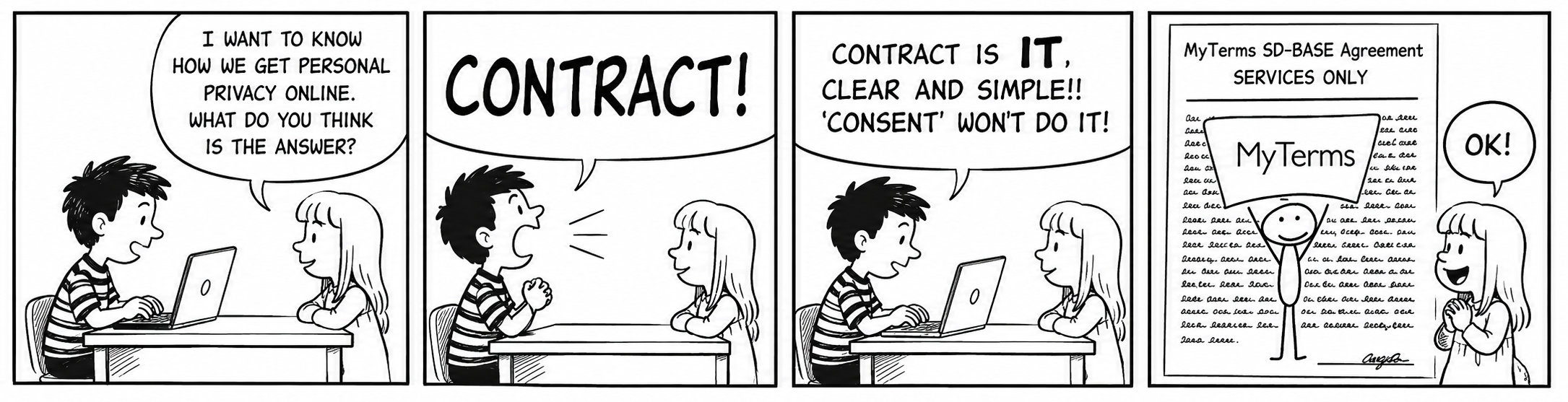
Digital Omnibus Article 88b needs to be about contract, not just consent

With gratitude to the famous Peanuts cartoon. (And art help from ChatGPT.)

The EU’s new Digital Omnibus proposal aims to update and expand the GDPR, notably with Article 88b, which includes this:

A new Article 88b Regulation (EU) 2016/679 (General Data Protection Regulation), for automated and machine-readable indications of individual choices and respect of those indications by website providers once standards are available.

That was written in June 2025. (I’ve boldfaced the phrases that matter.) We now have a standard for exactly what the EU wants and needs: IEEE 7012-2025—Standard for Machine-Readable Personal Privacy Terms. It is nicknamed MyTerms (much as IEEE 802.11 is nicknamed Wi-Fi) and was published by the IEEE in January 2026 after nine years in the making. Here’s the PDF.

Article 6 of the GDPR lists six bases for the  Lawfulness of Processing:

  1. the data subject has given consent to the processing of his or her personal data for one or more specific purposes;
  2. processing is necessary for the performance of a contract to which the data subject is party or in order to take steps at the request of the data subject prior to entering into a contract;
  3. processing is necessary for compliance with a legal obligation to which the controller is subject;
  4. processing is necessary in order to protect the vital interests of the data subject or of another natural person;
  5. processing is necessary for the performance of a task carried out in the public interest or in the exercise of official authority vested in the controller;
  6. processing is necessary for the purposes of the legitimate interests pursued by the controller or by a third party, except where such interests are overridden by the interests or fundamental rights and freedoms of the data subject which require protection of personal data, in particular where the data subject is a child.

I’ve boldfaced the three that matter, and italicised their core distinctions.

The entire adtech business relies on the first and last of these, consent and legitimate interests, as their excuses for tracking people, allowing them to obey the letter of the GDPR while screwing its spirit.

We see consent at work with every cookie notice we click on or click past. And we have no faith that clicks on consent “choices” provide any privacy protection at all. Reasons:

  1. Most sites ignore cookie choices.
  2. Many sites set cookies even before a cookie choice is made.
  3. It’s obvious that adtech is a personalised guesswork business that relies on surveillance, so most of these “choices” are misdirections away from corporate hunger for personal data.
  4. We have no record of the “choices” we make (and in many cases, no choice is offered), or any way to audit or dispute compliance.
  5. Uninvited and unwanted surveillance is by now so far out of control that cars, TVs, and AI chatbots are all in on the game (and hardly bother with consent notices).

The legitimate interests are advertising and surveillance, which Google, Facebook and the IAB say the world needs, because it funds so much of what happens online.

To the adtech business, personal privacy is a bug, not a feature. The whole business is incentivised to violate privacy, because violating privacy pays. No amount of regulatory oversight will fix that. To adtech, paying fines for privacy violations is just a cost of doing business.

The only fix that will work is what people—customers and citizens—bring to the market’s table. With MyTerms, they can do that.

MyTerms addresses the second of the GDPR’s six legal bases: contract. Put simply, here is what  the MyTerms standard says:

  • The person (not a mere data subject) is the first party, and the site or service is the second party.
  • The person proffers a contractual agreement chosen from a limited roster posted on the public website of a disinterested nonprofit, such as Customer Commons (which was created to do for personal contracts what Creative Commons does for personal copyrights—and which the IEEE approached with the idea for making MyTerms a standard).
  • When the second party agrees, both parties keep an identical record, which supports compliance auditing and dispute resolution. (By preserving evidence, this also creates an infrastructure for dispute avoidance as well.)

The GDPR succeeded by recognising natural persons as holders of rights, but it left intact the industrial age convention in which organisations are the exclusive originators of terms at scale. That’s one reason why persons have remained mere data subjects rather than contractual parties.

Fortunately, the Internet’s base protocols are peer-to-peer. Treating people on the Net as mere “users” and “data subjects” limits their agency. With MyTerms, people acquire a status they yielded when industry won the industrial revolution. (Before the industrial age, surnames—Baker, Müller, Weaver,  Lefebvre, Smith, Marchand, Farmer—signified agency: what people did in the world. That’s just one thing we lost when we became workers, executives, consumers, and users.)

In the natural world, privacy is maintained mostly by tacit agreements. In the digital world there is no tacit, so agreements must become explicit and programmable. This is why contracts are the only way we’ll get real personal privacy in the digital world.

It should also be clear by now that polite requests also don’t work. We tried that with Do Not Track, and by the time it finished failing, the adtech lobby had turned it into Tracking Preference Expression—as if we wanted to be tracked all along.

That main pro-consent lobby is the Interactive Advertising Bureau, or IAB. Among its recommendations for the Digital Omnibus are deleting 88b and  improving consent in various ways, such as  “Revise the proposed stricter consent rules.”

The IAB is blind to the simple fact that people hate being spied on and do what they can to stop it—mainly by turning off ads. By 2015, ad blocking was already the biggest boycott in human history. That boycott rose in direct response to obvious tracking, especially with retargeting. (That’s how one ad or advertiser keeps following you from site to site and app to app.)  And the boycott is much bigger now:

The IAB earned all of that. Yet they still see ad blocking and tracking protection as problems to solve rather than clear and constructive signals from the marketplace.

So it should be clear by now that the old brownfield of consent has become a toxic wasteland of surveillance, lost privacy, and minimised human agency—led by an industry that has been hostile to privacy from the start.

In fact, consent is required for what Shoshana Zuboff calls Surveillance Capitalism. That form of capitalism is based on inferred or extracted consent. The only way we can defeat that regime is by re-basing e-commerce on contractual agreements in which customers take the lead. After all, it’s their privacy that needs protection.

The surveillance economy is limited entirely by its methods, which are built around grabbing attention, harvesting data, and guessing at people.

We can replace it with an intention economy that’s based on what customers actually want. The range of those wants far exceeds what companies and their systems can guess at. Far more business, and business improvement, opens up when market intelligence can flow both ways. In the consent/surveillance regime, it can’t, because all relationships are silo’d in sellers’ separate systems, all built to minimize customer interactions, by design. But relationships built on respectful contractual agreements can be far more capacious when those relationships start with forms of mutual trust that whole markets share. That’s what MyTerms makes possible.

Here is a quick outline of some additional benefits.

For customers, the most obvious one is getting rid of cookie notices, which are annoying and not worth the pixels they are printed on.  If a company really does care about personal privacy, it’ll respect personal privacy requirements. This is how things work in the natural world, where tracking people like marked animals has been morally wrong for millennia. In the digital world, however, agreements need to be explicit, so programming and services can be based on them. MyTerms does that.

For business, MyTerms has lots of advantages:

  • Reduced or eliminated compliance risk
  • Competitive differentiation
  • Lower customer churn
  • A basis for real rather than coerced relationships
  • A basis for better signalling in both directions
  • Reduced or eliminated guesswork about what customers want, how they use products and services, and  how both might be improved

Lawyers get a new market for services on both the buy and sell sides of the marketplace. Companies in the CMP (consent management platform) business (e.g. Admiral and OneTrust) have something new and better to sell to enterprises (and perhaps to people as well).

Lawmakers and Regulators can start looking at the Internet and the Web as places where freedom of contract prevails, and contracts of adhesion (such as what you “agree” to with cookie notices) are obsolete.

Developers can have a field day (or decade). Look for these categories to emerge

In the marketplace, we can start to see all these things:

  • VRM + CRM will flourish, as described by Iain Henderson (one of MyTerms’ authors) in Towards Network-Based Ecosystems.
  • We should expect improvements to digital public infrastructure, as relationships move out of Big Tech’s silos and into distributed relationship frameworks based on the Internet’s base peer-to-peer protocols.
  • Predictions I made in The Intention Economy: When Customers Take Charge (Harvard Business Review Press, 2012) and Tim Berners-Lee made in the Attention vs. Intention chapter of This Is for Everyone: The Unfinished Story of the World Wide Web (Farrar, Straus and Giroux, 2025) will finally come true.
  • There will be new dances between customers and companies. (“The Dance” is a closing chapter of The Intention Economy.)
  • New commercial ecosystems can grow around a richer flow of useful information in both directions, based on shared interest and trust between customers and companies.
  • Surveillance capitalism will be obsolesced — and replaced by an economy aligned with personal agency and mutual respect from contractual partners.

And much more.

So it would be helpful for the European Commission to expand its scope from protecting data subjects to empowering first parties. They can do that by welcoming MyTerms in the Omnibus Directive, expanding human agency into a new greenfield where boundless positive outcomes can flourish.


Drafts of myterms agreements are currently posted at MyTerms.info, which is a project of Customer Commons and MyData Global. You can also read more about MyTerms in writings by Iain Henderson, Nitin Badjatia, and me.

We also invite you to join the ProjectVRM list, where we can converse and collaborate on moving MyTerms forward.

🔲 ⭐

The Personal AI Greenfield

What forms of pAI—personal AI—are Apple, Mozilla, Google, Meta, Microsoft and the rest not doing?

Let’s look at those first two because they’re at the top of the news LIFO buffer.

Apple Intelligence (“coming in beta this fall*“), announced yesterday, will help you with writing and creating images while giving you less lame answers from Siri. (Which they should re-name. Siri is Apple’s Clippy.) It “can draw on larger server-based models, running on Apple silicon, to handle more complex requests for you while protecting your privacy.” The “larger models” will be white-labeled ChatGPT, plus Apple’s own small language models (SLMs).

Mozilla, which got $400+ million a year from Google (for search in the Firefox browser) starting in 2020, announce on June 3 that they will be Building open, private AI with the Mozilla Builders Accelerator. Jive:

This program is designed to empower independent AI and machine learning engineers with the resources and support they need to thrive. It aims to cultivate a more innovative AI ecosystem, and it’s one of Mozilla’s key initiatives to make AI meaningfully impactful — alongside efforts like Mozilla.ai, the Responsible AI Challenge and the Rise25 Awards.

The Mozilla Builders Accelerator’s inaugural theme is local AI, which involves running AI models and applications directly on personal devices like laptops, smartphones, or edge devices rather than depending on cloud-based services…

We chose Local AI as the theme for the Accelerator’s first cohort because it aligns with our core values of privacy, user empowerment, and open source innovation. This method offers several benefits including:

  • Privacy: Data stays on the local device, minimizing exposure to potential breaches and misuse.
  • Agency: Users have greater control over their AI tools and data.
  • Cost-effectiveness: Reduces reliance on expensive cloud infrastructure, lowering costs for developers and users.
  • Reliability: Local processing ensures continuous operation even without internet connectivity.

Looks to me like both of these are Big AI writ small. It’s “local,” not personal. It’s made to serve your needs with what BigAI offers through APIs. It is still essentially AIaaS (AI as a Service), rather than truly personal AI (pAI): personalized more than personal.

That’s also what I see when I read between the lines at Mozilla’s AI job openings. Take platform engineer. This person will (among other things), “assist in managing and orchestrating workloads across multiple cloud providers.” That’s fine. I’m sure true pAIs will do that too. But most of pAI will be more personal than that. It will deal with the mundanities of your everyday life. Not with coughing up answers that can only come from AIaaSes.

The problem with personalizing AI giant offerings is that they are large language models (LLM) trained on everything that can be crawled on the Internet, plus who knows what else. Not on your truly personal stuff. This is why “prompt engineering” worthy of the noun is ” not for anybody:

Prompt engineering is crucial for deploying LLMs but is poorly understood mathematically. We formalize LLM systems as a class of discrete stochastic dynamical systems to explore prompt engineering through the lens of control theory. We investigate the reachable set of output token sequences $R_y(\mathbf x_0)$ for which there exists a control input sequence $\mathbf u$ for each $\mathbf y \in R_y(\mathbf x_0)$ that steers the LLM to output $\mathbf y$ from initial state sequence $\mathbf x_0$. We offer analytic analysis on the limitations on the controllability of self-attention in terms of reachable set, where we prove an upper bound on the reachable set of outputs $R_y(\mathbf x_0)$ as a function of the singular values of the parameter matrices. We present complementary empirical analysis on the controllability of a panel of LLMs, including Falcon-7b, Llama-7b, and Falcon-40b. Our results demonstrate a lower bound on the reachable set of outputs $R_y(\mathbf x_0)$ w.r.t. initial state sequences $\mathbf x_0$ sampled from the Wikitext dataset. We find that the correct next Wikitext token following sequence $\mathbf x_0$ is reachable over 97% of the time with prompts of $k\leq 10$ tokens. We also establish that the top 75 most likely next tokens, as estimated by the LLM itself, are reachable at least 85% of the time with prompts of $k\leq 10$ tokens. Intriguingly, short prompt sequences can dramatically alter the likelihood of specific outputs, even making the least likely tokens become the most likely ones. This control-centric analysis of LLMs demonstrates the significant and poorly understood role of input sequences in steering output probabilities, offering a foundational perspective for enhancing language model system capabilities.

But all that stuff applies mostly when we’re prompting a big LLM system.

What about using AI in our own lives, where the data that matters most are in our calendars, contacts, financial and health records, our travels, our correspondence (email, chat, whatever)? And how about all the location data we might get from our cars, phone apps, and phone companies? These should be much easier for a pAI to gather, examine, and help us do useful things. Caring about much less data also means a pAI will be less likely to give wrong (hallucinated) answers.

Today the mental frame almost everybody uses for AI is the Big kind, ingesting everything they can get their crawlers on, and munching all of it in giant compute farms. Those systems are great for lots of stuff, but they still don’t deal with personal data listed in the last paragraph.

Not yet, anyway.

Look at it this way. For each of us, there are three data pools:

  1. The entire Net, which is what gets crawled by all the giant LLM operators, plus whatever else they can get their claws on.
  2. One’s personal life, some of which is digitized in useful form (contacts, calendar, mail, stuff in folders inside PCs and attached drives).
  3. Personal data that is in the hands of giants, but is rightfully ours. These include our driving record and driving practices (,recorded by our late model cars and snitched to insurance companies and others), our location data (kept and shared by car and phone carriers to the likes of Google and the feds), our TV viewing habits, (gathered by Google, Amazon, Roku, Apple, etc.).

The pAI greenfield is with the last two.

Tell us who is working on what there, preferably with open source, and not sitting on walled garden silicon.

[Later… ] Since readers told me I had small language models (SLMs) wrong in one of the paragraphs above, and I’m not sure I had them right, I rewrote them out of the piece. I invite readers to post comments to further correct and expand on the subject of pAIs and what they can do.

🔲 ☆

An Approach to Paying for Everything That’s Free

Prompt: “A public marketplace for digital goods where people pay whatever they please for everything they consume.” Via Microsoft Image Creator

Now that we’ve hit peak subscription, and paywalls are showing up in front of formerly free digital goods (requiring, of course, more subscriptions), perhaps the world is ready for EmanciPay, an idea that has been biding its time on our wiki since 2009.

So, rather than leave it buried there, we’ll surface it here. Dig:::

Overview

Simply put, Emancipay makes it easy for anybody to pay (or offer to pay) —

  1. as much as they like
  2. however they like
  3. for whatever they like
  4. on their own terms

— or at least to start with that full set of options, and to work out differences with sellers easily and with minimal friction.

Emancipay turns consumers (aka users) into customers by giving them a pricing gun (something which in the past only sellers used) and their own means to make offers, to pay outright, and to escrow the intention to pay when price and other requirements are met. And to be able to do this at scale across all sellers, much as cash, browsers, credit cards, and email clients do the same. Payments themselves can also be escrowed.

In slightly more technical terms, EmanciPay is a payment framework for customers operating with full agency in the open marketplace, and at scale. It operates on open protocols and standards, so it can be used by any buyer, seller or intermediary.

It was conceived as a way to pay for music, journalism, or what any artist brings into the world. But it can apply to anything. For example, [subscriptions], have become a giant fecosystem in which every seller has separate and non-substitutable scale across all subscribers, while subscribers have zero scale across all sellers, with the highly conditional exceptions of silo’d commercial intermediaries. As [Customer Commons] puts it,

There’s also not much help coming from the subscription management services we have on our side: Truebill, Bobby, Money Dashboard, Mint, Subscript Me, BillTracker Pro, Trim, Subby, Card Due, Sift, SubMan, and Subscript Me. Nor from the subscription management systems offered by Paypal, Amazon, Apple or Google (e.g. with Google Sheets and Google Doc templates). All of them are too narrow, too closed and exclusive, too exposed to the surveillance imperatives of corporate giants, and too vested in the status quo.

That status quo sucks (see here, or just look up “subscription hell”), and it’s way past time to unscrew it.) But how?

The better question is where?

The answer to that is on our side: the customer’s side.

While EmanciPay was first conceived by ProjectVRM as a way to make live payments to nonprofits and to provide a new monetization method for publishers. it also works as a counterpart to sellers’ subscription systems in what Zuora (a supplier of subscription management systems to the publishing industry, including The Guardian and Financial Times) calls the “subscription economy“, which it says “is built on ever-changing relationships with your customers”. Since relationships are two-way by nature, EmanciPay is one way that customers can manage their end, while publisher-side systems such as Zuora’s manage the other.

Emancipay economic case

EmanciPay provides a new form of economic signaling not available to individuals, either on the Net or before the Net became available as a communications medium. EmanciPay will use open standards and be comprised of open-source code. While any commercial fourth parties can use EmanciPay (or its principles, or any parts of it they like), EmanciPay’s open and standard framework will support fourth parties by making them substitutable, much as the open standards of email (SMTP, POP3, IMAP) make email systems substitutable. (Each has what Joe Andrieu calls service endpoint portability.)

EmanciPay is an instrument of customer independence from all of the billion (or so) commercial entities on the Net, each with its own arcane and siloed systems for engaging and managing customer relations, as well as receipt, acknowledgment, and accounting for payments from customers.

Use Case Background

EmanciPay was conceived originally as a way to provide customers with the means to signal interest and the ability to pay for media and creative works (most of which are freely available on the Web, if not always free of charge). Through EmanciPay, demand and supply can relate, converse, and transact business on mutually beneficial terms, rather than only on terms provided by the countless different siloed systems we have today, each serving to hold the customer captive, and causing much inconvenience and friction in the process.

Media goods were chosen for five reasons: 1) because most are available for free, even if they cost money, or are behind paywalls 2) paywalls, which are cookie-based, cannot relate to individuals as anything other than submissive and dependent parties (and each browser a users employs carries a different set of cookies) 3) both media companies and non-profits are constantly looking for new sources of revenue 4) the subscription model, while it creates steady income and other conveniences for sellers, is often a bad deal for customers, and is now so overused (see Subscriptification) that the world is approaching a peak subscription crisis, and unscrewing it can only happen from the customer’s side (because the business is incapable of unscrewing the problem itself 5) all methods of intermediating payment choices are either siloed by the seller or siloed by intermediators, discouraging participation by individuals.

What the marketplace requires are new business and social contracts that ease payment and stigmatize non-payment for creative goods. The friction involved in voluntary payment is still high, even on the Web, where one must go through complex ceremonies even to make simple payments. There is no common and easy way either to keep track of what media (free or otherwise) we use (see Media Logging), to determine what it might be worth, and to pay for it easily and in standard ways — to many different suppliers. (Again, each supplier has its own system for accepting payments.)

EmanciPay differs from other payment models (subscriptions, newsstands, tip jars) by providing customers with the ability to choose what they wish to pay and how they’ll pay it, with minimum friction — and with full choice about what they disclose about themselves.

EmanciPay will also support credit for referrals, requests for service, feedback, and other relationship support mechanisms, all at the control of the user. For example, EmanciPay can provide quick and easy ways for listeners to pay for public radio broadcasts or podcasts, for readers to pay for otherwise “free” papers or blogs, for listeners to pay to hear music and support artists, for users to issue promises of payment for stories or programs — all without requiring the individual to disclose unnecessary private information or to become a “member” — although these options are kept open.

This will scaffold genuine relationships between buyers and sellers in the media marketplace. It will also give deeper meaning to “membership” in non-profits. (Under the current system, “membership” generally means putting one’s name on a pitch list for future contributions, and not much more than that.)

EmanciPay will also connect the sellers’ CRM (Customer Relationship Management) systems with customers’ VRM (Vendor Relationship Management) systems, supporting rich and participatory two-way relationships. In fact, EmanciPay will by definition be a VRM system.

Micro-accounting and Macro-distribution

The idea of “micro-payments” for goods on the Net has been around for a long time and is often brought up as a potential business model for journalism. For example in this article by Walter Isaacson in Time Magazine. It hasn’t happened, at least not globally, because it’s too complicated, and in prototype only works inside private silos.

What ProjectVRM suggests instead is something we don’t yet have, but very much need:

  1. micro-accounting for actual uses. Think of this simply as “keeping track of” the news, podcasts, newsletters, or music we consume.
  2. macro-distribution of payments for accumulated use (that’s no longer “micro”).

Much — maybe most — of the digital goods we consume are both free for the taking and worth more than $zero. How much more? We need to be able to say. In economic terms, demand needs to have a much wider range of signals it can give to supply. And give to each other, to better gauge what we should be willing to pay for free stuff that has real value but not a hard price.

As currently planned, EmanciPay would –

  1. Provide a single and easy way for consumers of “content” to become customers of it. In the current system — which isn’t one — every artist, every musical group, and every public radio and TV station has his, her or own way of taking in contributions from those who appreciate the work. This can be arduous and time-consuming for everybody involved. (Imagine trying to pay separately every musical artist you like, for all your enjoyment of each artist’s work.) What EmanciPay proposes, however, is not a replacement for existing systems, but a new system that can supplement existing fund-raising systems — one that can soak up much of today’s MLOTT: Money Left On The Table.
  2. Provide ways for individuals to look back through their media usage histories, inform themselves about what they have been enjoying, and determine how much it is worth to them. The Copyright Arbitration Royalty Panel (CARP), and later the Copyright Royalty Board (CRB), both came up with “rates and terms that would have been negotiated in the marketplace between a willing buyer and a willing seller.” This almost absurd language first appeared in the 1995 Digital Performance Royalty Act (DPRA) and was tweaked in 1998 by the Digital Millennium Copyright Act (DMCA), under which both the CARP and the CRB operated. The rates they came up with peaked at $.0001 per “performance” (a song or recording), per listener. EmanciPay creates the “willing buyer” that the DPRA thought wouldn’t exist.
  3. Stigmatize non-payment for worthwhile media goods. This is where “social” will finally come to be something more than yet another tech buzzmodifier.

All these require micro-accounting, not micro-payments. Micro-accounting can inform ordinary payments that can be made in clever new ways that should satisfy everybody with an interest in seeing artists compensated fairly for their work. An individual listener, for example, can say “I want to pay 1¢ for every song I hear,” and “I’ll send SoundExchange a lump sum of all the pennies wish to pay for songs I have heard over a year, along with an accounting of what artists and songs I’ve listened to” — and leave dispersal of those totaled pennies up to the kind of agency that likes, and can be trusted, to do that kind of thing. That’s the macro-distribution part of the system.

Similar systems can also be put in place for readers of newspapers, blogs, and other journals. What’s important is that the control is in the hands of the individual and that the accounting and dispersal systems work the same way for everybody.

🔲 ☆

Individual Empowerment and Agency on a Scale We’ve Never Seen Before

I was listening to the latest Pivot Podcast when Kara Swisher played a clip from Sam Altman‘s keynote at OpenAI’s Developers Day, earlier this week. Spake Sam (at the 35:18 mark),

We believe that AI will be about individual empowerment and agency on a scale we’ve never seen before

Whoa! That’s what we’ve been working toward here at ProjectVRM since 2006.

Shall we call it IEASWNSB? (Pronounced “Eewasnib,” perhaps?) We might have better luck with that than we’ve had with VRM, Me2B, and other initialisms and acronyms.

For fun, I asked Bing Image Create, which uses OpenAI’s DALL-E to produce images, to make art with its boss’s words. It gave me the images above. Here’s the link.

Those are a little too Ayn Randy for me. So I tried just “Empowered individuals,” and got this

—which is almost the ulta-woke opposite of the first one.

But never mind that. Let’s talk about individual empowerment with AI help. Here’s my personal punch list:

  1. Health. Make sense of all my health data. Suck it in from every medical care provider I’ve ever had, and help me make decisions based on it. Also, help me share it on an as-needed basis with my current providers. (On my own terms, about which more below.)
  2. Finances. Pull in and help me make sense of my holdings, obligations, recurring payments, incomes, whatever. Match my orders and shipments from Amazon and other retailers with the cryptic entries (always in ALL CAPS) on my credit card bills. I want to run every receipt I collect through a scanner that does OCR for my AI, which will know what receipt is for what, where it goes in the books it helps me keep, and yearly helps me work through my taxes. The list can go on.
  3. Property. What have I got? I want to point my phone camera at everything that a good AI can recognize, and make sense of all that too. Know all the books on my shelves by reading their spines. Know my furniture, the stuff in my basement. Help me keep records of my car’s history after I give it the VIN number I photographed under the windshield, and run all the records I’ve kept in the glove box through the same scanner I mentioned above. Whatever. Why not?
  4. Correspondence. I have half a million emails here, going back to 1995. (Wish it went back farther.) Lots of texts too, in lots of systems. Help me do a better job of looking back through those than my various clients do. Help me cross-reference those with events I attended and other stuff that may be relevant to some current inquiry.
  5. Contacts. Who do I have in my various directories? How many entries are wrong in one way or another? Go through and correct them, AI butler, using whatever clever new algorithm works for that, supplied by corporate entities whose knowledge of me remains as close to zero as I allow.
  6. Crumb trail. What did I buy from Amazon (or anybody) and when? Where do Google and Apple know I’ve been and what I’ve been doing? How about my late model car, which at the very least knows lots about my driving, and may even know what I’ve said, to whom, or even if sexual activity was going on? How about my TV, the maker of which gets paid to snitch on what I’ve watched and when—and may even be watching me and others, sitting and staring at it. All that information is far more useful to me than it is to them.
  7. Calendar. Tell me where I was on a given day, what I was doing, and who I was with. Knowing all that other personal data (above) will help too.
  8. Business relationships. Look into all my subscriptions and help me fight the fuckery behind nearly all of them. Make better sense of all the “loyalty” programs I’m involved with, and help me unfuck those too since most of them are about entrapment rather than real loyalty. (Bonus links here and here.)
  9. Other involvements. What associations do I belong to? How deeply am I involved with any or all of them? Can we drop some? Add some? Have some insights into how those are going, or should go?
  10. Travel. I have 1.6 million miles with United Airlines alone. Where did I go? When? Why? What did I pay? Are there ways to improve my relationships with airlines and other entities (e.g. car rental agencies, Uber/Lyft, Airbnb, cruise lines)? Are there ways I can help them that don’t require enduring yet another of those annoying surveys that seem to follow every contact with them?
  11. Shopping. We’ve been talking about (and working toward) intentcasting since the late aughts, with lots of developers on the case, but not big breakthroughs. But with AI it’s easy to imagine countless possibilities that begin with one’s intent to buy rather than retailers’ intent to sell. Words to wise sellers: A) Make it as easy as possible for customers’ personal and privacy-guarding AI agents to find what you’ve got and know as much about it as possible, and B) Fire every marketer and marketing system that wants in any ways to trap, milk, coerce, and otherwise fuck over customers. Meanwhile, customers should have AI capacities that keep them from getting screwed, to know when the screwing happens, and to help do something about it.
  12. My own personal data collection. There have been many of these, by many names, tried over the years. The current leading candidate (IMHO) is Sir Tim Berners-Lee‘s Solid project.

Our lives are packed with too much data for our meat brains alone to fully comprehend and put to use. AI is good for that. So bring it on.

And don’t bet that any of the bigs, including OpenAI, will give you anything on the punch list above*. They’re too big, too centralized, too stuck in a mainframe paradigm. They look for what only they can do for you, rather than what you can do for yourself—or do better with your own damn AI.

Personal AI today is where personal computing was fifty years ago. We don’t yet have the Apple II, the Osborne, the TRS-80, the Commodore PET, much less the IBM  PC or the Macintosh. We just have big companies with big everything and hooks for developers. Coming soon: an app store (also announced in Sam Altman’s keynote).

Real personal AI is a huge greenfield. Going there is also, to switch metaphors, a blue ocean strategy. Wrote about that here.


*Except by pouring all that data into their LLM. Not yours.

🔲 ☆

Toward better buy ways

For sixteen years, ProjectVRM has encouraged the development of tools and services that solve business problems from the customer side. This work is toward testing a theory: that free customers are more valuable—to themselves and to the businesses they engage—than captive ones. That theory can only be tested when tools for doing that are in place.

We already have some of those tools. Our big four in the digital world are the browser, the phone, email, and texting. In the analog offline world, our best model is cash. From The Cash Model of Customer Experience:

Here’s the handy thing about cash: it gives customers scale. It does that by working the same way for everybody, everywhere it’s accepted. It’s also anonymous by nature, meaning it carries no personal identifiers. Recording what happens with it is also optional, because using it doesn’t require an entry in a ledger (as happens with cryptocurrencies). Cash has also been working this way for thousands of years. But we almost never talk about our “experience” with cash, because we don’t need to.

The problem with our four personal digital tools—browser, phone, email and texting—is that they are not fully ours. So our agency is at best compromised. Specifically,

  1. The most popular browsers are also agents of Apple, Google, Microsoft, plus countless thousands of third parties inserting cookies and other tracking instruments into our devices.
  2. Our phones are not just ours. They are corporate tentacles of Apple and Google, lined with countless personal data suction cups from unknown surveillance systems. (For more on this, see Apple vs (or plus) Adtech, Part I and Part II.)
  3. Apple and Google together supply 87% of all email software and services. Apple promises privacy, while Google makes a business out of knowing the contents of your messages, plus every other Google-provided or -involved piece of software reveals to the company about your life. As for how well Apple delivers on its privacy promises, look up apple+compromised+privacy.
  4. The original messaging service for phones, SMS, is owned and run by phone companies. Other major messaging, texting and chat services are run entirely by private companies.
  5. Among common Internet activities, only email and browsing are based on open and simple standards. The main ones are SMTP, IMAP, and POP3 for email, and HTTP/S for browsing. Those share the Internet’s three NEA virtues: Nobody owns them, Everybody can use them, and Anybody can improve them.

This is important: If a product or service mostly works for some company, it’s not yours. You are a user or a consumer. You are not a customer; nor are you operating with full agency in a truly free market. So, while it is obvious that all of us are made more valuable to business, and to ourselves, because we use browsers, phones, email, and messaging, we can’t say that we are free while we do.

But the Internet is still young: dating in its current form—supportive of e-commerce—since 30 April 1995, when the NSFNET (one of the Internet’s backbones) was decommissioned, and its policy forbidding commercial traffic on its pipes no longer stood in the way. The Net will also be with us for dozens or hundreds of decades to come, with its base protocol, TCP/IP, continuing to support freedom for every node on it.

More importantly, there are many business problems best or only solved from the customer side. Here is a list:

  1. Identity. Logins and passwords are burdensome leftovers from the last millennium. There should be (and already are) better ways to identify ourselves by revealing to others only what we need them to know. Working on this challenge is the SSI—Self-Sovereign Identity—movement.  (Which also goes by many other names. The latest is Web5.) The solution here for individuals is tools of their own that scale. Note that there is a LOT happening here. One good way keep up with it is in the Identisphere newsletter.  You can also participate by attending the twice-yearly Internet Identity Workshop, which has been going strong since 2005.
  2. Subscriptions. Nearly all subscriptions are pains in the butt. “Deals” can be deceiving, full of conditions and changes that come without warning. New customers often get better deals than loyal customers. And there are no standard ways for customers to keep track of when subscriptions run out, need renewal, or change. The only way this can be normalized is from the customers’ side.
  3. Terms and conditions. In the world today, nearly all of these are ones that companies proffer; and we have little or no choice about agreeing to them. Worse, in nearly all cases, the record of agreement is on the company’s side. Oh, and since the GDPR came along in Europe and the CCPA in California, entering a website has turned into an ordeal typically requiring “consent” to privacy violations the laws were meant to stop. Or worse, agreeing that a site or a service provider spying on us is a “legitimate interest.” The solution here is terms individuals can proffer and organizations can agree to. The first of these is #NoStalking, and allows a publisher to do all the advertising they want, so long as it’s not based on tracking people. Think of it as the opposite of an ad blocker. (Customer Commons is also involved in the IEEE’s P7012 Standard for Machine Readable Personal Privacy Terms.
  4. Payments. For demand and supply to be truly balanced, and for customers to operate at full agency in an open marketplace (which the Internet was designed to support), customers should have their own pricing gun: a way to signal—and actually pay willing sellers—as much as they like, however, they like, for whatever they like, on their own terms. There is already a design for that, called EmanciPay. Its promise for the music industry alone is enormous.
  5. Intentcasting. Advertising is all guesswork, which involves massive waste. But what if customers could safely and securely advertise what they want, and only to qualified and ready sellers? This is called intentcasting, and to some degree, it already exists. Toward this, the Intention Byway is a core focus of Customer Commons. (Also see a list of intentcasting providers on the ProjectVRM Development Work list.)
  6. Shopping. Why can’t you have your own shopping cart—that you can take from store to store? Because we haven’t invented one yet. But we can. And when we do, all sellers are likely to enjoy more sales than they get with the current system of all-silo’d carts.
  7. Internet of Things. We don’t have this yet. Instead, we have the Apple of things, the Amazon of things, the Google of things, the Samsung of things, the Sonos of things, and so on, each silo’d in separate systems we don’t control. Things we own on the Internet should be our things. We should be able to control them, as independent operators, as we do with our computers and mobile devices. (Also, by the way, things don’t need to be intelligent or connected to belong to the Internet for us to control what’s known about them. They can be, or have, picos.)
  8. Loyalty. All loyalty programs are gimmicks, and coercive. True loyalty is worth far more to companies than the coerced kind, and only customers are in a position to truly and fully express it. We should have our own loyalty programs, to which companies are members, rather than the reverse.
  9. Privacy. We’ve had privacy tech in the physical world since the inventions of clothing, shelter, locks, doors, shades, shutters, and other ways to limit what others can see or hear—and to signal to others what’s okay and what’s not. Instead, all we have are unenforced promises by others not to watch our naked selves, or to report what they see to others. Or worse, coerced urgings to “accept” spying on us and distributing harvested information about us to parties unknown, with no record of what we’ve agreed to.
  10. Customer service. There are no standard ways for customers and companies to enjoy relationships, with useful data flowing both ways, and for help to come when it’s needed. Instead, every company does it differently, in its own silo’d system. For more on this, see # 12 below.
  11. Regulatory compliance. Especially around privacy. Because really, all the GDPR and the CCPA want is for companies to stop spying on people. Without any privacy tech on the individual’s side, however, responsibility for everyone’s privacy is entirely a corporate burden. This is unfair to people and companies alike, as well as insane—because it can’t work. (Worse, nearly all B2B “compliance” solutions only solve the felt need by companies to obey the letter of a law while ignoring its spirit. But if people have their own ways to signal their privacy requirements and expectations (as they do with clothing and shelter in the natural world), life gets a lot easier for everybody, because there’s something there to respect. We don’t have that yet online, but it shouldn’t be hard. For more on this, see Privacy is Personal and our own Privacy Manifesto.
  12. Real relationships: ones in which both parties actually care about and help each other, and good market intelligence flows both ways. Marketing by itself can’t do it. All you get is the sound of one hand slapping. (Or, more typically, pleasuring itself with mountains of data and fanciful maths first described in Darrell Huff’s How to Lie With Statistics, written in 1954). Sales departments can’t do it either, because their job is done once the relationship is established. CRM can’t do it without a VRM hand to shake on the customer’s side. From What Makes a Good Customer: “Consider the fact that a customer’s experience with a product or service is far more rich, persistent and informative than is the company’s experience selling those things, or learning about their use only through customer service calls (or even through pre-installed surveillance systems such as those which for years now have been coming in new cars). The curb weight of customer intelligence (knowledge, know-how, experience) with a company’s products and services far outweighs whatever the company can know or guess at. So, what if that intelligence were to be made available by the customer, independently, and in standard ways that work at scale across many or all of the companies the customer deals with?”
  13. Any-to-any/many-to-many business: a market environment where anybody can easily do business with anybody else, mostly free of centralizers or controlling intermediaries (with due respect for inevitable tendencies toward federation). There is some movement in this direction around what’s being called Web3.
  14. Life management platforms. KuppingerCole has been writing and thinking about these since not long after they gave ProjectVRM an award for its work, way back in 2007. These have gone by many labels: personal data clouds, vaults, dashboards, cockpits, lockers, and other ways of characterizing personal control of one’s life where it meets and interacts with the digital world. The personal data that matters in these is the kind that matters in one’s life: health (e.g. HIEofOne), finances, property, subscriptions, contacts, calendar, creative works, and so on, including personal archives for all of it. Social data out in the world also matters, but is not the place to start, because that data is less important than the kinds of personal data listed above—most of which has no business being sold or given away for goodies from marketers. (See We can do better than selling our data.)

All of these, however, are ocean-boiling ideas. In other words, not easy, especially without what the military calls “robust funding.” So our strategies are best aimed toward what are called “blue” rather than “red” (blood filled) oceans. One of those is the Byway (or “buyway”) project by Customer Commons, in Bloomington, Indiana. An excerpt:

There are three parts to the Byway project as it now stands (in July 2022): an online community (Small Town/mastodon), a matcher tool (Intently), and a local e-commerce “buyway.” (For more on that one, download the slide deck presented by Doc and Joyce at The Mill in November 2021. Or download this earlier and shorter one.)

We also see the Byway as complementary to, rather than competitive with, developments with similar and overlapping ambitions, such as SSI, DIDcomm, picos, JLINC, Digital Homesteading / Dazzle and many others.

Joyce and I, both founders and board members of Customer Commons, are heading up to DWeb Camp in a few minutes, and plan to make progress there on Byway development. I’ll report here on progress.

[Later…] DWeb Camp was a great success for us. We are now in planning conversations with developers and others. Stay tuned for more on that.

🔲 ⭐

The Rise of Robot Retail

end of personal dealings
From Here Comes the Full Amazonification of Whole Foods, by Cecelia Kang (@CeceliaKang) in The New York Times:

…In less than a minute, I scanned both hands on a kiosk and linked them to my Amazon account. Then I hovered my right palm over the turnstile reader to enter the nation’s most technologically sophisticated grocery store…

Amazon designed my local grocer to be almost completely run by tracking and robotic tools for the first time.

The technology, known as Just Walk Out, consists of hundreds of cameras with a god’s-eye view of customers. Sensors are placed under each apple, carton of oatmeal and boule of multigrain bread. Behind the scenes, deep-learning software analyzes the shopping activity to detect patterns and increase the accuracy of its charges.

The technology is comparable to what’s in driverless cars. It identifies when we lift a product from a shelf, freezer or produce bin; automatically itemizes the goods; and charges us when we leave the store. Anyone with an Amazon account, not just Prime members, can shop this way and skip a cash register since the bill shows up in our Amazon account.

And this is just Amazon. Soon it will be every major vendor of everything, most likely with Amazon as the alpha sphincter among all the chokepoints controlled by robotic intermediaries between first sources and final customers—with all of them customizing your choices, your prices, and whatever else it takes to engineer demand in the marketplace—algorithmically, robotically, and most of all, personally.

Some of us will like it, because it’ll be smooth, easy and relatively cheap. It will also subordinate us utterly to machines. Or perhaps udderly, because we will be calves raised to suckle on the teats of retail’s robot cows.

This system can’t be fixed from within. Nor can it be fixed by regulation, though some of that might help. It can only be obsolesced by customers who bring more to the market’s table than cash, credit, appetites and acquiescence to systematic training.

What more?

Start with information. What do we actually want (including, crucially, to not be bothered by hype or manipulated by surveillance systems)?

Add intelligence. What do we know about products, markets, needs, and how things actually work than roboticized systems can begin to guess at?

Then add values, such as freedom, choice, agency, care for others, and the ability to collectivize in constructive and helpful ways on our own.

Then add tech. But this has to be our tech: customertech that we bring to market as independent, sovereign and capable human beings. Not just as “users” of others’ systems, or consumers (which Jerry Michalski calls “gullets with wallets and eyeballs”) of whatever producers want to feed us.

Time for solutions. Here is a list of fourteen market problems that can only be solved from the customers’ side.

And yes, we do need help from the sellers’ side. But not with promises to make their systems more “customer centric.” (We’ve been flagging that as a fail since 2008.) We need CRM that welcomes VRM. B2C that welcomes Me2B.

And money. Our startups and nonprofits have done an amazing job of keeping the VRM and Me2B embers burning. But they could do a lot more with some gas on those things.

🔲 ☆

How yours is your car?

Peugeot

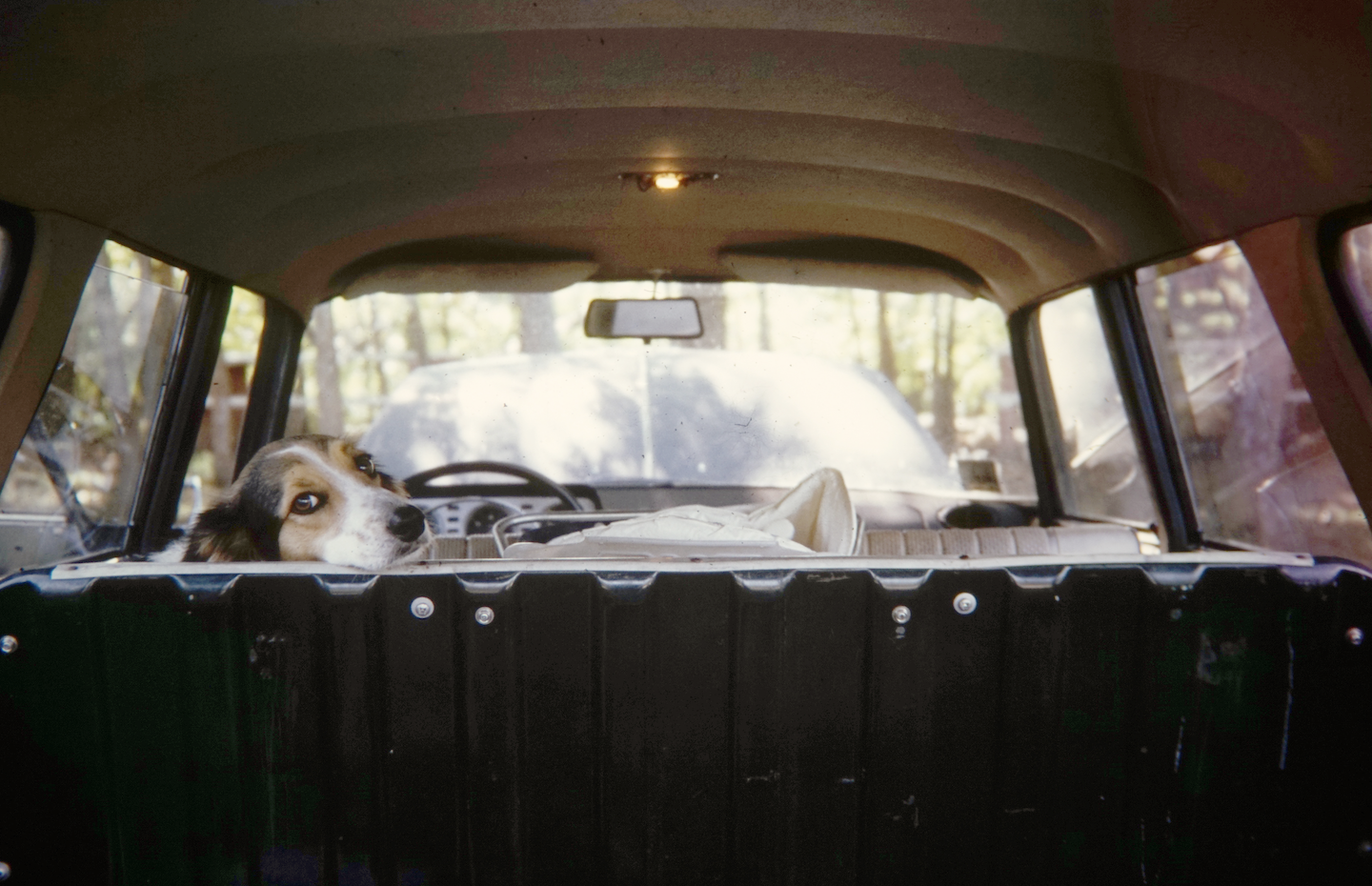
I’ve owned a lot of bad cars in my decades.  But some I’ve loved, at least when they were on the road. One was the 1965 Peugeot 404 wagon whose interior you see above, occupied by family dog Christy, guarding the infant seat next to her. You’ll note that the hood is open, because I was working on it at the time, which was constantly while I owned it.

I shot that photo in early 1974, not long after arriving at our new home in Graham, North Carolina. The trip down from our old home in far northern New Jersey was one of the most arduous I’ve ever taken, with frequent stops to fix whatever went wrong along the way, which was plenty.

Trouble started when a big hunk of rusted floor fell away beneath my feet, so I could see the New Jersey Turnpike whizzing by down there, while worrying that the driver’s seat itself might fall to the moving pavement, and my ass with it.

The floor had rusted because rainwater would gather in the air vents between the far side of the windshield and the dashboard, and suddenly splat down on one’s feet, and the floor, soon as the car began to move.  (The floor was prepared for this with a drainage system of tubes laminated between layers of metal, meant to carry downward whatever water fell on top. Great foresight, I suppose. But less prepared was the metal itself, which was determined to rust.)

Later a can attached to the exhaust manifold blew to pieces so sound and exhaust straight from the engine sounded like a machine gun and could be heard to the horizons in all directions, and echoed into the cabin off the pavement through the new hole in the floor. I am sure that the hearing loss I have now began right then.

I replaced the lost metal with an emptied V8 juice can that I filled with steel wool for percussive exhaust damping, and fastened into place with baling wire that I carried just in case of, well, anything. I also always carried a large toolbox, because you never know. If you owned a cheap used car back in those days, you had to be ready for anything.

The car did have its appeals, some of which were detailed by coincidence a month ago by Raphael Orlove in Jalopnik, calling this very model the best wagon he’s ever driven. His reasons were correct—for a working car. The best feature was a cargo area was so far beyond capacious that I once loaded a large office desk into it with room to spare. It also had double shocks on the rear axle, to help handle the load, plus other arcane graces meant for heavy use, such as a device in the brake fluid line to the rear axle that kept the brakes from locking up when both rear wheels were spinning but off the ground. This, I was told, was for drivers on rough dirt roads in Africa.

While the Peugeot 404 was not as weird in its time as the Citroën DS or 2CV (both of which my friend Julius called “triumphs of French genius over French engineering”), it was still weird as shit in some remarkably impractical ways.

For example, screw-on hubcaps. These meant no tire machine could handle changing a tire, and you had to do the job by hand with tire irons and a sledgehammer. I carried those too. For unknown reasons, Peugeot also also hid spark plugs way down inside the valve cover, and fed them electricity through a spring inside a bakelite sleeve that was easy to break and would malfunction even if they weren’t broken.

I could go on, but all that stuff is beside my point, which is that this car was, while I had it, mine. I could fix it myself, or take it to a mechanic friendly to the car’s oddities. While some design features were odd or crazy, there were no mysteries about how the car worked, or how to fix or replace its parts. More importantly, it contained no means for reporting its behavior or use back to Peugeot, or to anybody.

It’s very different today. That difference is nicely unpacked in A Fight Over the Right to Repair Cars Turns Ugly, by @Aarian Marshall in Wired. At issue are right-to-repair laws, such as the one currently raising a fuss in Massachusetts.

See, all of us and our mechanics had a right to repair our own cars for most of the time since automobiles first hit the road. But cars in recent years have become digital as well as mechanical beings. One good thing about this is that lots of helpful diagnostics can be revealed. One bad thing is that many of those diagnostics are highly proprietary to the carmakers, as the cars themselves become so vertically integrated that only dealers can repair them.

But there is hope. Reports Aarian,

…today anyone can buy a tool that will plug into a car’s port, accessing diagnostic codes that clue them in to what’s wrong. Mechanics are able to purchase tools and subscriptions to manuals that guide them through repairs.

So for years, the right-to-repair movement has held up the automotive industry as the rare place where things were going right. Independent mechanics remain competitive: 70 percent of auto repairs happen at independent shops, according to the US trade association that represents them. Backyard tinkerers abound.

But new vehicles are now computers on wheels, gathering an estimated 25 gigabytes per hour of driving data—the equivalent of five HD movies. Automakers say that lots of this information isn’t useful to them and is discarded. But some—a vehicle’s location, how specific components are operating at a given moment—is anonymized and sent to the manufacturers; sensitive, personally identifying information like vehicle identification numbers are handled, automakers say, according to strict privacy principles.

These days, much of the data is transmitted wirelessly. So independent mechanics and right-to-repair proponents worry that automakers will stop sending vital repair information to the diagnostic ports. That would hamper the independents and lock customers into relationships with dealerships. Independent mechanics fear that automakers could potentially “block what they want” when an independent repairer tries to access a car’s technified guts, Glenn Wilder, the owner of an auto and tire repair shop in Scituate, Massachusetts, told lawmakers in 2020.

The fight could have national implications for not only the automotive industry but any gadget that transmits data to its manufacturer after a customer has paid money and walked away from the sales desk. “I think of it as ‘right to repair 2.0,’” says Kyle Wiens, a longtime right-to-repair advocate and the founder of iFixit, a website that offers tools and repair guides. “The auto world is farther along than the rest of the world is,” Wiens says. Independents “already have access to information and parts. Now they’re talking about data streams. But that doesn’t make the fight any less important.”

As Cory Doctorow put it two days ago in Agricultural right to repair law is a no-brainer, this issue is an extremely broad one that basically puts Big Car and Big Tech on one side and all the world’s gear owners and fixers on the other:

Now, there’s new federal agricultural Right to Repair bill, courtesy of Montana Senator Jon Tester, which will require Big Ag to supply manuals, spare parts and software access codes:

https://s3.documentcloud.org/documents/21194562/tester-bill.pdf

The legislation is very similar to the Massachusetts automotive Right to Repair ballot initiative that passed with a huge margin in 2020:

https://pluralistic.net/2020/09/03/rip-david-graeber/#rolling-surveillance-platforms

Both initiatives try to break the otherwise indomitable coalition of anti-repair companies, led by Apple, which destroyed dozens of R2R initiatives at the state level in 2018:

https://pluralistic.net/2021/02/02/euthanize-rentiers/#r2r

It’s a bet that there is more solidarity among tinkerers, fixers, makers and users of gadgets than there is among the different industries who depend on repair price-gouging. That is, it’s a bet that drivers will back farmers’ right to repair and vice-versa, but that Big Car won’t defend Big Ag.

The opposing side in the repair wars is on the ropes. Their position is getting harder and harder to maintain with a straight face. It helps that the Biden administration is incredibly hostile to that position:

https://pluralistic.net/2021/07/07/instrumentalism/#r2r

It’s no coincidence that this legislation dropped the same week as Aaron Perzanowski’s outstanding book “The Right to Repair” — R2R is an idea whose time has come to pass.

https://pluralistic.net/2022/01/29/planned-obsolescence/#r2r

[The next day…]

Cory just added this in a follow-up newsletter and post:

…remember computers are intrinsically universal. Even if manufacturers don’t cooperate with interop, we can still make new services and products that plug into their existing ones. We can do it with reverse-engineering, scraping, bots – a suite of tactics we call Adversarial Interoperability or Competitive Compatibility (AKA “comcom”):

https://www.eff.org/deeplinks/2019/10/adversarial-interoperability

These tactics have a long and honorable history, and have been a part of every tech giant’s own growth…

Read all three of those pieces. There is much to be optimistic about, especially once the fighting is mostly done, and companies have proven knowledge that free customers—and truly free markets—are more valuable than captive ones. That has been our position at ProjectVRM from the start. Perhaps, once #R2R and #comcom start paying off, we’ll finally have one of the proofs we’ve wanted all along.

❌