

CircularPlace booste l’économie circulaire des entreprises

L’article CircularPlace booste l’économie circulaire des entreprises est apparu en premier sur TheGood.

L’article CircularPlace booste l’économie circulaire des entreprises est apparu en premier sur TheGood.
Newsletters are all the rage now. In recognition of that, I blogged here two years ago about the idea of writing a solo newsletter. Since then I’ve been co-producing this one with Katherine Druckman at Reality 2.o. It’s a Substack one, so I know how that game works on the production as well as the consumption ends.
Recently I also learned that WordPress makes it easy to turn blogs into newsletters, which is why you see “Get New Posts by Email” in the right column here. So, wanting an image to go with the news that this blog can now be a newsletter if you like, I said to ChatGPT, “Draw me Doc Searls blogging on the left side of the image, and producing a newsletter on the right side.” It gave me this, including the caption:

Except for the slouch, I never looked like that. But what the hell. AI is wacky shit, so there ya go.
Feel free to subscribe.


What forms of pAI—personal AI—are Apple, Mozilla, Google, Meta, Microsoft and the rest not doing?
Let’s look at those first two because they’re at the top of the news LIFO buffer.
Apple Intelligence (“coming in beta this fall*“), announced yesterday, will help you with writing and creating images while giving you less lame answers from Siri. (Which they should re-name. Siri is Apple’s Clippy.) It “can draw on larger server-based models, running on Apple silicon, to handle more complex requests for you while protecting your privacy.” The “larger models” will be white-labeled ChatGPT, plus Apple’s own small language models (SLMs).
Mozilla, which got $400+ million a year from Google (for search in the Firefox browser) starting in 2020, announce on June 3 that they will be Building open, private AI with the Mozilla Builders Accelerator. Jive:
This program is designed to empower independent AI and machine learning engineers with the resources and support they need to thrive. It aims to cultivate a more innovative AI ecosystem, and it’s one of Mozilla’s key initiatives to make AI meaningfully impactful — alongside efforts like Mozilla.ai, the Responsible AI Challenge and the Rise25 Awards.
The Mozilla Builders Accelerator’s inaugural theme is local AI, which involves running AI models and applications directly on personal devices like laptops, smartphones, or edge devices rather than depending on cloud-based services…
We chose Local AI as the theme for the Accelerator’s first cohort because it aligns with our core values of privacy, user empowerment, and open source innovation. This method offers several benefits including:
- Privacy: Data stays on the local device, minimizing exposure to potential breaches and misuse.
- Agency: Users have greater control over their AI tools and data.
- Cost-effectiveness: Reduces reliance on expensive cloud infrastructure, lowering costs for developers and users.
- Reliability: Local processing ensures continuous operation even without internet connectivity.
Looks to me like both of these are Big AI writ small. It’s “local,” not personal. It’s made to serve your needs with what BigAI offers through APIs. It is still essentially AIaaS (AI as a Service), rather than truly personal AI (pAI): personalized more than personal.
That’s also what I see when I read between the lines at Mozilla’s AI job openings. Take platform engineer. This person will (among other things), “assist in managing and orchestrating workloads across multiple cloud providers.” That’s fine. I’m sure true pAIs will do that too. But most of pAI will be more personal than that. It will deal with the mundanities of your everyday life. Not with coughing up answers that can only come from AIaaSes.
The problem with personalizing AI giant offerings is that they are large language models (LLM) trained on everything that can be crawled on the Internet, plus who knows what else. Not on your truly personal stuff. This is why “prompt engineering” worthy of the noun is ” not for anybody:
Prompt engineering is crucial for deploying LLMs but is poorly understood mathematically. We formalize LLM systems as a class of discrete stochastic dynamical systems to explore prompt engineering through the lens of control theory. We investigate the reachable set of output token sequences $R_y(\mathbf x_0)$ for which there exists a control input sequence $\mathbf u$ for each $\mathbf y \in R_y(\mathbf x_0)$ that steers the LLM to output $\mathbf y$ from initial state sequence $\mathbf x_0$. We offer analytic analysis on the limitations on the controllability of self-attention in terms of reachable set, where we prove an upper bound on the reachable set of outputs $R_y(\mathbf x_0)$ as a function of the singular values of the parameter matrices. We present complementary empirical analysis on the controllability of a panel of LLMs, including Falcon-7b, Llama-7b, and Falcon-40b. Our results demonstrate a lower bound on the reachable set of outputs $R_y(\mathbf x_0)$ w.r.t. initial state sequences $\mathbf x_0$ sampled from the Wikitext dataset. We find that the correct next Wikitext token following sequence $\mathbf x_0$ is reachable over 97% of the time with prompts of $k\leq 10$ tokens. We also establish that the top 75 most likely next tokens, as estimated by the LLM itself, are reachable at least 85% of the time with prompts of $k\leq 10$ tokens. Intriguingly, short prompt sequences can dramatically alter the likelihood of specific outputs, even making the least likely tokens become the most likely ones. This control-centric analysis of LLMs demonstrates the significant and poorly understood role of input sequences in steering output probabilities, offering a foundational perspective for enhancing language model system capabilities.
But all that stuff applies mostly when we’re prompting a big LLM system.
What about using AI in our own lives, where the data that matters most are in our calendars, contacts, financial and health records, our travels, our correspondence (email, chat, whatever)? And how about all the location data we might get from our cars, phone apps, and phone companies? These should be much easier for a pAI to gather, examine, and help us do useful things. Caring about much less data also means a pAI will be less likely to give wrong (hallucinated) answers.
Today the mental frame almost everybody uses for AI is the Big kind, ingesting everything they can get their crawlers on, and munching all of it in giant compute farms. Those systems are great for lots of stuff, but they still don’t deal with personal data listed in the last paragraph.
Not yet, anyway.
Look at it this way. For each of us, there are three data pools:
The pAI greenfield is with the last two.
Tell us who is working on what there, preferably with open source, and not sitting on walled garden silicon.
[Later… ] Since readers told me I had small language models (SLMs) wrong in one of the paragraphs above, and I’m not sure I had them right, I rewrote them out of the piece. I invite readers to post comments to further correct and expand on the subject of pAIs and what they can do.

There is a war going on. Humanity and nature are on one side and Big Tech is on the other. The two sides are not opposed. They are orthogonal. The human side is horizontal and the Big Tech side is vertical.*
The human side is personal, social, self-governed, heterarchical, open, and grounded in the physical world. Its model is nature, and the cooperative contexts in which competition, creation, and destruction happen in the natural world.
The Big Tech side is corporate, industrial, hierarchical, competitive, mechanistic, extractive, and closed, even though it produces many positive-sum products and services that are good for people and good for nature. It is also, being competitive and rewarding toward winner-take-most outcomes, dominated by giants.
This war has been fought over many other things in the past, especially in tech. But AI is the big one right now—and perhaps the biggest one of all time.
Over the long run, both sides will win, because we need the best of what both bring to the world’s big round table. In the past, this has happened in countless markets, countries, polities, societies, and other contexts. In tech it happened with the conflict between PCs and mainframes, between the open and public Internet and closed private networks, and between open operating systems and closed ones. None of those conflicts have final outcomes, but they have arrived at stable and cooperative states. They arrived at those states because everyone recognized that people can do more with their own tools than those big entities can do on theirs, or by using people as extracted resources.
This conflict is perhaps best represented by the ironies that have been at work within OpenAI and Sam Altman, its prior and current CEO. We can also see it with sparkling clarity in something amazing that Sam said near the close of his keynote at the first OpenAI Developer Conference, in November of last year:

Lets unpack that.
Individual empowerment means exactly what it says. Agency is the ability to take action or to choose what action to take (Cambridge Dictionary). Scale means growth toward ubiquity.
You have individual empowerment and agency when you ride your bike, drive your car, mow your lawn, or button your shirt. You also have it when you work on your laptop, phone, and other smart rectangles. Scale means your power and agency will grow to the max while the same will happen for nearly everyone else. Scale for you alone won’t cut it. When most of us have it, that’s scale.
Technologies extend us. They enlarge our capacities in the world. Intelligence is one of those capacities. So is memory. Your rectangles help a lot with both. That’s why those have already scaled to ubiquity, or close enough.
AI will do the same, but only if it’s personal. Not if it’s just “personalized.”
As Jamie Smith made clear here a year ago, “your personal AI isn’t really personal.”
ChatGPT4 doesn’t know that yet. I can tell because I just asked:
Me:
What is “personal AI”?ChatGPT4:
“Personal AI” refers to artificial intelligence systems that are designed to serve individual users through personalized interactions and services. These AI systems learn from the specific preferences, behaviors, and needs of their users to offer more tailored assistance, recommendations, or information. The goal of personal AI is to enhance user experience by adapting to unique personal profiles.There are various applications of personal AI, including:
- Virtual Assistants: Like Siri, Google Assistant, and others, these AIs help with daily tasks such as scheduling, reminders, searching information, and controlling smart home devices, all customized to the user’s habits and preferences.
- Recommendation Systems: Used in streaming services like Netflix or shopping platforms like Amazon, these AI systems analyze your past behavior to recommend movies, shows, or products you might like.
- Healthcare: Personal AI can track individual health metrics and provide personalized advice, monitor conditions, or even alert medical professionals if needed.
- Learning and Development: In education, personal AI can adapt learning materials to the pace and learning style of the student, offering a customized educational experience.
- Gaming: AI in gaming can adapt to provide a challenge tailored to the player’s skill level or alter the game narrative based on choices made by the player.
The development of personal AI focuses on enhancing user engagement by creating more intuitive and responsive interactions that feel uniquely suited to each individual.
For a second opinion, I asked Google’s Gemini the same question.
Me:
What is “personal AI”?Gemini:
Personal AI refers to artificial intelligence designed to assist and interact with a specific individual. It’s essentially your own AI companion that learns about you and tailors its services to your needs. Here are some key aspects of personal AI:
- Personalization: Unlike general-purpose AI assistants, personal AI focuses on you. It learns from your interactions, preferences, and habits to become more helpful over time.
- Focus on Memory and Knowledge: Some personal AI systems aim to become an extension of your mind. They can store your memories, knowledge, and experiences, making them readily accessible and even usable to help with tasks like writing or communication.
- Varied Applications: Personal AI can have a wide range of applications. Imagine an AI that helps you:
- Organize your life: Manage schedules, appointments, and reminders.
- Boost productivity: Assist with tasks, research, and communication.
- Enhance creativity: Help you brainstorm ideas or generate creative content.
- Improve learning: Personalize learning experiences and provide targeted information.
Privacy Concerns: Storing personal data on an AI raises concerns about privacy and security.
Overall, personal AI holds promise for a future where technology seamlessly integrates with our lives, offering personalized assistance and support.
To both companies, personal AI is a personalized service—from them. It’s not something you own and control. It’s not about individual empowerment and agency. It doesn’t extend you. It’s hired prosthesis: an extension of them rather than of you.
Let’s name the category: AIaaS—AI as a Service.
But hats off. OpenAI and Gemini do amazing jobs. So do lots of other AI services by wannabe giants. I use AI every day to improve what I write, to generate and fix images, to answer questions that old-fashioned search engines can’t answer or suck at. I even pay extra for some of it (such as ChatGPT4 and Adobe’s Creative Suite). And it seems they all get better, all the time, at everything. Won’t personalization be good enough, eventually?
No. Because they aren’t you. They also aren’t yours, so they can’t extend you. They can seem to. But they don’t. They also don’t have access to most of your private life. Nor should they.
But your private life could use some AI help. For example—
It’s not easy to visualize what a personal AI might do for those, but let’s try. Here’s how Microsoft’s Copilot (or whatever it’s called this week) did it for me before I got rid of all its misspellings and added my own hunks of text:

All that stuff is data. But most of it is scattered between apps and clouds belonging to Apple, Google, Microsoft, Amazon, Meta, phone companies, cable companies, car makers, health care systems, insurance companies, banks, credit card companies, retailers, and other systems that are not yours. And most of them also think that data is theirs and not yours.
To collect and manage all that stuff, you need tools that don’t yet exist: tools that are yours and not theirs. We could hardly begin to imagine those tools before AI came along. Now we can.
For example, you should be able to take a picture of the books on your shelves and have a complete record of what those books are and where you got them. You’ll know where you got them because you have a complete history of what you bought, where and from whom. You should be able to point your camera in your closets, at the rugs on your floors, at your furniture, at the VIN number of your car that’s visible under your windshield, at your appliances and plumbing fixtures, and have your AI tell you what those are, or at least make far more educated guesses than you can make on your own.
Yes, your AI should be able to tap into external databases and AI systems for help, but without divulging identity information or other private data. Those services should be dependent variables, not independent ones. For full individual empowerment and agency, you need to be independent. So does everyone else with personal AI.
Now imagine having a scanner that you can feed every bill, every receipt, every subscription renewal notice, and have AI software that tells you what’s what with each of them, and sorts records into the places they belong.
Ever notice that the Amazon line items on your credit card bill not only aren’t itemized, but don’t match Amazon’s online record of what you ordered? Your personal AI can sort that out. It can help say which are business and personal expenses, which are suspicious in some way, what doesn’t add up, and much more.
Your personal AI should be able to answer questions like, How many times have I had lunch at this place? Who was I with? When was it we drove to see so-and-so in Wisconsin? What route did we take? What was that one car we rented that we actually liked?
Way back in 1995, when our family first got on the Internet over dial-up, using the first graphical browsers on our PC, and e-commerce began to take off with Amazon, eBay, and other online retailers, my wife asked an essential question: Why can’t I have my own shopping cart that I take from site to site?
Twenty-nine years later, we still don’t have the answer, because every retailer wants you to use its own. And we’re stuck in that system. It’s the same system that has us separately consenting to what sites ironically call “your privacy choices.” And aren’t.
There are countless nice things we can’t have in the digital world today because we aren’t people there. We are accounts. And we are reduced to accounts by every entity that requires a login and password.
This system is a legacy of client-server, a euphemism for slave-master. We might also call it calf-cow, because that’s how we relate to businesses with which we have accounts. And that model is leveraged on the Web like this:

We go to sites for the milk of content and free cookies, whether we want them or not. We are also just “users.”
In the client-server world, servers get scale. Clients have no more scale than what each account—each cow—separately allows. Sure, users get lots of benefits, but scale across many cows is not one of them. And no, “login with Google” and “login with Facebook” are just passes that let calves of ruling cows wander into vassal pastures.
For individual empowerment and scale to happen, we need to be self-sovereign and independent. Personal AI can give that to us. It can do that by solving problems such as the ones listed above, and by working as agents that represent us as human beings—rather than mere users—when we engage with Big Tech’s cows.
This will be a fight at first, because the cows think they run all of nature and not just their own farms. And $trillions are being invested in the same old cattle industry, with AI painted all over the new barns. Comparatively speaking, close to nothing is going toward giving independent and self-sovereign individuals the kind of power and scale Sam Altman says he wants to give us but can’t because he’s on the big cow side of this thing.
So where do we start?
First, with open source code and open standards. We have some already. Llama 3, from Meta AI, is “your own intelligent assistant,” and positions Meta as a more open and user-friendly cow than OpenAI. Meta is still on the top-down Big Tech side of the war we’re in. But hell, we can use what they’ve got. So let’s play with it.
Here on the ground there are all these (with quotage lifted from their sites or reviews such as this one)—
—and lots of others that readers can tell me about. Do that and I will add links later. This is a work in progress.
Below all of those we still need something Linux-like that will become the open base on which lots of other stuff runs. The closest I’ve seen so far is pAI-OS, by Kwaai.ai, a nonprofit I now serve as Chief Intention Officer. I got recruited by Reza Rassool, Kwaai’s founder and chair, because he believes personal AI is required to make The Intention Economy finally happen. So that was a hard offer to refuse. Kwaai also has a large, growing, and active community, which I believe is necessary, cool, and very encouraging.
As with most (maybe all) of the projects listed above, Kwaai is a grass-roots effort by human beings on the natural, human, and horizontal side of a battle with giants who would rather give us personalized AI than have us meet them in a middle to which we will bring personal AI powers of our own. In the long run, we will meet in that middle, because personal AI will be better for everyone than personalized AI alone.
Watch us prove it. Better yet, join the effort.
*I am indebted to Lavonne Reimer for introducing and co-thinking the horizontal vs. vertical frame, and look forward eagerly to her own writings and lecturings on the topic.

L’article L’industrie cosmétique parie sur l’innovation éthique est apparu en premier sur TheGood.

Vous pensiez connaître Castlevania sur le bout des doigts ? Eh bien 25 ans après la sortie de Castlevania: Legacy of Darkness sur notre bonne vieille Nintendo 64, des petits malins ont déniché un tout nouveau code Konami planqué dans les entrailles du jeu.
Ce code Konami est une vraie petite bombe puisqu’il déverrouille d’un coup TOUS les personnages et leurs costumes alternatifs, et ce dès le début de l’aventure ! Fini de devoir se farcir le jeu deux fois pour accéder à Henry et Carrie. Là c’est open bar direct, et ça change complètement la donne !
Moises et LiquidCat, deux fans passionnés du jeu, ont également déniché deux autres codes bien sympathiques. Le premier remplit entièrement votre inventaire, peu importe le héros que vous incarnez. Fini la galère pour trouver des potions et des équipements, vous voilà paré pour latter du vampire en claquant des doigts. Le second code, disponible uniquement dans les versions japonaise et européenne, booste votre arme au max et vous file un stock de joyaux dont même Picsou serait jaloux. De quoi rendre votre quête bien plus funky !
Pour activer ces codes, rien de plus simple :
Codes bonus pour les plus curieux :
Alors certes, dit comme ça, ça peut sembler un poil cheaté mais ça fait un quart de siècle que ce jeu nous nargue avec ses secrets, donc ça va, y’a tolérance. En plus, avouons-le, ces codes tombent à pic pour (re)découvrir cet opus culte car s’il y a bien un reproche qu’on pouvait faire à Legacy of Darkness, c’était ce côté un peu prise de tête avec un seul personnage jouable au début. Un choix curieux qui pouvait rebuter certains joueurs. Mais grâce à ce code Konami providentiel, ce problème est relégué aux oubliettes ! Vous pouvez enfin profiter des cinq perso et de leurs capacités uniques sans vous prendre le chou.
Alors si vous aussi vous avez une Nintendo 64 qui prend la poussière dans un coin (ou un émulateur), c’est le moment ou jamais de ressortir Castlevania: Legacy of Darkness et de tester ces fameux codes.


Les générateurs d’images IA actuels comme Midjourney, Dall-E et j’en passe, font polémique puisqu’ils piochent allégrement dans les œuvres des artistes sans leur consentement ni rémunération. Mais des solutions sont en train de se mettre en place pour les entreprises qui souhaiteraient utiliser l’IA pour illustrer leurs supports sans pour autant piller les artistes.
Une de ces solutions, c’est Tess qui propose une approche que j’ai trouvée intéressante puisqu’elle met en place des collaborations avec des créateurs pour utiliser leur style dans des modèles de diffusion d’images.

Concrètement, chaque modèle d’IA est entraîné sur le style visuel d’un artiste unique, avec son accord puis l’outil utilise un SDXL custom (Stable Diffusion) pour générer les images. Évidemment, à chaque fois qu’une image est générée avec son style, l’artiste touche des royalties ! C’est gagnant-gagnant donc.
L’outil intègre également un système de métadonnées basé sur le protocole C2PA, qui permet d’identifier clairement les images générées par IA et de les distinguer des créations originales.
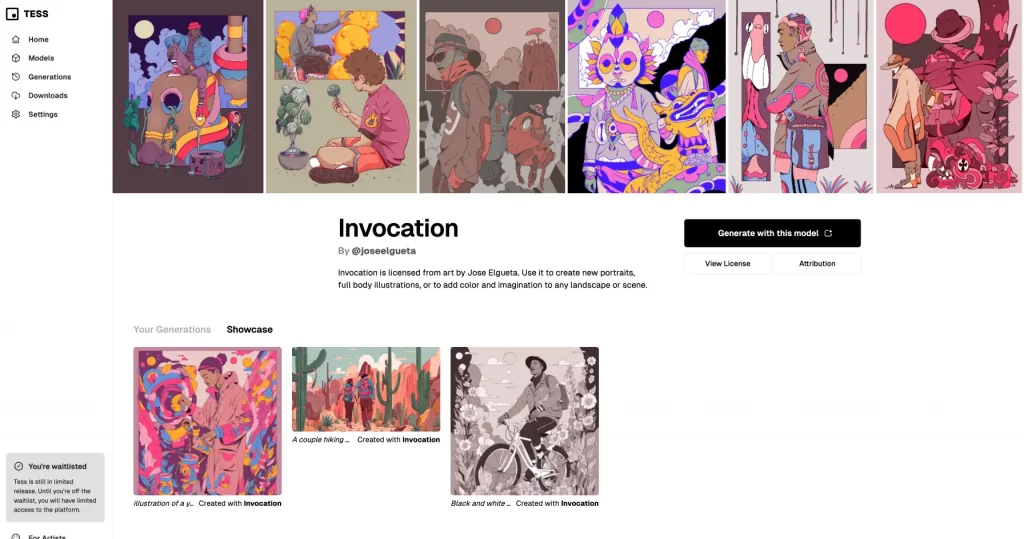
L’objectif de Tess est donc clair : démocratiser la création d’images artistiques de qualité, en la rendant accessible au plus grand nombre, tout en rémunérant équitablement les artistes et leur permettant de garder la maitrise de leur art. C’est une bonne idée vous ne trouvez pas ?
Et les artistes dans tout ça ? Et bien si j’en crois le site de Tess, ils sont déjà plus de 100 à avoir déjà sauté le pas, séduits par ce nouveau modèle de rémunération. Maintenant si vous voulez devenir clients de la plateforme, ce n’est malheureusement pas encore ouvert à tous, mais une liste d’attente est en place pour vous inscrire et être tenu au courant.



Cloudflare nous sort encore un truc marrant : Cloudflare Calls ! Il s’agit d’une plateforme WebRTC serverless qui vous permet de créer des applications temps réel que ce soit de l’audio, de la vidéo ou même de la data. Le tout, sans vous prendre la tête avec l’infrastructure. Ça peut servir d’unité SFU (selective forwarding unit) pour router intelligemment les flux, ou même de système de diffusion pour broadcaster du contenu. Bref, les possibilités sont énormes !
Le gros avantage, c’est que ça tourne sur le réseau mondial de Cloudflare, présent dans des centaines de villes. Donc niveau latence et qualité, vous êtes aux petits oignons et pas besoin de vous soucier de la scalabilité ou des régions, puisque c’est géré.

Pour commencer à bidouiller avec Cloudflare Calls, rien de plus simple. Vous créez une app dans le dashboard, vous récupérez les identifiants, et hop, vous pouvez commencer à coder votre propre app WebRTC. Il y a même un exemple complet sur GitHub, l’app de démo « Orange Meets – room Korben ^^ ». (Non, ça n’a rien à voir avec l’opérateur du même nom, même si c’est de la téléphonie…)

Après, faut quand même mettre les mains dans le cambouis hein. Mais si vous êtes à l’aise avec WebRTC, vous allez vous éclater. Sinon, c’est l’occasion d’apprendre ! Et puis la doc est plutôt bien foutue, avec des tutos pas à pas. Ça ouvre un paquet de possibilités pour créer des apps temps réel fun ou utiles comme un outil de collaboration en ligne, avec un tableau blanc partagé et de la visio. Ou même un petit jeu multijoueur. Avec Cloudflare Calls, vous pouvez prototyper ça rapidement sans vous soucier de l’infrastructure.
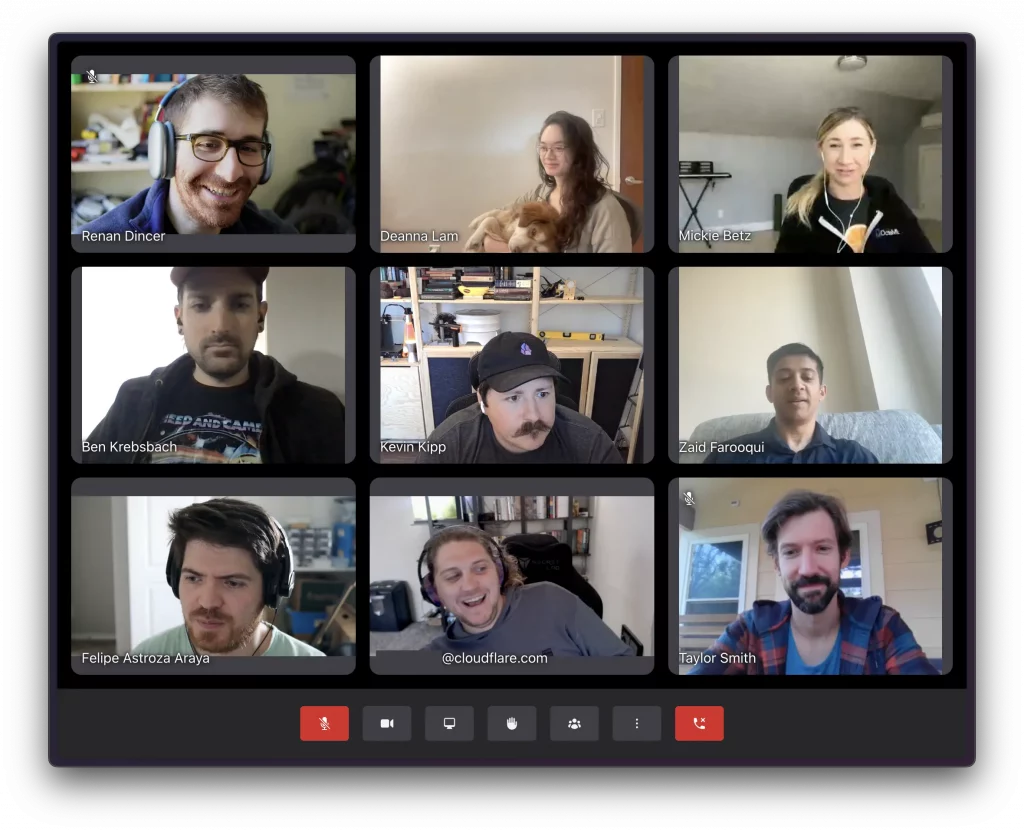
Après, attention quand même, c’est encore en beta. Donc à utiliser en prod avec précaution. Mais pour tester et apprendre, c’est parfait. Et puis connaissant Cloudflare, le produit final sera sûrement béton.
Bref, je vous invite à aller jeter un œil à Cloudflare Calls, à tester la démo « Orange Meets », et pourquoi pas, à vous lancer dans le développement de votre propre app WebRTC serverless.


Non, Toolong n’est pas ce qu’a dit votre correspondante américaine la première fois qu’elle vous a vu en maillot de bain. C’est plutôt (le chien) un outil vachement pratique qui s’utilise ne ligne de commande et qui permet d’afficher, suivre en temps réel, fusionner les fichiers de log et d’y rechercher tout ce que vous voulez.

L’outil est capable d’appliquer une petite coloration syntaxique sur les formats de journalisation classique comme ceux d’un serveur web par exemple. Il est également capable d’ouvrir très rapidement de gros fichiers même s’ils font plusieurs gigas.
Si vous travaillez avec des fichiers JSONL, Toolong les affichera également au format pretty print. Il prend également en charge l’ouverture des fichiers .bz et .bz2.
De quoi arriver à vos fins beaucoup plus facilement qu’en jouant avec tail, less, ou encore grep.
Toolong est compatible avec Linux, macOS et Windows et pour l’installer Toolong, la meilleure solution actuelle consiste à utiliser pipx :
pipx install toolong
Vous pouvez également l’installer avec Pip :
pip install toolong
Note : Si vous utilisez Pip, il est recommandé de créer un environnement virtuel pour éviter les conflits de dépendances potentiels.
Une fois Toolong installé, la commande tl sera ajoutée à votre PATH. Pour ouvrir un fichier avec Toolong, ajoutez les noms de fichiers en arguments de la commande :
tl fichierdelog.log
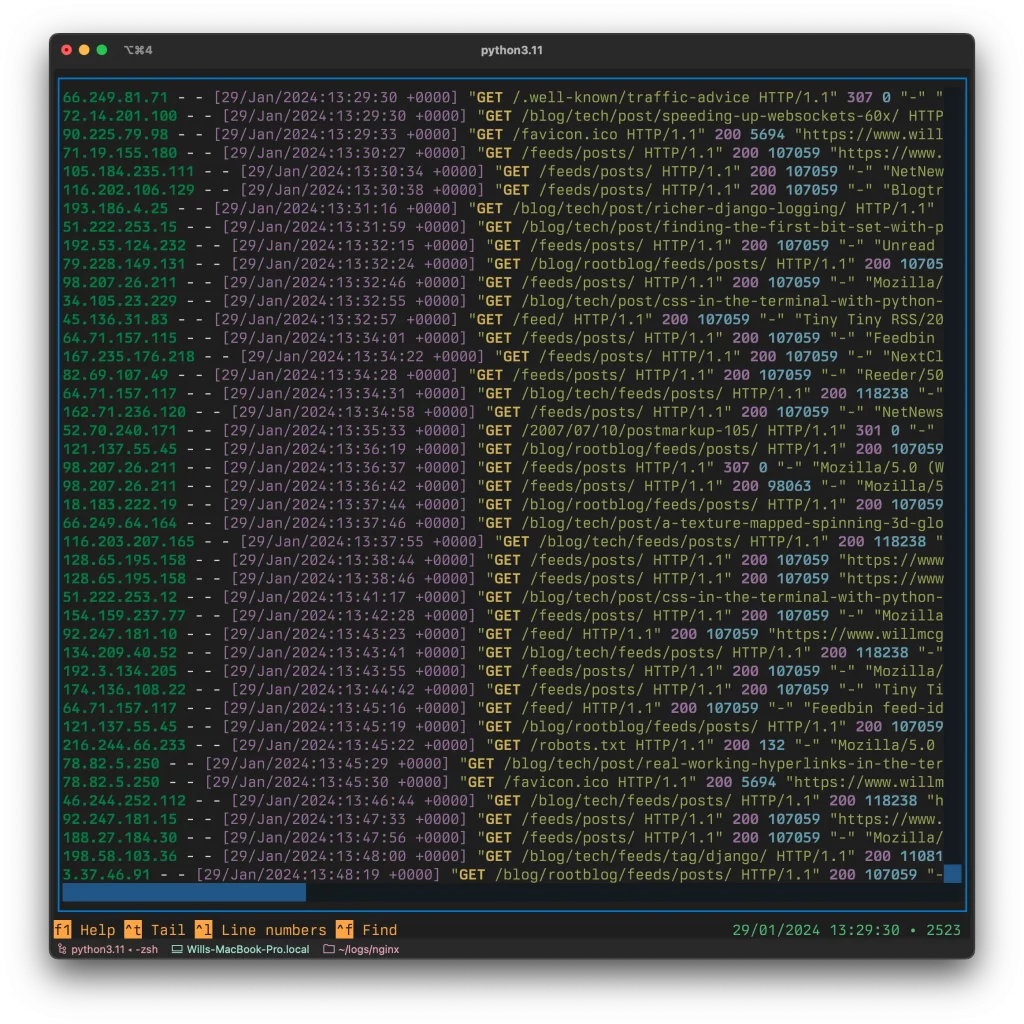
Si vous ajoutez plusieurs noms de fichiers, ils s’ouvriront dans des onglets. Ajoutez l’option --merge pour ouvrir plusieurs fichiers et les combiner en une seule vue :
tl access.log* --merge
Voilà, l’essayer, c’est l’adopter. Si vous manipulez de gros logs, Toolong pourra vous faire gagner un max de temps !
Merci à Lorenper


This post is for the benefit of anyone wondering about, researching, or going into business on the proposition that selling one’s own personal data is a good idea. Here are some of my learnings from having studied this proposition myself for the last twenty years or more.
Personal AIs are today where personal computers were fifty years ago. Nearly all the AI news today is about modern mainframe businesses: giants with massive data centers churning away on ingested data of all kinds. But some of these models are open sourced and can be made available to any of us for our own purposes, such as dealing with the abundance of data in our own lives that is mostly out of control. Some of it has never been digitized. With AI help it could be.
I’m in a time crunch right now. So, if you’re with me this far, read We can do better than selling our data, which I wrote in 2018 and remains as valid as ever. Or dig The Intention Economy: When Customers Take Charge (Harvard Business Review Press, 2012), which Tim Berners Lee says inspired Solid. I’m thinking about following it up. If you’re interested in seeing that happen, let me know.

Faut-il craindre l’intelligence artificielle ? Une question légitime, mais qui posée comme cela a vite fait de vous poser comme un rétif au changement, un conservateur pusillanime, un luddite inavoué. Bref, un vieux con.
Pourtant, même en étant technophile (et je le suis), la question peut se poser. Les récentes avancées dans les IA génératives, Dall-E, Midjourney pour les images et maintenant ChatGPT (GPT pour Generative Pre-trained Transformer 3), ce logiciel conversationnel d’OpenAI pour répondre à de multiples questions, progressent de manière exponentielle, l’exponentiel est important en l’espèce.
Si tout le monde a joué avec Dall-e pour créer des images improbables ou parfaitement imitées de la réalité, la version 3.5 de ChatGPT a explosé les compteurs. Plus d’un million de personnes ont testé ChatGPT en moins d’une semaine. Que ce soit pour faire du code ou en déboguer, répondre à des questions en tout genre, créer un site web en 10 minutes,
composer de la musique, ou imaginer de nouveaux business plans. D’autres ont même eu l’idée
de créer des prompts (des commandes pour l’IA) pour générer des images sur Dall-E. Une mise en abyme s’il en est.
Malgré quelques fausses réponses, des approximations liées souvent à la formulation de la question, les résultats sont dans l’ensemble bluffants. Certes, les réponses peuvent être parfois incohérentes. Pour le vérifier, posez plusieurs fois de suite la même question. N’oubliez pas que pour répondre, l’IA générative se fonde sur de la statistique et la probabilité de l’occurrence proxémique des mots dans un corpus sémantique donné. Le résultat peut donner une impression de cohérence, mais une véracité parfois suspecte.
Ce qui est surtout bluffant, c’est la progression de GPT entre la version 3 livrée en 2020 et la 3.5 de 2022. Malgré ces défauts liés à l’IA générative, il est clair que ChatGPT a sidéré tous ceux qui l’ont essayé. Et sans doute créé un petit début d’interrogation, voir d’anxiété sur l’avenir de nombreux emplois pour les travailleurs de la connaissance et industrie du savoir.

À juste titre ou non ? Depuis quelques jours la question divise les réseaux sociaux.
Pour certains, l’IA vient juste comme aide et outil pour accomplir plus rapidement une tâche. En cela ils rejoignent la doxa Schumpétérienne de la destruction créatrice. Les machines se substituent à des travailleurs, mais ne suppriment pas le besoin en main-d’œuvre grâce aux nouveaux métiers et compétences créées. Jusqu’alors le modèle fonctionne et la productivité affiche une hausse linéaire malgré les 4 révolutions industrielles et technologiques. RPA, IA, Machine learning apportent une aide réelle dans de nombreux métiers. Tout ce qui est du ressort du calcul peut bénéficier de l’IA, c’est une évidence.
Autre argument avancé par les optimistes : l’IA n’est pas créative ; elle se fonde sur un corpus fini donc ne peut anticiper ; elle n’est pas originale dans ses réponses ; elle est parfois approximative et se trompe régulièrement dans ses réponses.

Pour les optimistes, l’IA sera une aide précieuse pour accomplir des tâches rébarbatives et récurrentes, par exemple écrire des fiches produits en grand nombre, déboguer du code (ou pas), mais aussi pêle-mêle rédiger des dissertations, des billets de blog, et moult autres tâches avec pour seule limite l’imagination.
Pour les pessimistes aussi les arguments sont nombreux. Et vont dans le sens des optimistes. Oui, l’IA d’Open AI peut écrire du code, mais il est souvent bugué. Il faut donc comprendre le code pour être à même de les identifier. Oui, il peut rédiger des dissertations de bon niveau, Il a beaucoup été écrit sur la fin de l’enseignement tel qu’on le connaît, inutile d’en rajouter.
Il peut bien sûr écrire des posts et articles qui resteront sans grand intérêt, mais le web nous habitue déjà à de nombreux contenus sans intérêts, il y en aura beaucoup plus.
Et ce sera drôle quand l’IA se nourrira de contenus issus de l’IA, là encore une autre mise en abyme.
Autre point : il va remplacer Google et autres moteurs de recherche, voir supprimer les recherches tout court, en répondant directement aux questions, effaçant ainsi toute velléité de recherches croisées pour valider les réponses. Peut-être.
Quoi qu’il en soit, Sam Altman prévient qu’il faudra faire preuve « d’adaptabilité et de résilience. Nous avons là une piste sérieuse 

Si tous les arguments, pour ou contre, sont recevables, le véritable juge arbitre est bien sûr l’usage qui sera fait de l’outil (merci captain obvious).
Si Prométhée amène la connaissance, son frère Epiméthée par étourderie ouvre la boîte de Pandore. ChatGPT est peut-être un moment Épiméthéen.
L’histoire de ces deux décennies démontre si besoin en était l’absence de limite dans l’utilisation des technologies. Les objectifs peuvent être très variés, modifier le cours d’une élection, semer le doute via les fake news envoyées à des millions d’utilisateurs sur un réseau, créer de manière automatisée des sites en scrapant d’autres sites, attaquer les entreprises en exigeant une rançon, la liste est longue.

Il y a bien sûr un côté positif dans de nombreux champs.
La technologie est pharmakon et seul l’usage dicte si elle soigne ou rend malade. À ce jour le bilan est mitigé selon où l’on regarde. L’outil est aussi un vecteur d’expression des penchants de l’humanité.
Pour sa part, l’IA exponentialise le champ des possibles, dans un sens ou dans l’autre. Selon les rumeurs, la prochaine version de GPT-4 sera 500 fois plus puissante que GPT 3.5.

Comment faudra-t-il considérer rétroactivement la sidération causée par ChatGPT. Quelle régulation prévue pour affronter la vague. Faut-il suivre la Chine qui impose d’intégrer des filigranes pour tout contenu créé avec l’IA ? Les régulateurs n’ont pas l’air pressés.
Avons-nous le temps ?
PS : si vous voulez jouer avec ChatGPT et Google, Github recense un portefeuille d’app
The post ChatGPT : faut-il craindre l’intelligence artificielle (spoiler : oui, mais pas pour ce que vous croyez) appeared first on Fabrice Frossard.
Les Tiers-Lieux comme cheville ouvrière du développement local
The post L’Usine Végétale : investir le rural par la transition appeared first on Observatoire des Tiers-Lieux.
L’intelligence artificielle est devenue un catalyseur de la transformation numérique des industries. La technologie fait partie du Peak of Inflated Expectations présentant les technologies émergentes en 2023. Elle devrait impacter les entreprises, offrant une synergie entre main-d’œuvre et machine. Toutefois, à mesure que les technologies d’IA évoluent, les entreprises doivent engager leur responsabilité dans l’élaboration de bonnes pratiques.
Alors que les régulateurs tentent de s’imposer dans ce nouveau paradigme, les entreprises sont en bonne posture pour proposer des outils garantissant sécurité, gouvernance, contrôles et mesures responsables pour l’IA. Voici les raisons pour lesquelles il est crucial pour une organisation de développer des bonnes pratiques pour l’usage de l’IA et que quelques conseils pour renforcer les compétences dans ce domaine.
Il faudra des années pour que régulateurs et autorités législatives élaborent un corpus complet de réglementations et de législations concernant l’IA qui concilient innovation, éthique et sécurité. Qui plus est, il s’agit d’un processus continu et donc en constante évolution. Le manque de réglementations strictes peut de prime abord sembler lucratif car il laisse de place à l’innovation. Toutefois, une entreprise avant-gardiste se rendra compte qu’il existe des mises en œuvre de l’IA contraires à l’éthique et potentiellement nuisibles.
Les entreprises qui proposent un guide de bonnes pratiques bénéficient d’un avantage concurrentiel. Lorsqu’il s’agit d’IA, les clients exigent que les solutions soient à la fois dignes de confiance, transparentes, responsables et éthiques. Lorsqu’une entreprise définit des bonnes pratiques, elle crée une émulation auprès des autres entreprises.
Aussi, l’adoption anticipée de ces pratiques peut également protéger les entreprises contre d’éventuelles responsabilités une fois les réglementations et législations mises en place.
L’IA éthique ne doit pas être considérée comme une tendance. Il s’agit d’un engagement à utiliser cette technologie de sorte à ce qu’elle bénéficie à la société et faire regagner la confiance des utilisateurs. Pour s’inscrire dans un leadership éthique, les entreprises doivent faire preuve de transparence dans leurs pratiques, leurs sources, l’utilisation des données, les algorithmes et les processus de prise de décision ainsi que sur la reproductibilité et l’audibilité. En outre, elles doivent s’appliquer à créer une culture de la responsabilité en élaborant des guidelines et en limitant les biais de leurs systèmes d’IA afin que les décisions prises soient justes et non discriminatoires. Enfin, elles doivent donner la priorité à la confidentialité et à la sécurité des données afin de garantir que les applications d’IA aient autant d’accès que nécessaire aux données des utilisateurs. Cela ne peut se faire que par le biais d’audits réguliers des systèmes d’IA et de la rectification immédiate des problèmes éthiques potentiels. Ces audits doivent être réalisés par des tiers indépendants afin de garantir l’impartialité.
Les entreprises doivent prioriser le développement des compétences en IA au sein de l’organisation. À l’heure où l’IA remodèle le paysage commercial et social, il est essentiel que les employés acquièrent les connaissances et les capacités nécessaires pour exploiter efficacement son potentiel.
Pour ce faire :
L’ère de l’IA a créé une vague d’opportunités et de défis pour les entreprises. Alors que les réglementations régissant l’IA sont encore en cours d’élaboration, les entreprises doivent se montrer proactives dans l’élaboration des bonnes pratiques et des approches responsible by design. L’objectif est de garantir que les technologies de l’IA soient utilisées à la hauteur de leur potentiel, de manière éthique et responsable.

tribune dna infosys
Les neurosciences affectives et sociales permettent d’appréhender les bases cérébrales de l’attachement et de l’intersubjectivité parentale. Cette approche peut déboucher sur des interventions adaptées, guidées par des modèles neurocognitifs.
L’article Attachement et neurosciences est apparu en premier sur Santé Mentale.
Vous connaissez déjà mon invité de cette semaine, Jérémie Mercier, qui est venu échanger avec moi sur notre rapport au stress et l’importance de gérer ses émotions. Les pensées provoquent les émotions et les émotions génèrent des pensées. Mais comment faire pour sortir de ce cercle infernal ? Et pourquoi sommes-nous autant touchés par le stress provoqué par la violence de ce monde alors que nous lisons de moins en moins les journaux et n’écoutons quasiment plus les nouvelles de ces journalistes payés à faire peur ?
Le stress est certainement un du plus grand mal du siècle. Silencieux et honteux, nous faisons tout pour le cacher. Et si vous lisez/regardez LE CHOU, vous savez ce que le stress peut engendrer. Des simples douleurs musculaires aux maladies chroniques en passant certainement par le cancer, soyons attentifs à ne pas nous habituer à lui. La gestion de nos émotions doit être prise comme une hygiène de vie, car elles sont le précurseur de ce satané stress.
Une discussion ouverte, pleine de bonne humeur et sans langue de bois. Un échange brut de pomme qui déculpabilise et donne envie de se regarder différemment dans le miroir. Faisons notre maximum pour n’avoir aucun regret à la fin de cette vie. Donc osons !
Profitez de contenu exclusif tout en soutenant un média 100% indépendant !

Les REPLAY de direct
Vidéos exclusives
Nouveaux Articles
Soutenir le CHOU
L’article Stress & émotions, une hygiène de vie – Jérémie Mercier est apparu en premier sur Lechou.

In her latest Ars Technica story, Ashley Belanger reports that Patreon, the widely used and much-trusted monetization platform for creative folk, opposes the minimal personal privacy protections provided by a law you probably haven’t heard of until now: the Video Privacy Protection Act, or VPPA. Patreon, she writes, wants a judge to declare that law (which dates from the videotape rental age) unconstitutional because it inconveniences Patreon’s ability to share the personal data of its users with other parties.† Naturally, the EFF, the Center for Democracy & Technology, the ACLU of Northern California, and the ACLU itself all stand opposed to Patreon on this and have filed an amicus brief explaining why.
But I’m not here to talk about that. I’m here to bring up the inconvenient fact that Ars Technica is also in the surveillance business. A PageXray of Ashley’s story finds this—
—which it visualizes with this:

And that’s just one small part of it.
But will Ashley, or any reporter, grab the third rail of their employer’s participation in the tracking-based advertising business? Or visit that business’s responsibility for what was already the biggest boycott in human history way back in 2015? The odds are against it. I’ve challenged many reporters to grab that third rail, just like I’m challenging Ashley here. In every case, nothing happened.
I never challenged Farhad Manjoo, but he did come through exposing The New York Times (his employer’s) own participation in the privacy-opposed tracking-based adtech business, back in 2019. Here’s a PageXray of tracking via that piece today:

Better, but not ideal.
Five years ago this month, I wrote a column about privacy in Linux Journal with the same title as this post. Here it is again, with just a few tiny edits. Amazing how little things have changed since then—and how much worse they have become. But I do see hope. Read on.
If you think regulations are going to protect your privacy, you’re wrong. In fact, they can make things worse, especially if they start with the assumption that your privacy is provided only by other parties, most of whom are incentivized to violate it.
Exhibit A for how much worse things can get is the EU’s GDPR (General Data Protection Regulation). As soon as the GDPR went into full effect in May 2018, damn near every corporate entity on the Web put up a “cookie notice” requiring acceptance of terms and privacy policies that allow them to continue violating your privacy by harvesting, sharing, auctioning off and otherwise using your data, and data about you.
For websites and services in that harvesting business (a population that rounds to the whole commercial web), these notices provide a one-click way to adhere to the letter of the GDPR while violating its spirit.
There’s also big business in the friction that it produces. To see how big, look up GDPR+compliance on Google. You’ll get 232 million results (give or take a few dozen million).
None of those results are for you, even though you are who the GDPR is supposed to protect. See, to the GDPR, you are a mere “data subject” and not an independent and fully functional participant in the technical, social, and economic ecosystem the Internet supports by design. All privacy protections around your data are the burden of other parties.
Or at least that’s the interpretation that nearly every lawmaker, regulatory bureaucrat, lawyer, and service provider goes by. (One exception is Elizabeth Renieris @hackylawyer. Her collection of postings is required reading on the GDPR and much else.) The same goes for those selling GDPR compliance services, comprising most of those 190 million GDPR+compliance search results.
The clients of those services include nearly every website and service on Earth that harvests personal data. These entities have no economic incentive to stop harvesting, sharing, and selling personal data the usual ways, beyond fear that the GDPR might actually be enforced, which so far (with few exceptions), it hasn’t been. (See Without enforcement, the GDPR is a fail.)
Worse, the tools for “managing” your exposure to data harvesters are provided entirely by the websites you visit and the services you engage. The “choices” they provide (if they provide any at all) are between 1) acquiescence to them doing what they please and 2) a maze of menus full of checkboxes and toggle switches “controlling” your exposure to unknown threats from parties you’ve never heard of, with no way to record your choices or monitor effects.
So let’s explore just one site’s presentation, and then get down to what it means and why it matters.
Our example is https://www.mirror.co.uk. If you haven’t clicked on that site already, you’ll see a cookie notice that says,
We use cookies to help our site work, to understand how it is used, and to tailor the adverts presented on our site. By clicking “Accept” below, you agree to us doing so. You can read more in our cookie notice. Or, if you do not agree, you can click Manage below to access other choices.
They don’t mention that “tailor the adverts” really means something like this:
We open your browser to infestation by tracking beacons from countless parties in the online advertising business, plus who-knows-what-else that might be working with those parties (there is no way to tell, and if there was we wouldn’t provide it), so those parties and their “partners” can use those beacons to follow you like a marked animal everywhere you go and report your activities back to a vast marketplace where personal data about you is shared, bought and sold, much of it in real time, supposedly so your eyeballs can be hit with “relevant” or “interest-based” advertising as you travel from site to site and service to service. While we are sure there are bad collateral effects (fraud and malware, for example), we don’t care about those because it’s our business to get paid just for clicks or “impressions,” whether you’re impressed or not—and the odds that you won’t be impressed average to certain.
Okay, so now click on the “Manage” button.
Up will pop a rectangle where it says “Here you can control cookies, including those for advertising, using the buttons below. Even if you turn off the advertising-related cookies, you will still see adverts on our site, because they help us to fund it. However, those adverts will simply be less relevant to you. You can learn more about cookies in our Cookie Notice on the site.”
Under that text, in the left column, are six “Purposes of data collection”, all defaulted with little check marks to ON (though only five of them show, giving the impression that there are only those five). The right column is called “Our partners”, and it shows the first five of what turn out to be 259 companies, nearly all of which are not brands known to the world or to anybody outside the business (and probably not known widely within the business as well). All are marked ON by that little check mark. Here’s that list, just through the letter A:
If you bother to “manage” any of this, what record do you have of it—or of all the other collections of third parties who you’ve agreed to follow you around? Remember, there are a different collection of these at every website with third parties that track you, and different UIs, each provided by other third parties.
It might be easier to discover and manage parasites in your belly than cookies in your browser.
Think I exaggerate? The long list of cookies in just one of my browsers (which I had to dig deep to find) starts with this list:
After several hundred others, my cookie list ends with:
I know what zoom.us is. The rest are a mystery to me.
To look at just that first one, 1rx.io, I have to dig way down in the basement of the preferences directory (in Chrome it’s chrome://settings/cookies/detail?site=1rx.io), where I find that its locally stored data is this:
_rxuuid
Name
_rxuuid
Content
%7B%22rx_uuid%22%3A%22RX-2b58f1b1-96a4-4e1d-9de8-3cb1ca4175b0%22%2C%22nxtrdr%22%3Afalse%7D
Domain
.1rx.io
Path
/
Send for
Any kind of connection
Accessible to script
No (HttpOnly)
Created
Wednesday, December 12, 2018 at 4:48:53 AM
Expires
Thursday, December 12, 2019 at 4:48:53 AM
I’m a somewhat technical guy, and at least half of that stuff means nothing to me.
As for “managing” those, my only choice on that page is to “Remove All”. Does that mean Remove everything on that page alone or Remove all cookies everywhere? And how can I remember what I’ve had removed?
Obviously, there is no way for anybody to “manage” this, in any meaningful sense of the word.
We also can’t fix it on the sites and services side, no matter how much those sites and services care (which most don’t) about the “customer journey”, the “customer experience” or any of the other bullshit they’re buying from marketers this week.
Even within the CRM (customer relationship management) world, the B2B customers of CRM companies use one cloud and one set of tools to create as many different “experiences” for users and customers as there are companies deploying those tools to manage customer relationships from their side. There are no corresponding tools on our side. (Though there is work going on. See here.)
So the digital world remains one where we have no common or standard way to scale our privacy and data usage tools, choices, or experiences across all sites and services. And that’s what we’ll need if we want real privacy online.
The simple place where we need to start is this: privacy is personal, meaning something we create for ourselves (which in the natural world we do with clothing and shelter, both of which lack equivalents in the digital world).
And we need to be clear that privacy is not a grace of privacy policies and terms of service that differ with every company and over which none of us have true control—especially when there is an entire industry devoted to making those companies untrustworthy, even if they are in full compliance with privacy laws.
Devon Loffreto (who coined the term self-sovereign identity and whose good work we’ll be visiting in an upcoming issue of Linux Journal) puts the issue in simple geek terms: we need root authority over our lives. Hashtag: #OwnRoot.
It is only by owning root that we can crank up agency on the individual’s side. We have a perfect base for that in the standards and protocols that gave us the Internet, the Web, email, and too little else. And we need it here too. Soon.
We (a few colleagues and I) created Customer Commons as a place for terms that individuals can proffer as first parties, just by pointing at them, much as licenses at Creative Commons can be pointed at. Sites and services can agree to those terms, and both can keep records and follow audit trails.
And there are some good signs that this will happen. For example, the IEEE approached Customer Commons last year with the suggestion that we stand up a working group for machine-readable personal privacy terms. It’s called P7012. If you’d like to join, please do.
Unless we #OwnRoot for our own lives online, privacy will remain an empty promise by a legion of violators.
One more thing. We can put the GDPR to our use if we like. That’s because Article 4 of the GDPR defines a data controller as “the natural or legal person, public authority, agency or other body which, alone or jointly with others, determines the purposes and means of the processing of personal data…” This means each of us can be our own data controller. Most lawyers dealing with the GDPR don’t agree with that. They think the individual data subject will always need a fiduciary or an intermediary of some kind: an agent of the individual, but not an individual with agency. Yet the simple fact is that we should have root authority over our lives online, and that means we should have some degree of control over our data exposures, and how our data, and data about us, is used—much as we do over how we control or moderate our privacy in the physical world. More about all that in upcoming posts.
The original version of this post was published on the Private Internet Access blog. Private Internet Access and Linux Journal at the time were both holdings of London Trust Media.
Also, check out the Privacy Manifesto at the ProjectVRM wiki. I maintain it and welcome bug fixes.
† This is an example of what Cory Doctorow calls “enshittification” and Wikipedia (at that link) more politely calls “platform decay.” It’s a big trade-away of goodwill by Patreon. Says to me they must be making an enshitload of money in the adtech fecosystem.

Eight years ago, I called ad blocking The Biggest Boycott in World History, because hundreds of millions of people were blocking ads online. (The headline came from my wife, by the way.) Then, a few days ago, Cory Doctorow kindly pointed to that post in one of his typically trenchant Pluralistic newsletters.
So I thought I’d check to see how the boycott is doing.
It’s hard to find original sources of hard numbers on ad blocking. Instead, there are lots of what I’ll call claims. But some of those claims do cite or link to sources of some kind. Here are four:
Perhaps more interesting than any of those stats (all of which are unsurprising) is using AI to generate graphics for a post such as this one. At first, I wanted the system (Bing Creator or whatever it’s called this week) to show two separate populations: one living blissfully in a land without advertising, and one with advertising everywhere. That was a fail. I couldn’t get it not to show advertising on both sides. Then I tried to get it to depict the blocking of ads, for example with a wall. That failed too, because advertising always appeared on the wall. Finally, I got the image above with a prompt asking for people who were happy to have advertising inside a giant bottle. Isn’t it crazy how fast the miraculous becomes annoying?
