Vue lecture

Il y a de nouveaux articles disponibles, cliquez pour rafraîchir la page.
🔲 ☆

Digital Omnibus Article 88b needs to be about contract, not just consent
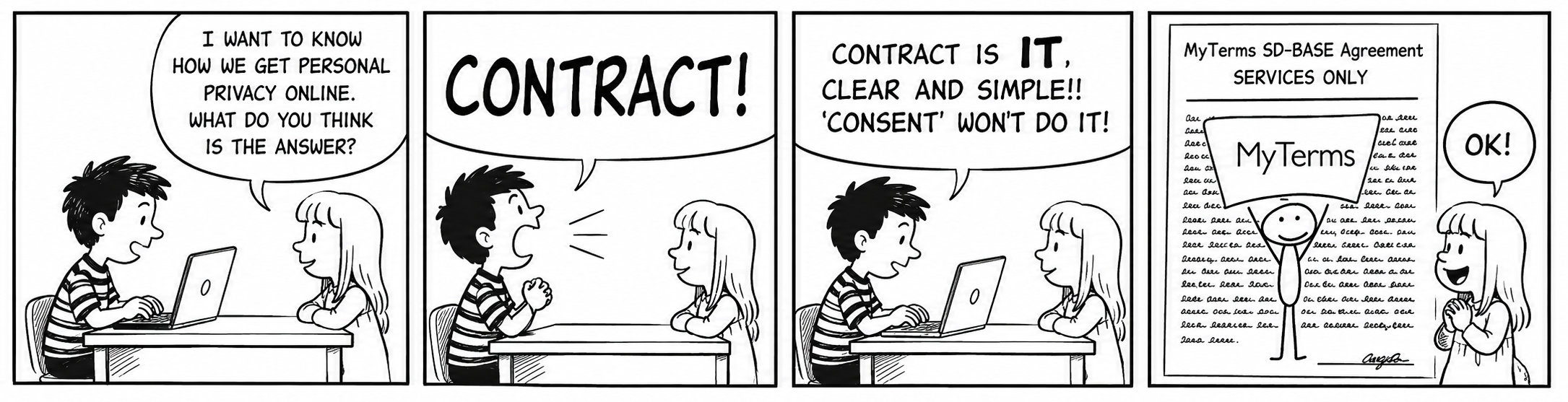
With gratitude to the famous Peanuts cartoon. (And art help from ChatGPT.)

The EU’s new Digital Omnibus proposal aims to update and expand the GDPR, notably with Article 88b, which includes this:

A new Article 88b Regulation (EU) 2016/679 (General Data Protection Regulation), for automated and machine-readable indications of individual choices and respect of those indications by website providers once standards are available.

That was written in June 2025. (I’ve boldfaced the phrases that matter.) We now have a standard for exactly what the EU wants and needs: IEEE 7012-2025—Standard for Machine-Readable Personal Privacy Terms. It is nicknamed MyTerms (much as IEEE 802.11 is nicknamed Wi-Fi) and was published by the IEEE in January 2026 after nine years in the making. Here’s the PDF.

Article 6 of the GDPR lists six bases for the  Lawfulness of Processing:

  1. the data subject has given consent to the processing of his or her personal data for one or more specific purposes;
  2. processing is necessary for the performance of a contract to which the data subject is party or in order to take steps at the request of the data subject prior to entering into a contract;
  3. processing is necessary for compliance with a legal obligation to which the controller is subject;
  4. processing is necessary in order to protect the vital interests of the data subject or of another natural person;
  5. processing is necessary for the performance of a task carried out in the public interest or in the exercise of official authority vested in the controller;
  6. processing is necessary for the purposes of the legitimate interests pursued by the controller or by a third party, except where such interests are overridden by the interests or fundamental rights and freedoms of the data subject which require protection of personal data, in particular where the data subject is a child.

I’ve boldfaced the three that matter, and italicised their core distinctions.

The entire adtech business relies on the first and last of these, consent and legitimate interests, as their excuses for tracking people, allowing them to obey the letter of the GDPR while screwing its spirit.

We see consent at work with every cookie notice we click on or click past. And we have no faith that clicks on consent “choices” provide any privacy protection at all. Reasons:

  1. Most sites ignore cookie choices.
  2. Many sites set cookies even before a cookie choice is made.
  3. It’s obvious that adtech is a personalised guesswork business that relies on surveillance, so most of these “choices” are misdirections away from corporate hunger for personal data.
  4. We have no record of the “choices” we make (and in many cases, no choice is offered), or any way to audit or dispute compliance.
  5. Uninvited and unwanted surveillance is by now so far out of control that cars, TVs, and AI chatbots are all in on the game (and hardly bother with consent notices).

The legitimate interests are advertising and surveillance, which Google, Facebook and the IAB say the world needs, because it funds so much of what happens online.

To the adtech business, personal privacy is a bug, not a feature. The whole business is incentivised to violate privacy, because violating privacy pays. No amount of regulatory oversight will fix that. To adtech, paying fines for privacy violations is just a cost of doing business.

The only fix that will work is what people—customers and citizens—bring to the market’s table. With MyTerms, they can do that.

MyTerms addresses the second of the GDPR’s six legal bases: contract. Put simply, here is what  the MyTerms standard says:

  • The person (not a mere data subject) is the first party, and the site or service is the second party.
  • The person proffers a contractual agreement chosen from a limited roster posted on the public website of a disinterested nonprofit, such as Customer Commons (which was created to do for personal contracts what Creative Commons does for personal copyrights—and which the IEEE approached with the idea for making MyTerms a standard).
  • When the second party agrees, both parties keep an identical record, which supports compliance auditing and dispute resolution. (By preserving evidence, this also creates an infrastructure for dispute avoidance as well.)

The GDPR succeeded by recognising natural persons as holders of rights, but it left intact the industrial age convention in which organisations are the exclusive originators of terms at scale. That’s one reason why persons have remained mere data subjects rather than contractual parties.

Fortunately, the Internet’s base protocols are peer-to-peer. Treating people on the Net as mere “users” and “data subjects” limits their agency. With MyTerms, people acquire a status they yielded when industry won the industrial revolution. (Before the industrial age, surnames—Baker, Müller, Weaver,  Lefebvre, Smith, Marchand, Farmer—signified agency: what people did in the world. That’s just one thing we lost when we became workers, executives, consumers, and users.)

In the natural world, privacy is maintained mostly by tacit agreements. In the digital world there is no tacit, so agreements must become explicit and programmable. This is why contracts are the only way we’ll get real personal privacy in the digital world.

It should also be clear by now that polite requests also don’t work. We tried that with Do Not Track, and by the time it finished failing, the adtech lobby had turned it into Tracking Preference Expression—as if we wanted to be tracked all along.

That main pro-consent lobby is the Interactive Advertising Bureau, or IAB. Among its recommendations for the Digital Omnibus are deleting 88b and  improving consent in various ways, such as  “Revise the proposed stricter consent rules.”

The IAB is blind to the simple fact that people hate being spied on and do what they can to stop it—mainly by turning off ads. By 2015, ad blocking was already the biggest boycott in human history. That boycott rose in direct response to obvious tracking, especially with retargeting. (That’s how one ad or advertiser keeps following you from site to site and app to app.)  And the boycott is much bigger now:

The IAB earned all of that. Yet they still see ad blocking and tracking protection as problems to solve rather than clear and constructive signals from the marketplace.

So it should be clear by now that the old brownfield of consent has become a toxic wasteland of surveillance, lost privacy, and minimised human agency—led by an industry that has been hostile to privacy from the start.

In fact, consent is required for what Shoshana Zuboff calls Surveillance Capitalism. That form of capitalism is based on inferred or extracted consent. The only way we can defeat that regime is by re-basing e-commerce on contractual agreements in which customers take the lead. After all, it’s their privacy that needs protection.

The surveillance economy is limited entirely by its methods, which are built around grabbing attention, harvesting data, and guessing at people.

We can replace it with an intention economy that’s based on what customers actually want. The range of those wants far exceeds what companies and their systems can guess at. Far more business, and business improvement, opens up when market intelligence can flow both ways. In the consent/surveillance regime, it can’t, because all relationships are silo’d in sellers’ separate systems, all built to minimize customer interactions, by design. But relationships built on respectful contractual agreements can be far more capacious when those relationships start with forms of mutual trust that whole markets share. That’s what MyTerms makes possible.

Here is a quick outline of some additional benefits.

For customers, the most obvious one is getting rid of cookie notices, which are annoying and not worth the pixels they are printed on.  If a company really does care about personal privacy, it’ll respect personal privacy requirements. This is how things work in the natural world, where tracking people like marked animals has been morally wrong for millennia. In the digital world, however, agreements need to be explicit, so programming and services can be based on them. MyTerms does that.

For business, MyTerms has lots of advantages:

  • Reduced or eliminated compliance risk
  • Competitive differentiation
  • Lower customer churn
  • A basis for real rather than coerced relationships
  • A basis for better signalling in both directions
  • Reduced or eliminated guesswork about what customers want, how they use products and services, and  how both might be improved

Lawyers get a new market for services on both the buy and sell sides of the marketplace. Companies in the CMP (consent management platform) business (e.g. Admiral and OneTrust) have something new and better to sell to enterprises (and perhaps to people as well).

Lawmakers and Regulators can start looking at the Internet and the Web as places where freedom of contract prevails, and contracts of adhesion (such as what you “agree” to with cookie notices) are obsolete.

Developers can have a field day (or decade). Look for these categories to emerge

In the marketplace, we can start to see all these things:

  • VRM + CRM will flourish, as described by Iain Henderson (one of MyTerms’ authors) in Towards Network-Based Ecosystems.
  • We should expect improvements to digital public infrastructure, as relationships move out of Big Tech’s silos and into distributed relationship frameworks based on the Internet’s base peer-to-peer protocols.
  • Predictions I made in The Intention Economy: When Customers Take Charge (Harvard Business Review Press, 2012) and Tim Berners-Lee made in the Attention vs. Intention chapter of This Is for Everyone: The Unfinished Story of the World Wide Web (Farrar, Straus and Giroux, 2025) will finally come true.
  • There will be new dances between customers and companies. (“The Dance” is a closing chapter of The Intention Economy.)
  • New commercial ecosystems can grow around a richer flow of useful information in both directions, based on shared interest and trust between customers and companies.
  • Surveillance capitalism will be obsolesced — and replaced by an economy aligned with personal agency and mutual respect from contractual partners.

And much more.

So it would be helpful for the European Commission to expand its scope from protecting data subjects to empowering first parties. They can do that by welcoming MyTerms in the Omnibus Directive, expanding human agency into a new greenfield where boundless positive outcomes can flourish.


Drafts of myterms agreements are currently posted at MyTerms.info, which is a project of Customer Commons and MyData Global. You can also read more about MyTerms in writings by Iain Henderson, Nitin Badjatia, and me.

We also invite you to join the ProjectVRM list, where we can converse and collaborate on moving MyTerms forward.

🔲 ☆

The Original and the Eventual Intention Economy

The Intention Economy subtitle. It’s the whole thing, right there.

A recent post by Simon Taylor on X expresses something important about AI agents and markets: if an AI agent arrives in a market with a clear mandate—

Get me X. Budget Y. Constraints Z.

—it obsolesces business-as-usual for digital marketing.

See, all of martech and adtech starts with the assumption that human intent is fuzzy and manipulable—and that the best customers are captive and manipulated. Let’s look at this from three angles, which are also the three things that happen in markets:

  • transactions
  • conversations
  • relationships.

On the transaction side, companies invest heavily in tracking people, analyzing their behavior, targeting ads at them, and then (in many cases) rationalizing extremely wasteful results. Plus, of course, discounting or ignoring boundless negative externalities, such as the annoying people to new extremes and massively abusing personal privacy. (In fact, the system treats absent personal privacy as a base feature.) Anyway, the entire surveillance-based advertising fecosystem exists to guess what people want, or to influence what they might want.

On the relationship side, all we have so far is on the sell side: CRM, for Customer Relationship Management, and CX, for Customer Experience. We’ve been trying here to build (or to encourage building) systems for VRM, for Vendor Relationship Management, to give CRM customer hands to shake. But, in VRM’s absence, CRM is all we’ve got. One hand clapping. Or slapping. Or pushing prospects into a funnel.

What many of us, including Simon Taylor, suggest is facilitating conversation through AI agents. Simon’s case, specifically, is that an agent representing a person doesn’t need to be guessed at. It already knows the user’s intent. So there is no attention to capture and no desire to manufacture or manipulate. The demand signal is clear from the start. That’s why he says agents can collapse the attention economy.

The underlying shift in this direction has been visible for a long time. In The Intention Economy: When Customers Take Charge (Harvard Business Review Press, 2012), I argued that markets work best when customers drive them with clear signals of demand, rather than when sellers try to infer demand through surveillance and unwelcome persuasion. I also said markets can be far richer and more vital when customers and companies operate as equals, with relationships based on mutual interest rather than forms of coercion (such as “loyalty” programs that aren’t).

The work of Vendor Relationship Management (VRM) has been about correcting that imbalance.

Instead of companies managing relationships with customers through CRM (Customer Relationship Management) systems, we need customers able to manage relationships with vendors through VRM (Vendor Relationship Management) tools.

Note that relationship is the middle name of both CRM and VRM. Markets are not just about transactions. They are about relationships that continue over time.

That’s why a working intention economy will involve far more than simple buying transactions.

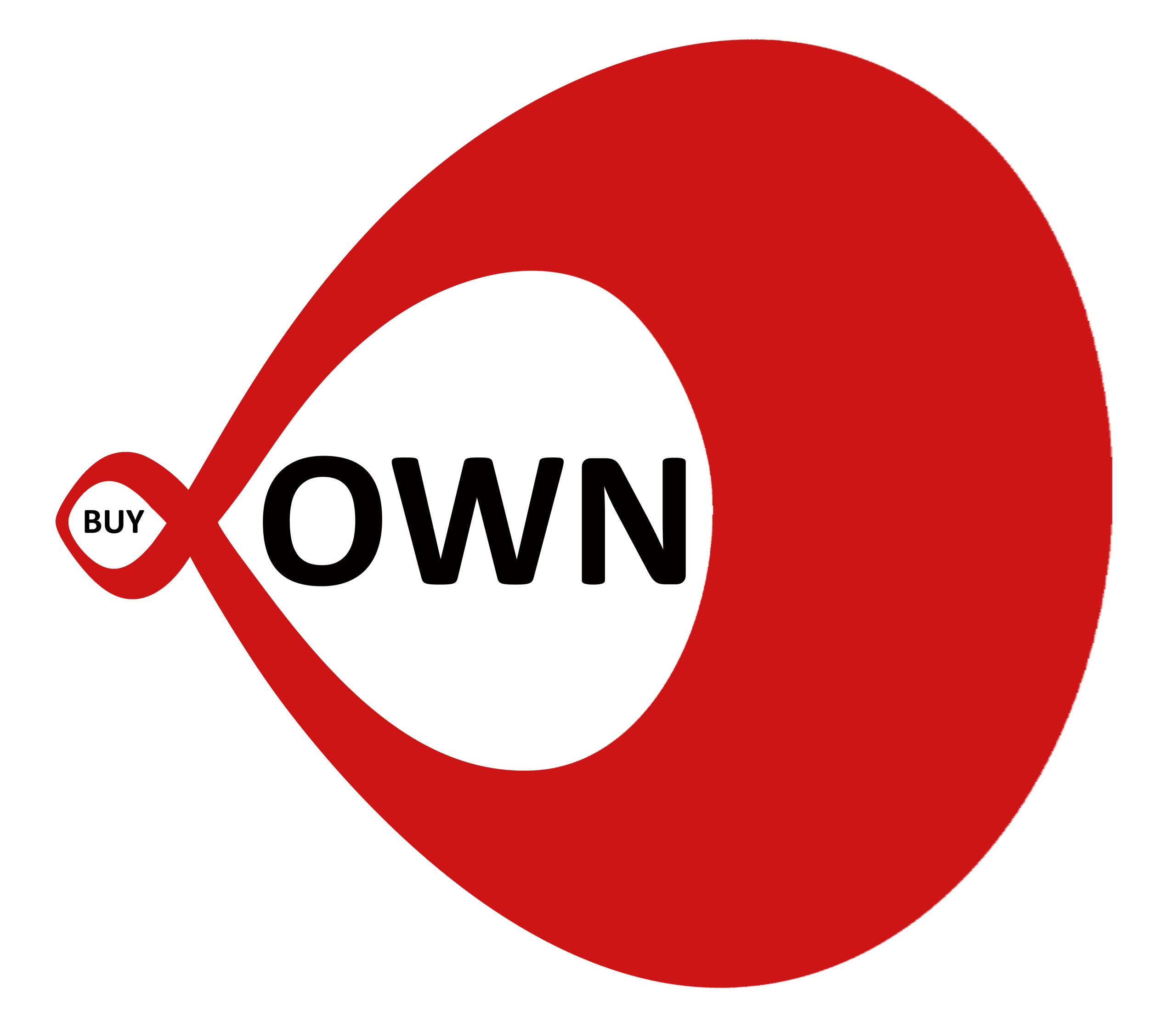
As Esteban Kolsky once put it, companies often focus almost entirely on the “buy cycle.” But customers live mostly in the “own cycle”—the long period of using, maintaining, fixing, improving, and learning from the products and services they already have:

In an intention economy, intelligence about that experience flows both ways between customers and companies. I wrote about this recently here:

Market intelligence that flows both ways.

VRM has long described one key mechanism for this: intentcasting, where customers signal their needs directly to the market rather than being targeted by guesses and ads.

Agents may make this far more feasible than it was when we first started talking about VRM nearly two decades ago.

But there’s an important point that often gets missed in current AI discussions.

The agency that matters most is the person’s, not the agent’s.

A personal AI agent is an instrument—like a phone, a computer, or a car. It acts on behalf of the individual, but the intention behind it must be the person’s own.

And that leads to another requirement:

The only truly personal agents will be owned and operated by individuals.

We don’t have that yet.

What we have instead are assistants that live inside corporate systems—helpful, sometimes impressive, but ultimately operating within feudal structures run by very large companies.

They are, at best, friendly suction cups on the tentacles of giants.

Individuals may well rent or borrow AI models from those giants. But the agents that represent us should operate inside our own environments, in our exclusive interest, rather than inside corporate systems whose interests may diverge from ours.

In other words, our agents should live in our own castles, not inside someone else’s kingdom.

When that happens—when individuals can show up in markets through tools they control—then the deeper shift becomes possible: from guesswork based on surveillance of captive customers to servicing self-qualified leads from free customers in the open marketplace.

Markets then begin to work the way markets are supposed to work: with demand and supply meeting in the open, in relationships that can last far beyond a single transaction.

This is also where work like MyTerms and the emerging ecosystem around personal AI becomes important. If individuals are to operate in markets through their own agents, those agents need ways to assert the person’s terms, preferences, and boundaries in forms that other systems can recognize and respect.

That is the direction VRM has been pointing for nearly twenty years: toward a world where individuals can arrive in markets with their own tools, their own data, and their own terms—and where markets can finally listen.

When that happens, markets will stop guessing what customers want—and start hearing them.

[Later… I actually wrote this post about a month ago, and put off publishing it while I worked on other things. Meanwhile, Adrian Gropper posted A Fork in the Road, which is required reading. I thank him for reminding me in the comments below, and for being a founding participant in ProjectVRM—going back to our earliest meetings almost 20 years ago.]

🔲 ☆

Shooting for the World

There is no organisation on Earth with a more audacious purpose than this one:

From Customer Commons’ current index page.

This isn’t shooting for the Moon. It’s shooting for the whole world of business.

What Customer Commons wants to restore isn’t just what was lost when the Internet got real. (For example, privacy.) Customer Commons also wants to restore personal agency that was lost when Industry won the Industrial Revolution. That’s when jobs replaced work, labour replaced teams, and customers became consumers.

That last shift, Jerry Michalski explains, was from human beings to “gullets with wallets and eyeballs.” After that shift, freedom of contract in marketplaces was enjoyed only by businesses. Not by gullets.

Customer Commons was created to change that. It was spun out of ProjectVRM as a 501(c)3 nonprofit in 2013, shortly after Harvard Business Review Press published  The Intention Economy: When Customers Take Charge. That book specifically gave Customer Commons the job of doing for personal privacy terms what Creative Commons did for personal copyright.  And to do it by making privacy a contract between customers and businesses, rather than a “consent” to whatever the hell businesses wanted to shove down our gullets. (For example, with interruptive cookie “choices” that really aren’t and leave no audit trail.)

Work on that began in 2017, when the IEEE approached Customer Commons with an offer to host development of a standard for machine-readable personal privacy terms. That standard, officially called IEEE 7012-2025, and nicknamed MyTerms, was published this past January, concluding nine years of work.

Now what?

MyTerms is a great start toward completing Customer Commons’ audacious mission. Here are some goals we will achieve when that mission is accomplished:

  1. VRM will be a business category, welcomed and engaged by CRM and CX functions on the sell sides of markets.
  2. We will have proof that free customers are worth more than captive ones—to companies they engage, to whole markets, and to themselves. This was ProjectVRM’s original mission in 2006.
  3. The intention economy will materialize when voluntary signaling from customers to companies outperforms and obsolesces surveillance as the primary means for companies to obtain data about customers.

MyTerms is required for all three, because a contract is the only way for companies to commit to respecting personal privacy, and MyTerms is the standard for doing that.

So the first challenge is to make Customer Commons viable as the first mover in establishing MyTerms in the world.

The second challenge is to make Customer Commons substantial enough to lead work toward all three of the challenges listed above. Customer Commons won’t be the only entity working on those. In the U.S., Consumer Reports has already stepped forward as a natural ally.  MyData Global is partnering with Customer Commons in standing up the MyTerms Alliance, which is HQ’d in Europe. There are many other potential partners, such as Mozilla and the EFF.

There is development work on MyTerms already. You can learn more about those at VRM Day, IIW, and AIW, which run M-F through the last week of this month (April 27 to May 1) at the Computer History Museum in Silicon Valley.

Here are other ideas that have been floated in the past for Customer Commons:

  1. Customers Union. Being for customers what the AARP is for retired people. Only bigger, because it would include everybody who is a customer of anything. This isn’t far from Consumers Union, which begat Consumer Reports, and is now its advocacy group.
  2. CustomerCon. A trade show with company booths run by customers, to which companies are invited as guests. Key feature: no complaining. Guest companies are treated only to positive and constructive ideas. HT to Tim Hwang for helping come up with that one.
  3. Omie. A tablet with apps free of Google and Apple. HT to Iain Henderson.
  4. The ByWay, a new path for local e-commerce.
  5. The Free Customer Award. This would be given to companies that value free customers and do nothing to entrap them. The canonical example described in The Intention Economy is Trader Joe’s. But there are others. In-N-Out Burger, for example.

I share those only to give you an idea of how big and influential Customer Commons might be, and how it’s possible to have fun making a new and better economy happen.

We’re not at Square One. Customer Commons is an extant nonprofit, has an energetic board, and a huge accomplishment by getting MyTerms finished. What it needs now is to build out a working organisation. How can we do that?

Let’s look at how Creative Commons got rolling in 2002 and kept moving after that. Here is what I’ve found in diggings so far—

  • The History of Creative Commons in Wired (December 2011) says, “An hour after the court’s decision was announced, the William and Flora Hewlett Foundation presented Creative Commons with $1,000,000 to launch the movement.” The case was Eldred v. Ashcroft.
  • In 2008, there was a successful funding challenge from Hewlett: “The 5×5 challenge, issued in honor of Creative Commons’ fifth birthday, called for the organization to find five funders to each promise five years of support at $500,000 per year. In addition to the Hewlett Foundation, Creative Commons received pledges of $500,000 in yearly support for five years from Omidyar Network, as well as from an anonymous European trust. Google has pledged $300,000 in support renewable for five years, while Mozilla and Red Hat have each pledged to contribute $100,000 annually for five years. The final block of support comes from the board of Creative Commons, which has promised to personally raise or contribute $500,000 to the organization annually for five years.”(Source: Creative Commons Newsletter No.5, February 2008)
  • A Creative Commons  announcement in April 2008 said, “We’re thrilled about a major new grant of $4 million from the William and Flora Hewlett Foundation, consisting of $2.5 million to provide general support to Creative Commons over five years, as well as $1.5 million to support ccLearn.”
  • A MacArthur grant search reports a total of $3,225,000 provided between 2002 and 2022:
    • $750,000 in 2005 to support general operations for three years
    • $500,000 in 2007 to support Science Commons for two years
    • $700,000 in2008 to support general operations and an endowment campaign for three years
    • $25,000 in 2015 to provide travel and other support for attendees of the Creative Commons Global Summit in South Korea, for two months. The meeting was also funded in part by the Institute for Museu m and Library Services and th e Gates Foundation, and by the Korean Ministry of Culture, Sports and Tourism ($25,000), Mozilla ($10,000), and the Wikimedia Foundation ($10,000).
    • $50,000 in 2022 to support dedicated programming on open journalism issues at the 2023 Global Summit, “which is an annual event that brings together educators, artists, technologists, legal experts, and activists to promote the power of open licensing and global access.”

So, by inference, the phases were roughly this:

  • Launch (2001–2002) $1M of initial funding
  • Early build-out (2002–2004) +$1–3M with  additional foundation support
  • Continuous operations (2005 onward) at ~$1–3M/year

That gives us an idea of what we need to raise. (Given inflation, multiply those numbers by 1.5x.)

I’ll tell you more when I find out more. Meanwhile, watch this space. Better yet, jump in and help out.


🔲 ☆

Toward better buy ways

For sixteen years, ProjectVRM has encouraged the development of tools and services that solve business problems from the customer side. This work is toward testing a theory: that free customers are more valuable—to themselves and to the businesses they engage—than captive ones. That theory can only be tested when tools for doing that are in place.

We already have some of those tools. Our big four in the digital world are the browser, the phone, email, and texting. In the analog offline world, our best model is cash. From The Cash Model of Customer Experience:

Here’s the handy thing about cash: it gives customers scale. It does that by working the same way for everybody, everywhere it’s accepted. It’s also anonymous by nature, meaning it carries no personal identifiers. Recording what happens with it is also optional, because using it doesn’t require an entry in a ledger (as happens with cryptocurrencies). Cash has also been working this way for thousands of years. But we almost never talk about our “experience” with cash, because we don’t need to.

The problem with our four personal digital tools—browser, phone, email and texting—is that they are not fully ours. So our agency is at best compromised. Specifically,

  1. The most popular browsers are also agents of Apple, Google, Microsoft, plus countless thousands of third parties inserting cookies and other tracking instruments into our devices.
  2. Our phones are not just ours. They are corporate tentacles of Apple and Google, lined with countless personal data suction cups from unknown surveillance systems. (For more on this, see Apple vs (or plus) Adtech, Part I and Part II.)
  3. Apple and Google together supply 87% of all email software and services. Apple promises privacy, while Google makes a business out of knowing the contents of your messages, plus every other Google-provided or -involved piece of software reveals to the company about your life. As for how well Apple delivers on its privacy promises, look up apple+compromised+privacy.
  4. The original messaging service for phones, SMS, is owned and run by phone companies. Other major messaging, texting and chat services are run entirely by private companies.
  5. Among common Internet activities, only email and browsing are based on open and simple standards. The main ones are SMTP, IMAP, and POP3 for email, and HTTP/S for browsing. Those share the Internet’s three NEA virtues: Nobody owns them, Everybody can use them, and Anybody can improve them.

This is important: If a product or service mostly works for some company, it’s not yours. You are a user or a consumer. You are not a customer; nor are you operating with full agency in a truly free market. So, while it is obvious that all of us are made more valuable to business, and to ourselves, because we use browsers, phones, email, and messaging, we can’t say that we are free while we do.

But the Internet is still young: dating in its current form—supportive of e-commerce—since 30 April 1995, when the NSFNET (one of the Internet’s backbones) was decommissioned, and its policy forbidding commercial traffic on its pipes no longer stood in the way. The Net will also be with us for dozens or hundreds of decades to come, with its base protocol, TCP/IP, continuing to support freedom for every node on it.

More importantly, there are many business problems best or only solved from the customer side. Here is a list:

  1. Identity. Logins and passwords are burdensome leftovers from the last millennium. There should be (and already are) better ways to identify ourselves by revealing to others only what we need them to know. Working on this challenge is the SSI—Self-Sovereign Identity—movement.  (Which also goes by many other names. The latest is Web5.) The solution here for individuals is tools of their own that scale. Note that there is a LOT happening here. One good way keep up with it is in the Identisphere newsletter.  You can also participate by attending the twice-yearly Internet Identity Workshop, which has been going strong since 2005.
  2. Subscriptions. Nearly all subscriptions are pains in the butt. “Deals” can be deceiving, full of conditions and changes that come without warning. New customers often get better deals than loyal customers. And there are no standard ways for customers to keep track of when subscriptions run out, need renewal, or change. The only way this can be normalized is from the customers’ side.
  3. Terms and conditions. In the world today, nearly all of these are ones that companies proffer; and we have little or no choice about agreeing to them. Worse, in nearly all cases, the record of agreement is on the company’s side. Oh, and since the GDPR came along in Europe and the CCPA in California, entering a website has turned into an ordeal typically requiring “consent” to privacy violations the laws were meant to stop. Or worse, agreeing that a site or a service provider spying on us is a “legitimate interest.” The solution here is terms individuals can proffer and organizations can agree to. The first of these is #NoStalking, and allows a publisher to do all the advertising they want, so long as it’s not based on tracking people. Think of it as the opposite of an ad blocker. (Customer Commons is also involved in the IEEE’s P7012 Standard for Machine Readable Personal Privacy Terms.
  4. Payments. For demand and supply to be truly balanced, and for customers to operate at full agency in an open marketplace (which the Internet was designed to support), customers should have their own pricing gun: a way to signal—and actually pay willing sellers—as much as they like, however, they like, for whatever they like, on their own terms. There is already a design for that, called EmanciPay. Its promise for the music industry alone is enormous.
  5. Intentcasting. Advertising is all guesswork, which involves massive waste. But what if customers could safely and securely advertise what they want, and only to qualified and ready sellers? This is called intentcasting, and to some degree, it already exists. Toward this, the Intention Byway is a core focus of Customer Commons. (Also see a list of intentcasting providers on the ProjectVRM Development Work list.)
  6. Shopping. Why can’t you have your own shopping cart—that you can take from store to store? Because we haven’t invented one yet. But we can. And when we do, all sellers are likely to enjoy more sales than they get with the current system of all-silo’d carts.
  7. Internet of Things. We don’t have this yet. Instead, we have the Apple of things, the Amazon of things, the Google of things, the Samsung of things, the Sonos of things, and so on, each silo’d in separate systems we don’t control. Things we own on the Internet should be our things. We should be able to control them, as independent operators, as we do with our computers and mobile devices. (Also, by the way, things don’t need to be intelligent or connected to belong to the Internet for us to control what’s known about them. They can be, or have, picos.)
  8. Loyalty. All loyalty programs are gimmicks, and coercive. True loyalty is worth far more to companies than the coerced kind, and only customers are in a position to truly and fully express it. We should have our own loyalty programs, to which companies are members, rather than the reverse.
  9. Privacy. We’ve had privacy tech in the physical world since the inventions of clothing, shelter, locks, doors, shades, shutters, and other ways to limit what others can see or hear—and to signal to others what’s okay and what’s not. Instead, all we have are unenforced promises by others not to watch our naked selves, or to report what they see to others. Or worse, coerced urgings to “accept” spying on us and distributing harvested information about us to parties unknown, with no record of what we’ve agreed to.
  10. Customer service. There are no standard ways for customers and companies to enjoy relationships, with useful data flowing both ways, and for help to come when it’s needed. Instead, every company does it differently, in its own silo’d system. For more on this, see # 12 below.
  11. Regulatory compliance. Especially around privacy. Because really, all the GDPR and the CCPA want is for companies to stop spying on people. Without any privacy tech on the individual’s side, however, responsibility for everyone’s privacy is entirely a corporate burden. This is unfair to people and companies alike, as well as insane—because it can’t work. (Worse, nearly all B2B “compliance” solutions only solve the felt need by companies to obey the letter of a law while ignoring its spirit. But if people have their own ways to signal their privacy requirements and expectations (as they do with clothing and shelter in the natural world), life gets a lot easier for everybody, because there’s something there to respect. We don’t have that yet online, but it shouldn’t be hard. For more on this, see Privacy is Personal and our own Privacy Manifesto.
  12. Real relationships: ones in which both parties actually care about and help each other, and good market intelligence flows both ways. Marketing by itself can’t do it. All you get is the sound of one hand slapping. (Or, more typically, pleasuring itself with mountains of data and fanciful maths first described in Darrell Huff’s How to Lie With Statistics, written in 1954). Sales departments can’t do it either, because their job is done once the relationship is established. CRM can’t do it without a VRM hand to shake on the customer’s side. From What Makes a Good Customer: “Consider the fact that a customer’s experience with a product or service is far more rich, persistent and informative than is the company’s experience selling those things, or learning about their use only through customer service calls (or even through pre-installed surveillance systems such as those which for years now have been coming in new cars). The curb weight of customer intelligence (knowledge, know-how, experience) with a company’s products and services far outweighs whatever the company can know or guess at. So, what if that intelligence were to be made available by the customer, independently, and in standard ways that work at scale across many or all of the companies the customer deals with?”
  13. Any-to-any/many-to-many business: a market environment where anybody can easily do business with anybody else, mostly free of centralizers or controlling intermediaries (with due respect for inevitable tendencies toward federation). There is some movement in this direction around what’s being called Web3.
  14. Life management platforms. KuppingerCole has been writing and thinking about these since not long after they gave ProjectVRM an award for its work, way back in 2007. These have gone by many labels: personal data clouds, vaults, dashboards, cockpits, lockers, and other ways of characterizing personal control of one’s life where it meets and interacts with the digital world. The personal data that matters in these is the kind that matters in one’s life: health (e.g. HIEofOne), finances, property, subscriptions, contacts, calendar, creative works, and so on, including personal archives for all of it. Social data out in the world also matters, but is not the place to start, because that data is less important than the kinds of personal data listed above—most of which has no business being sold or given away for goodies from marketers. (See We can do better than selling our data.)

All of these, however, are ocean-boiling ideas. In other words, not easy, especially without what the military calls “robust funding.” So our strategies are best aimed toward what are called “blue” rather than “red” (blood filled) oceans. One of those is the Byway (or “buyway”) project by Customer Commons, in Bloomington, Indiana. An excerpt:

There are three parts to the Byway project as it now stands (in July 2022): an online community (Small Town/mastodon), a matcher tool (Intently), and a local e-commerce “buyway.” (For more on that one, download the slide deck presented by Doc and Joyce at The Mill in November 2021. Or download this earlier and shorter one.)

We also see the Byway as complementary to, rather than competitive with, developments with similar and overlapping ambitions, such as SSI, DIDcomm, picos, JLINC, Digital Homesteading / Dazzle and many others.

Joyce and I, both founders and board members of Customer Commons, are heading up to DWeb Camp in a few minutes, and plan to make progress there on Byway development. I’ll report here on progress.

[Later…] DWeb Camp was a great success for us. We are now in planning conversations with developers and others. Stay tuned for more on that.

❌