Vue lecture

Il y a de nouveaux articles disponibles, cliquez pour rafraîchir la page.
🔲 ☆

The end of what’s on, when, and where

But not of who, how, and why. Start by looking here:

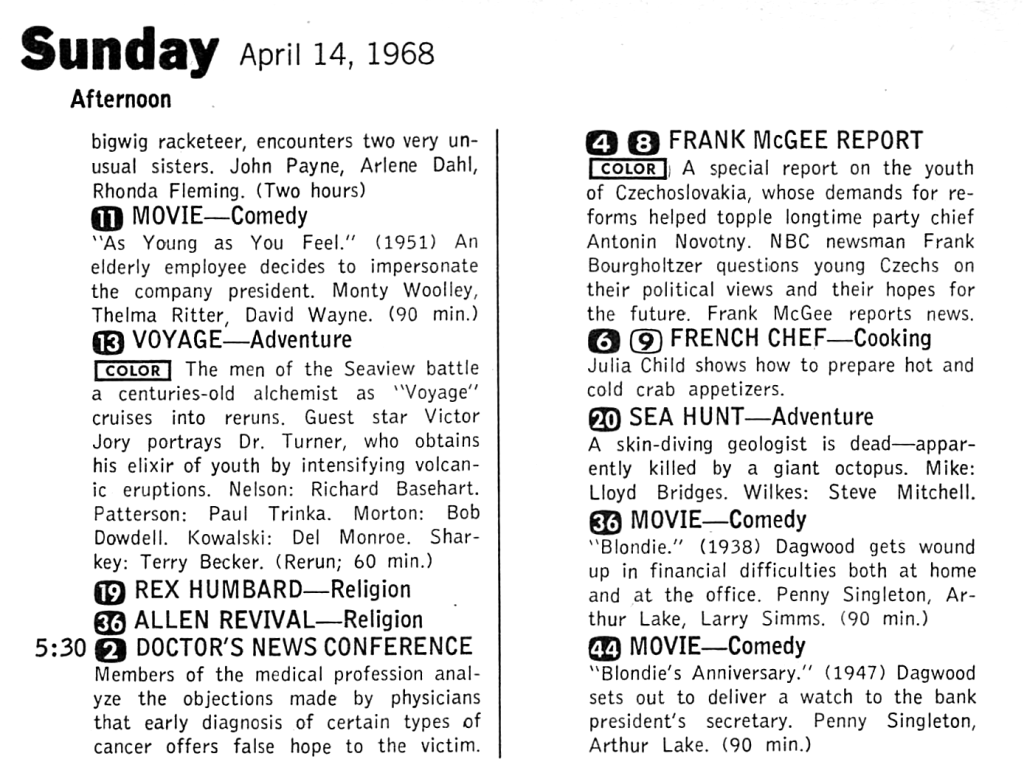
tv guide page

That’s a page of TV Guide, a required resource in every home with a TV, through most of the last half of the 20th century.

Every program was on only at its scheduled times. Sources were called stations, which broadcast over the air on channels, which one found using a dial or a display with numbers on it. Stations at their largest were regional, meaning you could only get them if you were within reach of signals on channels.

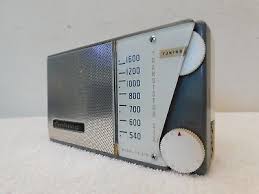
Continental transistor radioBy the time TV came along, America was already devoting its evenings to scheduled programs on AM radio, which was the only kind of radio at the time.  After TV took over, everyone sat in a room bathed in soft blue light from their TV screen. Radio was repurposed for music, especially rock & roll. My first radio was the one on the right. Being in a New York suburb, my stations were WMCA/570, WMGM/1050, WINS/1010, WABC/770, and WKBW/1520 (coming in at night from Buffalo, loud as a local). All of those stations are still on the air, but playing talk, sports and religious programs.  Many fewer people listen to AM radio, or over-the-air anything, anymore. They watch and listen to glowing rectangles that connect to the nearest router, wi-fi hot spot, or cellular data site. Antennas exist, but wavelengths are so short that the antennas fit inside the rectangles.

The question “what’s on?” is mostly gone. “Where?” is still in play, at least for TV, because nobody knows what streaming service carries what you want. All the “guides”—Apple’s, Google’s, Amazon’s, everyone’s—suck, either because they’re biased to promote their own shows or because there’s simply too much content and no system to catalog and display all of it. Search engines help, but not enough.

The age we’re closing is the one Jeff Jarvis calls The Gutenberg Parenthesis. The age we’re entering is the Age of Optionality. It began for print with blogging, for TV with VCRs and DVRs, and for radio with podcasting and streaming. John Robb calls what we have now packetized media. It is obsolescing all the media we knew, almost too well, by putting it in the hands Clay Shirky named in 2009 with Here Comes Everybody.

What we make of this new age is now up to all of us. We are who, how, and why.


🔲 ☆

Emission de radio LIBRE JOURNAL DE LA RÉSISTANCE FRANÇAISE DU 17 JANVIER 2024

Réécoutez l’émission de Nicolas Stoquer « Le libre journal de la résistance française » du 17 janvier 2024.

Dans la 2ème partie de l’émission, Nicolas Stoquer reçoit le Dr Philippe Dransart pour parler du livre d’Olivier Soulier « Comprendre le sens des eczémas atopiques ». Egalement un hommage du Dr Vincent Reliquet à son collègue nordiste.

Nicolas Stoquer, assisté de Lara Stam, reçoit :

  • Corinne Lalo, journaliste à Grands Reporters
  • François Godeau, directeur de recherche de l’INSERM, médecin
  • Vincent Reliquet, médecin généraliste dans le nord de la France, fondateur de l’Association Internationale pour une Médecine Scientifique Indépendante et Bienveillante (AIMSIB)
  • Pierre Chaillot, statisticien
  • Philippe Dransart, médecin homéopathe, phytothérapeute


Ecoutez l’émission : https://www.radiocourtoisie.fr/2024/01/17/libre-journal-de-la-resistance-francaise-du-17-janvier-2024-scandales-sanitaires-suite-mais-pas-fin/

Paru dans la Lettre Médecine du Sens n° 355

🔲 ☆

Ripples

The song “Ripple,” by the Grateful Dead, never fails to move me. Here’s a live performance by the Dead, in 1980, on YouTube.

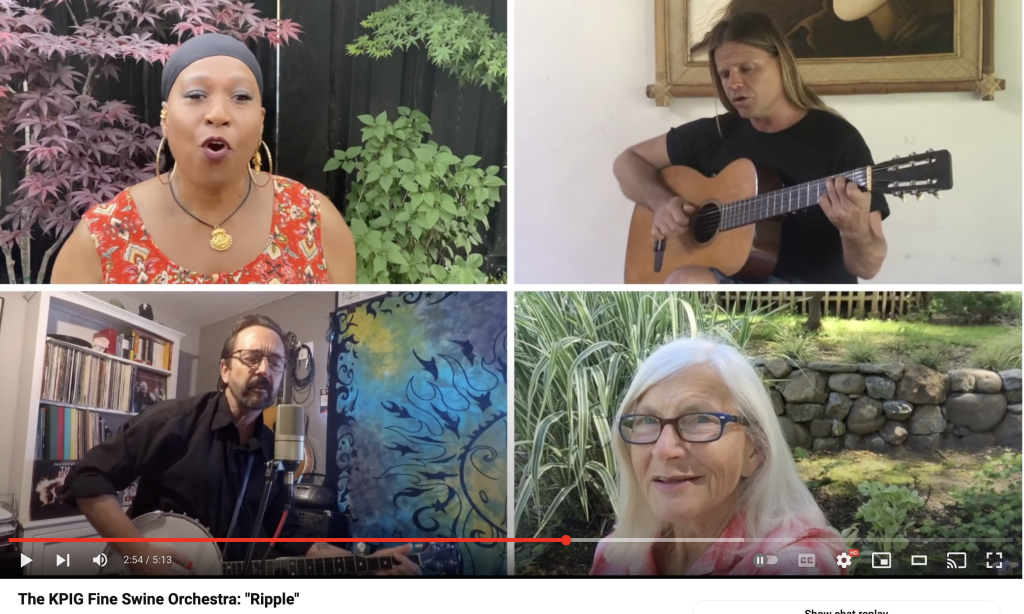
My favorite version, however, is this one by KPIG’s Fine Swine Orchestra, recorded by Santa Cruz musicians sheltering in place during the pandemic. That’s a screen grab, above.

I am pretty sure I’ve blogged about “Ripple” before, but can’t find evidence of that right now, perhaps because I published it somewhere obscure, or perhaps because we have entered the Enshittocene. Whatever the case, it doesn’t hurt to re-hear a classic.

KPIG, long one of my favorite radio stations, is no longer live streaming for the world, but for subscribers only. (It’s free only for a week.) I know they need the money. But so does Radio Paradise, which has KPIG ancestry, is free, and supported by donations.

Toward normalizing the donations for every worthy thing, see what I wrote here.

🔲 ☆

La Ferme Urbaine où les sourires fleurissent

SUR DE BONS RAILS 3/4 : LA FERME URBAINE OÙ LES SOURIRES FLEURISSENT

Le 20 février 2023

Cette mini-série de reportages offre une immersion sonore au sein de la REcyclerie. La programmation culturelle, la Ferme Urbaine, le Café-Cantine, l’Atelier de REné : avec ses quatre facettes et sa nouvelle agence, ce tiers-lieu parisien entend faire bruisser les écologies sociales et culturelles.

Épisode 3 : La Ferme Urbaine où les sourires fleurissent.

Chaque vendredi après-midi, Isabelle se rend à la Ferme Urbaine. Elle y dépose son compost, nourrit les poules, et retrouve un brin de campagne. Elle retrousse ses manches et rejoint ensuite les autres bénévoles pour un chantier participatif. Aujourd’hui, iels sont une petite dizaine à installer des gouttes à gouttes dans la serre. Et les sourires fleurissent.

Pour aller plus loin

Sophie Labruyère, Nicolas Meyrieux, (Agri)culture : semer, filmer, résister, Radio REcyclerie, août 2022.

Julien Vidal, Qu’est-ce qu’un métier porteur de sens ?, Radio REcyclerie, mars 2023.

Jean-Baptiste Fressoz, La décroissance pour sortir de l’accumulation énergétique ?, Radio REcyclerie, janvier 2024.

L’équipe

Production et programmation : La REcyclerie.

Réalisation : Simon Beyrand.

Illustration : Belen Fernandez – Olelala.

Sound design : JFF.

Pour suivre ce podcast

S’abonner à Radio REcyclerie : RSS, APPLE PODCASTSPOTIFYDEEZER, Podcast addict, YOUTUBE, IMAGO, etc.

S’inscrire à la newsletter du podcast.

Radio REcyclerie : toutes les émissions en réécoute

L’article La Ferme Urbaine où les sourires fleurissent est apparu en premier sur La REcyclerie.

🔲 ☆

Le Café-Cantine où tout se cuisine.

SUR DE BONS RAILS 2/4 : LE CAFÉ-CANTINE OÙ TOUT SE CUISINE.

Le 13 février 2024

Cette mini-série de reportages offre une immersion sonore au sein de la REcyclerie. La programmation culturelle, la Ferme Urbaine, le Café-Cantine, l’Atelier de REné : avec ses quatre facettes et sa nouvelle agence, ce tiers-lieu parisien entend faire bruisser les écologies sociales et culturelles.

Épisode 2 : Le Café-Cantine où tout se cuisine.

Le service approche. Hugo, le chef de la cantine, est « on fire. » Ce midi, il a concocté avec son équipe des plats aux petits oignons dans une ambiance des grands jours. Aromates issus de la ferme urbaine, épluchures réutilisées ou compostées : chaque démarche est fructueuse. À quelques mètres, au coin pâtisserie, Alice peaufine les banana breads, les carrot cakes, les moelleux aux pommes vegans. Nous voilà dans l’embarras du choix.

Pour aller plus loin

Jean-Baptiste Fressoz, La décroissance pour sortir de l’accumulation énergétique ?, Radio REcyclerie, janvier 2024.

Julien Vidal, Qu’est-ce qu’un métier porteur de sens ?, Radio REcyclerie, mars 2023.

Élisabeth Lavaill, Alexis Mattei, Pierre Blanchemaison, REcyclotour : le vélo vintage, ça roule !, Radio REcyclerie, juin 2021.

L’équipe

Production et programmation : La REcyclerie.

Réalisation : Simon Beyrand.

Illustration : Belen Fernandez – Olelala.

Sound design : JFF.

Pour suivre ce podcast

S’abonner à Radio REcyclerie : RSS, APPLE PODCASTSPOTIFYDEEZER, Podcast addict, YOUTUBE, IMAGO, etc.

S’inscrire à la newsletter du podcast.

Radio REcyclerie : toutes les émissions en réécoute

L’article Le Café-Cantine où tout se cuisine. est apparu en premier sur La REcyclerie.

🔲 ☆

Sur de bons rails 1/4 : L’Atelier où tout renaît (même ce Magimix).

SUR DE BONS RAILS 1/4 : L’ATELIER OÙ TOUT RENAÎT (MÊME CE MAGIMIX).

Le 6 février 2024

Cette mini-série de reportages offre une immersion sonore au sein de la REcyclerie. La programmation culturelle, la Ferme Urbaine, le Café-Cantine, l’Atelier de REné : avec ses quatre facettes et sa nouvelle agence, ce tiers-lieu parisien entend faire bruisser les écologies sociales et culturelles.

Épisode 1 : L’atelier où tout renaît (même ce Magimix).

Dimitri a cassé son Magimix, son appareil qui lui offre la « magie du mixage » tous les matins pour ses jus d’oranges. Habitant de Saint-Ouen dans le 93, il entre pour la première fois dans l’Atelier de REné. Ou plutôt, dans l’atelier de Mouloud, un as de la bricole qui fait renaître chaque objet. Après un diagnostic et quelques blagues échangées, l’objet est bel et bien réparable. C’est le début d’une nouvelle vie pour ce Magimix, et d’une belle histoire entre les co-réparateurs Dimitri et Mouloud.

Pour aller plus loin

Jean-Baptiste Fressoz, La décroissance pour sortir de l’accumulation énergétique ?, Radio REcyclerie, janvier 2024.

Julien Vidal, Qu’est-ce qu’un métier porteur de sens ?, Radio REcyclerie, mars 2023.

Élisabeth Lavaill, Alexis Mattei, Pierre Blanchemaison, REcyclotour : le vélo vintage, ça roule !, Radio REcyclerie, juin 2021.

L’équipe

Production et programmation : La REcyclerie.

Réalisation : Simon Beyrand.

Illustration : Belen Fernandez – Olelala.

Sound design : JFF.

Pour suivre ce podcast

S’abonner à Radio REcyclerie : RSS, APPLE PODCASTSPOTIFYDEEZER, Podcast addict, YOUTUBE, IMAGO, etc.

S’inscrire à la newsletter du podcast.

Radio REcyclerie : toutes les émissions en réécoute

L’article Sur de bons rails 1/4 : L’Atelier où tout renaît (même ce Magimix). est apparu en premier sur La REcyclerie.

🔲 ☆

Des livres et des gens – RIG fm 90.7

Ma participation à l’émission « Des livres et des gens » sur RIG fm 90.7 a été l’occasion d’exposer différents éclairages sur les perturbations qui agitent la période actuelle. Lors de cette interview j’ai pu démontrer comment l’outil astrologique s’avère très performant pour expliciter les troubles qui perturbent notre quotidien. Ce fut également l’occasion de livrer quelques indices sur les avenirs possibles. Cette intervention faisait suite à la parution de mon livre « Le niveau vibratoire de la Terre » chez Terre en Ciel éditions. Je remercie Jérôme Vigouroux de m’avoir invité à participer à cette émission.

The post Des livres et des gens – RIG fm 90.7 first appeared on Les yeux ouverts.

💾

🔲 ☆

A look at broadcast history happening

When I was a kid in the 1950s and early 1960s, AM was the ruling form of radio, and its transmitters were beyond obvious, taking the form of towers hundreds of feet high, sometimes in clusters formed to produce directional signals favoring some directions over others. These were typically landmarks out on the edge of town, or standing oddly on salt bogs or farmland.

From my bedroom in New Jersey, not far across the Hudson from New York City, I could see the red lights on the tops of towers standing in the “Meadowlands” (we called them swamps then) with Manhattan’s skyline beyond.

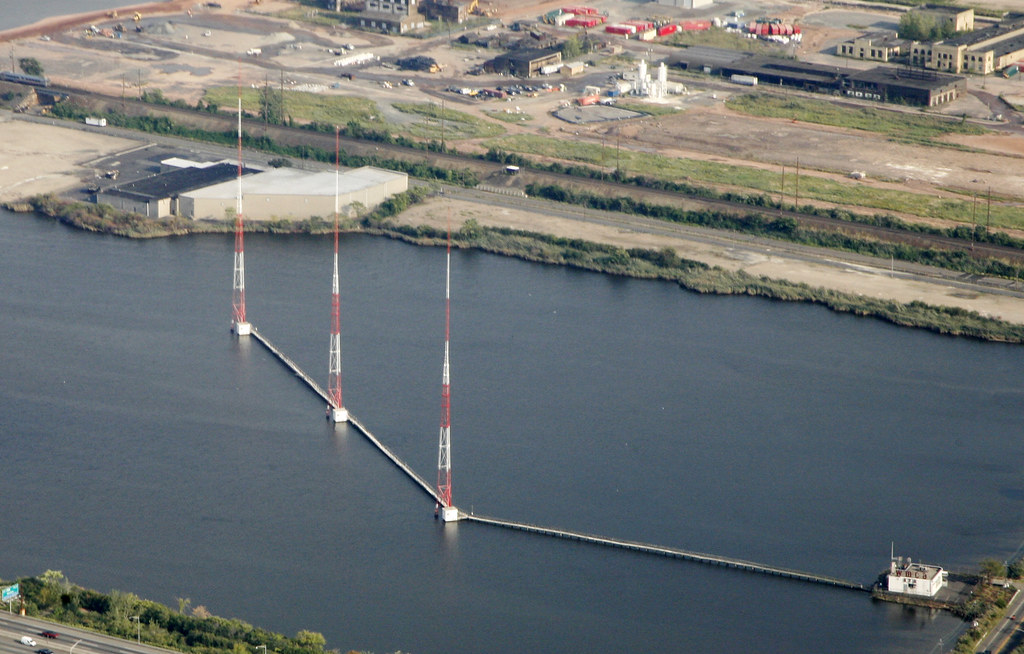
The towers in the photo above are three of those, tasked with beaming WMCA/570 and WNYC/820 toward New York’s boroughs from a pond of impounded water beside the Hackensack River and the east spur of the New Jersey Turnpike. Built in 1940, these three towers have by now become the most-seen AM radio signal source on Earth. For a while, they were also the most heard. That’s because, in its prime, which ran from 1958 to 1966, WMCA was also the leading top 40 music station in the world’s leading radio market. (WABC, with a signal ten times as strong, ruled the suburbs, with a night signal heard across half the country.)

While these days WNYC is the AM side of New York’s public radio empire (which brings in more money, largely from listeners, than any of the commercial stations in town), it is most famous for Mayor Fiorello LaGuardia’s “Talk to the People” show, which ran in the first half of the 1940s. (Back then WNYC had its own towers standing on what’s now WNYC Transmitter Park, alongside the East River in Brooklyn.)

Prior to the Internet, major media comprised a fewness of sources, in both print and broadcast. That fewness is over now, and the writing of over-the-air broadcasting’s end is being written on the Internet’s walls, perhaps most purposefully by yours truly. Because I’ve shot and shared thousands of photos of transmitters and antennas, knowing that the land under the most vulnerable ones—those on the AM band—tends to be worth more than the signals themselves. Many of these sites have already been sold off, with signals moving to shared towers on other stations’ sites, or just going dark.

Radio itself is also slowly being eaten alive: on the talk side by podcasts and on the music side by streaming services and webcasters. So I publish those photos as historical evidence of what in a few years (decades at most) will be no more. (Sorry, but no amount of lawmaking or regulation will save AM radio. Much as many of us—me included—still love it, neither the tech nor the economics can compete with the Internet, smartphones, the cellular system, and computers.)

So I recently ran a test of a theory: that it is good to have a conversation about all these developments, at least among professionals both active and retired in the broadcast engineering world. What follows is a post I put up for a private group that includes more than a dozen thousand of those.

Some hopefully fun detective work.

First, an ad in the November 14, 1949 issue of Broadcasting, the Youngstown-based company that built (or supplied steel) for countless AM stations in that band’s golden age. The image is of the array of six 400-foot tall self-supporting towers putting out the directional night signal for WFMJ, now WNIO/1390. HT for scanning and publishing that page goes to David Gleason, who gives us the amazing and valuable [https://worldradiohistory.com/](https://worldradiohistory.com/)

Second is a Google StreetView of what I think is the current view of the same site, with the transmitter shack and the six towers replaced. One of those is also a tower in WKBN’s own directional nighttime array. (Also, in the distance is another tower that appears not to participate in either station’s system.)

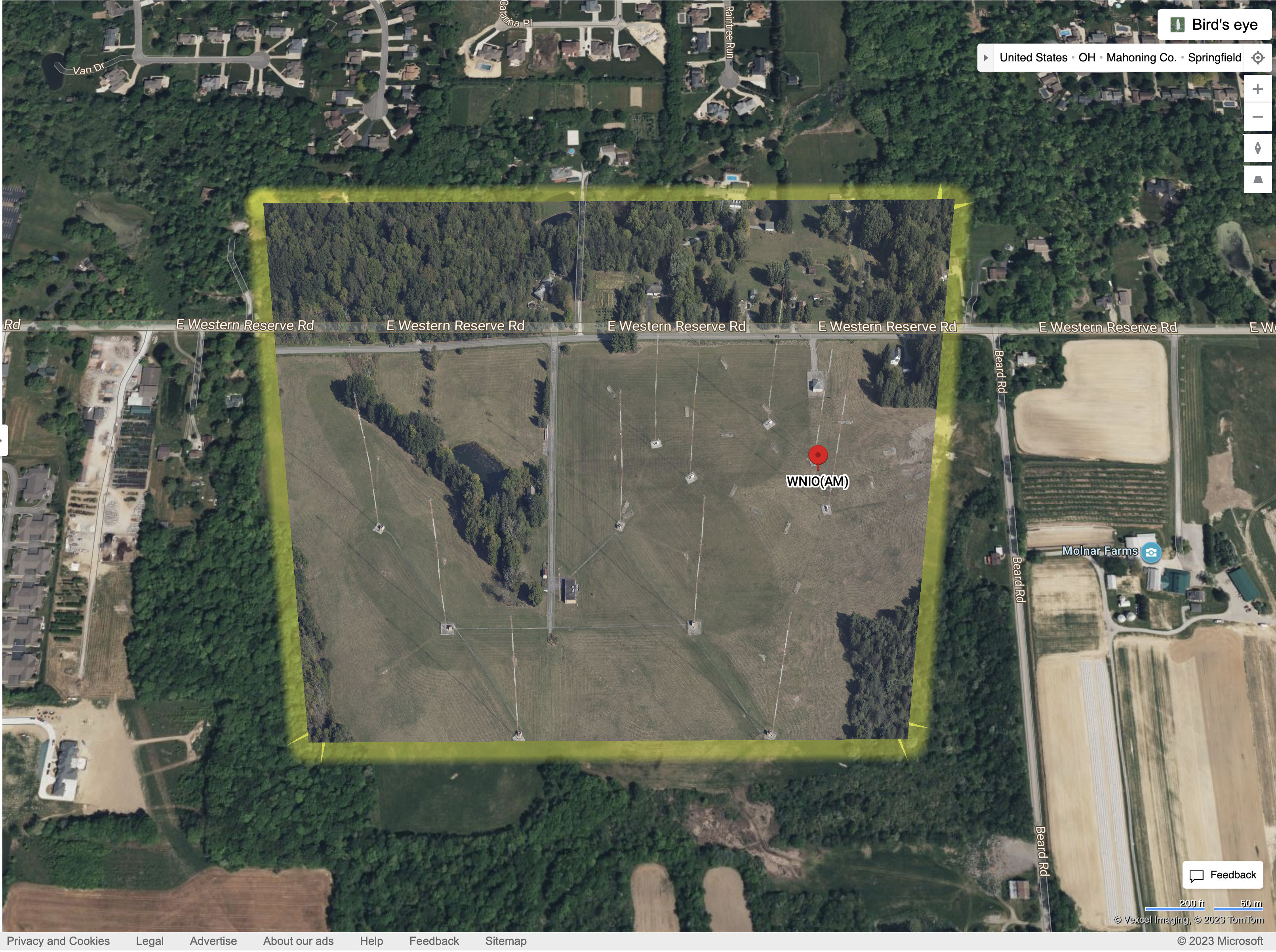
Third is a Bing Birds Eye (a fixed-wing aircraft) view of the whole site:
And a fourth is the Google view from space of the same.
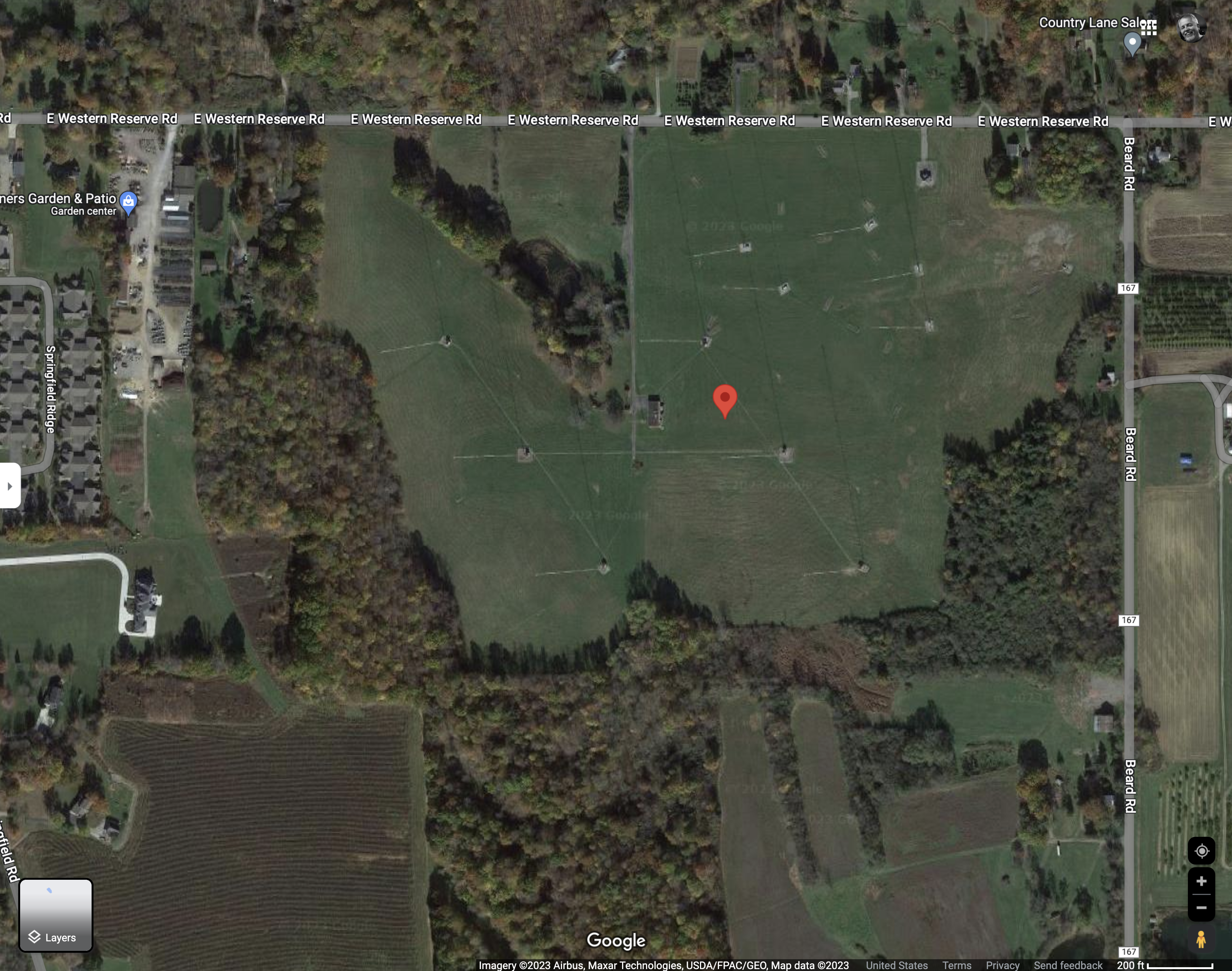
Of possible relevance is that WNIO and WKBN are non-directional by day, the former from a tower at another site in town. Also that WNIO was a 5kw DA-N from the site for most of its life and is now 9.5kw from the day site and 4.8kw from the night site we see in these images—and that its six towers have six different electrical lengths, ranging from 105.8° to 215.1°, apparently in slightly different positions on the ground. Also that WKBN has been 5kw day and night since the late 1940s.

We can also see from the Truscon ad that the original address of WFMJ was on Poland-Broadmans Road, which I think is now just Broad. (The current shack for WNIO is on East Western Reserve Road, while WKBN’s is at the end of a long driveway off that same road.) One can also see from above something of the entrance off broad and possibly something of the original footprint of the original tower layout.

So, some questions are:

1) Is the first photo from the entrance to the site in the Truscon ad?
2) When did WKBN show up, or was it already at this site?
3) Are the different lengths of towers in the current WNIO array the result of more efficient towers in it, and also why the 4.8kw signal roughly matches the old 5kw footprint on the ground?
4) In 1949, were six towers about the limit of what one could do with a directional array using long math, trig tables, and graph paper, and perhaps a record number for its time?
5) Was Truscon the outfit that pioneered narrow rather than fat towers, and ones with three sides rather than four?

There are other variables, of course. But I just enjoy this kind of detective work, and I’m kinda chumming the waters to bait others who like to do the same. Thanks in advance.

We’ll see who rises to the bait and with what.

[Later…] Old pal Scott Fybush pointed to one of his transmitter visit reports and added this:  “Summary: the current WNIO night site is not the original 1949 six-tower site. That was on what’s now Boardman-Poland Road (US 224) at what’s now the Shops at Boardman Park strip mall. It succumbed to development in the early 1990s, at which point 1390 moved to what’s now its current day tower. The current six-tower night array on Western Reserve Rd. was built in 2003, next to the 1977-vintage WKBN array. WKBN’s original DA was at the WKBN studios at 3930 Sunset, which is still the WKBN-TV facility.”

Given that radio’s content (as we now call it) is gone at the speed of short-term memory (unless it’s recorded, which mostly it isn’t), this kind of reporting may be the only history it has. So, if history matters, this kind of inquiry also matters.


The top photo is one of many I’ve shot on en route to EWR (Newark Liberty International Airport). By the way, these towers were built when one could walk on the land there. One needed boots and a scythe, but it was possible. The water was impounded in the 1990s, I think. Here are some shots from a visit to the site nine years ago.

❌