Vue lecture

Il y a de nouveaux articles disponibles, cliquez pour rafraîchir la page.
🔲 ☆

From the Economy to the Sumbonomy*

On a foundation of Symbiocene life law based on ghehds, we need to develop a replacement concept for economics, one immersed in symbiosis. As was argued in chapter 4, the term ‘economy’ is based on ‘oikos,’ or the Greek word for the household. The general meaning relates to the (male) management of the household. The new term, ‘sumbonomy’ (sum-bon-o-mee), in addition to the ‘sumbios’ (living together) and ‘nomia’ (to manage), has echoes of the ‘summum bonum,’ a Latin expression for the highest or ultimate good. The French word ‘bon’ also means good. The ‘economy’ of the Anthropocene is replaced by the sumbonomy of the Symbiocene.

As such a social structure does not yet exist, I can only offer speculative thoughts on what form it might take. The sumbonomy is the highest form of practical living humans can undertake for a good life. The sumbonomy is the material foundation for humans living in nature, and we can now create the new conceptual domain of sumbonomics. It has a transdisciplinary partner in sumbiology, or the study of humans living together with each other and other forms of life.

Contrary to the degrowth movement, this conceptual domain can align human enterprise with the symbiotically generated growth that can be found in life. To generate this type of growth, we will need new, creative forms of design and technology based on symbioactive production and benign symbiomimicry. It is from the microcosm—the fungi, algae, bacteria, and archaea, the building blocks of complex life—that the human sumbonomy can be created.

The sumbonomy will be the result of sumbiocentric thinking and, because of the potential for mersis in the Anthropocene, will require the most intense period of genuine growth since the Industrial Revolution. I wish to see the pro-parasitic or terraphthoric (earth destroying) ‘economy’ of the Anthropocene totally replaced by the terranascient (earth-creating) ‘sumbonomy’ of the Symbiocene.

Fossil fuels are finite reserves of energy that can be used only once and are not able to be regenerated in meaningful geological time frames, and similar considerations apply to an insane economy that becomes dependent on “rare” earth elements and compounds. Fossil fuels, because of their finitude, can be owned and traded for wealth maximization. Rare earths are like diamonds. While the current technologies we use to generate renewable energy can be privately owned, the source of that energy, the sun, cannot.[i]

In switching from private property ownership and extraction rights to symbiotically produced resources respectful of the ghehds (intersecting life interests) of free-living microorganisms, we metamorphose from the Anthropocene to the Symbiocene. In doing this, we give microorganisms the space and resources to do what they would want to do anyway, such as reproduce and grow. That is how we shift from the scarcity of fossil fuel energy and materials to the abundance of life forms powered by the sun, plants, and microorganisms, from morbid dead carbon to vital living carbon.


[i] Ralph Nader is supposed to have said “The use of solar energy has not been opened up because the oil industry does not own the sun.” The other way of putting this quote would be to argue that if the oil industry owned the sun, we would have had sun powered renewable energy for everything by now. The good news is that nobody can own the sun as it is an inviolable common with an inviolable ghehd that is more powerful by quantum leaps than all the corporations and despots of the world combined.

*Draft material from The Symbiocene: Our Only Future (2027), Cornell University Press.

AI generated image of a solar shrine where humans once again pay homage to our energy common, the Sun.


🔲 ☆

Sumbiotecture and More

Sumbiotecture

To design and build according to Symbiocene principlessumbiocentric thinking, symbiomimicry and the discipline of sumbiology, (sumbios: living together and techne: to build). The archi in architecture means to rule or to command … it has to go. We used to talk about form and function … now we must talk about process, form and function.

Symbioscapes

Symbiotically animated landscapes that require sumbiocentric thinking to bring the scape (a stalk) to life., (symbiosis, living together, from sumbios).

Sumbioversity

A place where sumbiosic thinking and sumbiosity can house sumbiotecture and the study of symbioscapes.

From Earth Emotions (2019):

Habitat

 “Cities, as they are currently configured, owe their existence to globalized gigantism, supported by the carbon-intensive global transport of goods by aircraft, shipping and trucks. Symbiocene planners agree with Bill Rees in seeing cities as “entropic black holes” failing in all superficial attempts at even pseudo-sustainability with their ‘green walls’.[1] We will need to exit the megapolis and live in what we could call the “sumbiopolis”. I have no clear idea of what this kind of city will look like, but would not rule out the ‘living city’ of Frank Lloyd Wright’s ‘Broadacres’ countryside, complete with skyscrapers, forests and factories, surrounded by agricultural fields; an assemblage he described as “patterns of cultivation mingling with good buildings”.[2] I can also see Friedensreich Hundertwasser’s organic, living design and architecture, informing every aspect of the built symbioment.[3] Finally, architects and designers will be able to create organic form and flow in their work. The era of the straight line and ‘the box’ ends, as engineers figure out how to replace Anthropocene concrete and steel (two of the highest emitters of carbon) with new materials that satisfy Symbiocene principles.”

 [1] Rees 1997.

[2] Wright 1958, 198.

[3] Hundertwasser 1997.

🔲 ☆

Relief Maps – L’app d’itinéraires indispensable pour vos aventures outdoor

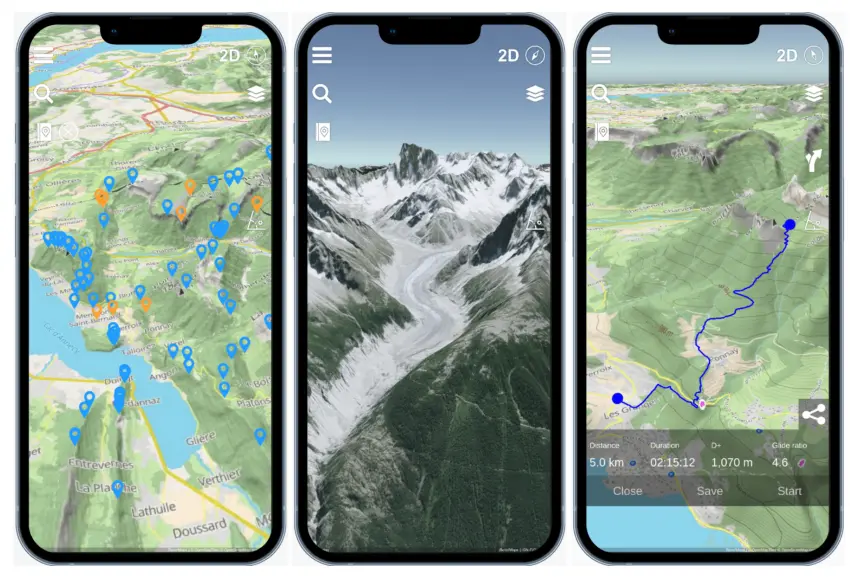
Vous êtes un passionné d’activités en pleine nature comme la randonnée, le ski de randonnée ou encore le parapente ? Alors laissez-moi vous présenter l’application mobile Relief Maps ! Créée par Batiste, un lecteur de Korben.info, cette petite merveille va révolutionner vos sorties dans la pampa.

Fini les galères d’orientation, avec Relief Maps, vous avez accès à des cartes 3D ultra détaillées pour la randonnée qui vont vous permettre de visualiser votre environnement comme jamais : Vallées, sommets, cols, sentiers… Tout est représenté de manière intuitive et interactive. Vous pouvez zoomer, dézoomer, faire pivoter la carte dans tous les sens pour mieux appréhender le terrain. Bref, c’est un vrai régal pour les yeux et un outil hyper pratique pour préparer vos itinéraires.

En parlant d’itinéraires, l’application propose un catalogue très fourni de parcours pour différentes activités et cela dans le monde entier : randonnée à pied ou à ski, alpinisme, trail… Il y en a pour tous les goûts et tous les niveaux ! Vous pouvez aussi créer vos propres tracés, les enregistrer et les partager avec la communauté. C’est top pour découvrir de nouveaux spots ou échanger des bons plans avec d’autres passionnés.

Autre point fort de Relief Maps : son mode hors-ligne. Parce qu’en montagne, on n’a pas toujours du réseau (ce serait trop facile sinon), l’application permet de télécharger des cartes pour les consulter offline. Comme ça, même au fin fond du Queyras ou du massif des Écrins, vous pouvez continuer à vous repérer sans problème. Génial pour éviter de se retrouver comme un con à bouffer son casse-croûte en pleine face nord !

Mais Relief Maps, ce n’est pas qu’une app de cartographie, c’est aussi une mine d’infos pour optimiser vos sorties : Relevés météo détaillés, webcams des sommets, horaires des remontées mécaniques pour les skieurs… Tout est à portée de doigt pour ne rien laisser au hasard. De quoi mettre toutes les chances de votre côté pour profiter un max !

Alors certes, même si la plupart des fonctionnalités sont gratuites, celles pour les pro ont un coût. Pour débloquer le plein potentiel de l’application (cartes hors-ligne, couches spécifiques, météo…), il faudra passer à la version Premium. Comptez donc un abonnement à 29,99 € par an. Ça peut paraître un peu cher mais croyez-moi, vu tout ce que vous avez pour ce prix-là, ça les vaut largement ! C’est toujours moins qu’un télésiège à la journée et au moins, vous êtes sûr de rentabiliser votre investissement.

Alors encore un grand bravo à Batiste pour cette app bien pensée et diablement efficace. Je la recommande à tous les amoureux de nature et de sensations fortes !

L’application est disponible gratuitement sur l’App Store et le Google Play Store. Il suffit de la télécharger sur votre smartphone et vous êtes parés pour vos prochaines aventures en altitude.

🔲 ☆

Un client IRC fonctionnel intégré dans un BIOS (UEFI)

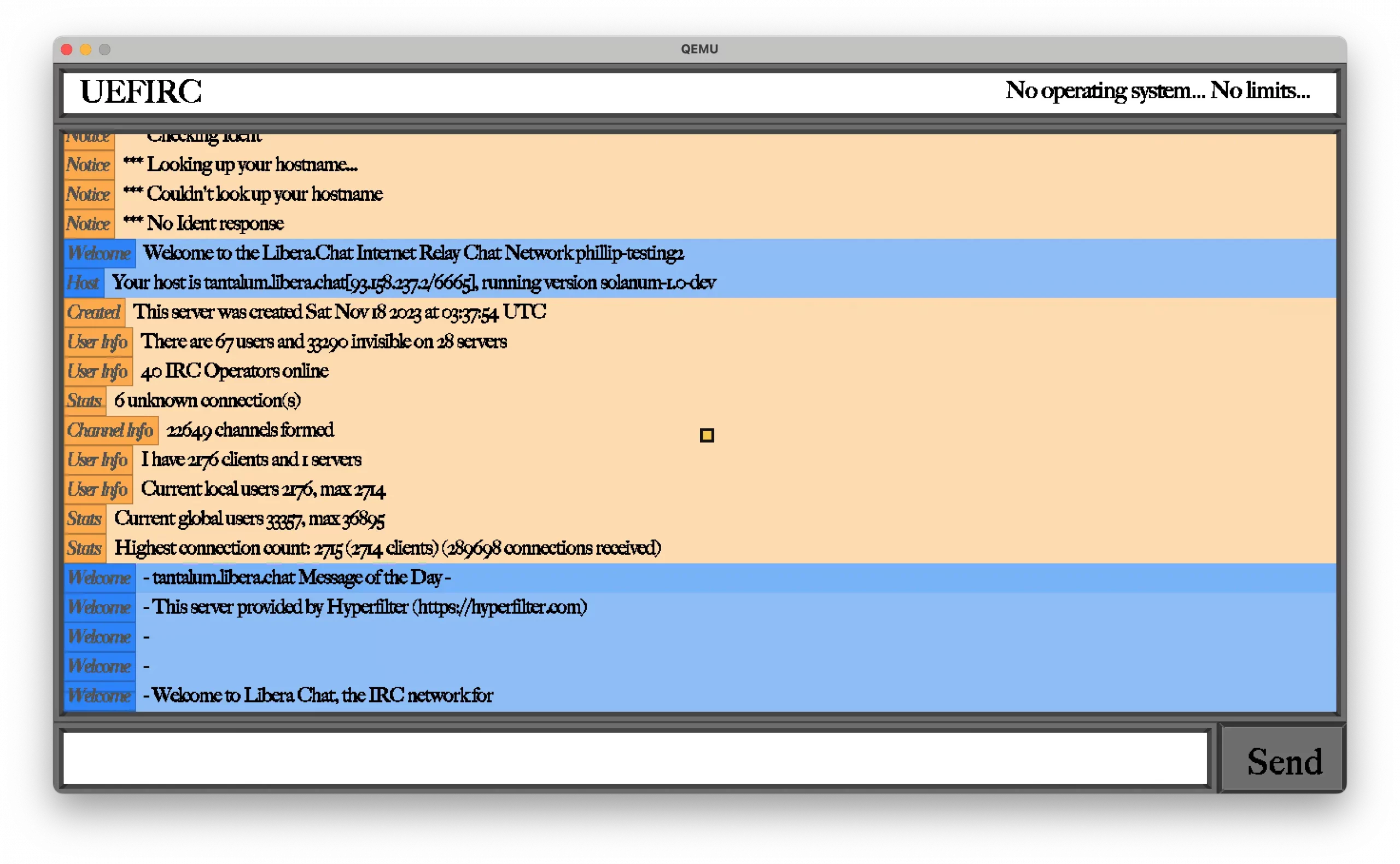
La news de ce dimanche, c’est que Phillip Tennen, un de ces génies du clavier a réussi l’impensable : faire tourner un client IRC directement dans l’UEFI (anciennement appelé BIOS, si j’abuse un peu) de sa carte mère, sans même avoir besoin d’un système d’exploitation !

Alors, pour faire simple, le BIOS (ou l’UEFI maintenant), c’est comme le cerveau reptilien de votre ordinateur. C’est le premier truc qui se lance quand vous appuyez sur le bouton « ON », avant même que Windows, Linux ou MacOS ne pointe le bout de son nez. Normalement, ce bidule sert juste à vérifier que tout est en ordre et à passer la main au système d’exploitation. Mais voilà certains se lèvent un matin et décident que ce serait cool d’y coller un client IRC.

Alors concrètement, à quoi ça ressemble ? Eh bien ça a une vraie interface graphique, avec des polices TrueType et tout le toutim et notre bonhomme a même implémenté quelques commandes IRC de base, histoire de pouvoir tailler une bavette avec les copains sans même avoir à démarrer Windows. Pratique pour les soirées LAN où on a la flemme d’attendre que l’OS se lance ! (Quoi ça existe plus les soirées LAN ?? ouinnn)

Ça montre qu’avec un peu (beaucoup) d’huile de coude et une bonne dose de créativité, y’a pas de limites à ce qu’on peut faire avec nos bécanes même si dans 99% des cas, ça sert à rien, faut bien l’avouer.

Mais bon, je sais que parmi vous, y’a plein de bidouilleurs de génie qui rêvent déjà de faire tourner leur propre truc dans le BIOS, alors si vous voulez vous lancer, je vous conseille d’aller jeter un œil au code source et aux explications concernant ce fameux client IRC pour UEFI. C’est bourré de commentaires et d’explications, de quoi vous donner des idées pour vos propres projets délirants. Perso, si y’en a qui sont chaud, je vous commande un browser, une version offline de Korben.info et un client Twitter pour BIOS.

Bref, ça ne va pas révolutionner nos vies mais ça reste une sacrée prouesse technique !

Source

🔲 ☆

L’App Store d’Apple accepte enfin les émulateurs de jeux rétro

Ça y est, les émulateurs de jeux rétro débarquent enfin sur l’App Store ! C’est la grande nouvelle annoncée par Apple ce vendredi. Les règles de l’App Store de la firme à la pomme s’assouplissent pour accueillir ces applications tant attendues par les fans de jeux rétro.

Jusqu’à présent, les émulateurs étaient persona non grata sur iOS, laissant les possesseurs d’iPhone dans l’obligation de passer par des solutions de contournement comme le jailbreak ou des magasins d’apps alternatifs. Mais ça, c’était avant ! Avec ce revirement, Apple ouvre grand les portes aux émulateurs déjà présents sur Android (enfin, ceux qui ont survécu aux assauts de Nintendo). Une décision qui pourrait bien couper l’herbe sous le pied des app stores tiers désormais autorisés dans l’Union Européenne.

Mais attention, pas question pour autant de faire n’importe quoi. Les jeux proposés devront respecter « toutes les lois en vigueur« , sous-entendu pas de place pour le piratage. Comme ça, les développeurs sont prévenus !

En parallèle, la firme de Cupertino a également clarifié sa position sur les « super apps » type WeChat. Mini-jeux et mini-apps devront se contenter donc se contenter d’HTML5 et n’auront pas le droit à leur app native.

Ces changements interviennent alors qu’Apple est dans le collimateur de la justice américaine. Le géant est accusé de vouloir étouffer la concurrence des apps de cloud gaming et des super apps. Une plainte qu’Apple semble avoir anticipée en autorisant récemment les services comme le Xbox Cloud Gaming ou GeForce Now.

Et ici, c’est la Commission Européenne qui met la pression. Résultat, Apple autorise désormais les apps de streaming musical à inclure des liens et des infos sur les abonnements hors App Store. Spotify peut dire merci à Bruxelles ! Mais tout n’est pas encore réglé. Malgré l’injonction de la commissaire européenne Margrethe Vestager de laisser les apps communiquer « librement » avec leurs utilisateurs, Apple compte bien continuer à prélever sa dîme sur les achats via les fameux liens. De quoi faire grincer des dents chez Spotify.

« Suivre la loi n’est pas optionnel, mais Apple continue de défier cette décision« , s’agace un porte-parole. « À partir du 6 avril, la Commission pourra lancer des procédures pour non-conformité et imposer des amendes quotidiennes. Il est temps d’agir de manière décisive pour donner une fois pour toutes un véritable choix aux consommateurs.« 

Bref, vous l’aurez compris, c’est un petit pas pour les émulateurs, un grand pas pour l’ouverture de l’App Store. Mais le chemin est encore long avant d’arriver à un véritable marché ouvert et concurrentiel sur iOS. En attendant, sortez vos manettes et préparez-vous à replonger dans la nostalgie du rétrogaming directement sur votre iPhone !

Source

🔲 ☆

Growth in The Sumbonomy

Sumboikos 1

As the economy undergoes de-growth … the sumbonomy undergoes pro-growth.

My work is pro-growth. However, it is not pro-parasitic or terraphthoric (earth destroying) growth which is tierracide (Earth murder). It is the negation of the above and its re-placement with a form of growth that is consistent with symbiosis, a foundation of life on Earth as we know it. Terranascient (earth nurturing) growth is good and we need as much of it as we can create.

We can call this new form of economy* the ‘sumbonomy’ from sumbios (living together) and nomia, (to manage). The ‘economy’ of the Anthropocene is re-placed by the sumbonomy** of the Symbiocene.

The sumbonomy is a form of economy that enables humans to live symbiotically along with the rest of life and living processes in the one home known as the Earth. To generate this type of growth we will need new, creative forms of design and technology based on symbiomimicry. The sumbonomy will be the result of sumbiocentric thinking and will require the most intense period of genuine growth since the industrial revolution and the rise of the Anthropocene.

As the old indicator of ‘growth’, GNP, rapidly goes down, new indicators, genuine sumbiosic indicators of gross sumbioregional product (GSP) start going up. Cancerous growth is replaced by normal growth, that is, growth that assists maturity and reproduction. The sumbonomy will be both restorative of life, and innovative of new forms of symbiotic activity. It will have a good purpose and a clear direction (directionality).

The Symbiocene entails a real revolution, because the challenge for the current society is to replace every single toxic and polluting Anthropocene essential artefact with an equivalent (if possible) benign Symbiocene ‘sumbiofact’.

There are now so many humans on the planet that the Earth cannot tolerate anything less than the complete adoption of Symbiocene principles. Those who want innovation to drive a new way of life that is productive within the associations of life, now have a new narrative to give an outlet for their creativity. There is no hopium here, it is radical anticipation for a future worth living in.

………………………………………………………………………………………………………………………..

* The term, ‘economy’, is based on ‘oikos’ or the Greek word for home. The general meaning relates to the management of the household. The word, ‘ecology’ shares the same root. I have found it problematic to connect the ‘oikos’ to the meme of the Symbiocene, so now I try to avoid the use of both economy and ecology in my most recent work.

** I have used ‘sumboikos’ as my term for the new symbiosis-based economy in the past. Nobody liked it, not even me. This new term, the sumbonomy (sum-bon-o-mee), in addition to the sumbios (living together), has echoes of the summum bonum, a Latin expression for the highest or ultimate good. The French, ‘bon’, also means good. Therefore, the sumbonomy is the highest form of living humans can undertake for a good life. The sumbonomy is the material foundation for humans living in Nature and we can now discuss the new conceptual domain of sumbonomics. It has a transdisciplinary partner in Sumbiology or the study of humans living together with each other and other forms of life.

🔲 ☆

Growth in The Sumbonomy

Sumboikos 1

As the economy undergoes de-growth … the sumbonomy undergoes pro-growth.

My work is pro-growth. However, it is not pro-parasitic or terraphthoric (earth destroying) growth which is tierracide (Earth murder). It is the negation of the above and its re-placement with a form of growth that is consistent with symbiosis, a foundation of life on Earth as we know it. Terranascient (earth nurturing) growth is good and we need as much of it as we can create.

We can call this new form of economy* the ‘sumbonomy’ from sumbios (living together) and nomia, (to manage). The ‘economy’ of the Anthropocene is re-placed by the sumbonomy** of the Symbiocene.

The sumbonomy is a form of economy that enables humans to live symbiotically along with the rest of life and living processes in the one home known as the Earth. To generate this type of growth we will need new, creative forms of design and technology based on symbiomimicry. The sumbonomy will be the result of sumbiocentric thinking and will require the most intense period of genuine growth since the industrial revolution and the rise of the Anthropocene.

As the old indicator of ‘growth’, GNP, rapidly goes down, new indicators, genuine sumbiosic indicators of gross sumbioregional product (GSP) start going up. Cancerous growth is replaced by normal growth, that is, growth that assists maturity and reproduction. The sumbonomy will be both restorative of life, and innovative of new forms of symbiotic activity. It will have a good purpose and a clear direction (directionality). Much of this ‘directionality’ takes place within ‘sumbioregions’ as citizens engage with their unique set of cultural, agri-cultural, biological and physical conditions of existence. 

The Symbiocene entails a real revolution, because the challenge for the current society is to replace every single toxic and polluting Anthropocene essential artefact with an equivalent (if possible) benign Symbiocene ‘sumbiofact’.

There are now so many humans on the planet that the Earth cannot tolerate anything less than the complete adoption of Symbiocene principles. Those who want innovation to drive a new way of life that is productive within the associations of life, now have a new narrative to give an outlet for their creativity. There is no hopium here, it is radical anticipation for a future worth living in.

………………………………………………………………………………………………………………………..

* The term, ‘economy’, is based on ‘oikos’ or the Greek word for home. The general meaning relates to the management of the household. The word, ‘ecology’ shares the same root. I have found it problematic to connect the ‘oikos’ to the meme of the Symbiocene, so now I try to avoid the use of both economy and ecology in my most recent work.

** I have used ‘sumboikos’ as my term for the new symbiosis-based economy in the past. Nobody liked it, not even me. This new term, the sumbonomy (sum-bon-o-mee), in addition to the sumbios (living together), has echoes of the summum bonum, a Latin expression for the highest or ultimate good. The French, ‘bon’, also means good. Therefore, the sumbonomy is the highest form of living humans can undertake for a good life. The sumbonomy is the material foundation for humans living in Nature and we can now discuss the new conceptual domain of sumbonomics. It has a transdisciplinary partner in Sumbiology or the study of humans living together with each other and other forms of life.

❌