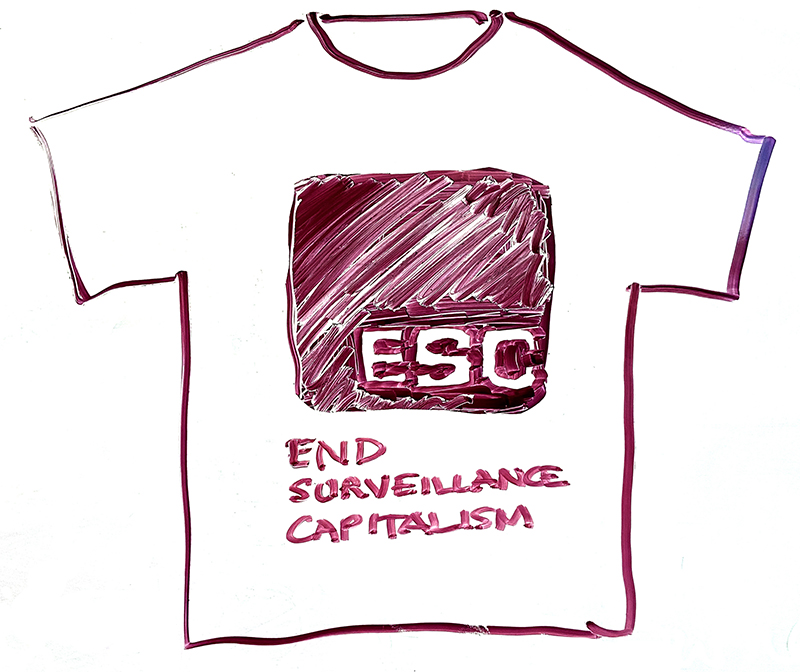
VRM Day had an extraordinary outcome this time: a movement to end surveillance capitalism.
The movement began with a talk by Roger McNamee titled Saving us from Big Tech: the Gen Z Solution. It was the latest in the Ostrom Workshop‘s Beyond the Web salon series, which on this occasion took place live and in person simultaneously in the Computer History Museum‘s Boole room and on the Web via Owl and Zoom, through the Workshop at Indiana University, where people also participated in a room and virtually. You can see the first hour of the talk here.
The conversation with Roger was super-energized, continued well past the scheduled hour, and onward through breakout sessions on each of the three days that followed at the Museum during IIW, and since then on Signal and Zoom. The conversation informally called itself “Roger and We,” and it vectored toward what it says on the t-shirt design above, drawn on a whiteboard during the third of the IIW sessions: End Surveillance Capitalism or ESC. (Also implying ESCape). One of us at the session created this graphic—

—and used it to create this t-shirt at Zazzle.com:

He’s bought a number of them, so far, because when he wore the first to Thanksgiving dinner, other people there also wanted one. In the spirit of freedom and openness, please feel free to use the same graphic (which, if you drag it off, is quite large ), or something like it, to make one or more of your own. Or run with it any way you please. Movements work that way.
This is where I pause and thank Shoshana Zuboff for making surveillance capitalism a full-sized Thing. Also to Brett Frishcmann and Evan Sellinger for explaining what it does to all of us, personally.
Where this goes is up to the group, which is small, growing, and gathering weekly in virtual space while corresponding asynchronously as well. It’s still small but growing.
To succeed, its fire needs to be so large and hot that profiting by tracking people will fail because neither people nor regulators will put up with it. It is also sobering to know that similar efforts to end surveillance capitalism have faltered in the past (which is still now), in spite of the simple fact that spying on people without their clear invitation (not mere “consent”) or a court order is wrong on its face, regardless of the purposes to which that spying is put.
We talked about lots of other stuff during VRM Day, of course. For example, Don Marti led a session on the W3C’s Private Advertising Technology Community Group, which he encouraged everyone in the room to join. (Please do.)
But the main outcome was ESC.
Now, some background for those not familiar with ProjectVRM.
From its start at the Berkman Klein Center in 2006, ProjectVRM has had (says here) “the immodest ambition of turning business on its head — for its own good, and for everyone else’s as well.” Perhaps ESC will be the thing to do that, after sixteen years of encouraging countless other efforts, some of which are listed here. (There is no easy way to keep up with all of them.)
If you’re interested in joining this cabal, write to me (the email is doc @ my last name dot com). You can also follow along on the ProjectVRM mailing list.