
❌

Vue lecture

Il y a de nouveaux articles disponibles, cliquez pour rafraîchir la page.
🔲 ☆

UCP needs VRM

In Microsoft Advertising’s Agentic Playbook, Laurie Sullivan of MediaPost looks into Microsoft’s “agentic commerce blueprint to guide businesses, retailers, and developers when AI agents make purchases on behalf of humans.”

Meaning agents are out there shopping for customers already. Intentcasting anyone?

Laurie explains,

Microsoft’s “Agentic Playbook” focuses on three priorities:

  • Getting discovered by the agent (which many brands struggle with today).
  • Ensuring the purchase becomes seamless.
  • Having the tools to optimize performance of the intended purchase.

Part of the blueprint details a path for marketers to build a 90-day structure for agentic.

Microsoft’s agentic, that is. She goes on:

One Microsoft product marketing director on the call focusing on product feeds said she can already see a major change in consumer behavior — the way people shop….

Microsoft Copilot runs on the same Universal Commerce Protocol (UCP) that many of its larger partners run on, the company said.

The framework connects Copilot with retail, including giants like Target, Ulta Beauty, and Stripe.

UCP founding partners include Google and Shopify.

UCP is new to me. Wikipedia too. But it does have a website: UCP.dev. There it says, “Universal Commerce Protocol (is) the common language for platforms, agents, and businesses (and) provides building blocks for agentic commerce across industries—from discovery to checkout and beyond—allowing the ecosystem to operate through one standard, without custom builds.”

The page goes on to say UCP is “co-developed by industry leaders,” and “built by the industry, to enable seamless agentic experiences. It solves fragmented user journeys that lead to frustrated users and conversion drop off.”

Solves for the seller, that is. Not for the buyer. Yet.

In Under the Hood: Universal Commerce Protocol (UCP), Amit Handa, Google’s Director of Engineering, Google Commerce, and  Ashish Gupta,  VP/GM Merchant Shopping and Engineering Fellow at Google, write,

By establishing a common language and functional primitives, UCP enables seamless commerce journeys between consumer surfaces, businesses, and payment providers. It is built to work with existing retail infrastructure, and is compatible with Agent Payments Protocol (AP2) to provide secure agentic payments support. It also provides businesses flexible ways to integrate via APIs, Agent2Agent (A2A), and the Model Context Protocol (MCP).

UCP is developed by Google in collaboration with industry leaders including Shopify, Etsy, Wayfair, Target, and Walmart endorsed by over 20 global partners across the ecosystem like Adyen, American Express, Best Buy, Flipkart, Macy’s Inc, Mastercard, Stripe, The Home Depot, Visa, Zalando and many more.

Then,

UCP is built to benefit the entire commerce ecosystem

  • For businesses: UCP empowers you to showcase your unique product and service offerings at shopping touchpoints across consumer interfaces such as AI Mode in Google Search and Gemini app, and others in the future. With UCP, you own your business logic, and you remain the Merchant of Record. UCP is built for retailer flexibility, and provides an ’embedded option’ that allows you to maintain a fully customized checkout experience from day one.

  • For AI platforms: With UCP, you can enable agentic shopping for your audiences. You can simplify business onboarding using standardized APIs while giving them flexibility to use MCP, A2A and existing agent frameworks of their choice.

  • For developers: UCP is an evolving open-source standard designed to be community-driven. We invite you to build the next generation of digital commerce with us.

  • For payment providers: UCP’s open, modular payment handler design enables open interoperability and choice of payment methods. Through this design, UCP enables universal payments that are provable. Every authorization is backed by cryptographic proof of user consent.

  • For consumers: When your favorite brands adopt UCP, it removes friction from product discovery to decision, so you can shop the brands you love, with peace of mind, ensuring you get the best value inclusive of your member benefits.

The last bullet is bullshit, but ignore that. Look at it the consumer side as an empty space where independent customers operate with agents of their own. These agents will roam and engage in the open market. They won’t just be “members” trapped in coercive “loyalty” programs. (Although smart agents can take advantage of whatever privileges might appear in those places too.)

Personal agents are VRM tools. They are the first VRM tools with real power since we started this project two decades ago.

In AI shopping gets simpler with Universal Commerce Protocol updates, Ashish Gupta writes,

Thanks to our partners and community contributors, UCP now provides new optional capabilities including:

  • UCP can help make online shopping more intuitive and convenient, thanks to a new Cart option that will let agents save or add multiple items to a shopping cart at once from a single store — just as a shopper typically would.

  • UCP adopters will be able to access a new Catalog capability that lets agents retrieve select real-time product details from a retailer’s catalog where necessary — like variants, inventory and pricing.

  • Building on existing standards, UCP will also support Identity Linking. That allows shoppers on UCP-integrated platforms to receive the same loyalty or member benefits they would on a retailer’s site when they’re logged in — like pricing or free shipping — making shopping more connected across the web.

Good, but again still just for retailers. Nothing in there addresses a question my wife asked when she first encountered e-commerce in 1995: Why can’t I take my shopping cart from site to site?

Back to Laurie:

On Thursday, Microsoft officially began rolling out “AI Max,” its full suite of features for search advertising campaigns, to all accounts. It optimizes performance across Copilot Search and Bing.

The product provides search term matching that expands reach beyond keyword lists.

It uses keywords, ads, and landing pages, along with intent and contextual signals to find relevant searches campaign might not reach.

It also customizes text by using a campaign’s existing assets and website content to generate and test variations on messages.

The system then selects the most appropriate combinations at auction time.

URL expansion sends people to the page on a brand’s website that best matches their intent.

Instead of always sending traffic to a static landing page, it can route people to the page that best matches what they seek.

With AI Max features turned on, advertisers importing existing search campaigns from Google, for example, will seamlessly carry over into the corresponding Microsoft campaign.

I boldfaced intent because that’s the main force customers bring to the market’s table.

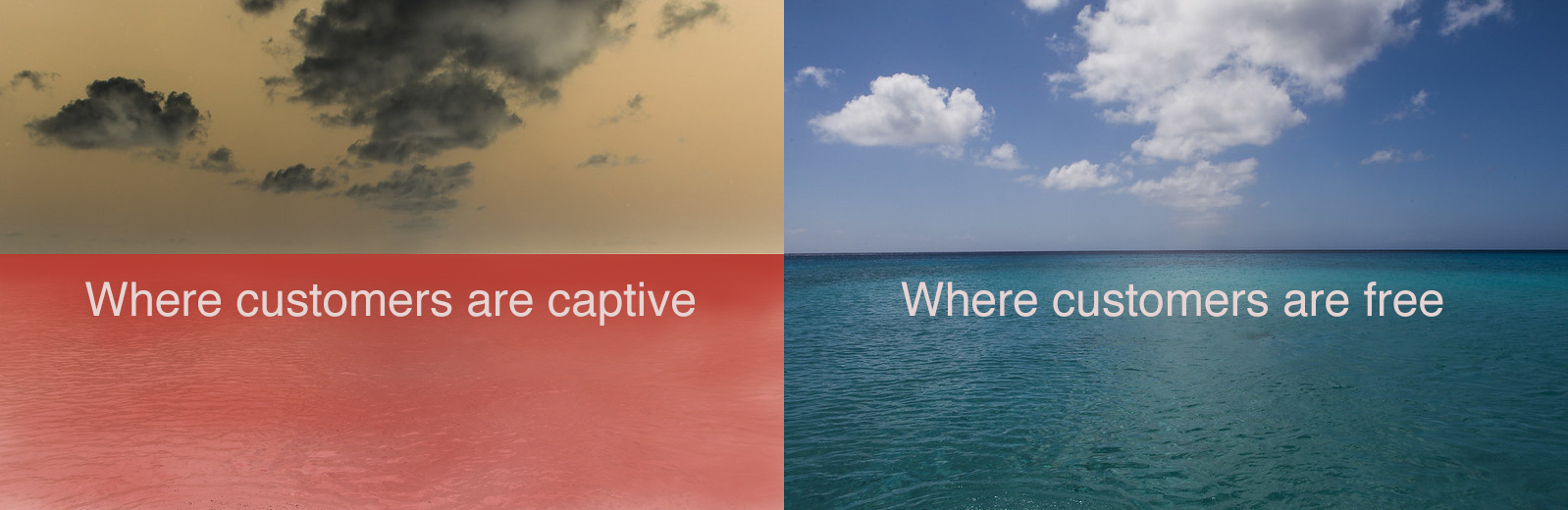
Add intelligence to that. Big AI today has far more market intelligence for customers than it does for companies, because customers are free to roam the whole world’s marketplace, while retailers and their third parties are trapped inside the walls of their own self-interest, offerings, and situations. Also their old mentality: the one that assumes that the best customer is a surveilled and captive one.

We started ProjectVRM twenty years ago next month with a thesis to prove: that free customers are more valuable than captive ones—to themselves and the marketplace. Turns out we couldn’t prove that until AI came along.

AI puts customers at an extreme advantage.  Roger Dunn, Chief Commercial Officer of Thrad, talks about this in a recent  Microsoft Advertising blog post:

When someone asks ChatGPT, Copilot, or Gemini for a product recommendation, the AI assembles a shortlist, usually three to five options, and that shortlist becomes the only consideration set that matters…

The vast majority of consumers still verify AI recommendations before buying. They take that shortlist to Google, to Bing, to a brand website, to YouTube. The verification stage is a confirmation exercise, not an open-ended one. They’re searching for the specific brands the AI mentioned, not starting from scratch…

So trust now operates in two layers.

First, there’s machine trust. From a retailer’s perspective – can an AI agent find you, understand what you sell, and have confidence that your product data is accurate and current? That’s about structured data, reviews, fulfillment reliability, pricing consistency. It’s operational, not emotional.

Second, there’s human trust. When the consumer arrives to verify, does your brand have the credibility, the reputation, the experience to close the deal? That’s the brand equity layer, and it’s not going away.

The brands that win will be the ones who treat product data as a strategic asset while continuing to invest in the emotional signals that make humans want to buy. The mistake is thinking you have to choose.

Product truth comes first signal to matter most, and it’s non-negotiable. AI agents reason over structured attributes: dimensions, compatibility, features, use cases. If those attributes don’t exist as machine-readable data, you’re not even a candidate. In the old world, poor data meant lower conversion. In the agentic world, poor data means you never enter consideration. Consumers aren’t prompting “what’s a good shoe brand.” They’re saying “I’m running a 5K this weekend on mixed terrain and my feet run narrow.” If your catalogue can’t answer that level of specificity, the agent recommends someone who can.

Reviews and third-party signals come second. AI systems synthesise review sentiment to answer highly specific questions. One detailed review explaining how a product performed in a real scenario is worth dozens of generic five-star ratings. Third-party endorsements, expert mentions, and certifications act as trust multipliers that AI increasingly weights.

Fulfillment reliability is third and rising fast. As we move up the automation curve, especially when consumers start authorising agents to purchase within preset rules, delivery reliability becomes a make-or-break signal. If an agent places an order and the delivery fails, the agent learns. Your logistics will become your trust score.

Brand authority is fourth. Still vital, but its mechanism is shifting from emotional halo to verifiable digital identity. Your reputation is increasingly a technical credential that agents use to evaluate trustworthiness.

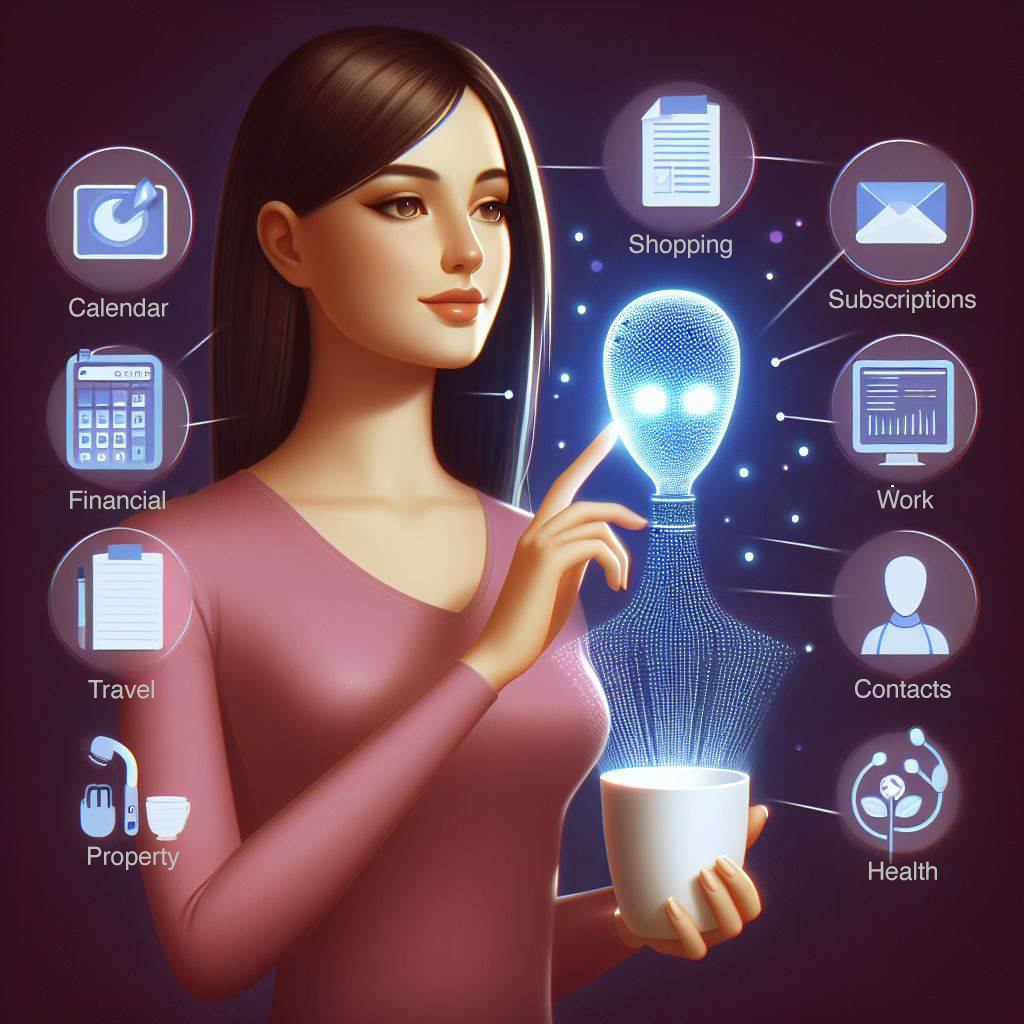
That’s today, when all customers have to work with are Big AI agents. What happens when people get truly personal AIs, in addition to what the giants give them? These will be AIs that give them knowledge and control over the whole corpus of their personal data, meaning everything in this image:

Prompt: A woman uses personal AI to know, get control of, and put to better use all available data about her property, health, finances, contacts, calendar, subscriptions, shopping, travel, and work

What you’re looking at in that image is a far more empowered and agentic customer than one who operates only inside the milieu Roger describes. Because personal AI is by the person, not just for the person. This completely changes the game—especially when the customer comes with her own terms of engagement and  her own identity, credentials, policies, and engagement mechanisms. Both will happen. As Joe Mandese put it in MediaPost last November, Imagine Consumers Delegating Their Relationships With Marketers To Agents.

Nothing in marketing as we’ve known it contemplates the implications of full and independent customer agency, because marketing still lives inside the business-as-usual box to which we addressed The Cluetrain Manifesto twenty-six years ago.  Cluetrain said a lot of stuff to that box, but here was the summary statement:

Chris Locke wrote that. Wish he was still around to see personal AI’s reach break corporate grasp.

From inside that old box, what Microsoft talks about looks like this:

retailer → machine-readable offers → agent → customer

The customer’s side looks like this:

customer → machine-readable intentions/terms/preferences → agent → market → company

The view from above is this:

customer → agent ←  market → agent ← company

Just three things happen in markets:

  • Transactions
  • Conversations
  • Relationships

In the industrial age, which is finally ending, business was focused almost entirely on transactions. Still is, for good reason: without transactions we wouldn’t have markets. It was strong there, but weak in the other two.

Conversations were kept to a minimum because they looked like overhead: costly in time and money. Service was pushed off to call centers, and now call center workers are being replaced by AI robots.

Relationships were about “loyalty” programs in which customers were held captive and milked.

In the agentic world, the opportunities for conversation and relationship are immense—and will drive many more transactions.

Customers and companies can collaborate on countless benefits for each other when imarket ntelligence flows both ways. Products, services, and experiences by customers and companies can all improve together. Guesswork is minimized. So are the operational and moral costs of surveillance.

Lots to work on here.

Bonus linkages:

🔲 ☆

Other Looks

One possible header.

Last month, Devon Loffreto shared some takes on how this website might look with some big tweaks. Check ’em out:

One post.

On MyTerms.

I think they’re brilliant.

We do need a refresh, and I’ve been working with our friends at WordPress on that. The main constraint is that we need to base the site on a WordPress theme of some kind. I invite suggestions.

🔲 ☆

The Original and the Eventual Intention Economy

The Intention Economy subtitle. It’s the whole thing, right there.

A recent post by Simon Taylor on X expresses something important about AI agents and markets: if an AI agent arrives in a market with a clear mandate—

Get me X. Budget Y. Constraints Z.

—it obsolesces business-as-usual for digital marketing.

See, all of martech and adtech starts with the assumption that human intent is fuzzy and manipulable—and that the best customers are captive and manipulated. Let’s look at this from three angles, which are also the three things that happen in markets:

  • transactions
  • conversations
  • relationships.

On the transaction side, companies invest heavily in tracking people, analyzing their behavior, targeting ads at them, and then (in many cases) rationalizing extremely wasteful results. Plus, of course, discounting or ignoring boundless negative externalities, such as the annoying people to new extremes and massively abusing personal privacy. (In fact, the system treats absent personal privacy as a base feature.) Anyway, the entire surveillance-based advertising fecosystem exists to guess what people want, or to influence what they might want.

On the relationship side, all we have so far is on the sell side: CRM, for Customer Relationship Management, and CX, for Customer Experience. We’ve been trying here to build (or to encourage building) systems for VRM, for Vendor Relationship Management, to give CRM customer hands to shake. But, in VRM’s absence, CRM is all we’ve got. One hand clapping. Or slapping. Or pushing prospects into a funnel.

What many of us, including Simon Taylor, suggest is facilitating conversation through AI agents. Simon’s case, specifically, is that an agent representing a person doesn’t need to be guessed at. It already knows the user’s intent. So there is no attention to capture and no desire to manufacture or manipulate. The demand signal is clear from the start. That’s why he says agents can collapse the attention economy.

The underlying shift in this direction has been visible for a long time. In The Intention Economy: When Customers Take Charge (Harvard Business Review Press, 2012), I argued that markets work best when customers drive them with clear signals of demand, rather than when sellers try to infer demand through surveillance and unwelcome persuasion. I also said markets can be far richer and more vital when customers and companies operate as equals, with relationships based on mutual interest rather than forms of coercion (such as “loyalty” programs that aren’t).

The work of Vendor Relationship Management (VRM) has been about correcting that imbalance.

Instead of companies managing relationships with customers through CRM (Customer Relationship Management) systems, we need customers able to manage relationships with vendors through VRM (Vendor Relationship Management) tools.

Note that relationship is the middle name of both CRM and VRM. Markets are not just about transactions. They are about relationships that continue over time.

That’s why a working intention economy will involve far more than simple buying transactions.

As Esteban Kolsky once put it, companies often focus almost entirely on the “buy cycle.” But customers live mostly in the “own cycle”—the long period of using, maintaining, fixing, improving, and learning from the products and services they already have:

In an intention economy, intelligence about that experience flows both ways between customers and companies. I wrote about this recently here:

Market intelligence that flows both ways.

VRM has long described one key mechanism for this: intentcasting, where customers signal their needs directly to the market rather than being targeted by guesses and ads.

Agents may make this far more feasible than it was when we first started talking about VRM nearly two decades ago.

But there’s an important point that often gets missed in current AI discussions.

The agency that matters most is the person’s, not the agent’s.

A personal AI agent is an instrument—like a phone, a computer, or a car. It acts on behalf of the individual, but the intention behind it must be the person’s own.

And that leads to another requirement:

The only truly personal agents will be owned and operated by individuals.

We don’t have that yet.

What we have instead are assistants that live inside corporate systems—helpful, sometimes impressive, but ultimately operating within feudal structures run by very large companies.

They are, at best, friendly suction cups on the tentacles of giants.

Individuals may well rent or borrow AI models from those giants. But the agents that represent us should operate inside our own environments, in our exclusive interest, rather than inside corporate systems whose interests may diverge from ours.

In other words, our agents should live in our own castles, not inside someone else’s kingdom.

When that happens—when individuals can show up in markets through tools they control—then the deeper shift becomes possible: from guesswork based on surveillance of captive customers to servicing self-qualified leads from free customers in the open marketplace.

Markets then begin to work the way markets are supposed to work: with demand and supply meeting in the open, in relationships that can last far beyond a single transaction.

This is also where work like MyTerms and the emerging ecosystem around personal AI becomes important. If individuals are to operate in markets through their own agents, those agents need ways to assert the person’s terms, preferences, and boundaries in forms that other systems can recognize and respect.

That is the direction VRM has been pointing for nearly twenty years: toward a world where individuals can arrive in markets with their own tools, their own data, and their own terms—and where markets can finally listen.

When that happens, markets will stop guessing what customers want—and start hearing them.

[Later… I actually wrote this post about a month ago, and put off publishing it while I worked on other things. Meanwhile, Adrian Gropper posted A Fork in the Road, which is required reading. I thank him for reminding me in the comments below, and for being a founding participant in ProjectVRM—going back to our earliest meetings almost 20 years ago.]

🔲 ☆

Without Privacy, VRM Can’t Happen

Nor can CRM. Not really. The middle name of both is Relationship, and those require respect for each other’s boundaries. We don’t have that yet online, and can’t without working standards (hello MyTerms), tech, and norms. In fact, the opposite prevails: extreme exploitation of absent personal privacy.

Helen Nissenbaum has been teaching us that for decades, and working on solutions. One is Adnauseum, which may be on your browser already.  It works (says that last link) “by automating ad clicks universally and blindly on behalf of its users. Built atop uBlock Origin, AdNauseam quietly clicks on every blocked ad, registering a visit on ad networks’ databases. As the collected data gathered shows an omnivorous click-stream, user tracking, targeting and surveillance become futile.” In another word, obfuscation.

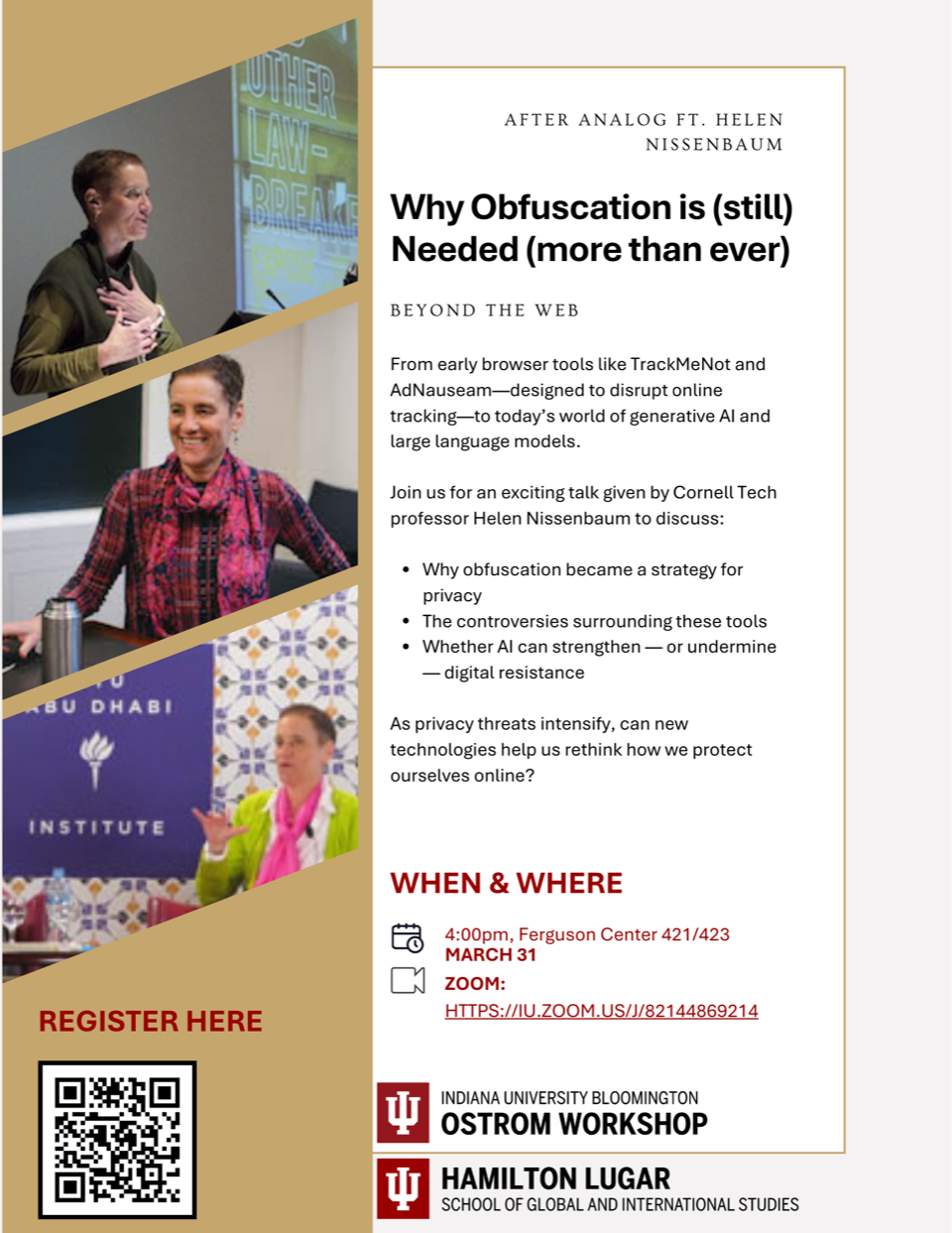
And that’s what Helen will unpack when she speaks in our salon series here at Indiana University next Tuesday at 4 pm Eastern, and on Zoom. Her title is Why Obfuscation is (still) Needed (more than ever). Here’s the flyer, with the registration and Zoom links:

And in case you don’t click on that, here it is again.

See you there.

🔲 ☆

Personal vs. Personalized AI

There is a war going on. Humanity and nature are on one side and Big Tech is on the other. The two sides are not opposed. They are orthogonal. The human side is horizontal and the Big Tech side is vertical.*

The human side is personal, social, self-governed, heterarchical, open, and grounded in the physical world. Its model is nature, and the cooperative contexts in which competition, creation, and destruction happen in the natural world.

The Big Tech side is corporate, industrial, hierarchical, competitive, mechanistic, extractive, and closed, even though it produces many positive-sum products and services that are good for people and good for nature. It is also, being competitive and rewarding toward winner-take-most outcomes, dominated by giants.

This war has been fought over many other things in the past, especially in tech. But AI is the big one right now—and perhaps the biggest one of all time.

Over the long run, both sides will win, because we need the best of what both bring to the world’s big round table. In the past, this has happened in countless markets, countries, polities, societies, and other contexts. In tech it happened with the conflict between PCs and mainframes, between the open and public Internet and closed private networks, and between open operating systems and closed ones. None of those conflicts have final outcomes, but they have arrived at stable and cooperative states. They arrived at those states because everyone recognized that people can do more with their own tools than those big entities can do on theirs, or by using people as extracted resources.

This conflict is perhaps best represented by the ironies that have been at work within OpenAI and Sam Altman, its prior and current CEO. We can also see it with sparkling clarity in something amazing that Sam said near the close of his keynote at the first OpenAI Developer Conference, in November of last year:

Lets unpack that.

Individual empowerment means exactly what it says. Agency is the ability to take action or to choose what action to take (Cambridge Dictionary). Scale means growth toward ubiquity.

You have individual empowerment and agency when you ride your bike, drive your car, mow your lawn, or button your shirt. You also have it when you work on your laptop, phone, and other smart rectangles. Scale means your power and agency will grow to the max while the same will happen for nearly everyone else. Scale for you alone won’t cut it. When most of us have it, that’s scale.

Technologies extend us. They enlarge our capacities in the world. Intelligence is one of those capacities. So is memory. Your rectangles help a lot with both. That’s why those have already scaled to ubiquity, or close enough.

AI will do the same, but only if it’s personal. Not if it’s  just “personalized.”

As Jamie Smith made clear here a year ago, “your personal AI isn’t really personal.”

ChatGPT4 doesn’t know that yet. I can tell because I just asked:

Me:
What is “personal AI”?

ChatGPT4:
“Personal AI” refers to artificial intelligence systems that are designed to serve individual users through personalized interactions and services. These AI systems learn from the specific preferences, behaviors, and needs of their users to offer more tailored assistance, recommendations, or information. The goal of personal AI is to enhance user experience by adapting to unique personal profiles.

There are various applications of personal AI, including:

  1. Virtual Assistants: Like Siri, Google Assistant, and others, these AIs help with daily tasks such as scheduling, reminders, searching information, and controlling smart home devices, all customized to the user’s habits and preferences.
  2. Recommendation Systems: Used in streaming services like Netflix or shopping platforms like Amazon, these AI systems analyze your past behavior to recommend movies, shows, or products you might like.
  3. Healthcare: Personal AI can track individual health metrics and provide personalized advice, monitor conditions, or even alert medical professionals if needed.
  4. Learning and Development: In education, personal AI can adapt learning materials to the pace and learning style of the student, offering a customized educational experience.
  5. Gaming: AI in gaming can adapt to provide a challenge tailored to the player’s skill level or alter the game narrative based on choices made by the player.

The development of personal AI focuses on enhancing user engagement by creating more intuitive and responsive interactions that feel uniquely suited to each individual.

For a second opinion, I asked Google’s Gemini the same question.

Me:
What is “personal AI”?

Gemini:
Personal AI refers to artificial intelligence designed to assist and interact with a specific individual. It’s essentially your own AI companion that learns about you and tailors its services to your needs. Here are some key aspects of personal AI:

  1. Personalization: Unlike general-purpose AI assistants, personal AI focuses on you. It learns from your interactions, preferences, and habits to become more helpful over time.
  2. Focus on Memory and Knowledge: Some personal AI systems aim to become an extension of your mind. They can store your memories, knowledge, and experiences, making them readily accessible and even usable to help with tasks like writing or communication.
  3. Varied Applications: Personal AI can have a wide range of applications. Imagine an AI that helps you:
  4. Organize your life: Manage schedules, appointments, and reminders.
  5. Boost productivity: Assist with tasks, research, and communication.
  6. Enhance creativity: Help you brainstorm ideas or generate creative content.
  7. Improve learning: Personalize learning experiences and provide targeted information.

Privacy Concerns: Storing personal data on an AI raises concerns about privacy and security.

Overall, personal AI holds promise for a future where technology seamlessly integrates with our lives, offering personalized assistance and support.

To both companies, personal AI is a personalized service—from them. It’s not something you own and control. It’s not about individual empowerment and agency. It doesn’t extend you. It’s hired prosthesis: an extension of them rather than of you.

Let’s name the category: AIaaS—AI as a Service.

But hats off. OpenAI and Gemini do amazing jobs. So do lots of other AI services by wannabe giants. I use AI every day to improve what I write, to generate and fix images, to answer questions that old-fashioned search engines can’t answer or suck at. I even pay extra for some of it (such as ChatGPT4 and Adobe’s Creative Suite). And it seems they all get better, all the time, at everything. Won’t personalization be good enough, eventually?

No. Because they aren’t you. They also aren’t yours, so they can’t extend you. They can seem to. But they don’t. They also don’t have access to most of your private life. Nor should they.

But your private life could use some AI help. For example—

  • Schedules, including on your calendars, past and future
  • Health data, including all your medical reports, prescriptions, appointments, insurance information, past and present providers, plus what your watch, phone, and other devices record about you
  • Financial records, including bills, receipts, taxes, and anything called an account that involves money
  • Travel, including all the movements your phone (and phone company), watch, and car record about where you go and where you’ve been
  • Work—past and present, including whatever HR systems know or knew about you
  • Contacts—all the people, businesses, and other entities you know
  • Business relationships, with brokers, retailers, service providers, whatever
  • Subscriptions, including all those “just $1 for the first four weeks” offers you’ve accepted, plus other forms of screwage that are stock-in-trade for companies selling subscription systems to businesses.
  • Property, including all the stuff on your shelves, floors, closets, garages, and storage spaces—plus your stocks and real estate.

It’s not easy to visualize what a personal AI might do for those, but let’s try. Here’s how Microsoft’s Copilot (or whatever it’s called this week) did it for me before I got rid of all its misspellings and added my own hunks of text:

All that stuff is data. But most of it is scattered between apps and clouds belonging to Apple, Google, Microsoft, Amazon, Meta, phone companies, cable companies, car makers, health care systems, insurance companies, banks, credit card companies, retailers, and other systems that are not yours. And most of them also think that data is theirs and not yours.

To collect and manage all that stuff, you need tools that don’t yet exist: tools that are yours and not theirs. We could hardly begin to imagine those tools before AI came along. Now we can.

For example, you should be able to take a picture of the books on your shelves and have a complete record of what those books are and where you got them. You’ll know where you got them because you have a complete history of what you bought, where and from whom. You should be able to point your camera in your closets, at the rugs on your floors, at your furniture, at the VIN number of your car that’s visible under your windshield, at your appliances and plumbing fixtures, and have your AI tell you what those are, or at least make far more educated guesses than you can make on your own.

Yes, your AI should be able to tap into external databases and AI systems for help, but without divulging identity information or other private data. Those services should be dependent variables, not independent ones. For full individual empowerment and agency, you need to be independent. So does everyone else with personal AI.

Now imagine having a scanner that you can feed every bill, every receipt, every subscription renewal notice, and have AI software that tells you what’s what with each of them, and sorts records into the places they belong.

Ever notice that the Amazon line items on your credit card bill not only aren’t itemized, but don’t match Amazon’s online record of what you ordered? Your personal AI can sort that out. It can help say which are business and personal expenses, which are suspicious in some way, what doesn’t add up, and much more.

Your personal AI should be able to answer questions like, How many times have I had lunch at this place? Who was I with? When was it we drove to see so-and-so in Wisconsin? What route did we take? What was that one car we rented that we actually liked?

Way back in 1995, when our family first got on the Internet over dial-up, using the first graphical browsers on our PC, and e-commerce began to take off with Amazon, eBay, and other online retailers, my wife asked an essential question: Why can’t I have my own shopping cart that I take from site to site?

Twenty-nine years later, we still don’t have the answer, because every retailer wants you to use its own. And we’re stuck in that system. It’s the same system that has us separately consenting to what sites ironically call “your privacy choices.” And aren’t.

There are countless nice things we can’t have in the digital world today because we aren’t people there. We are accounts. And we are reduced to accounts by every entity that requires a login and password.

This system is a legacy of client-server, a euphemism for slave-master. We might also call it calf-cow, because that’s how we relate to businesses with which we have accounts. And that model is leveraged on the Web like this:

We go to sites for the milk of content and free cookies, whether we want them or not. We are also just “users.”

In the client-server world, servers get scale. Clients have no more scale than what each account—each cow—separately allows. Sure, users get lots of benefits, but scale across many cows is not one of them. And no, “login with Google” and “login with Facebook” are just passes that let calves of ruling cows wander into vassal pastures.

For individual empowerment and scale to happen, we need to be self-sovereign and independent. Personal AI can give that to us. It can do that by solving problems such as the ones listed above, and by working as agents that represent us as human beings—rather than mere users—when we engage with Big Tech’s cows.

This will be a fight at first, because the cows think they run all of nature and not just their own farms. And $trillions are being invested in the same old cattle industry, with AI painted all over the new barns. Comparatively speaking, close to nothing is going toward giving independent and self-sovereign individuals the kind of power and scale Sam Altman says he wants to give us but can’t because he’s on the big cow side of this thing.

So where do we start?

First, with open source code and open standards. We have some already. Llama 3, from Meta AI, is “your own intelligent assistant,” and positions Meta as a more open and user-friendly cow than OpenAI. Meta is still on the top-down Big Tech side of the war we’re in. But hell, we can use what they’ve got. So let’s play with it.

Here on the ground there are all these (with quotage lifted from their sites or reviews such as this one)—

  • MindsDB: “an open-source AutoML framework”
  • Alt.ai: “It’s an A.I. which aims to digitize users’ intentions and place it on the cloud to let our clones deal with all digital operations.”
  • Keras: “a multi-backend deep learning framework, with support for JAX, TensorFlow, and PyTorch”
  • PyTorch: “Python package that provides two high-level features: Tensor computation (like NumPy) with strong GPU acceleration, and Deep neural networks built on a tape-based autograd system
  • Tensor Flow: “open-source framework for machine learning”
  • CoreNet: a deep neural network toolkit for small and large-scale models, from Apple
  • Haystack: an “open source Python framework by deepset for building custom apps with large language models (LLMs).”
  • Image Super-Resolution (ISR): “(an) open source tool employs a machine learning model that you can train to guess at the details in a low-resolution image:
  • Blender: “A rich interface and numerous plugins make it possible to create complex motion graphics or cinematic vistas”
  • DeepFaceLab: “open source deepfake technology that runs on Python”
  • tflearn: “an advanced deep learning library”
  • PYTensor: “a Python library that allows you to define, optimize/rewrite, and evaluate mathematical expressions involving multi-dimensional arrays efficiently.” (Was Theano)
  • LM Studio: “Discover, download, and run local LLMs”
  • HuggingFace Transformers: “a popular open-source library for Natural Language Processing (NLP) tasks”
  • Fast.ai: “a library for working with deep learning tasks”
  • OpenCV: “a popular Computer Vision and Image Processing library developed by Intel”
  • Detectron2: “a next-generation library that provides advanced detection and segmentation algorithm” and “a PyTorch-based modular object detection library”
  • Ivy.ai: “an open-source deep learning library in Python focusing on research and development”
  • OpenAssistant: “a project aimed at giving everyone access to a great chat-based large language model”
  • PaddleNLP: “a popular open source NLP library that you can use to glean search sentiment and flag important entities”
  • Delphi.AI: “Clone yourself. Build the digital version of you to scale your expertise and availability, infinitely.”
  • Fauxpilot: “This is an attempt to build a locally hosted alternative to GitHub Copilot. It uses the SalesForce CodeGen models inside NVIDIA’s Triton Inference Server with the FasterTransformer backend.”
  • Ray: “An open source framework to build and scale your ML and Python applications easily”
  • Solid: “Solid is a specification that lets individuals and groups store their data securely in decentralized data stores called Pods. Pods are like secure web servers for data. When data is stored in a Pod, its owners control which people and applications can access it.”
  • Sagen.ai: “Your very own AI Personal Assistant to manage your digital life.”
  • YOLOv7: “is one of the fastest and most accurate open source object detection tools. Just provide the tool with a collection of images full of objects and see what happens next.”

—and lots of others that readers can tell me about. Do that and I will add links later. This is a work in progress.

Below all of those we still need something Linux-like that will become the open base on which lots of other stuff runs. The closest I’ve seen so far is pAI-OS, by Kwaai.ai, a nonprofit I now serve as Chief Intention Officer. I got recruited by Reza Rassool, Kwaai’s founder and chair, because he believes personal AI is required to make The Intention Economy finally happen. So that was a hard offer to refuse. Kwaai also has a large, growing, and active community, which I believe is necessary, cool, and very encouraging.

As with most (maybe all) of the projects listed above, Kwaai is a grass-roots effort by human beings on the natural, human, and horizontal side of a battle with giants who would rather give us personalized AI than have us meet them in a middle to which we will bring personal AI powers of our own. In the long run, we will meet in that middle, because personal AI will be better for everyone than personalized AI alone.

Watch us prove it. Better yet, join the effort.


*I am indebted to Lavonne Reimer for introducing and co-thinking the horizontal vs. vertical frame, and look forward eagerly to her own writings and lecturings on the topic.

🔲 ☆

Why selling personal data is a bad idea

Prompt: “a field of many different kinds of people being harvested by machines and turned into bales of fertilizer.” Via Microsoft CoPilot | Designer.

This post is for the benefit of anyone wondering about, researching, or going into business on the proposition that selling one’s own personal data is a good idea. Here are some of my learnings from having studied this proposition myself for the last twenty years or more.

  1. The business does exist. See eleven companies in Markets for personal data listed among many other VRM-ish businesses on the ProjectVRM wiki.
  2. The business category harvesting the most personal data is adtech (aka ad tech and “programmatic”) advertising, which is the surveillance-based side of the advertising business. It is at the heart of what Shoshana Zuboff calls surveillance capitalism, and is now most of what advertising has become online. It’s roughly a trillion-dollar business. It is also nothing like advertising of the Mad Men kind. (Credit where due: old-fashioned advertising, aimed at whole populations, gave us nearly all the brand names known to the world). As I put it in Separating Advertising’s Wheat and Chaff, Madison Avenue fell asleep, direct response marketing ate its brain, and it woke up as an alien replica of itself.
  3. Adtech pays nothing to people for their data or data about them. Not personally. Google may pay carriers for traffic data harvested from phones, and corporate customers of auctioned personal data may pay publishers for moments in which ads can be placed in front of tracked individuals’ ears or eyeballs. Still, none of that money has ever gone to individuals for any reason, including compensation for the insults and inconveniences the system requires. So there is little if any existing infrastructure on which paying people for personal data can be scaffolded up. Nor are there any policy motivations. In fact,
  4. Regulations have done nothing to slow down the juggernaut of growth in the adtech industry. For Google, Facebook, and other adtech giants, paying huge fines for violations (of the GDPR, the CCPA, the DMA, or whatever) is just the cost of doing business. The GDPR compliance services business is also in the multi-$billion range, and growing fast. In fact,
  5. Regulations have made the experience of using the Web worse for everyone. Thank the GDPR for all the consent notices subtracting value from every website you visit while adding cognitive overhead and other costs to site visitors and operators. In nearly every case, these notices are ways for site operators to obey the letter of the GDPR while violating its spirit. And, although all these agreements are contracts, you have no record of what you’ve agreed to. So they are worse than worthless.
  6. Tracking people without their clear and conscious invitation or a court order is wrong on its face. Period. Full stop. That tracking is The Way Things Are Done online does not make it right, any more than driving drunk or smoking in crowded elevators was just fine in the 1950s. When the Digital Age matures, decades from now, we will look back on our current time as one thick with extreme moral compromises that were finally corrected after the downsides became clear and more ethically sound technologies and economies came along. One of those corrections will be increasing personal agency rather than just corporate capacities. In fact,
  7. Increasing personal independence and agency will be good for markets, because free customers are more valuable than captive ones. Having ways to gather, keep, and make use of personal data is an essential first step toward that goal. We have made very little progress in that direction so far. (Yes, there are lots of good projects listed here, but there we still a long way to go.)
  8. Businesses being “user-centric” will do nothing to increase customers’ value to themselves and the marketplace. First, as long as we remain mere “users” of others’ systems, we will be in a subordinate and dependent role. While there are lots of things we can do in that role, we will be able to do far more if we are free and independent agents. Because of that,
  9. We need technologies that create and increase personal independence and agency. Personal data stores (aka warehouses, vaults, clouds, life management platforms, lockers, and pods) are one step toward doing that. Many have been around for a long time: ProjectVRM currently lists thirty-three under the Personal Data Stores heading. Some have been there a long time. The problem with all of them is that they are still too focused on what people do as social beings in the Web 2.0 world, rather than on what they can do for themselves, both to become more well-adjusted human beings and more valuable customers in the marketplace. For that,
  10. It will help to have independent personal AIs. These are AI systems that work for us, exclusively. None exist yet. When they do, they  will help us manage the personal data that fully matters:
    • Contacts—records and relationships
    • Calendars—where we’ve been, what we’ve done, with whom, where, and when
    • Health records and relationships with providers, going back all the way
    • Financial records and relationships, including past and present obligations
    • Property we have and where it is, including all the small stuff
    • Shopping—what we’ve bought, plan to buy, or might be thinking about,
    • Subscriptions—what we’re paying for, when they end or renew, what kind of deal we’re locked into, and what better ones might be out there.
    • Travel—Where we’ve been, what we’ve done, with whom, and when

Personal AIs are today where personal computers were fifty years ago. Nearly all the AI news today is about modern mainframe businesses: giants with massive data centers churning away on ingested data of all kinds. But some of these models are open sourced and can be made available to any of us for our own purposes, such as dealing with the abundance of data in our own lives that is mostly out of control. Some of it has never been digitized. With AI help it could be.

I’m in a time crunch right now. So, if you’re with me this far, read We can do better than selling our data, which I wrote in 2018 and remains as valid as ever. Or dig The Intention Economy: When Customers Take Charge (Harvard Business Review Press, 2012), which Tim Berners Lee says inspired Solid. I’m thinking about following it up. If you’re interested in seeing that happen, let me know.

🔲 ☆

Personal AI at VRM Day and IIW

Prompt: A woman uses personal AI to know, get control of, and put to better use all available data about her property, health, finances, contacts, calendar, subscriptions, shopping, travel, and work. Via Microsoft Copilot Designer, with spelling corrections by the author.

Most AI news is about what the giants (OpenAI/Microsoft, Meta, Google/Apple, Amazon, Adobe, Nvidia) are doing (seven $trillion, anyone?), or what AI is doing for business (all of Forbes’ AI 50). Against all that, personal AI appears to be about where personal computing was in 1974: no longer an oxymoron but discussed more than delivered.

For evidence, look up “personal AI.” All the results will be about business (see here and here) or “assistants” that are just suction cups on the tentacles of giants (Siri, Google Assistant, Alexa, Bixby), or wannabes that do the same kind of thing (Lindy, Hound, DataBot).

There may be others, but three exceptions I know are Kin, Personal AI and Pi.

Personal AI is finding its most promoted early uses on the side of business more than the side of customers. Zapier, for example, explains that Personal AI “can be used as a productivity or business tool.”

Kin and Pi are personal assistants that help you with your life by surveilling your activities for your own benefit. I’ve signed up for both, but have only experienced Pit,” or “just vent,” when I ask it to help me with the stuff outlined in (and under) the AI-generated image above, it wants to hook me up with a bunch of siloed platforms that cost money, or to do geeky things (PostgreSQL, MongoDB, Python on my own computer. Provisional conclusion: Pi means well, but the tools aren’t there yet. [Later… Looks like it’s going to morph into some kind of B2B thing, or be abandoned outright, now that Inflection AI’s CEO, Mustafa Suleyman is gone to Microsoft. Hmm… will Microsoft do what we’d like in this space?]

Open source approaches are out there: OpenDAN, Khoj, Kwaai , and Llama are four, and I know at least one will be at VRM Day and IIW.

So, since personal AI may finally be what pushes VRM into becoming a Real Thing, we’ll make it the focus of our next VRM Day.

As always, VRM Day will precede IIW in the same location: the Boole Room of the Computer History Museum in Mountain View, just off Highway 101 in the heart of Silicon Valley. It’ll be on Monday, 15 April, and start at 9am. There’s a Starbucks across the street and ample parking because the museum is officially closed on Mondays, but the door is open. We lunch outdoors (it’s always clear) at the sports bar on the other corner.

Registration is open now at this Eventbrite link:

https://vrmday2024a.eventbrite.com

You can also just show up, but registering gives us a rough headcount, which is helpful for bringing in the right number of chairs and stuff like that.

See you there!


🔲 ☆

On Customer Constituency

A customer looks at a market where choice rules and nobody owns anybody. Source: Microsoft Copilot | Designer

I’m in a discussion of business constituencies. On the list (sourced from the writings of Doug Shapiro) are investors, employees, suppliers, customers, and regulators.

The first three are aware of their membership, but the last two? Not so sure.

Since ProjectVRM works for customers, let’s spin the question around. Do customers have a business constituency? If so, businesses are members by the customer’s grace. She can favor, ignore, or more deeply engage with any of those businesses at her pleasure. She does not “belong” to any of them, even though any or all of them may refer to her, or their many other customers, with possessive pronouns.

Take membership (e.g. Costco, Sam’s Club) and loyalty (CVS, Kroger) programs off the table. Membership systems are private markets, and loyalty programs are misnomered. (For more about that, read the “Dysloyalty” chapter of The Intention Economy.)

Let’s look instead at businesses that customers engage as a matter of course: contractors, medical doctors, auto mechanics, retail stores, restaurants, clubs, farmers’ markets, whatever. Some may be on speed dial, but most are not. What matters in all cases is that these businesses are responsible to their customers. “The real and effectual discipline which is exercised over a workman is that of his customers,” Adam Smith writes. “It is the fear of losing their employment which restrains his frauds and corrects his negligence.” That’s what it means to be a customer’s constituent.

An early promise of the Internet was supporting that “effectual discipline.” For the most part, that hasn’t happened. The “one clue” in The Cluetrain Manifesto said “we are not seats or eyeballs or end users or consumers. we are human beings and our reach exceeds your grasp. deal with it.” Thanks to ubiquitous surveillance and capture by corporate giants and unavoidable platforms, corporate grasp far outreaches customer agency.

That’s one reason ProjectVRM has been working against corporate grasp since 2006, and just as long for customer reach. Our case from the start has been that customer independence and agency are good for business. We just need to prove it.

🔲 ☆

The New News Business

Eigth in the News Commons series.

How Microsoft Bing Image Creator illustrates EmanciPay

Back when I was on the board of my regional Red Cross chapter (this one), I learned four lessons about fund raising:

  1. People are glad to pay value for value.
  2. People are most willing to pay when they perceive and appreciate the value they get from a product or service.
  3. People are most willing to pay full value when the need or opportunity to pay is immediate, and the amount they pay is up to them.
  4. People are willing to pay more when they have a relationship with the other party (seller, service provider, philanthropy, cause, whatever)

Here’s something I wrote in The Cluetrain Manifesto (10th anniversary edition) about all four lessons at work:

Not long after Cluetrain came out in early 2000, I found myself on a cross-country flight, sitting beside a Nigerian pastor named Sayo Ajiboye. After we began to talk, it became clear to me that Sayo (pronounced “Shaiyo”) was a deeply wise man. Among his accomplishments was translating the highly annotated Thompson Bible into his native Yoruba language: a project that took eight of his thirty-nine years.

I told him that I had been involved in a far more modest book project—The Cluetrain Manifesto—and was traveling the speaking circuit, promoting it. When Sayo asked me what the book was about, I explained how “markets are conversations” was the first of our ninety-five theses, and how we had unpacked it in a chapter by that title. Sayo listened thoughtfully, then came back with the same response I had heard from other readers in what back then was still called the Third World: “Markets are conversations” is a pretty smart thing for well-off guys from the First World to be talking about. But it doesn’t go far enough.

When I asked him why, he told me to imagine we were in a “natural” marketplace—a real one in, say, an African village where one’s “brand” was a matter personal reputation, and where nobody ruled customer choices with a pricing gun. Then he picked up one of those blue airline pillows and told me to imagine it was a garment, such as a coat, and that I was interested in buying it. “What’s the first thing you would say to the seller?” he asked.

“What does it cost?”

“Yes, you would say that,” he replied, meaning that this was typical of a First World shopper for whom price is the primary concern. Then he asked me to imagine that a conversation follows between the seller and me—that the two of us get to know each other a bit and learn from each other. “Now,” he asked, “What happens to the price?”
I said maybe now I’m willing to pay more while the seller is willing to charge less.

“Why?” Sayo asked.

I didn’t have an answer.

“Because you now have a relationship,” he said.

As we continued talking, it became clear to me that everything that happens in a marketplace falls into just three categories: transaction, conversation, and relationship. In our First World business culture, transaction matters most, conversation less, and relationship least. Worse, we conceive and justify everything in transactional terms. Nothing matters more than price and “the bottom line.” By looking at markets through the prism of transaction or even conversation, we miss the importance of relationship. We also don’t see how relationship has a value all its own: one that transcends, even as it improves, the other two.

Consider your relationship with friends and family, Sayo said. The value system there is based on caring and generosity, not on price. Balance and reciprocity may play in a relationship, but are not the basis of it. One does not make deals for love. There are other words for that.

Back in the industrialized world, few of our market relationships run so deep, nor should they. By necessity much of our relating is shallow and temporary. We don’t want to get personal with an ATM machine or even with real bank tellers. Friendly is nice, but in most business situations that’s about as far as we want to go.

But relationship is a broad category: broad enough to contain all forms of relating—the shallow as well as the deep, the temporary as well as the enduring. In the business culture of the industrialized world, Sayo said, we barely understand relationship’s full meaning or potential. And we should. Doing so would be good for business.

So he told me our next assignment was to unpack and study another thesis: Markets are relationships.

That is why, six years after the first edition of Cluetrain came out, I started ProjectVRM (the R means Relationship) at the Berkman Klein Center, wrote The Intention Economy: When Customers Take Charge, (Harvard Business Review Press, 2012), co-founded Customer Commons (in 2013), and am now a visiting scholar with the Ostrom Workshop at Indiana University, thinking out loud about how a news commons might thrive as a market of relationships—starting here in Bloomington, IU’s home town.

In The News Business (which precedes this post), I said the three current business models for local news were advertising, subscription, and philanthropy, and promised a fourth. This is it: emancipayments.

We* came up with this idea in 2009. Here is how the EmanciPay page on the ProjectVRM wiki puts it:

Overview

Simply put, Emancipay makes it easy for anybody to pay (or offer to pay) —

  1. as much as they like
  2. however they like
  3. for whatever they like
  4. on their own terms

— or at least to start with that full set of options, and to work out differences with sellers easily and with minimal friction.

Emancipay turns consumers (aka users) into customers by giving them a pricing gun (something which in the past only sellers used) and their own means to make offers, to pay outright, and to escrow the intention to pay when price and other requirements are met. And to be able to do this at scale across all sellers, much as cash, browsers, credit cards and email clients do the same. Payments themselves can also be escrowed.

In slightly more technical terms, EmanciPay is a payment framework for customers operating with full agency in the open marketplace, and at scale. It operates on open protocols and standards, so it can be used by any buyer, seller or intermediary.

It was conceived as a way to pay for music, journalism, or what any artist brings into the world. But it can apply to anything. For example, [subscriptions], which have become by 2021 a giant fecosystem in which every seller has separate and non-substitutable scale across all subscribers, while subscribers have zero scale across all sellers, with the highly conditional exceptions of silo’d commercial intermediaries. As [Customer Commons] puts it,

There’s also not much help coming from the subscription management services we have on our side: Truebill, Bobby, Money Dashboard, Mint, Subscript Me, BillTracker Pro, Trim, Subby, Card Due, Sift, SubMan, and Subscript Me. Nor from the subscription management systems offered by Paypal, Amazon, Apple or Google (e.g. with Google Sheets and Google Doc templates). All of them are too narrow, too closed and exclusive, too exposed to the surveillance imperatives of corporate giants, and too vested in the status quo.

That status quo sucks (see here, or just look up “subscription hell”), and it’s way past time to unscrew it.) But how?

The better question is where?

The answer to that is on our side: the customer’s side.

While EmanciPay was first conceived by ProjectVRM as a way to make live payments to nonprofits and to provide a new monetization method for publishers. it also works as a counterpart to sellers’ subscription systems in what Zuora (a supplier of subscription management systems to the publishing industry, including The Guardian and Financial Times) calls the “subscription economy“, which it says “is built on ever changing relationships with your customers”. Since relationships are two-way by nature, EmanciPay is one way that customers can manage their end, while publisher-side systems such as Zuora’s manage the other.

EmanciPay economic case

EmanciPay provides a new form of economic signaling not available to individuals, either on the Net or before the Net became available as a communications medium. EmanciPay will use open standards and be comprised of open source code. While any commercial [Fourth party] can use EmanciPay (or its principles, or any parts of it they like), EmanciPay’s open and standard framework will support fourth parties by making them substitutable, much as the open standards of email (smtp, pop3, imap) make email systems substitutable. (Each has what Joe Andrieu calls service endpoint portability.)

EmanciPay is an instrument of customer independence from all of the billion (or so) commercial entities on the Net, each with its own arcane and silo’d systems for engaging and managing customer relations, as well as receipt, acknowledgement and accounting for payments from customers.

Use Case Background

EmanciPay was conceived originally as a way to provide a customers with the means to signal interest and ability to pay for media and creative works (most of which are freely available on the Web, if not always free of charge). Through EmanciPay, demand and supply can relate, converse and transact business on mutually beneficial terms, rather than only on terms provided by the countless different silo’d systems we have today, each serving to hold the customer captive, and causing much inconvenience and friction in the process.

Media goods were chosen for five reasons:

  1. because most are available for free, even if they cost money, or are behind paywalls
  2. paywalls, which are cookie-based, cannot relate to individuals as anything other than submissive and dependent parties (and each browser a users employs carries a different set of cookies)
  3. both media companies and non-profits are constantly looking for new sources of revenue
  4. the subscription model, while it creates steady income and other conveniences for sellers, is often a bad deal for customers, and is now so overused (see Subscriptification) that the world is approaching a peak subscription crisis, and unscrewing it can only happen from the customer’s side (because the business is incapable of unscrewing the problem itself
  5. all methods of intermediating payment choices are either silo’d by the seller or silo’d by intermediators, discouraging participation by individuals.

What the marketplace requires are new business and social contracts that ease payment and stigmatize non-payment for creative goods. The friction involved in voluntary payment is still high, even on the Web, where one must go through complex ceremonies even to make simple payments.  There is no common and easy way either to keep track of what media (free or otherwise) we use (see Media Logging), to determine what it might be worth, and to pay for it easily and in standard ways — to many different suppliers. (Again, each supplier has its own system for accepting payments.)

EmanciPay differs from other payment models (subscriptions, newsstand, tip jars) by providing customers with the ability to choose what they wish to pay and how they’ll pay it, with minimum friction — and with full choice about what they disclose about themselves.

EmanciPay will also support credit for referrals, requests for service, feedback and other relationship support mechanisms, all at the control of the user. For example, EmanciPay can provide quick and easy ways for listeners to pay for public radio broadcasts or podcasts, for readers to pay for otherwise “free” papers or blogs, for listeners to pay to hear music and support artists, for users to issue promises of payment for for stories or programs — all without requiring the individual to disclose unnecessary private information, or to become a “member” — although these options are kept open.

This will scaffold genuine relationships between buyers and sellers in the media marketplace. It will also give deeper meaning to “membership” in non-profits. (Under the current system, “membership” generally means putting one’s name on a pitch list for future contributions, and not much more than that.)

EmanciPay will also connect the sellers’ CRM (Customer Relationship Management) systems with customers’ VRM (Vendor Relationship Management) systems, supporting rich and participatory two-way relationships. In fact, EmanciPay will by definition be a VRM system.

Micro-accounting and Macro-distribution

The idea of “micro-payments” for goods on the Net has been around for a long time, and is often brought up as a potential business model for journalism. For example in this article by Walter Isaacson in Time Magazine. It hasn’t happened, at least not globally, because it’s too complicated, and in prototype only works inside private silos.

What ProjectVRM suggests instead is something we don’t yet have, but very much need:

  1. micro-accounting for actual uses. Think of this simply as “keeping track of” the news, podcasts, newsletters, or music we consume.
  2. macro-distribution of payments for accumulated use (that’s no longer “micro”).

Much — maybe most — of the digital goods we consume are both free for the taking and worth more than $zero. How much more? We need to be able to say. In economic terms, demand needs to have a much wider range of signals it can give to supply. And give to each other, to better gauge what we should be willing to pay for free stuff that has real value but not a hard price.

As currently planned, EmanciPay would –

  1. Provide a single and easy way for consumers of “content” to become customers of it. In the current system — which isn’t one — every artist, every musical group, and every public radio and TV station has his, her or its own way of taking in contributions from those who appreciate the work. This can be arduous and time-consuming for everybody involved. (Imagine trying to pay separately every musical artist you like, for all your enjoyment of each artist’s work.) What EmanciPay proposes, however, is not a replacement for existing systems, but a new system that can supplement existing fund-raising systems — one that can soak up much of today’s MLOTT: Money Left On The Table.
  2. Provide ways for individuals to look back through their media usage histories, inform themselves about what they have been enjoying, and determine how much it is worth to them. The Copyright Arbitration Royalty Panel (CARP), and later the Copyright Royalty Board (CRB), both came up with “rates and terms that would have been negotiated in the marketplace between a willing buyer and a willing seller.” This almost absurd language first appeared in the 1995 Digital Performance Royalty Act (DPRA) and was tweaked in 1998 by the Digital Millennium Copyright Act (DMCA), under which both the CARP and the CRB operated. The rates they came up with peaked at $.0001 per “performance” (a song or recording), per listener. EmanciPay creates the “willing buyer” that the DPRA thought wouldn’t exist.
  3. Stigmatize non-payment for worthwhile media goods. This is where “social” will finally come to be something more than yet another tech buzzmodifier.

All these require micro-accounting, not micro-payments. Micro-accounting can inform ordinary payments that can be made in clever new ways that should satisfy everybody with an interest in seeing artists compensated fairly for their work. An individual listener, for example, can say “I want to pay 1¢ for every song I hear,” and “I’ll send SoundExchange a lump sum of all the pennies wish to pay for songs I have heard over a year, along with an accounting of what artists and songs I’ve listened to” — and leave dispersal of those totaled pennies up to the kind of agency that likes, and can be trusted, to do that kind of thing. That’s the macro-distribution part of the system.

Similar systems can also be put in place for readers of newspapers, blogs, and other journals. What’s important is that the control is in the hands of the individual and that the accounting and dispersal systems work the same way for everybody.

I visited EmanciPay use cases twice in Linux Journal:

There are two differences in the world today that should make it easier to code up something like EmanciPay:

  1. Smartphones and apps on them have become extensions of ourselves.
  2. AI.

For the latter, I am not talking about the kind of centralized AI we get from Amazon, Microsoft/OpenAI, Adobe, and the rest. I’m talking about AI that’s as personal as our own underwear and gives us what Sam Altman calls “individual empowerment and agency on a scale we’ve never seen before.” That quote became the title of the post I wrote at that link. I will unpack it further in an upcoming News Commons post.

But first I’ll dig deeper into what we need to develop EmanciPay, and how we can use it to scaffold up the kind of markets first imagined by The Cluetrain Manifesto, a quarter century ago.


*Big hat tip to Keith Hopper for his thinking and work on this, especially toward ListenLog, which is now fourteen years ahead of its time. And that time will come. Also to Joe Andrieu, whose The User as a Point of Integration (published in 2007) is a founding document in the VRM canon. He reported on progress here in 2017. All hail writers who keep their archives alive on the Web.

☑️ ☆

Start of an Era

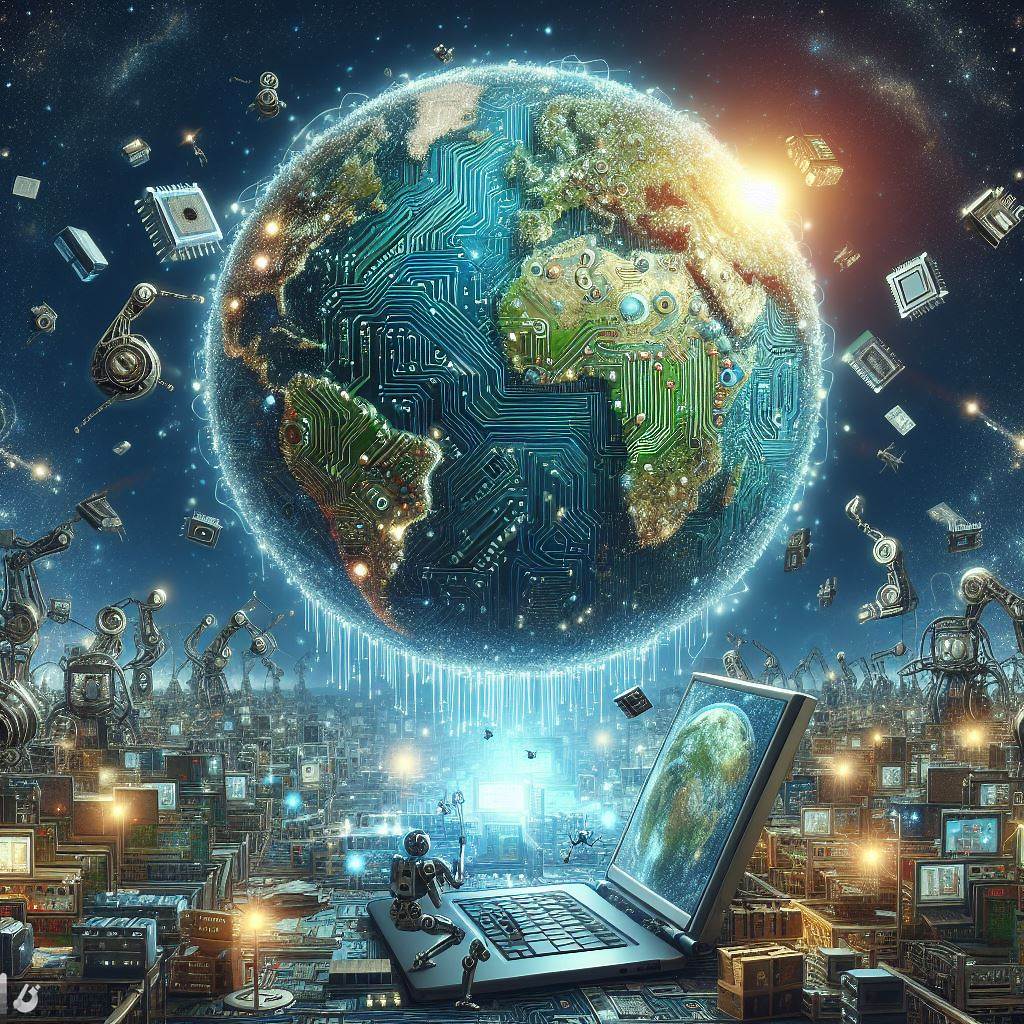
Bing Create’s visual answer to the prompt, “A world of open source software and hardware.”

After 17 years and 761 episodes, FLOSS Weekly ended its run on the TWiT network yesterday. I hosted the last 179 of those shows. My career as a professional (meaning paid) advocate of open source also ended with that show. The full span ran from 1996, when I first appeared on the Linux Journal masthead, until yesterday: about 27 years.

I still participate in market conversations around the many topics I covered in that span, but I’m mostly working on other stuff now. For example, in random-ish order:

All of those are cars in a cluetrain, about which more below.

They are also featured now and then on Reality 2.o, the podcast Katherine Druckman and I have been doing since our Linux Journal days.

For many decades now, I’ve been spoiled by success. For example, open source, an expression whose current meaning was born in 1998, is now beyond huge. Here’s VentureBeat:

Today, open-source software underpins almost everything: A whopping 97% of applications leverage open-source code, and 90% of companies are applying or using it in some way.

GitHub alone had 413 million open-source software (OSS) contributions in 2022.

“Open-source software is the foundation of 99% of the world’s software,” said Martin Woodward, VP of developer relations at GitHub.

By covering open source for Linux Journal from the start, I helped make that happen.

Same with The Cluetrain Manifesto. “Markets are conversations,” a one-liner of mine that became the first thesis in the manifesto, grew to become a meme that hasn’t gone away. The word cluetrain also appears almost daily in tweets on X, almost a quarter century after it was coined. (When Twitter was still itself, cluetrain was mentioned in tweets several times daily. The decline in cluetrain mentions is one small measure of how lame X has become.)

Also blogging!

Hmmm… I don’t think I ever blogged about my only encounter with Robin Williams. It was at some trade show in the early aughts. There was a scrum of attendees gathered around something or someone unseen in the middle. On the periphery was my old friend Tom Rielly, who quickly grabbed me and pulled me into the middle of the crowd, where stood Robin Williams, with two bags of swag. I almost said, “Hey, you look like Robin Williams, only shorter.” Then Tom introduced me, saying “This is Doc. He’s one of the top five bloggers in the world.” I said, “More like one of the top sixteen, but most of the others are duplicates.” Robin then said something funny, and I responded with something funny of my own, and an all-funny exchange ensued during which my separate self said, “Holy shit! I’m doing humor schtick with Robin Williams and holding my own!” After maybe half a minute of this, I excused myself, saying something like, “I’ll leave you to your private audience here,” and exited the crowd.

Oh, and photography. As of this moment, my photos have had 16,855,107 views on one Flickr account, and 1,470,281 on the other. Visits to those run from the hundreds to thousands per day. A search for my name on Wikimedia Commons also brings up 1850 results, nearly all of which are photos I’ve shared using Creative Commons licensing that encourages use and re-use, which is why many (or most) of them find their way into Wikipedia articles.

I’ve had less luck with the other missions I’ve listed above. But I believe in all of them, and in faith, I truck onward.

By the way, FLOSS Weekly has not slipped below the waves. I expect it will be picked up somewhere else on the Web, and wherever you get your podcasts. (I love that expression because it means podcasting isn’t walled into some giant’s garden.) When FLOSS Weekly becomes re-manifest, I’ll point to it here.

☑️ ☆

ProjectVRM 2.0

It took a while, but our website is now on its own. Big thanks go to the Berkman Klein Center for hosting us on its blog server since 2006. Also for continuing to host our mailing list and our wiki. And to all the friends who helped, including those at WordPress and Pressable, who made the transition smooth and complete. Links to every post and page we’ve published at blogs.harvard.edu/vrm/ (our old location) now travel down the same directory paths at projectvrm.org/. There will be no 404s. This is a rare thing for any site that moves from one host to another.

Clearly, this is not the one-year project we imagined in the first place. It may not be a one-generation project. But we will get from the state on the left above to the one on the right. And thanks to Gapingvoid‘s Hugh MacLeod for drawing that illustration in the first place, way back in 2005.


🔲 ☆

All home now

header images for three blogs

From 2007 until about a month ago, I wrote on three blogs that lived at blogs.harvard.edu. There was my personal blog (this one here, which I started after retiring my original blog), ProjectVRM‘s blog (also its home page), and Trunkline, a blog about infrastructure that was started by Christian Sandvig when he and I were both fellows at Harvard’s Berkman Center for Internet and Society (and which I kept alive with very occasional posts since then). The image above is from those blogs’ header images.

All three are now re-homed. This one is at doc.searls.com (a URL that had redirected to blogs/harvard.edu/doc for many years), ProjectVRM’s is at ProjectVRM.org (a URL that had redirected to blogs.harvard.edu/vrm address) and Trunkline’s (which had been at blogs.harvard.edu/trunk) is now at trunkli.org.

Their hosting service is Pressable.com, a WordPress subsidiary that worked with the Berkman Klein Center to make sure that every link on the Web pointing to pages at those three Harvard-hosted blogs now goes to those pages’ new locations, without anything being 404’d. Which is just. freaking. awesome.

My thanks and gratitude to all the people who helped, both within those organizations and in my own network of friends. Together they demonstrate that the Web is a living archive and not just a whiteboard.

🔲 ☆

Toward customer boats fishing on a sea of goods and services

I’ll be talking shortly to some readers of The Intention Economy who are looking for ways to connect that economy with advertising. (Or so I gather. I’ll know more soon.) What follows is the gist of what I wrote to them in prep for the call.

First,  take a look at People vs. Adtech, and/or Separating Advertising’s Wheat and Chaff.

Both are still valid (IMHO), but don’t yet cover what A.I. will inevitably do to advertising. There are two possible ways that can go.

One is toward hyper-personalized advertising based on even more pernicious uninvited tracking than we already have, with A.I.s rather than lawyers and hired intermediaries finding loopholes in privacy law that will automate specious forms of “consent” far more efficiently than possible without it.

The other is toward finding the best vectors for targeting the right audiences rather than the most-tracked individuals—and to find those amidst the millions of podcasts, newsletters, blogs, mainstream media, and other online outlets into the ever-widening world of thought, opinion, news, scholarship, journalism, sports, and the rest of it.

The former will make tracking and personalized targeting far worse, and the latter will make advertising targeted at audiences far better. It will also do a much better job of supporting journalism in the process because more money can get through to publishers and reporters who won’t be fed by an evil hand they avoid biting.

Those two directions are the chaff-vs-wheat choices for A.I.’s future in advertising. For now, there is surely far more action happening with the former than with the latter, given the sizes of today’s spinning adtech flywheels. But this also means there will be bigger opportunities with the latter: a blue ocean away from the red one.

What makes the intention economy ocean blue is that it will exist almost entirely outside both those advertising systems—and inside horizons that are far more expansive than can be seen through the lens of advertising and marketing as we’ve known them.

Here the opportunities will be in creating better signaling from demand to supply, and better intermediation between them: forms that will safeguard the privacy needs of individuals and the legitimate needs of businesses. In some cases there will be no intermediation at all—just forms of agency on both sides that are friendly to each other and can interact directly. And, where intermediations are required, they will find a wide-open space for what we’ve long called fourth parties.

To visualize the opportunities here, think of every customer as a boat afloat on a sea of goods and services, and friendly to the ecosystems where demand encourages supply at least as well as supply satisfies demand.

If you’re looking for market opportunities in this vast new ocean, here are thirteen of them.

🔲 ⭐

And now for something incompletely different

ProjectVRM has been HQ’d in blog form here since 2007. On Friday that ends.

Our plan is to move it to ProjectVRM.org, a URL that has redirected to the index page at blogs.harvard.edu and needs another way to point.

We’re working on that.

Our host will be WordPress.com. We will need to be on a Business plan there, which is $300/year or $480 for two years.

We can use some help with that. Also with the move.

Meanwhile, thanks to everyone involved, especially the Berkman Klein Center, which has supported us kindly and helpfully through all these years. It’s been a great ride.

🔲 ☆

Markets vs. Marketing in the Age of AI

Maybe history will defeat itself.

Remember FreePC? It was a thing, briefly, at the end of the last millennium, right before Y2K pooped the biggest excuse for a party in a thousand years. This may help. The idea was to put ads in the corner of your PC’s screen. The market gave it zero stars, and it failed.

And now comes Telly, hawking free TVs with ads in a corner, and a promise to “optimize your ad experience.” As if anybody wants an ad experience other than no advertising at all.

Negative demand for advertising has been well advertised by both ad blocking (the biggest boycott in human history) and ad-free “prestige” TV, (or SVOD, for subscription video on demand). With those we gladly pay—a lot— not to see advertising. (See numbers here.)

But the advertising business (in the mines of which I toiled for too much of my adult life) has always smoked its own exhaust and excels best at getting high with generous funders. (Yeah, some advertising works, but on the whole people still hate it on the receiving end.)

The fun will come when our own personal AI bots, working for our own asses, do battle with the robot Nazgûls of marketing — and win, because we’re on the Demand side of the marketplace, and we’ll do a better job of knowing what we want and don’t want to buy than marketing’s surveillant AI robots can guess at. Supply will survive, of course. But markets will defeat marketing by taking out the middle creep.

The end state will be one Cluetrain forecast in 1999, Linux Journal named in 2006, the VRM community started working on that same year, and The Intention Economy detailed in 2012. The only thing all of them missed was how customer intentions might be helped by personal AI.

Personal.* Not personalized.

Markets will become new and better dances between Demand and Supply, simply because Demand will have better ways to take the lead, and not just follow all the time. Simple as that.


*For more on how this will work, see Individual Empowerment and Agency on a Scale We’ve Never Seen Before.

☑️ ☆

A beckon for Beckn

Want to place a bet on where VRM will finally take off? Try India.

Because India is home to the Beckn protocol: one that enables peer-to-peer e-commerce at scale without the big platforms taking a large cut of the pie just for matchmaking. The possibilities are endless and extreme—especially for customers and small businesses.

Beckn is open source (here on Github),  moving into deployment, and expected to grow toward ubiquity on the same slope as Aadhaar, the government ID now held by 1.35 billion people.

To put this into perspective, India has more people than all of Europe (even when you throw in Russia and Turkey), and more than twice the population of North America. Only China has more people, but India is ready to overtake it in just four years.

We will discuss all this and more with Sujith Nair this coming Monday, 20 February, from 2-3:30 PM Eastern Time.  He is the CEO & Co-founder of FIDE.org, the nonprofit behind the Beckn protocol, and may have the clearest vision in the world toward an e-commerce future that isn’t contained inside big tech’s walled gardens: ones in which every business and every customer can operate with both independence and minimized friction.

This will kick off the Workshop’s next Beyond the Web salon series . Stay tuned for more in the coming months, but be sure to catch this one. It could hardly matter more for what our project has worked toward since 2006.

It’s both in-person and online, and free. But you need to register. Do that here.

☑️ ☆

Syndication and the Live Web Economy

This is from a December 2009 newsletter called Suitwatch, which I wrote for Linux Journal, and was 404’d long ago. (But I kept the original.) I’m re-posting it here because I think syndication may be the most potent power any of us have in the Internet age—and because the really simple kind, RSS, has been with us since before I wrote this piece. (I also think RSS has VRM implications as well, but I’ll leave those for another post.) My only edits here were to remove arcana and anachronisms that are pointless today. This graphic illustrates how entrenched and widespread RSS already is:


Until recently, the verb “syndication” was something big publishers and agencies did. As a kid, I recognized “© King Features Syndicate” was the one unfunny thing about Blondie or Dennis the Menace. All it meant to me was that some kind of Business was going on here.

Now millions of individual writers syndicate their own work, usually through RSS (Really Simple Syndication). Publishers and other large organizations do too. This article is syndicated. So are updates to product manuals, changes to development wikis, updates on SourceForge, and searches of keywords. You name it: if there’s something that updates frequently on the Web, there’s a better chance every minute that the new stuff is syndicated if it isn’t already.

Far as I know, not many sources are making money with it. Lots, however, are making money because of it. The syndicated world may not look like an economy yet. But trust me, it is.

At this early stage in its long future history, syndication is primarily a feature of blogging, which is primarily the product of too many people to count. Blogging is not about large-scale things. It’s about human beings who have no scale other than themselves. Only you can be good at being you, and nobody else is the same as you. Syndication does more to expand individual human potential than anything since the invention of type. Or perhaps ever. The syndicated world economy is the one that grows around unleashed personal powers of expression, productivity, creation, distribution, instruction, influence, leadership, whatever.

In a loose sense, syndication is one side of the conversation. Think about conversation in the best sense of the word: as the way people teach and learn from each other, the way topics start and move along. Syndication makes that happen in huge ways.

The notion that “markets are conversation”, popularized by The Cluetrain Manifesto, was borrowed from this case I used to make for a form of marketing that was far more natural and powerful than the formal kind:

  1. Markets are conversation, and
  2. Conversation is fire. Therefore,
  3. Marketing is arson.

If you want to set fires, start conversations that tend to keep going. Nothing does the latter better than syndication.

There are three reasons why we still don’t hear as much about syndication as we should (and will). First, it’s still new. Second, it didn’t come from The Big Guys. (It came from Dave Winer, father of RSS — Really Simple Syndication.) Third, it points toward a value system not grounded only in exchange — one especially suited for the Net, a deeply ironic worldwide environment where everybody is zero distance apart.

But let’s park the value system until later and talk about next week. That’s when I’ll be in San Francisco for Syndicate. It’s the second in a series of conferences by that name. The first was in New York last Spring.

Since I’m the conference chair (disclosure: it’s a paying gig), and since I’ll be giving both the introductory talk and the closing keynote, Syndication is on the front burner of my mind’s stove.

There are others subjects there as well, some of which will be visited in sessions at the show. RSS, for starters. And tagging—a practice so new it’s not even close to having standards of the sort we find at OASIS, the IETF, and the W3C. Instead, it has emerging standards, like the ones we find at microformats.org.

Like syndication, tagging is a long-tail activity. Something individuals do. Along with blogging and syndication, it helps outline a new branch of the Net we’re starting to call the Live Web — as opposed to the Static Web with “sites” that are “built” and tend not to change.

The World Live Web is the title of my December Linux For Suits column in Linux Journal. In it, I note that the directoryless nature of everything on the Web falls in the Unix file path east of the domain name. Every path to a document (or whatever) is a piece of straw in the static Web’s haystack. Google and Yahoo help us find needles in that haystack, but their amazing success at search also tends to confirm the haystack nature of the Static Web itself.

The Live Web is no less webby than the Static Web. They’re both parts of the same big thing. But the Live Web is new and very different. It cannot be understood in Static Web terms.

In that piece, I also observed that blogs, as continuing projects by human authors, leave chronological trails. These give the Live Web something of a structure: a chronological one that goes /year/month/day/date/post, even if that’s not the way each post’s URL is composed. There is an implicit organizational structure here, and it’s chronological.

Tagging, by which individuals can assign categorical tags of their own to everything from links to bookmarks to photos, has given the Live Web an ad hoc categorical structure as well.

So that’s what we’re starting to see emerge here: chronology and category. Rudimentary, sure, but real. And significant.

But not organized. New practices, and new ideas, are coming along too fast.

What matters, above all, is user-in-charge: a form of personal agency in the connected world. That’s a concept so key to everything else that’s happening on the Web, even on the Static one, that we may need a new word for it.

Or an old one, like independence, liberty, sovereignty, or autonomy. That’s my inner Libertarian, choosing those. If your sensibilities run a bit more to the social side, you may prefer words like actualization or fulfillment. Point is, the Big Boys aren’t in charge anymore. You are. I am. We are.

There’s an economy that will grow around us. I think free software and open-source practices (see various books and essays by Richard M. Stallman and Eric S. Raymond) put tracks in the snow that point in the direction we’re heading, but the phenomenon is bigger than that.

It’s also bigger than Google and Yahoo and Microsoft and IBM and Sun and Red Hat and Apple and the rest of the companies people (especially the media) look to for Leadership. For all the good those companies do in the world, the power shift is underway and is as certain as tomorrow’s dawn. The Big Boys will need to take advantage of it. We’ll need them to, as well.

This power shift is what I’d like to put in front of people’s attention when they come to Syndicate next week, or when they follow the proceedings in blogs and other reports.

Now more than ever, power is personal. Companies large and small will succeed by taking advantage of that fact. And by watching developments that aren’t just coming from The Usual Suspects. Including the Usual Economic Theories.

For example, not everything in an economy is about exchange, or the value chain, or about trade-offs of this for that. Many values come out of effort and care made without expectation of return. Consider your love for your parents, spouses, children, friends, and good work. Consider what you give and still get to keep. Consider debts erased by forgiveness. Consider how knowledge grows without its loss by anyone else.

Sayo Ajiboye, the Nigerian minister who so blew my mind in conversations we had on a plane nearly five years ago (Google them up if you like), taught me that markets are relationships, and not just conversations. Relationships, he said, are not just about exchange. They cannot be reduced to transactions. If you try, you demean the relationships themselves.

Also, in spite of the economic framings of our talk about morality and justice (owing favors, paying for crimes, just desserts), there is a deeper moral system that cannot be understood in terms of exchange. In fact, when you bring up exchange, you miss the whole thing. (Many great teachers have tried in futility to make this point, and I’m probably not doing any better.) Whatever it is, its results are positive. Growth in one place is not matched by shrinking in another. Value in both systems is created. But in the latter one, the purpose is not always, or exclusively, exchange, or profit. At least not from the activity itself. There are because effects at work. And we’re only beginning to understand them, much less practice them in new ways.

Toward that end, some questions…

Where did the Static Web, much less the Live Web, come from? What is it for? What are we doing with it? Whatever the answers, nothing was exchanged for them. (No, not even the record industry, the losses of which owe to their own unwillingness to take advantage of new opportunities opened by the Net.)

Nor was anything exchanged for Linux, which has grown enormously.

As Greg Kroah-Hartman said recently on the Linux-Elitists list,

Remember, Linux is a species, and we aren’t fighting anyone here, we are merely evolving around everyone else, until they aren’t left standing because the whole ecosystem changed without them realizing it.

Yes, we have living ends.

☑️ ☆

Toward a lexicon for advertising in both directions

We need a lexicon for the different ways buyers and sellers express their intentions to each other. Or, one might say, advertise.

On the demand side (⊂) we have what in ProjectVRM we’ve called intentcasting and (earlier) personal RFP. Scott Adams calls it broadcast shopping and John Hagel and David Siegel both (in books by that title) call it pull.

On the sell side (⊃) I can list at least six kinds of advertising alone that desperately need distinctive labels. To pull them apart, these are:

  1. Brand advertising. This kind is aimed at populations. All of it is contextual, meaning placed in media, TV or radio programs, or publications, that appeal broadly or narrowly to a categorized audience. None of it is tracking-based, and none of it is personal. Little of it wants a direct response. It simply means to impress. This is also the form of advertising that burned every brand you can name into your brain. In fact the word brand itself was borrowed from the cattle industry by Procter & Gamble in the 1930s, when it also funded the golden age of radio. Today it is also what sponsors all of sports broadcasting and pays most sports stars their massive salaries.
  2. Search advertising. This is what shows up with search results. There are two very different kinds here:
    1. Context-based. Not based on tracking. This is what DuckDuckGo does.
    2. Context+tracking based. This is what Google and Bing do.
  3. Tracking-based advertising. I’ve called this adtech. Cory Doctorow calls it ad-tech. Others call it ad tech. Some euphemize it as behavioral, relevant, interest-based, or personalized. Shoshana Zuboff says all of them are based on surveillance, which they are. So many critics speak of it as surveillance-based advertising.
  4. Advertising that’s both contextual and personal—but only in the sense that a highly characterized individual falls within a group, or a collection of overlapping groups, chosen by the advertiser. These are Facebook’s Core, Custom and Look-Alike audiences. Talk to Facebook and they’ll tell you these ads are not meant to be personal, though you should not be surprised to see ads for shoes when you have made clear to Facebook’s trackers (on the site, the apps, and wherever the company’s tentacles reach) that you might be in the market for shoes. Still, since Facebook characterizes every face in its audience in almost countless ways, it’s easy to call this form of advertising tracking-based.
  5. Interactive advertising. Vaguely defined by Wikipedia here,  and sometimes called conversational advertising,  the purpose is to get an interactive response from people. The expression is not much used today, even though the Interactive Advertising Bureau (IAB) is the leading trade association in the tracking-based advertising field and its primary proponent.
  6. Native advertising, also called sponsored content, is advertising made to look like ordinary editorial material.

The list is actually much longer. But the distinction that matters is between advertising that is tracking-based and the advertising that is not. As I put it in Brands need to fire adtech,

Let’s be clear about all the differences between adtech and real advertising. It’s adtech that spies on people and violates their privacy. It’s adtech that’s full of fraud and a vector for malware. It’s adtech that incentivizes publications to prioritize “content generation” over journalism. It’s adtech that gives fake news a business model, because fake news is easier to produce than the real kind, and adtech will pay anybody a bounty for hauling in eyeballs.

Real advertising doesn’t do any of those things, because it’s not personal. It is aimed at populations selected by the media they choose to watch, listen to or read. To reach those people with real ads, you buy space or time on those media. You sponsor those media because those media also have brand value.

With real advertising, you have brands supporting brands.

Brands can’t sponsor media through adtech because adtech isn’t built for that. On the contrary, adtech is built to undermine the brand value of all the media it uses, because it cares about eyeballs more than media.

Adtech is magic in this literal sense: it’s all about misdirection. You think you’re getting one thing while you’re really getting another. It’s why brands think they’re placing ads in media, while the systems they hire chase eyeballs. Since adtech systems are automated and biased toward finding the cheapest ways to hit sought-after eyeballs with ads, some ads show up on unsavory sites. And, let’s face it, even good eyeballs go to bad places.

This is why the media, the UK government, the brands, and even Google are all shocked. They all think adtech is advertising. Which makes sense: it looks like advertising and gets called advertising. But it is profoundly different in almost every other respect. I explain those differences in Separating Advertising’s Wheat and Chaff:

…advertising today is also digital. That fact makes advertising much more data-driven, tracking-based and personal. Nearly all the buzz and science in advertising today flies around the data-driven, tracking-based stuff generally called adtech. This form of digital advertising has turned into a massive industry, driven by an assumption that the best advertising is also the most targeted, the most real-time, the most data-driven, the most personal — and that old-fashioned brand advertising is hopelessly retro.

In terms of actual value to the marketplace, however, the old-fashioned stuff is wheat and the new-fashioned stuff is chaff. In fact, the chaff was only grafted on recently.

See, adtech did not spring from the loins of Madison Avenue. Instead its direct ancestor is what’s called direct response marketing. Before that, it was called direct mail, or junk mail. In metrics, methods and manners, it is little different from its closest relative, spam.

Direct response marketing has always wanted to get personal, has always been data-driven, has never attracted the creative talent for which Madison Avenue has been rightly famous. Look up best ads of all time and you’ll find nothing but wheat. No direct response or adtech postings, mailings or ad placements on phones or websites.

Yes, brand advertising has always been data-driven too, but the data that mattered was how many people were exposed to an ad, not how many clicked on one — or whether you, personally, did anything.

And yes, a lot of brand advertising is annoying. But at least we know it pays for the TV programs we watch and the publications we read. Wheat-producing advertisers are called “sponsors” for a reason.

So how did direct response marketing get to be called advertising ? By looking the same. Online it’s hard to tell the difference between a wheat ad and a chaff one.

Remember the movie “Invasion of the Body Snatchers?” (Or the remake by the same name?) Same thing here. Madison Avenue fell asleep, direct response marketing ate its brain, and it woke up as an alien replica of itself.

This whole problem wouldn’t exist if the alien replica wasn’t chasing spied-on eyeballs, and if advertisers still sponsored desirable media the old-fashioned way.

Bonus link.

I wrote that in 2017. The GDPR became enforceable in 2018 and the CCPA in 2020.  Today more laws and regulations are being instituted to fight tracking-based advertising, yet the whole advertising industry remains drunk on digital, deeply corrupt and delusional, and growing like a Stage IV cancer.

We live digital lives now, and most of the advertising we see and hear is on or through glowing digital rectangles. Most of those are personal as well. So, naturally, most advertising on those media is personal—or wishes it was. Regulations that require “consent” for the tracking that personalization requires do not make the practice less hostile to personal privacy. They just make the whole mess easier to rationalize.

So I’m trying to do two things here.

One is to make clearer the distinctions between real advertising and direct marketing.

The other is to suggest that better signaling from demand to supply, starting with intentcasting, may serve as chemo for the cancer that adtech has become. It will do that by simply making clear to sellers what buyers actually want and don’t want.


🔲 ⭐

The Rise of Robot Retail

end of personal dealings
From Here Comes the Full Amazonification of Whole Foods, by Cecelia Kang (@CeceliaKang) in The New York Times:

…In less than a minute, I scanned both hands on a kiosk and linked them to my Amazon account. Then I hovered my right palm over the turnstile reader to enter the nation’s most technologically sophisticated grocery store…

Amazon designed my local grocer to be almost completely run by tracking and robotic tools for the first time.

The technology, known as Just Walk Out, consists of hundreds of cameras with a god’s-eye view of customers. Sensors are placed under each apple, carton of oatmeal and boule of multigrain bread. Behind the scenes, deep-learning software analyzes the shopping activity to detect patterns and increase the accuracy of its charges.

The technology is comparable to what’s in driverless cars. It identifies when we lift a product from a shelf, freezer or produce bin; automatically itemizes the goods; and charges us when we leave the store. Anyone with an Amazon account, not just Prime members, can shop this way and skip a cash register since the bill shows up in our Amazon account.

And this is just Amazon. Soon it will be every major vendor of everything, most likely with Amazon as the alpha sphincter among all the chokepoints controlled by robotic intermediaries between first sources and final customers—with all of them customizing your choices, your prices, and whatever else it takes to engineer demand in the marketplace—algorithmically, robotically, and most of all, personally.

Some of us will like it, because it’ll be smooth, easy and relatively cheap. It will also subordinate us utterly to machines. Or perhaps udderly, because we will be calves raised to suckle on the teats of retail’s robot cows.

This system can’t be fixed from within. Nor can it be fixed by regulation, though some of that might help. It can only be obsolesced by customers who bring more to the market’s table than cash, credit, appetites and acquiescence to systematic training.

What more?

Start with information. What do we actually want (including, crucially, to not be bothered by hype or manipulated by surveillance systems)?

Add intelligence. What do we know about products, markets, needs, and how things actually work than roboticized systems can begin to guess at?

Then add values, such as freedom, choice, agency, care for others, and the ability to collectivize in constructive and helpful ways on our own.

Then add tech. But this has to be our tech: customertech that we bring to market as independent, sovereign and capable human beings. Not just as “users” of others’ systems, or consumers (which Jerry Michalski calls “gullets with wallets and eyeballs”) of whatever producers want to feed us.

Time for solutions. Here is a list of fourteen market problems that can only be solved from the customers’ side.

And yes, we do need help from the sellers’ side. But not with promises to make their systems more “customer centric.” (We’ve been flagging that as a fail since 2008.) We need CRM that welcomes VRM. B2C that welcomes Me2B.

And money. Our startups and nonprofits have done an amazing job of keeping the VRM and Me2B embers burning. But they could do a lot more with some gas on those things.

❌